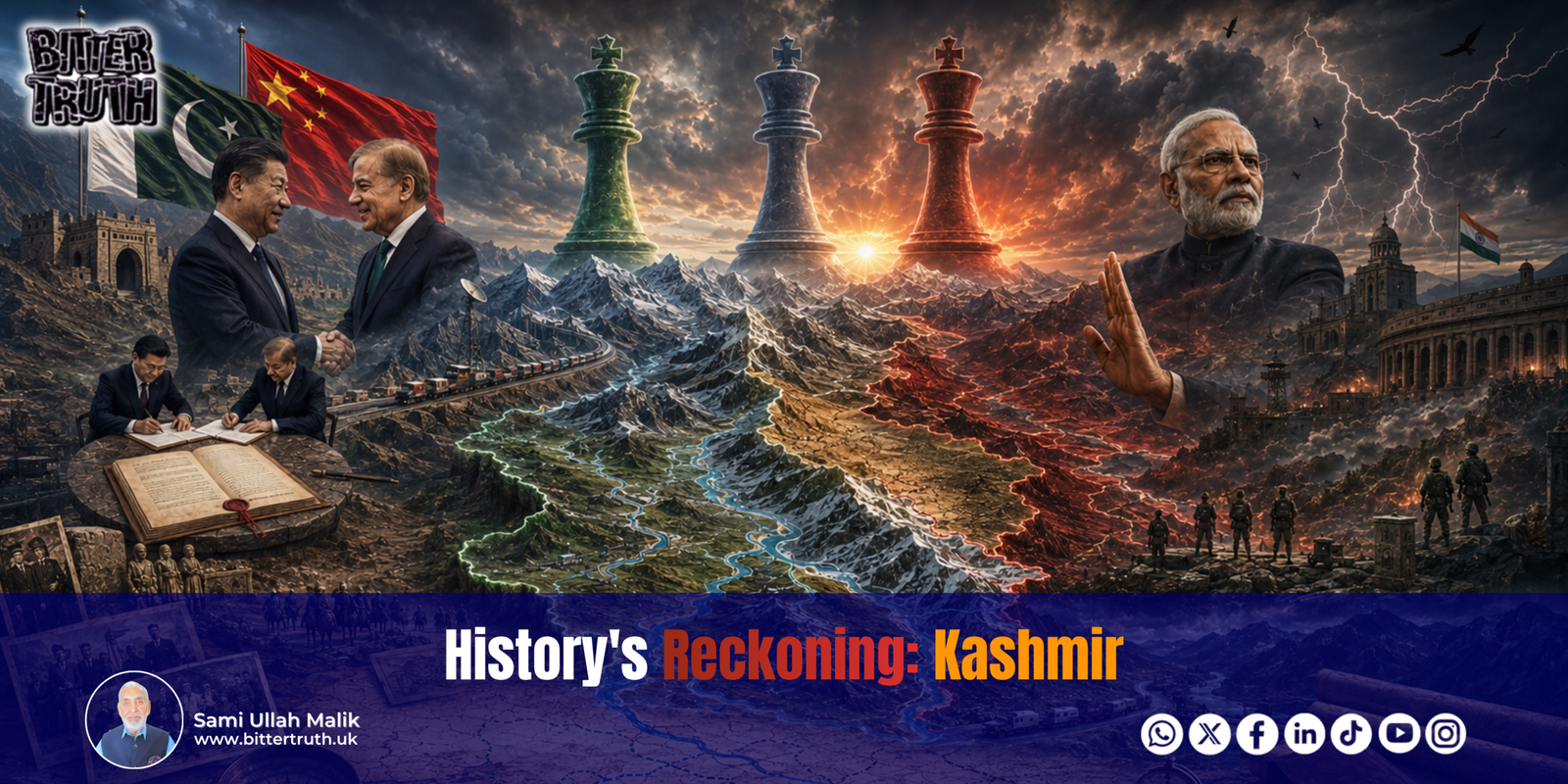
History’s Reckoning: Kashmir
When History Calls

The history of nations is never a mere accumulation of events, nor a cloud of passing occurrences; rather, it is a living manuscript inscribed upon the breast of time and terrain—a document wherein the undulations of politics, the harsh geometries of geography, and the restless contest of civilisations are interwoven as seamlessly as rivers cleave to their banks. The history of the Subcontinent, in particular, is not simply a chronological procession of incidents, but a grand and often turbulent narrative of clashing cultures, competing interests, and territorial realities—a chronicle in which every turn of the page begets a fresh question. It is, in essence, a mirror reflecting the ceaseless interplay of power, civilisation, and geography.
The boundary dispute among China, Pakistan, and India forms but one chapter of this larger saga—yet it is a chapter layered with the weight of history, the calculations of statecraft, the subtleties of diplomacy, and the shifting calculus of power. The question of the China–Pakistan border, too, belongs to this intricate narrative: a chapter at once luminous and contested, recently imbued with renewed significance and revived in the context of transboundary water cooperation. India, however, continues to deny not merely the validity of such cooperation, but the very existence of a shared frontier between Beijing and Islamabad, rejecting outright the agreement of 1963. That Islamabad and Beijing should speak of cross-border water collaboration while New Delhi contests the very premise of that boundary is no ordinary diplomatic divergence; it is, rather, the echo of unresolved verdicts handed down by history itself.
It is no secret that relations between Pakistan and China are today adorned with the metaphors of an “iron brotherhood” and an “all-weather friendship.” Yet such phrases, evocative though they may be, rest not upon sentiment alone, but upon the firmer ground of historical accords and convergent interests. Chief among these foundations stands the Sino–Pakistan Boundary Agreement of 1963—an accord that not only redefined bilateral relations but also introduced a new axis into the geopolitical imagination of South Asia.
The visit of Prime Minister Shehbaz Sharif to China in May 2026 marked the latest link in this historical continuum. When, in the joint communiqué issued at the conclusion of that visit, reference was made to cooperation in transboundary water resources, it stirred no small agitation within the corridors of power in New Delhi. India’s response was swift and emphatic: not only a rejection of the statement, but a categorical denial of the underlying reality—that any such shared border exists at all. This posture reflects more than a momentary diplomatic protest; it is the reiteration of a long-standing position that deems the 1963 agreement itself illegitimate. In truth, it is but the continuation of a protracted historical disagreement, rooted in the ambiguous cartographies of the British Raj—maps that bequeathed to the region not clarity, but a legacy of enduring uncertainty. Thus, once more, an old dispute has been summoned back into the present.
In the mid-nineteenth century, as the empire of Maharaja Ranjit Singh waned, British imperial power advanced to fill the vacuum. By virtue of the Treaty of Amritsar in 1846, Kashmir was transferred into the possession of Gulab Singh, giving rise to a princely state whose borders were anything but clearly defined—particularly in the east, where the barren expanses of Tibet and Xinjiang stretched into ambiguity. British authorities, in their attempts to impose order, proposed a succession of boundary lines—the Ardagh–Johnson Line, the Macartney–MacDonald Line, and later the McMahon Line—yet none achieved universal recognition.
It was precisely this ambiguity that later furnished the seedbed of dispute among China, India, and Pakistan. China has consistently maintained that it never entered into any formal boundary agreement with British India and is therefore under no obligation to accept these cartographic constructs. India, by contrast, inherited the colonial framework and elevated it into the basis of its sovereign claims.
What, then, is the essence of this dispute? Where do its roots truly lie? And at what historical juncture did the paths of Beijing and Islamabad converge? The answers lie buried in those earlier pages of history when the slogan “Hindi-Chini Bhai Bhai” once echoed with hopeful resonance, and two ancient civilisations entertained the prospect of enduring amity. It was within that fleeting moment of concord that the conditions were set for the later realignment—culminating in the agreement of 1963, which brought China and Pakistan into closer strategic embrace.
During the 1950s, relations between China and India appeared, at least outwardly, exemplary—imbued with warmth and mutual goodwill. At that time, Beijing’s diplomatic inclination leaned more towards New Delhi than Islamabad. Not only were close ties cultivated, but proposals for territorial adjustments aimed at resolving boundary disputes were also contemplated. Yet the chessboard of history is never static, and its pieces seldom remain where they are first placed.
This harmony proved short-lived. Disagreements over regions such as Aksai Chin and Arunachal Pradesh gradually transformed goodwill into rivalry, as each side advanced its own historical and geographical claims. Aksai Chin emerged as the focal point of contention: claimed by India as part of Ladakh, yet regarded by China as a vital corridor linking Xinjiang with Tibet. In the western sector, India persisted in its claim, while China viewed the region as a strategic lifeline. In the east, the McMahon Line deepened mistrust between the two powers.
Between 1956 and 1957, China constructed a road through Aksai Chin, significantly enhancing its military and logistical connectivity. India became aware of this development only belatedly, and the resulting tensions along the frontier escalated steadily, culminating in the Sino–Indian War of 1962.
This war was not merely a clash of arms; it proved a decisive moment that reordered the political alignments of the region. If India emerged from the conflict visibly shaken, Pakistan, by contrast, discerned within the upheaval a strategic opening. China, once perceived to be in close accord with India, began gradually to incline towards Pakistan, marking the beginning of a subtle yet consequential realignment.
Within this evolving landscape, the question of Kashmir could no longer be confined to a bilateral dispute between Pakistan and India; it assumed the character of a tripartite issue, with China present as a quiet yet consequential actor. Recent pronouncements have, in effect, underscored this reality—that the Kashmir question, so often framed as a contest between two states, is in truth an international matter involving three, with China occupying a position of undeniable significance.
Empirical estimates lend further clarity to this contention. By most scholarly assessments, approximately 45.62 per cent of the region lies under Indian administration, 35.15 per cent under Pakistani control, and 19.23 per cent under Chinese administration. This division is not merely geographical; it reflects a far more intricate web of political, military, and diplomatic realities, and in itself illustrates the layered complexity of the dispute.
It was against this backdrop that boundary negotiations between Pakistan and China commenced. In their early stages, Beijing’s posture was one of caution, tinged with scepticism; yet over time, a gradual convergence of perspectives emerged. Formal talks began in October 1962, culminating in the historic agreement concluded in Beijing on 2 March 1963.
The deeper roots of the dispute lie in the policies of the British Raj, which departed the region leaving behind an inheritance marked by ambiguity. Under the Treaty of Amritsar in 1846, Kashmir was constituted as a semi-autonomous entity, yet its frontiers—particularly in the east—remained undefined. Transferred to Gulab Singh under that same arrangement, the territory’s boundaries were left imprecise, especially across the desolate and sparsely inhabited expanses adjoining Tibet and Xinjiang.
From time to time, British officials advanced various boundary formulations; yet China never recognised these proposals, maintaining that it had been no party to such arrangements. The Ardagh–Johnson Line of 1865, the Macartney–MacDonald Line of 1899, and the McMahon Line of 1914 all remained devoid of formal acceptance through any binding accord with China. It was therefore unsurprising that Beijing rejected them in their entirety.
With the end of British rule in 1947, the frontier in Aksai Chin remained undefined—a geographical enigma claimed by both India and China and incorporated into their respective maps, even as its status on the ground remained indeterminate. Thus, what was in effect a no-man’s-land became the epicentre of a growing dispute.
In 1956–57, China constructed a strategic road across this region, linking Xinjiang with Tibet and thereby consolidating both its military reach and logistical cohesion. This development was not merely of tactical importance; it significantly reinforced China’s hold over the territory and sounded an alarm in New Delhi.
Seeking resolution, China advanced a pragmatic proposal: that India recognise Chinese control over Aksai Chin, in return for which China would relinquish its claims over the eastern sector. India, however, judged such an arrangement incompatible with its sovereignty and rejected it, thereby intensifying the tensions that have since endured in varying degrees of severity.
The consequence of this impasse was the war of October 1962, after which the north-eastern sector of Ladakh came under Chinese control, ushering the region into a new political phase. The conflict not only froze relations between the two countries but also fundamentally altered the geopolitical landscape.
Subsequent efforts sought to impose a measure of stability. In 1993, the Line of Actual Control was acknowledged, providing a temporary framework of restraint; yet in 2019, constitutional changes introduced by India unsettled this fragile balance once more, prompting a strong reaction from China, which viewed the move as inimical to its territorial position.
These developments collectively suggest that the Kashmir question has entered a new phase—one in which cooperation between China and Pakistan may acquire greater depth and strategic meaning.
It is worth recalling that Pakistan and China themselves were not without their initial differences over boundaries. In 1959, Pakistan’s overture for negotiations was met with a degree of reserve by China, whose principal focus at the time remained India. Yet circumstances evolved. Diplomatic engagement between President Ayub Khan and the Chinese leadership helped to break the impasse. Under Ayub Khan’s stewardship, both countries adopted a balanced and pragmatic approach, grounded in mutual respect, and set about constructing a durable framework of confidence-building measures. Pakistan’s support for China’s representation at the United Nations further contributed to bringing the two states into closer alignment.
Thus, on 12 October 1962, formal negotiations were set in motion. Despite initial divergences, both sides displayed a commendable realism, advancing steadily towards a mutually acceptable settlement. China, having initially asserted claims over certain areas, ultimately accommodated Pakistan’s position, agreeing to modest adjustments that paved the way for agreement.
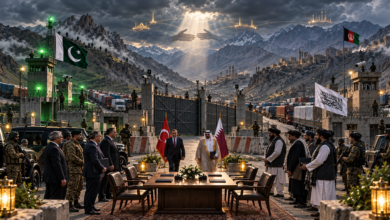
On 2 March 1963, a historic agreement was concluded in Beijing. Anchored upon the Karakoram watershed, this accord employed that natural divide as the basis for delimiting the frontier, with both countries arriving at a mutually agreed boundary through consent rather than coercion. It was a moment of quiet consequence—one that furnished their relationship with an enduring foundation.
The agreement between Pakistan and China was also conceived as a provisional arrangement, containing within it a clause of notable foresight: should the question of Kashmir advance towards a final settlement, the boundary thus delineated would remain open to review. It was explicitly affirmed that the arrangement would not prejudice the ultimate status of Jammu and Kashmir but would stand as an interim measure. In this provision lay not merely prudence, but a striking testament to diplomatic vision.
Pakistan, in entering this agreement, safeguarded its interests with notable precision. Not only did it refrain from ceding territory, but it in fact also secured approximately 750 square miles. Yet the significance of the accord transcended cartography. It represented a convergence of outlook as much as a demarcation of land. Pakistan ensured the inclusion of grazing territories beyond the Shimshal Pass—lands long utilised by the inhabitants of Hunza—within its recognised domain. This, in turn, reflected a measure of flexibility on China’s part, and an uncommon willingness to accommodate.
It was at this juncture that relations between Pakistan and China assumed a new character. The agreement did not merely resolve a boundary; it established a durable architecture of trust, cooperation, and strategic alignment. The boundary accord of 1963 was not simply a geographical settlement; it was the outward expression of a considered diplomatic strategy that subtly reshaped the balance of power within the region. In its aftermath, China extended consistent support to Pakistan’s position, including on the question of Kashmir, thereby deepening mutual confidence and reinforcing political harmony.
India, for its part, rejected the agreement in its entirety, declaring it unlawful on the grounds that the whole of Kashmir constituted an integral part of its territory. This position, however, was robustly contested by Pakistan’s Foreign Minister, Zulfikar Ali Bhutto, who played a pivotal role in both the negotiation of the accord and the reorientation of Pakistan’s external relations. With clarity and force, he advanced the argument that Kashmir remained a disputed territory whose future ought to be determined in accordance with international resolutions, rather than unilateral assertions. His diplomatic acumen lent Pakistan a renewed direction and anchored its relationship with China upon firmer ground.
Viewed against the present global landscape, it becomes evident that the Kashmir question has entered yet another phase. India’s constitutional measures of 5 August 2019, China’s response thereto, and Pakistan’s subsequent cartographic assertions together signal the emergence of a new alignment within the region. In such a context, a fundamental question arises: can disputes of this magnitude be resolved through unilateral action, or do they demand a comprehensive, equitable, and mutually acceptable settlement?
For one of Kashmiri origin, this question transcends abstraction; it assumes the weight of personal reflection. In my own encounters with distinguished scholars such as the late A. G. Noorani, one lesson stands out with enduring clarity: that the verdicts of history are not rendered through sentiment, but through evidence, principle, and the demands of justice.
It is instructive to observe that between 1963 and 2008, China succeeded in resolving the majority of its boundary disputes with neighbouring states. Yet its differences with India and Bhutan persist. This suggests that the matter is not merely one of lines upon a map, but of political will. It underscores a broader truth: that enduring solutions do not arise from historical claims or military strength alone, but from accommodation, flexibility, and a sober recognition of realities.
Thus, as one surveys this historical canvas, a pressing question re-emerges: are such disputes amenable to unilateral resolution, or do they require a spirit of compromise and realism? History offers a consistent lesson—that lasting peace becomes possible only when all parties are prepared to step back, however slightly, from their maximalist positions, and move instead towards a shared future. It is perhaps along this path that South Asia may yet find its way to a more stable and settled order.
The need of the present hour is not to rehearse the grievances of the past, but to prepare the ground for the possibilities of the future. The foresight demonstrated by Pakistan and China in 1963 remains, even today, a model worthy of reflection. Were India to proceed in a similar spirit, it is not inconceivable that the region might enter a new era marked by peace, stability, and development.
For in the final analysis, boundaries may divide land, but they do not divide hearts. Where sincerity informs intention, balance guides policy, and wisdom shapes leadership, even the most intractable dispute may be transformed into an opportunity—an opening towards renewal, and the promise of a better tomorrow.