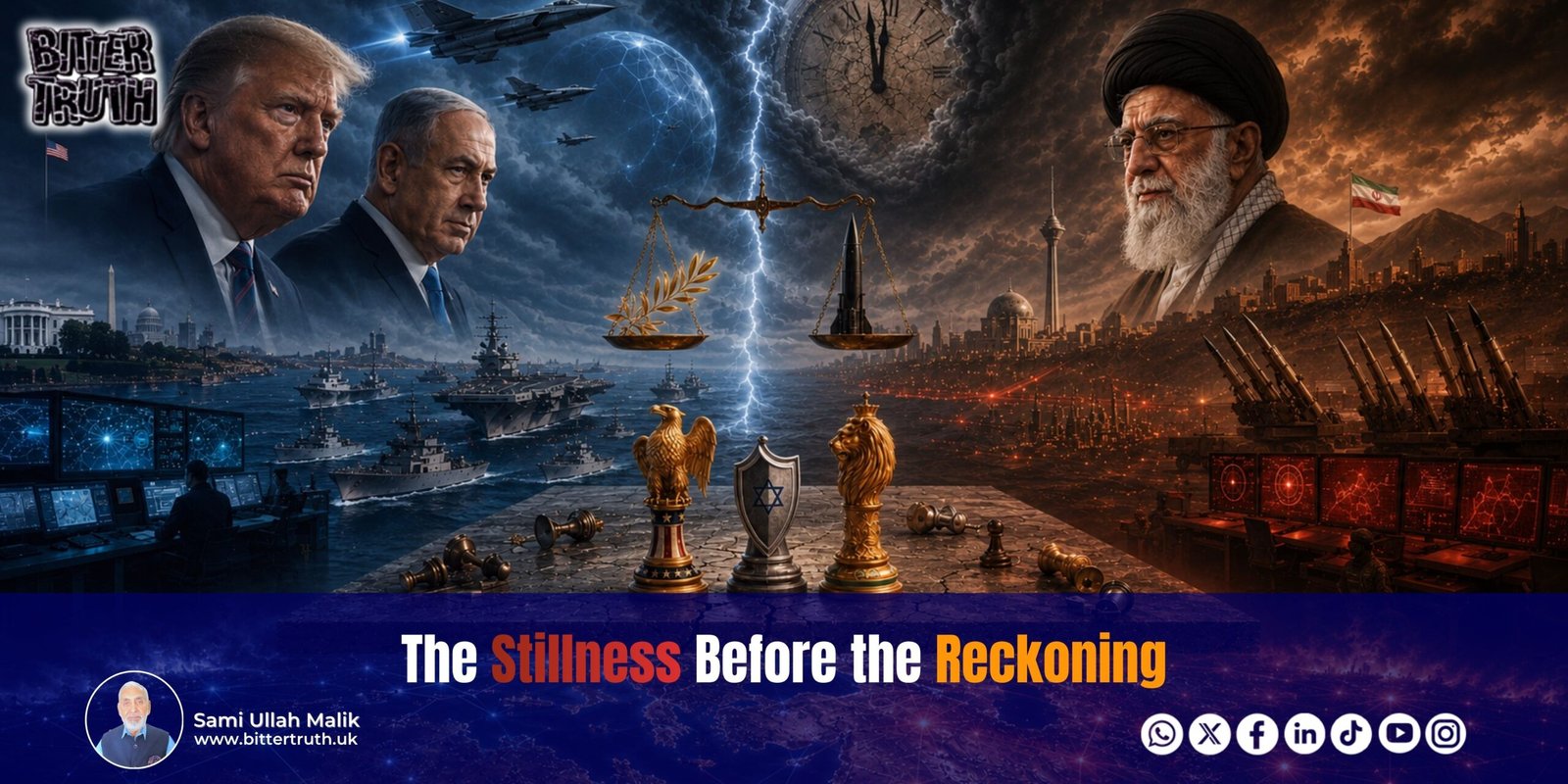
The Stillness Before the Reckoning
Between Truce and Tempest

There are moments in the long march of time when the age itself appears to hesitate—when history, as though seized by a sudden apprehension, pauses at a decisive bend. In such suspended intervals, it is not merely events that come into being; rather, the destinies of nations are inscribed with a firmer, more deliberate hand. Across the map of the world lie certain regions where silence does not denote stillness but resounds like a cry, and where every movement—however slight—conceals within it the tremor of an unspoken upheaval. Western Asia stands as a consummate expression of this condition: a theatre in which centuries of civilisational inheritance, the ardour of belief, the calculus of power, and the intricacies of competing interests are so deeply interwoven that the present appears as both the continuation of the past and the prelude to an uncertain future.
This is a land where, in ages past, caravans set forth in pursuit of knowledge and wisdom; yet today, that same soil has become an arena of contest, where the language of power too often drowns out the counsel of reason. Here, the acrid scent of gunpowder mingles uneasily with the hushed undertones of diplomacy; here, every proclamation of peace seems wrapped in a dense mantle of apprehension. Within such an atmosphere, the recent, tentative calm between Iran and the United States presents itself less as a resolution than as a fleeting surface upon deeper currents of disquiet—a momentary lull behind which lies a protracted narrative of uncertainty.
This interlude is neither a condition of settled repose nor one of open confrontation. It occupies that ambiguous middle ground where restraint walks hand in hand with mistrust. Outwardly, there is quiet; yet beneath this quietude, embers continue to smoulder. The question, therefore, is not whether circumstances will change, but when this latent heat will ignite and usher in a new and perhaps more volatile phase. It is against this backdrop that any meaningful understanding of the present discourse must proceed, for here every passing moment carries within it the potential to be transfigured into history.
On the broader horizon of global politics, there exist regions where time itself seems arrested, though the undercurrents of tension remain in perpetual motion. When the pages of history yield their concealed truths, one discovers that the fate of nations is not determined solely by the edge of the sword but is weighed—often more decisively—in the balance of prudence and judgement. There are theatres in the political landscape of the world where silence itself is clamorous, and where each gesture harbours the possibility of a storm. Western Asia is among these theatres, where power, faith, interest, and history are so intricately fused that each new development appears as an echo of older conflicts.
The Middle East—long a cradle of civilization and a perennial battleground for rival powers—once again finds itself at a juncture where the smell of explosives and the aroma of diplomacy are uneasily embracing. Each event here is more than an isolated incident. It resonates as an echo of a distant past.The recent cessation of hostilities between Iran and the United States constitutes one such delicate link in an unbroken chain of tension—a link that, though outwardly suggestive of peace, inwardly embodies unease. At either end of this tenuous arrangement lie knots of interest, apprehension, and ambition, tightly drawn and not easily undone.
A ceasefire, though it may convey the promise of temporary relief, cannot endure if it rests upon expediency rather than justice. It is not merely the silencing of guns; it is, in its truest sense, an accord animated by trust, equilibrium, and mutual interest. Where these vital elements are absent, such an arrangement resembles a structure raised upon sand—liable at any moment to collapse under the weight of its own insufficiency. The present pause between Iran and the United States bears precisely this fragility. It is a condition in which each side appears, for the moment, to tolerate the other, yet beneath this outward restraint burns the persistent fire of suspicion. Such a condition renders the arrangement inherently unstable, transforming patience into a burden that neither party can indefinitely sustain.
Thus, the question presses itself forward with renewed urgency: how long can such a ceasefire endure?
The agreement reached in early April had scarcely begun to translate from diplomatic parchment into lived reality when signs of strain emerged upon the horizon of the Gulf. The calm had barely drawn breath before the blue expanse of those waters seemed once more to flicker with flame. The downing of an American helicopter proved not merely an isolated military incident but a spark that illuminated the concealed tensions lurking behind the façade of diplomacy. It marked, in essence, not simply an operational setback but a symbolic fracture in the edifice of trust—an event that scattered the fragile coherence of the ceasefire and altered the trajectory of events.
As a result, a familiar pattern asserted itself: demonstrations of power were met with countermeasures, and each action invited a counter-reaction, further confusing an already complex situation.The illusion of calm was thereby exposed as little more than a veil, behind which tension had remained very much alive. Retaliatory strikes by the United States, and Iran’s corresponding responses—extending to Bahrain, Jordan, and beyond—served to underscore a fundamental truth: that beneath the silence lay a seething volatility, akin to molten lava awaiting its moment of eruption.
An equally significant dimension of this unfolding drama is the confrontation between Iran and Israel. Iran’s missile strikes, followed by Israeli aerial operations, have introduced a further layer of complexity into an already fraught landscape. This exchange is not merely episodic; it represents the latest chapter in a long-standing hostility. It reveals, with stark clarity, that the conflict cannot be confined to the boundaries of two states; rather, it exerts a gravitational pull over the politics of the entire region. Each strike is a message, each response a declaration. What is at stake is not only territory or security, but competing visions—on the one hand, a narrative of resistance; on the other, a doctrine of security.
When the guns fall silent, it is often the language of leaders that takes their place—and such language can, at times, prove more incendiary than weaponry itself. Statements issued by political leadership serve to amplify the tension, forming part of a broader psychological strategy aimed at projecting resolve, unsettling adversaries, and consolidating domestic confidence. The stern pronouncements of the American President, coupled with the resolute declarations of Iranian leadership, are not merely rhetorical flourishes; they are instruments in a war of perception, wherein words assume the function of bullets.
Finally, the assessments of think tanks and analysts converge upon a sobering conclusion: the present ceasefire has not addressed the underlying causes of the conflict. Sanctions, maritime pressures, regional interventions, and attacks upon allied actors continue to sustain the conditions of discord. To Iran, this arrangement appears less as a fair settlement than as a mechanism by which the United States maintains strategic dominance while avoiding open war—a method that is increasingly resembling a form of “soft war.” Until the underlying drivers of the conflict are addressed, any semblance of reconciliation will remain uncertain, its sustainability forever in doubt.
Iran harbours a growing apprehension that if the United States sustains a policy of continuous, low-intensity pressure, it may, in time, harden into a permanent and perilous doctrine. Such a strategy, subtle in execution yet relentless in effect, threatens gradually to erode Iran’s regional standing, thereby undermining its strategic interests and diminishing its influence. It is this very fear that compels Iran towards a posture at once cautious and, at moments, markedly assertive.
No state, however resolute, can afford to shape its external relations in abstraction from its internal realities. Foreign policy is seldom divorced from domestic sentiment; rather, it is its outward reflection. Iran is no exception. Within its polity reside powerful currents—public sentiment, revolutionary legacy, and a deeply rooted sense of national dignity—all of which exert a tangible influence upon decision-making. For its leadership, this presents a delicate and exacting test. To show leniency risks the appearance of weakness at home; to adopt severity invites the spectre of war abroad. Public expectation, ideological inheritance, and national pride together impose a stern injunction: that no sign of frailty be permitted to emerge. It is a narrow and treacherous path, one that few can tread without faltering. Thus, even amidst a nominal ceasefire, Iran maintains a posture of firmness, lest restraint be mistaken for retreat.
Within this intricate tableau, the role of Israel assumes particular significance. It is not a passive observer but an active and determined participant. Many analysts contend that Israel constitutes one of the principal impediments to the durability of the ceasefire. Its strategic calculus is governed by a singular imperative: to prevent Iran from consolidating itself as a dominant regional power. To Israel, Iran represents not merely a rival but an existential challenge; consequently, it is disinclined to countenance any arrangement that might strengthen Tehran’s hand. This explains its persistent efforts to frustrate or undermine diplomatic initiatives perceived to be advantageous to Iran. Each move it makes reflects a broader design—to preserve a balance of power favourable to itself, even at the cost of complicating or derailing diplomatic progress.
Yet strength, however formidable, is not without its limits. Israel possesses advanced military capabilities and stands as a potent force; nevertheless, a protracted conflict would present it with formidable challenges. Israeli analysts themselves concede that the burden of a long war cannot be borne indefinitely in isolation. Resources—whether matériel, manpower, or endurance—are finite. For this reason, Israel remains reliant upon external support, particularly that of the United States. While Washington’s alignment with Israel is evident, it is not without nuance or divergence. At times, American interests may not coincide entirely with those of its ally. Occasional signals of distance from Israeli actions serve as a reminder of this underlying complexity.
The relationship between the United States and Israel is, by any measure, robust; yet it is not devoid of tension. There are moments when broader regional stability assumes precedence in Washington’s calculations, even as Israel prioritises its immediate security concerns. This divergence, subtle though it may be, introduces a degree of ambiguity into policy and complicates the process of coherent decision-making. Where interests intersect, unity prevails; where they diverge, policy becomes a more intricate and delicate enterprise.
It would, however, be an oversimplification to regard tension as inherently detrimental. History suggests that states, at times, cultivate tension as an instrument of strategy, employing it to reinforce their own position. Iran appears to act in accordance with such a principle. The present strain is not merely accidental; it may well be deliberate. By enduring pressure while responding in measured fashion, Iran seeks to demonstrate resilience and fortify its standing. Limited strikes and calibrated responses function less as preludes to full-scale war than as signals—messages intended to convey both capability and resolve.
At the heart of Iran’s strategy lies a stark and practical maxim: if conflict is inexpensive for the adversary, it must be rendered costly. By raising the price of confrontation, it seeks to deter repetition and impose restraint. To this end, Iran employs a range of methods, often acting through allied actors across the region, thereby amplifying risk and extending the theatre of consequence for its opponents. Such an approach, though fraught with danger, has precedent in history and has, on occasion, yielded results.
The United States, however, remains the most powerful actor in this unfolding drama. Its role is not merely significant; it is decisive. It possesses the means, the influence, and the authority to shape the trajectory of the conflict. Should it choose to reinforce diplomacy with sincerity and prudence, the ceasefire may yet acquire substance and durability. Should it neglect this responsibility, the fragile equilibrium could unravel with alarming speed. The direction of this crisis, to a considerable extent, rests upon the judgement with which American power is exercised.
All these factors point to a singular conclusion: the present ceasefire is suspended by the thinnest of threads. If diplomacy is treated as mere theatre rather than earnest endeavour, Iran may well recalibrate its strategy, propelling the region into a more dangerous and unpredictable phase. A single miscalculation by any party could disturb the precarious balance. Should caution be abandoned, the conflict may evolve into a more complex and perilous confrontation than before. Thus, diplomacy remains the sole viable path—yet only if pursued in good faith and with genuine commitment.
In the tribunal of history, it is those nations that combine strength with wisdom that emerge vindicated. The true virtue of power lies not in its exercise, but in its restraint. History teaches us that wars are not won solely upon the battlefield; they are decided in the realm of judgement, strategy, and resolve. The contest between Iran and the United States is no exception; it is both a reflection of this principle and a test of it. If this tension is not managed with prudence, patience, and foresight, it may engulf not only the region but the wider world. Yet, if guided by restraint and clarity of purpose, this extreme crisis can serve as the basis for a new balance and a more sustainable peace.
We stand, it seems, upon a bridge suspended between two destinies: on one side, the path of reasoned judgement; on the other, the abyss of destruction. The gravity of the moment demands that decisions be governed not by impulse but by insight. Unchecked power has ever been the fuel of conflagration, whereas discipline and wisdom alone can chart a safer course. This struggle reminds us that the great contests of the world are not resolved merely by arms, but by the strength of will, the clarity of strategy, and the endurance of the mind.
The choice, even now, remains in human hands. It is within our power either to cast history into yet another tragedy or to elevate it into an example of wisdom. This is the hour in which power must be reconciled with conscience, and interest with justice. Failing this, the fire that today flickers at the margins may tomorrow consume far more than borders. Yet, if wisdom prevails, the tensions of today may, in time, be transformed into the foundations of a more stable and lasting peace.