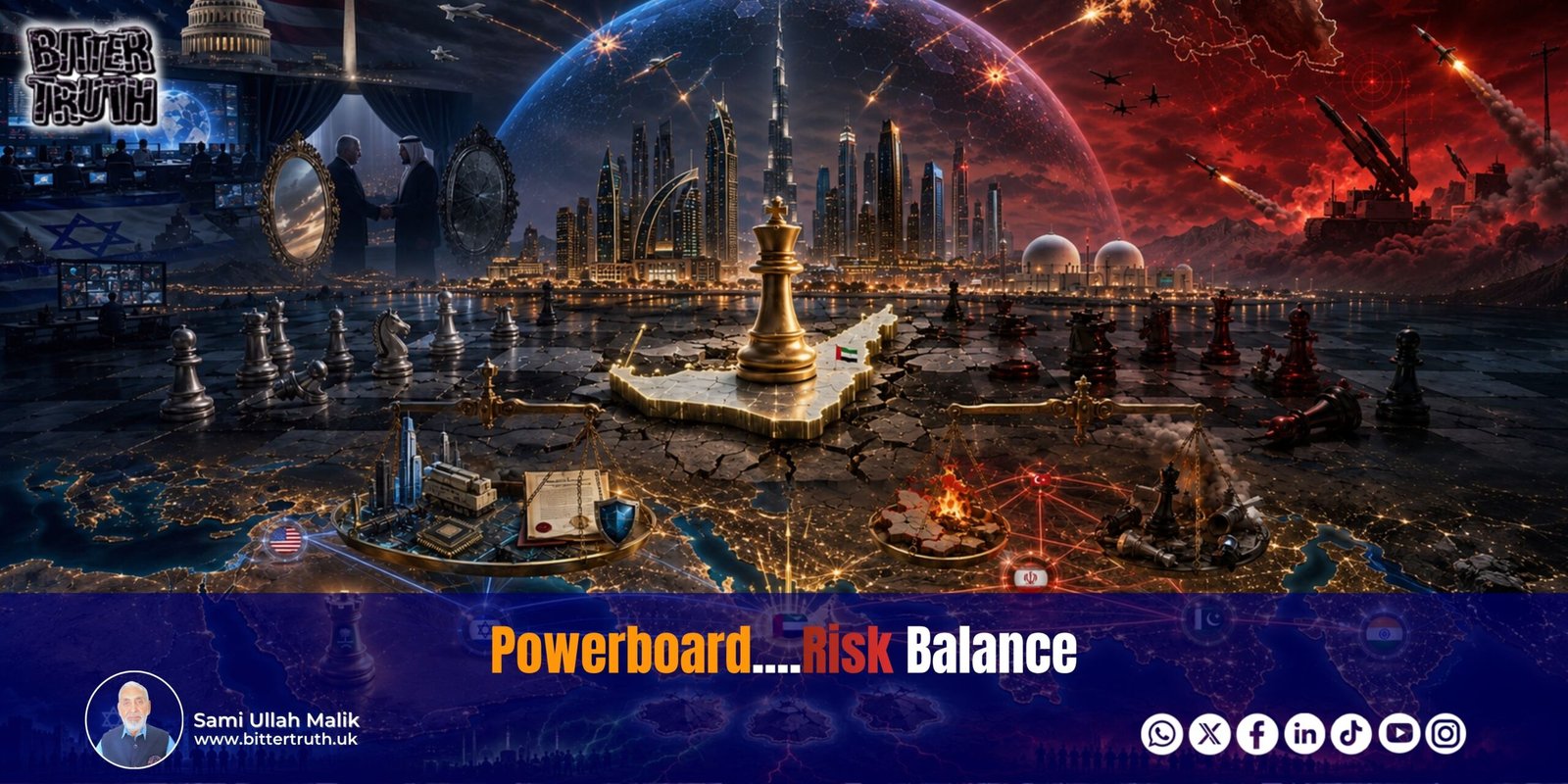

In the present age, politics has come to resemble a vast and intricate chessboard upon which the movement of pieces is no longer confined to terrestrial frontiers, but extends across skies, economies, and ideational realms alike. The recent tensions among Iran, the United States, and Israel constitute one of the most consequential configurations upon this global board—one whose reverberations have enveloped the entirety of the Middle East. Yet amidst this tumult of statecraft, if there is one polity that appears most palpably unsettled, it is the United Arab Emirates: a nation poised at the uneasy confluence of ambition, diplomacy, and peril.
To characterise the unfolding confrontation between Iran, America, and Israel as a mere military engagement would be to impoverish its true significance. It is, rather, a contest of power, doctrine, and supremacy—a furnace whose heat has been felt across the region. Indeed, what has emerged is less a conventional war than a gathering storm, one that has cast a pall of uncertainty over the political horizon of the Middle East. And yet, from the ash of this geopolitical volcano, it is the Emirates that appears most acutely singed. While no state has remained untouched, the UAE has found itself thrust into the eye of the tempest with singular visibility.
The barrage of drones and missiles unleashed by Iran—those faceless soldiers of modern warfare—has shaken to its core the Emirati conception of stability. These aerial assaults, falling like incendiary rain from the heavens, have fractured the carefully constructed image of security that had been forged through decades of economic expansion and global investment. The strike in proximity to Abu Dhabi’s Barakah nuclear facility was not merely a tactical manoeuvre; it was a psychological blow, a symbolic tremor. It signalled, with chilling clarity, that in the theatre of contemporary conflict, distance has ceased to afford protection. War is no longer bounded by borders; it has acquired the reach to penetrate even the most sensitive of installations. The skies themselves no longer guarantee safety, and the earth below has become a domain of uncertainty. In the wake of this episode, a disquieting question confronts the Emirates: does its geography still confer security, or has it become, instead, an exposed and inviting target?
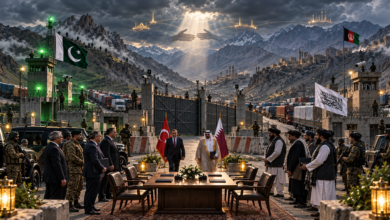
It is against this backdrop that the matter of the Israeli Prime Minister’s alleged clandestine visit assumes particular significance—a glimpse into the concealed stratagems of diplomacy. Here, truth and expediency appear locked in a delicate and elusive contest. Israel’s confirmation of the visit, set against the Emirates’ swift and categorical denial, reveals a diplomatic theatre in which competing narratives vie for legitimacy. The episode has stirred a haze of ambiguity, blurring the boundary between affirmation and repudiation. What emerges are two mirrors reflecting the same event in differing hues, each angle refracting a distinct version of reality. The central question, therefore, is not merely whether the visit occurred, but why its disclosure—or denial—was deemed necessary. If it did take place, why the insistence on secrecy? And if it did not, why the calculated announcement? Such questions illuminate the intricate and often paradoxical contours of modern diplomacy.
The Israeli statement, and the Emirati rebuttal that followed in swift succession, underscore a broader transformation: diplomacy is no longer confined to private chambers; public declarations themselves have become instruments of strategy. Words are now weapons, wielded with as much deliberation as any arsenal. The UAE’s invocation of the Abraham Accords sought to project an image of transparency yet reports of discreet engagements with Israeli intelligence services complicate that narrative. This dissonance points to a dual-track approach—one in which relations are quietly sustained while publicly circumscribed. It is a strategy at once pragmatic and precarious.
In truth, the Emirates is engaged in a delicate balancing act. It seeks to preserve and deepen its ties with Israel and the United States, while remaining wary of provoking Iran. This is diplomacy as choreography, where each step must be measured with utmost precision, for even the slightest miscalculation could unsettle the entire arrangement.
Israel’s internal political dynamics further enrich this narrative. The public disclosure of what would ordinarily remain a covert visit is, in itself, an anomaly. Electoral pressures, public scrutiny, and wartime exigencies appear to have impelled Prime Minister Benjamin Netanyahu towards actions that sit uneasily with established diplomatic conventions. The revelation of such visits may serve a domestic purpose: a calculated effort to project strength and secure political support—an expedient not unfamiliar in the annals of statecraft.
Yet the question persists: why did Israel choose to make this announcement at all? Such matters are typically consigned to unofficial channels, whispered through the corridors of informed speculation. A direct declaration suggests intent—an indication that the move was shaped, at least in part, by internal political considerations. Observers discern in this a familiar pattern: leadership, under electoral strain and public criticism, often amplifies external achievements to buttress its standing at home. Conversely, the Emirates’ denial reflects its apprehension that overt association might inflame tensions with Iran.
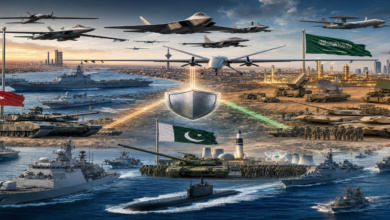
The provision of advanced defensive systems such as the Iron Dome to the UAE offers compelling evidence that relations between Israel and the Emirates have evolved beyond the symbolic into the operational and strategic. Yet this very proximity constitutes a double-edged sword. While it enhances security, it simultaneously renders the Emirates a more conspicuous target in the eyes of Iran. Thus, defence cooperation both shields and exposes—a paradox at the heart of contemporary alliances.
The Emirati policy, therefore, embodies a form of equilibrium that is as delicate as it is doubtful in its durability. It has sought to project a measure of neutrality, yet its actions frequently belie that posture. Iran’s general inclination to refrain from targeting states perceived as neutral imposes a further constraint upon the UAE’s manoeuvrability. In contrast, Saudi Arabia’s more cautious neutrality has afforded it a comparatively greater margin of safety. The Emirates, however, finds its neutrality persistently called into question by its close alignment with Israel and the United States—an ambiguity that draws it ever closer to the crosshairs of regional contention.
In this unfolding crisis, Saudi Arabia has adopted a posture at once cautious, measured, and diplomatically composed, whereas the United Arab Emirates has oscillated between silence and contradiction, betraying a policy that appears fluid, if not altogether opaque. Riyadh has neither openly confronted Iran nor unequivocally aligned itself with Israel. The Emirates, by contrast, has pursued a more agile yet less coherent course—at times reticent, at others dismissive, and occasionally engaged in undeclared cooperation. It is precisely this divergence that has come to define their respective standings within the region.
To regard the prospective visit of Benjamin Netanyahu as a routine diplomatic engagement would
be an exercise in naivety. Such a visit, if indeed undertaken, is better understood as an instrument of political necessity and strategic design. Israel, under mounting internal pressures and the exigencies of conflict, has sought to consolidate alliances capable of reinforcing its posture vis-à-vis Iran. In this calculus, the Emirates—by virtue of its economic weight and geographical significance—emerges as both a natural partner and a strategically situated ally.
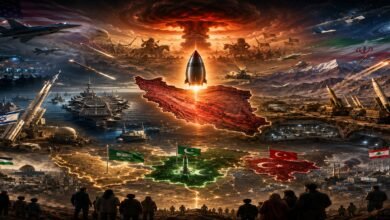
Iran’s decision to single out the Emirates as a target carries the unmistakable force of a message: proximity to Israel comes at a price. The volleys of missiles and drones were not merely acts of aggression, but expressions of a deliberate doctrine. Hundreds of ballistic missiles, scores of cruise projectiles, and thousands of drone incursions are not mere statistics; they constitute the architecture of a sustained military design intended to exert pressure and recalibrate behaviour.
Reports in the international press suggest that the conflict has not been confined to declared hostilities alone. It has also unfolded in the penumbra of deniability, where actions are undertaken without acknowledgement and influence is exerted without attribution. Accounts indicating that the Emirates has itself engaged in covert operations against Iran, while declining to admit them, illustrate a defining feature of modern warfare: that denial often carries as much strategic weight as action itself.
The policies pursued by Donald Trump towards Iran further tightened the bond between Washington and Abu Dhabi. Vast financial commitments, running into the trillions, were not merely economic undertakings but declarations of political and strategic alignment. Through investment and defence cooperation alike, the Emirates effectively tethered its security to American patronage—thereby distancing itself from Tehran even as it deepened its reliance upon external guarantees.
At the root of this tension lies the long-standing dispute over the islands of Abu Musa, Greater Tunb, and Lesser Tunb. This is no trivial territorial quarrel; it is a question infused with sovereignty, dignity, and historical claim. It is upon this contested foundation that much of the present discord rests, lending to the confrontation a depth that transcends immediate politics.
The Islamic Revolution in Iran did more than alter a system of governance; it unsettled the intellectual equilibrium of the entire region. It advanced an ideological current that, while not always overt, posed a profound challenge to hereditary systems of rule. For the Emirates, itself emblematic of such a structure, this revolutionary doctrine is not perceived as a contained domestic transformation, but as a potentially exportable creed.
Iran’s support for groups such as Hezbollah, Hamas, and the Houthis has only reinforced this apprehension. In the Emirati view, Iran thus ceases to be merely a neighbouring state and assumes the character of an ideological rival—one that seeks not only territorial influence but dominion over minds.
Sectarian division, particularly between Sunni and Shia, has further deepened mistrust across the region. It operates like a subterranean current—often unseen, yet capable of sudden and forceful eruption. External powers, too, have at times amplified these divisions for their own ends, entrenching an atmosphere of suspicion that continues to shape political realities in places such as Bahrain and Iraq. For the Emirates, this is not solely a matter of theology; it is a question of national security, bound up with concerns that internal stability might be unsettled by external ideological
currents.
In the realm of international relations, interests invariably eclipse ideals. Grand doctrines, however eloquent, tend to yield before the imperatives of survival and advantage. The policy of the Emirates reflects precisely this pragmatism: a calculus in which preservation and progress are accorded primacy above all else.
Both the Emirates and Saudi Arabia have devised strategies aimed at securing their continuity, yet the former has chosen the more venturesome path. Defence cooperation with Israel, the acquisition of advanced technologies, and the cultivation of close ties with the United States all testify to a governing principle rooted not in sentiment, but in interest. History has long affirmed this maxim: that states possess neither permanent friends nor enduring enemies, but only enduring interests.
The Abraham Accords represent more than a diplomatic agreement; they embody a reconfiguration of political thought within the Arab world. In their wake, relations between the Emirates and Israel have accelerated with striking rapidity, altering the balance of power within the region. By embracing this new course, the Emirates has stepped onto a path that promises development, innovation, and global partnership—yet one that simultaneously exposes it to the risk of regional estrangement. It is, in effect, a door that opens upon both opportunity and uncertainty.
Although overt public opposition within the Emirates remains limited, it would be a mistake to construe this silence as contentment. Beneath the surface, questions persist. In a polity where expression is carefully circumscribed, public sentiment does not always find immediate voice, yet it may accumulate and, in time, exert pressure. The question—“Whither are we bound?”—is one that arises, sooner or later, within every reflective society.
The Emirati economy remains its most formidable asset: a luminous centre of tourism, investment, and global commerce. Yet the shadow of conflict has dimmed this radiance. Investor confidence, commercial vitality, and the flow of visitors are all contingent upon stability. It is for this reason that the Emirates, above all, seeks equilibrium—endeavouring to sustain its alliances while avoiding direct entanglement in open confrontation.
These agreements signal the emergence of a new diplomatic pattern in which interests appear to prevail over inherited doctrines. The United States has sought to broaden the scope of such arrangements, yet ongoing conflict and mounting tensions have slowed their expansion. States such as Saudi Arabia remain circumspect, suggesting that the path chosen by the Emirates, however bold, is not one that commands universal assent.
The expanding defence cooperation between Israel and the United Arab Emirates—most notably in the provision of advanced systems such as the Iron Dome and associated security arrangements—offers compelling evidence that the Emirates has now entered the orbit of a new defensive alignment. In assuming this role, it does not merely follow precedent but, in some measure, establishes one. This emerging partnership is already recalibrating the balance of power within the region; yet it does so at a cost, for it simultaneously sharpens Iranian anxieties and provokes strategic unease. Thus, what presents itself as a shield may, in equal measure, serve as a summons to danger.
In the estimation of Tehran, the Emirates has ceased to be a peripheral actor and has instead become a consequential target. Its deepening association with the United States and Israel places it, unmistakably, within an opposing camp. This transformation marks the advent of a new phase in Emirati statecraft—one in which the safeguarding of national security will demand measures of an altogether more exacting and extraordinary kind.
At the same time, this policy trajectory risks estranging the Emirates from segments of the wider Arab world, thereby exposing it to longer-term diplomatic trials. Israel, for many within the region, continues to be regarded not as a partner but as a persistent source of concern. Should this divergence widen, it may harden into a lasting diplomatic rift—one capable of eroding the fragile cohesion of the region.
What appears to be taking shape is a broader realignment: on one side, an emerging constellation comprising Israel, the United States, and potentially India; on the other, a looser grouping of states gravitating towards Turkey, Pakistan, and Iran. Such a division signals not merely a regional rearrangement but the contours of a new global equilibrium—one in which alliances are forged less by shared doctrine than by converging interests.
The questions posed at the outset now admit of clearer answers. The Emirates is charting a distinct course and stands at a critical juncture where its choices will decisively shape its future. Its growing proximity to Israel, set against its mounting tensions with Iran, is propelling it along a path replete with both promise and peril—a path that may draw it closer to global centres of power even as it risks leaving it regionally isolated. Its rivalry with Iran is neither transient nor incidental; it is rooted in a dense interplay of history, ideology, and geography.
The Middle East, in this light, can no longer be understood as a mere expanse of territory. It has become an intricate web of interests, convictions, and competing powers—a knot of such consequence that, if loosened, it may unsettle the entire system, and if tightened, may give rise to a new order altogether.
This unfolding narrative is, at its core, a complex tale of power, apprehension, interest, and strategy—and the United Arab Emirates stands as one of its central protagonists, engaged simultaneously upon multiple fronts. The wheel of history turns, and the days ahead will determine whether this carefully wrought strategy yields stability or invites a fresh crisis.
For the Emirates, this is a moment of singular delicacy. It regards its ties with global powers—above all the United States and Israel—as emblems of progress and partnership. Yet it risks overlooking a sobering reality: that behind the allure of such alignments may lie the gathering shadows of isolation and regional discord. The direction it ultimately chooses will not only define its own destiny but will also exert a profound influence upon the balance of the Middle East itself.
In the final reckoning, this is not merely the story of a single state; it is the story of an era—an era in which the very meaning of power is being recast, and in which each decision inscribes a new line upon the ever-unfolding page of history.