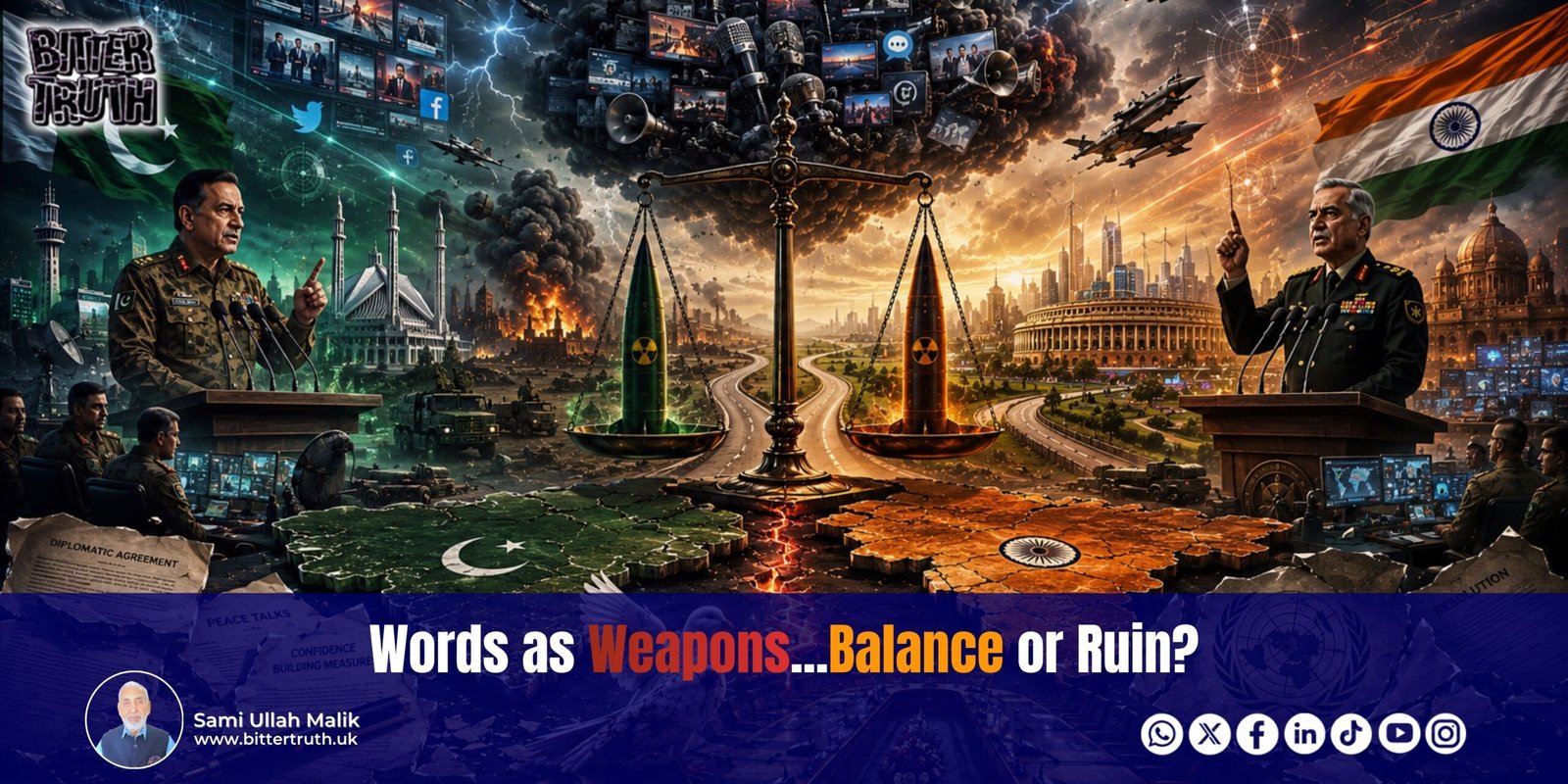
Words as Weapons
Balance or Ruin?

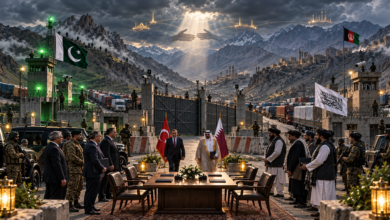
South Asia is a region in which history, politics, and civilisation are so intricately interwoven that no single strand may be isolated without doing violence to the whole. Whenever the pages of its past are turned, one encounters the indelible imprints of conflict, contestation, and the perennial struggle for power—imprints that shimmer still in the mirror of the present. Once again, the atmosphere of this region grows heavy with a familiar pall: a gathering of anxieties, forebodings, and uncertainties that history has, time and again, inscribed in letters of blood.
Recent pronouncements—wherein the very existence of a state has been called into question—serve as a stark reminder that the battle of narratives has now assumed a place alongside, and at times above, conventional military strategy. The suggestion that Pakistan might be effaced from the map is not a mere rhetorical flourish; it is, rather, the outward expression of a deeper intellectual disposition—one that accords primacy to power over principle. The threat, attributed to the head of the Indian Army, to erase Pakistan from the geography of the region has once more cast a long shadow over the prospects of peace. Words, it would seem, have already been loosed from the bow; and they now hang in the air, suspended between provocation and portent. One is compelled to ask: is this but a moment of oratorical excess, or the prelude to a gathering storm?
The response of Pakistan’s armed forces, by contrast, reflects not merely a calibration of military balance, but a measured and discerning strategic sensibility. It bears the imprint of that intellectual maturity and sobriety which ought to characterise a responsible nuclear state. For history is not merely a chronicle of events; it is the mirror of a people’s consciousness. In this light, the present contest transcends the realm of words alone: it is, at its core, a struggle between consciousness and power.
This essay seeks to examine the intensifying tensions between Pakistan and India through the prism of recent military and political statements in South Asia. Its purpose is to illuminate the interplay between narrative confrontation, nuclear deterrence, and regional stability. Drawing upon official pronouncements, historical context, and contemporary diplomatic conduct, it advances the argument that enduring peace in the region can only be secured through a judicious balance of power tempered by intellectual moderation.
Forums such as the Sena Samvad 2026 are ostensibly conceived as platforms for dialogue and intellectual exchange. Yet when moderation yields to extremity, dialogue is stripped of its very essence. When, during this gathering, the Indian Army Chief was asked how Pakistan ought to be answered in the event of conflict, his response was more than a mere reply—it was a revelation of mindset. By rendering Pakistan’s existence contingent upon historical and geographical interpretation, the statement not only contravened the principles of sovereign equality but also betrayed an unwillingness to concede parity among states. To predicate the existence of one state upon the will of another is to echo a darker chapter of history, wherein might was habitually mistaken for right.
According to the realist tradition in international relations, states pursue power in order to safeguard their interests. Yet in the nuclear age, such calculations acquire a perilous dimension. History teaches, with sobering clarity, that those who challenge the existence of others often invite instability upon themselves.
The rejoinder offered by Pakistan’s military spokesperson was at once lucid, composed, and steeped in historical awareness. To characterise the notion of erasing a nuclear state as an expression of intellectual bankruptcy and martial recklessness is to articulate, in a single phrase, the accumulated wisdom of decades. It is a formulation that preserves the decorum of diplomatic language while remaining firmly anchored in universal principles. Pakistan, in this view, is not merely a territorial entity but an ideological state, founded upon a distinct civilisational and intellectual identity.
Pakistan’s position rests upon the doctrine of nuclear deterrence—what Kenneth Waltz famously described as the “balance of peace.” Nuclear powers, by their very nature, are disinclined to wage war against one another, for the consequences would be mutually catastrophic. It is this principle that undergirds Pakistan’s stance: that any conflict would entail reciprocal devastation, rendering victory a hollow and illusory prize.
Pakistan has, moreover, consolidated its identity on the global stage and stands as an inextricable component of South Asia’s geopolitical landscape. These are not transient realities to be altered by the flourish of a speech. Nearly eight decades have passed since the partition of the subcontinent, yet certain minds remain imprisoned within the psychological confines of that bygone era—unable, or unwilling, to reconcile themselves to the present. It is precisely this intellectual inertia that repeatedly drags the region into cycles of tension and crisis.
The assertiveness discernible in Delhi’s policy posture may, in part, be read as the manifestation of a deeper psychological unease—a frustration born of unrealised ambitions, wherein the disappointments of the past exert an undue influence upon the decisions of the present. When nations become captive to their history, their present, too, is held in thrall.
The Pahalgam incident was, above all, a human tragedy, which sent shockwaves of grief across the region. The loss of innocent lives is a grief that cannot be acknowledged without merit. Yet the actions that followed transformed the tragedy into a tool for narrative construction. Invoking such an event as justification for unilateral action and claiming operations inside Pakistan under the banner of “Operation Sindh,” departs from established international norms and blurs the already delicate boundary between reality and narrative. Responsible states substantiate their claims with evidence and investigation. When emotions rise above reality, strategy itself becomes disorganized.
The ensuing four-day confrontation brought relations between the two countries to a precarious juncture. It served as a stark reminder that modern warfare is waged not only with weapons, but with information, narratives, and psychological pressure. Reports of aerial engagements and missile exchanges create an environment in which public opinion may be readily shaped, if not manipulated. Aircraft roaring across the skies, missiles falling along contested frontiers, and the ceaseless churn of media narratives—together they construct a theatre in which the distinction between reality and perception grows ever more elusive.
The confrontation of May last year stands as a telling illustration of the character of modern warfare: limited in duration, yet intense in its execution and far-reaching in its consequences. As Clausewitz observed, war is but the continuation of politics by other means; this episode appears as a near textbook manifestation of that enduring principle.
The competing claims of success advanced by both states are, in truth, less a reflection of battlefield realities than of a subtler contest—one waged in the realm of perception. This is the domain of informational warfare, a theatre in which narratives, carefully constructed and strategically disseminated, have come to rival, if not surpass, the significance of conventional military engagements. Pakistan’s assertion that it neutralised advanced aircraft, and India’s counterclaim of having inflicted damage upon critical installations, must be read within this broader framework. For such declarations, whatever their empirical merit, tend less to illuminate the truth than to erode the already fragile fabric of trust within the region. War, it would seem, is no longer confined to the field; it is equally prosecuted in the arena of narrative.
The recurrence of threats and the persistent spectre of renewed confrontation suggest that the region remains suspended in a condition of profound uncertainty. Statements concerning the future betray not confidence, but a continuing state of tension—an unease that renders the strategic environment volatile and unpredictable. Pakistan’s declared resolve to defend itself, coupled with India’s increasingly assertive rhetoric, has given rise to a dynamic in which escalation may be triggered by the slightest spark. The steady drumbeat of threatening language serves only to deepen strategic insecurity. As Barry Buzan’s theory of regional security complexes reminds us, instability within one state rarely remains confined; it reverberates across the entire region.
Platforms such as Sena Samvad are, in principle, convened in the service of dialogue. Yet dialogue, if it is to retain its integrity, must be anchored in balance and responsibility. When moderation yields to vehemence, discourse begins to assume the character not of deliberation, but of declaration. The observation by the Indian Army Chief—that harmony between the military and the populace is vital for wartime preparedness—is, in itself, an unremarkable truth. The question, however, lies in its application: to what end is such harmony directed? Towards the preservation of peace, or the preparation for conflict? Language is never a neutral instrument; it is, inescapably, a reflection of character.
The accusations levelled against Pakistan in relation to terrorism are neither novel nor infrequent; they form part of a long-standing narrative that resurfaces at regular intervals. Yet, despite their persistence, such allegations have seldom been substantiated at the level or with the clarity with which they are proclaimed. The evidence presented by Pakistan, conversely, suggests that the phenomenon of terrorism in the region is neither singular in origin nor simple in character, but rather complex and multidimensional.
The exchange of responses and denials suggests that terrorism in this context is not simply a matter of security policy but an instrument within a broader political narrative. The materials put forward by Pakistan to the international community point to a reality that is far more complex than the current discourse. In this light, the persistence of such allegations appears less an exercise in objective analysis than a strategic attempt to divert attention from domestic challenges by exerting external pressure.
Over the course of the past year, the increasingly acrimonious tone adopted by both sides has borne witness to the weakening of diplomatic channels. As the language of statecraft loses its customary restraint, one may infer the depth of grievance that lies beneath. When words grow sharp, it is seldom long before actions follow. Yet within the international system, diplomacy remains the indispensable pillar upon which equilibrium rests; its erosion inevitably augurs instability.
Statements issued by India’s Defence Minister form part of this same pattern, wherein the prospect of future action is articulated in terms that verge upon the threatening. The deployment of martial rhetoric for purposes of domestic political gain is not without precedent; indeed, it often proves effective in the short term. Yet history offers a sobering corrective: such language, while momentarily advantageous, tends in the long run to undermine the very stability it purports to secure.
The response from Pakistan’s Defence Minister, by contrast, has been marked by a greater degree of balance and adherence to principle. It aligns more closely with international law and the foundational norms of the United Nations, while affirming both a commitment to peace and an unambiguous resolve to defend sovereignty and territorial integrity. It reflects a policy grounded not in impulse, but in considered judgement.
Recent remarks concerning Sindh have introduced yet another dimension to the discourse. These statements appear to transform a civilisational narrative into a territorial claim—an endeavour that runs counter to established international norms. In doing so, they exemplify a mode of thinking that seeks to reshape history in accordance with present ambitions. To invoke culture and history as grounds for contesting borders is, in essence, to revive a logic that has too often led to conflict. The rejoinder from Pakistan’s Foreign Office—that states would do well to ensure justice and equity within their own borders before casting aspersions beyond them—was both apt and instructive. For it is frequently internal frailty that gives rise to external aggression.
Taken as a whole, this evolving landscape serves as a reminder that South Asia stands at a delicate crossroads. One path leads towards confrontation, instability, and potential ruin; the other towards dialogue, restraint, and mutual respect. At its core lies a fundamental truth: it is the balance of power that underwrites peace. When that balance is disturbed, history has a disquieting tendency to reopen its oldest wounds.
The region now finds itself at a moment that demands not bravado, but wisdom; not impulse, but restraint. Nations do not determine their destinies solely upon the battlefield; they do so, perhaps more decisively, within the realm of ideas. Should prudence fail to prevail, history may yet repeat itself in tragic form. Yet if reason and foresight are permitted to guide policy, this same region could emerge as a testament to peace, development, and stability.
The argument advanced in this study is therefore clear: peace in South Asia rests upon a triad—balance of power, intellectual moderation, and effective diplomacy. Should the contest of narratives remain unchecked, it may well propel the region once more towards confrontation. The imperative, then, is not merely to manage conflict, but to discipline the language through which it is conceived.
In the words of the great philosopher and national poet Allama Iqbal, For civilisation does not flourish through collision, but through concord.