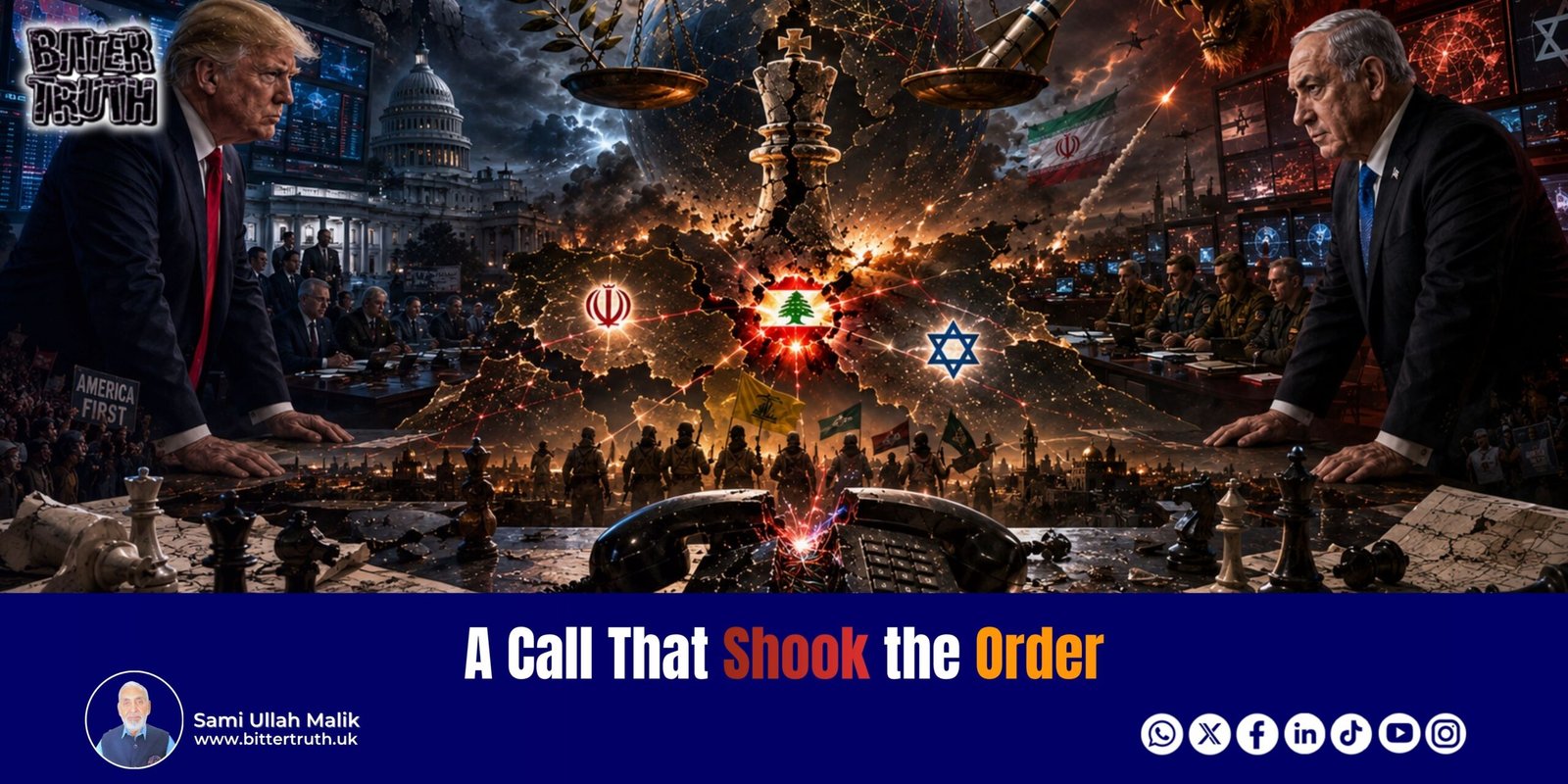
A Call That Shook the Order
At the Edge of History

At the threshold of the twenty-first century, as history once again gathers itself to turn upon a new hinge, the murmurs that echo through the corridors of power have ceased to be ceremonial whispers; they now carry the weight of destinies yet to be decided. From the long, polished passageways of Washington to the guarded war rooms of Tel Aviv, and behind the sealed deliberative doors of Tehran, there drifts an indistinct yet palpable unease—a tension that resists naming yet refuses concealment.
This is an age in which alliances are no longer certainties but contingencies, and discord is no longer accidental but structural—an inevitability woven into the very fabric of international affairs. When two powerful leaders, in whose grasp rest the fates of regions and the aspirations of nations, address one another, their utterances do not dissipate as mere sound; they settle instead into the sediment of history, inscribed with a permanence that outlives the moment.
The much-discussed exchange between Donald Trump and Benjamin Netanyahu—dismissed in some quarters as no more than a telephone conversation—was, in truth, the early tremor of a gathering storm whose full resonance has yet to be heard. It was not dialogue, but disturbance; not disagreement, but disclosure—the revelation of fissures long embedded within the architecture of the global order.
The Middle East, that ancient theatre of imperial ascent and decline, now finds itself once more poised upon a decisive threshold—where a single decision may redirect the course of generations. The acrid scent of gunpowder in the streets of Lebanon, the ideological steadfastness of Iran, and the restless military vigilance of Israel together compose a narrative in which each passing moment gives rise to a new and disquieting question.
This essay seeks to unlayer that narrative—not merely in its sequence of events, but in the deeper impulses that animate it; forces which, though often obscured from view, determine the true direction of play.
Global politics in the twenty-first century has reached a point where leadership no longer operates with autonomous clarity but is increasingly entangled in governmental behavior. Centers of power are no longer harmonious alliances, but rather arenas of perpetual contradictions that coexist in flexibility and contradiction. When powerful heads of state engage with each other on the global stage, their exchanges transcend rhetoric. They become inflection points in the next present of history. In this light, the reported “tense call” between Trump and Netanyahu emerges not as an isolated incident, but as a symptom of deeper systemic tensions.
To interpret recent contacts between the two leaders as a routine diplomatic episode would be to indulge in a superficial reading. Viewed within a broader strategic frame, these interactions reveal a system that appears outwardly robust yet is burdened by internal contradictions. The post–Cold War order has, in effect, yielded to a polycentric strategic configuration, wherein each power continually tests the limits of the other.
This tension is not the offspring of a single event, but the cumulative result of years of layered policies, regional conflicts, and reciprocal expectations. It is not merely a matter of personal displeasure; rather, it conceals within it the intricate politics of the Middle East, the charged atmosphere of Lebanon, and the enduring diplomatic contest with Iran. In this sense, what occurred was not merely a phone call—it was the subtle trembling of a delicate equilibrium of power.
Historically, Lebanon has served as a buffer state between Israel, Syria, and Iran. Yet in the present moment, it has ceased to buffer and begun to flare – transforming into a threat where every military action resonates as a diplomatic jolt. Lebanon’s political importance has thus magnified its geographical prominence. It now stands at the very center of the region’s strategic dynamics.
Iran’s policy posture, for its part, is neither episodic nor merely reactive; it is grounded in a coherent ideological framework, within which the so-called “axis of resistance” functions as a central pillar. Since 1979, a discernible continuity has marked Iranian foreign policy, with the containment of American influence in the region as a persistent objective.
Thus, Lebanon once again becomes the focal point of a broader regional condition—one in which military operations refuse confinement to the battlefield, instead unsettling diplomatic tables far beyond. The evolving situation in Lebanon has rendered policy-making more intricate not only for regional actors but for global powers as well, particularly as Israel’s military posture grows increasingly assertive.
In the aftermath of recent tensions, Iran has adopted a more resolute diplomatic tone. Its indication of suspending negotiations with the United States following Israeli actions in Lebanon is not a gesture of impulse, but a calculated signal—a strategic message that regional conflicts will no longer be treated in isolation, but as interconnected theatres demanding a comprehensive approach. It is precisely at this juncture that American mediation efforts enter a realm of uncertainty.
This was the moment when the prospects of peace dimmed, and the shadow of conflict lengthened perceptibly. Tehran has long maintained that the question of Lebanon cannot be disentangled from Iran itself. In this context, American attempts to avert escalation found themselves poised upon a delicate and precarious threshold.
Trump’s remarks in his New York Post interview—where he acknowledged the conversation in a characteristically unconventional tone—offer a revealing glimpse into the evolving idiom of American diplomacy. While he denied anger, he conceded “concern.” The reported phrase, “Are you crazy?” was not merely an outburst of emotion, but an index of political pressure—suggesting a moment of dissatisfaction within the American establishment regarding the conduct of a traditional ally. Yet, in parallel, both leaders continued to describe one another as “good friends,” preserving the outward veneer of continuity.
To understand Trump’s foreign policy fully, one must situate it within the broader terrain of domestic American politics. Washington’s posture has never been purely external; it is invariably shaped by internal political currents. Foreign policy in the United States has increasingly become an extension of a domestic pressure system, wherein global decisions are tethered to electoral narratives.
In international politics, certain relationships embody both intimacy and tension in equal measure. The association between Trump and Netanyahu is emblematic of this duality: personal rapport, political cooperation, and historical alignment on the one hand; operational divergence and policy friction on the other. It is, in effect, a double-edged sword—keen on both sides, and perilous to wield without consequence.
The recent sharpening of tone in Donald Trump’s political pronouncements is not merely a matter of temperament; it is, rather, a reflection of the internal pressures that course through the machinery of American foreign policy. Beneath the rhetoric lies a discernible unease—an anxiety born of allies whose decisions no longer conform to predictable patterns. It is a condition that underscores a larger truth: that global leadership is not simply the exercise of decision, but the ceaseless discipline of response.
It is by no means the first occasion upon which Benjamin Netanyahu has placed an American president under strain. The history of his engagement with successive administrations in Washington is, in essence, a chronicle of recurring tension—each chapter raising anew questions that refuse easy resolution. Under Netanyahu’s stewardship, Israel has consistently privileged a doctrine of active defence within the region. This disposition has, at different moments, served as both the basis of cooperation with the United States and the source of palpable strain. Israeli policy is frequently shaped by immediate security imperatives, which do not always sit comfortably alongside the longer horizon of American strategic patience.
Netanyahu’s leadership must, in fact, be understood as part of a broader continuity within Israeli strategic thought, one that since 1948 has regarded security not as a policy preference but as the very foundation of statehood. It is for this reason that Israel’s military posture has often revolved around the logic of anticipatory action—a doctrine that does not invariably align with the more measured cadence of American diplomacy.
Within Netanyahu’s political idiom, disagreement is seldom presented as exceptional; it is instead rendered routine, absorbed into the ordinary grammar of statecraft. One of the more subtle strategies of his rhetoric lies precisely in this normalisation—the recasting of discord not as crisis, but as an expected feature of engagement. His characterisation of tensions as akin to a “family disagreement” evokes a style of political expression in which even sharp divergences are softened by the language that contains them. Such phrasing is not incidental; it is a deliberate attempt to situate conflict within a frame of familiarity, thereby tempering its perceived severity in the eyes of the wider world. In contemporary diplomacy, this may be described as the mitigation of crisis through normalisation—a technique designed to shield global opinion from the destabilising effects of uncertainty.
Yet the underlying reality resists such softening. The divergences in question are not merely rhetorical; they carry tangible consequences. Observers note that these are not disagreements of a domestic or incidental character but are rooted in substantive strategic contradictions—particularly with regard to Lebanon and Iran.
Specialists in international diplomacy have long observed that Israel’s autonomous military posture often advances beyond the expectations set in Washington. Analysts have pointed to a consistent pattern of resolve, even rigidity, within Netanyahu’s approach—an unwillingness to accept American guidance in its entirety. There exists within Israeli policy-making a persistent inclination towards independence, one that does not fully converge with American assumptions. It is precisely this misalignment that has, over time, generated frustration and uncertainty among policy-makers in the United States.
Such dynamics are not without precedent. In earlier periods, limits articulated in Washington have frequently proved fragile when tested in practice, and the alliance has, at times, shifted from a condition of managed coordination to one of differentiated alignment. It is at this juncture that Trump, too, appears to have recognised a fundamental truth: that alliance does not guarantee uniformity.
The relationship between Iran and Lebanon is not merely political; it rests upon a matrix of ideological affinity and military coordination. Groups supported by Tehran, together with entrenched military structures within Lebanon, constitute an enduring security challenge for Israel. Within this strategic context, the objectives of the United States and Israel do not entirely coincide. Israel seeks to confront its adversaries directly, whereas the United States remains reluctant to foreclose the avenue of engagement with Iran.
This alignment of forces produces, for Israel, a sense of strategic encirclement; for the United States, it presents a complexity that demands a continuous balancing act between deterrence and diplomacy. It is this very complexity that compels Washington into a posture where diplomatic engagement and military support proceed in tandem, yet without perfect harmony.Here, then, lies the point at which alliance begins to shade into divergence.
Within the United States itself, a quiet but profound awakening is underway in public attitudes toward Israel. This shift is not temporary. It has the characteristics of a generational shift. Younger Americans increasingly interpret foreign policy through the lens of moral responsibility and human rights, thus exposing long-standing strategic alignments to renewed scrutiny. This evolution does not simply change foreign policy priorities. It raises deeper questions about American identity and its role in the world.
Such a trend suggests that foreign policy in the modern age is no longer the exclusive domain of governments; it is increasingly shaped by the consciousness of the public. Survey evidence indicating a rise in critical opinion points to a development that is not only political but also moral and intellectual—one that is generating fresh debate within American society.
Within political circles in Washington, a more pointed discussion has begun to take hold: whether policy in the Middle East is guided primarily by national interest, or whether it is subject to the influence of organised advocacy. In this debate, the centres of power appear not only external but internally diffused. Questions are being raised as to the extent to which external considerations shape policy formation in the region. At its core, this discourse challenges the intricate balance of power and influence within the American democratic framework, and its implications are not merely theoretical; they are increasingly visible in practical politics.
Even among certain conservative quarters, the question has been posed—whether Israel exercises a discernible influence upon American policy. Statements from former officials have served only to intensify this discussion. The issue at stake, therefore, extends beyond foreign policy into the realm of domestic political equilibrium.
For Trump, it has sometimes become politically advantageous to signal a degree of distance from Israel, in order to balance the domestic narrative. This trend reflects a broader reality: that foreign policy is often subordinate to electoral needs. In such a context, every statement becomes a tool of strategy, not just for diplomatic effect but also for political consequences.
This condition is not new to American politics; yet its intensity in the present moment is without recent parallel. It marks the point at which politics becomes less the servant of principle than the captive of narrative.
The history of tension between Benjamin Netanyahu and successive American presidents is neither novel nor incidental. The relationship between Netanyahu and varying administrations in Washington has seldom followed a straight or untroubled line. From the era of Bill Clinton to that of Barack Obama, elements of strain have persisted, surfacing in different forms yet rooted in enduring policy divergences. The aftermath of the Oslo Accords during Clinton’s presidency offers one instructive example, where emerging frictions signalled the limits of alignment. Likewise, under Obama, the question of the Iranian nuclear agreement became a defining moment—laying bare the widening distance between the strategic outlooks of the two states.
During Joe Biden’s tenure, the challenge assumed a different, though no less intricate, character: the delicate balance between military support and mounting humanitarian concern. Disagreements over arms provision and the conduct of war policy came to the fore, exposing a phase in which American policy appeared burdened by a dual responsibility—on the one hand, the imperative of alliance; on the other, the pressure of humanitarian accountability. At certain junctures, Israel itself suggested that Washington had exerted undue pressure, a claim that hinted at a subtle erosion of mutual confidence. Such tensions underscore a fundamental reality: that the interests of the two states, though often aligned, are not invariably identical. They further suggest that institutional policy has, in many respects, grown more decisive than personal rapport—particularly in light of disagreements over the Iranian accord and positions adopted within international forums.
Trump’s manner of discourse departs markedly from the conventions of classical diplomacy. In his lexicon, words are not merely calibrated along a spectrum of restraint or severity; they function as instruments of force. The sharpness of his language is not simply an expression of personal sentiment, but an outward sign of a broader political unease. It is for this reason that his more strident statements have come to symbolise a moment of strain within global diplomacy—where emotion and strategy converge, and at times collide. One is reminded that, in contemporary statecraft, linguistic style itself has assumed the character of a strategic tool; words no longer serve merely to convey meaning, but to project intent. It is at this juncture that the language of diplomacy begins to bend beneath the weight of feeling.
At the core of the relationship between Netanyahu and Trump lies not sentiment, but the complementarity of strategic interests. The durability of their association rests upon the degree to which those interests remain aligned; where they diverge, tension becomes unavoidable. Their relationship thus embodies both confidence and contention in equal measure—a political equilibrium grounded in calculation rather than affection. Notwithstanding their differences, Netanyahu has described Trump as one of Israel’s greatest friends. Such a statement is not merely an expression of praise; it is, in equal measure, an act of political positioning. In the politics of the Middle East, friendships are seldom permanent, but interests often are.
The central question, then, remains unresolved: does the present tension signify a lasting transformation, or is it but a passing disturbance? Is it the prelude to a more profound rupture, or merely a transient jolt within an otherwise resilient structure? The history of relations between Netanyahu and Trump suggests that such ties are less prone to fracture than to evolve. Indeed, international relationships rarely end; they are recast, reshaped, and reinterpreted—and therein lies one of the most enduring truths of global politics. Yet in a world defined by shifting currents, no prediction can claim final authority. History has a habit of pronouncing its judgments without warning—after long silences, or in the wake of a single exchange.
The contemporary global order is not a static arrangement, but a structure in perpetual motion, within which alignment and divergence travel side by side. The relationship between Netanyahu and Trump stands as a vivid illustration of this dynamism: not a story of final decisions, but of continual transformation.
When history gathers its pages, it does not draw a straight line. Rather, it traces a series of interwoven lines, within which truth is concealed—awaiting the patience of time to be understood. The recent tension between Trump and Netanyahu may well be one such line: neither a complete severance nor a seamless continuity, but a turning point at which paths appear to diverge even as they incline towards a common horizon.
What appears, at first glance, to be a relationship between two individuals is, in truth, a prolonged dialogue between states, ideologies, and interests. Here, friendship itself is subject to calculation, and disagreement forms part of a broader design. It is for this reason that the bitterness of today may yet furnish the foundation of tomorrow’s accord.
And yet, the essential question remains suspended: is this contention the beginning of a greater transformation, or merely a passing tremor? Is it the stillness that precedes a storm, or the exhaustion that follows one?
The temper of global politics teaches us that certainty is fleeting, while change is constant. Decisions made within the halls of power do not merely shape the present; they open, of their own accord, the doors of the future—whether those doors lead towards peace or towards conflict.
Perhaps this is the deepest suspense of the entire narrative: that nothing, as yet, is final. History is still being written, and within the ink of its pen there lingers a tremor—one that may, at any moment, give rise to a new chapter.
Who can say what tomorrow’s headline will declare?
A new alignment… or a new war?
For now, the question remains suspended in the air—and in that suspended moment resides the most compelling mystery of all.