Hangor: Silent Strike
Power in Depth

In the long chronicle of the world, there exist certain forces that are discerned not by their display, but by their restraint—known less for their presence than for their deliberate concealment. The sea, through the ages, has stood as an emblem of power, silence, and secrecy. Within its depths resides a latent force: outwardly tranquil, yet in truth decisive. Beneath its surface, unseen currents gather with the quiet potency to alter the course of history itself. The submarine is the embodied expression of this concealed strength—a weapon that evades the eye yet commands consequence. Moving silently along the ocean floor, it belongs to that class of forces whose very invisibility confers strategic weight: a silent sentinel, decisive even in absence.
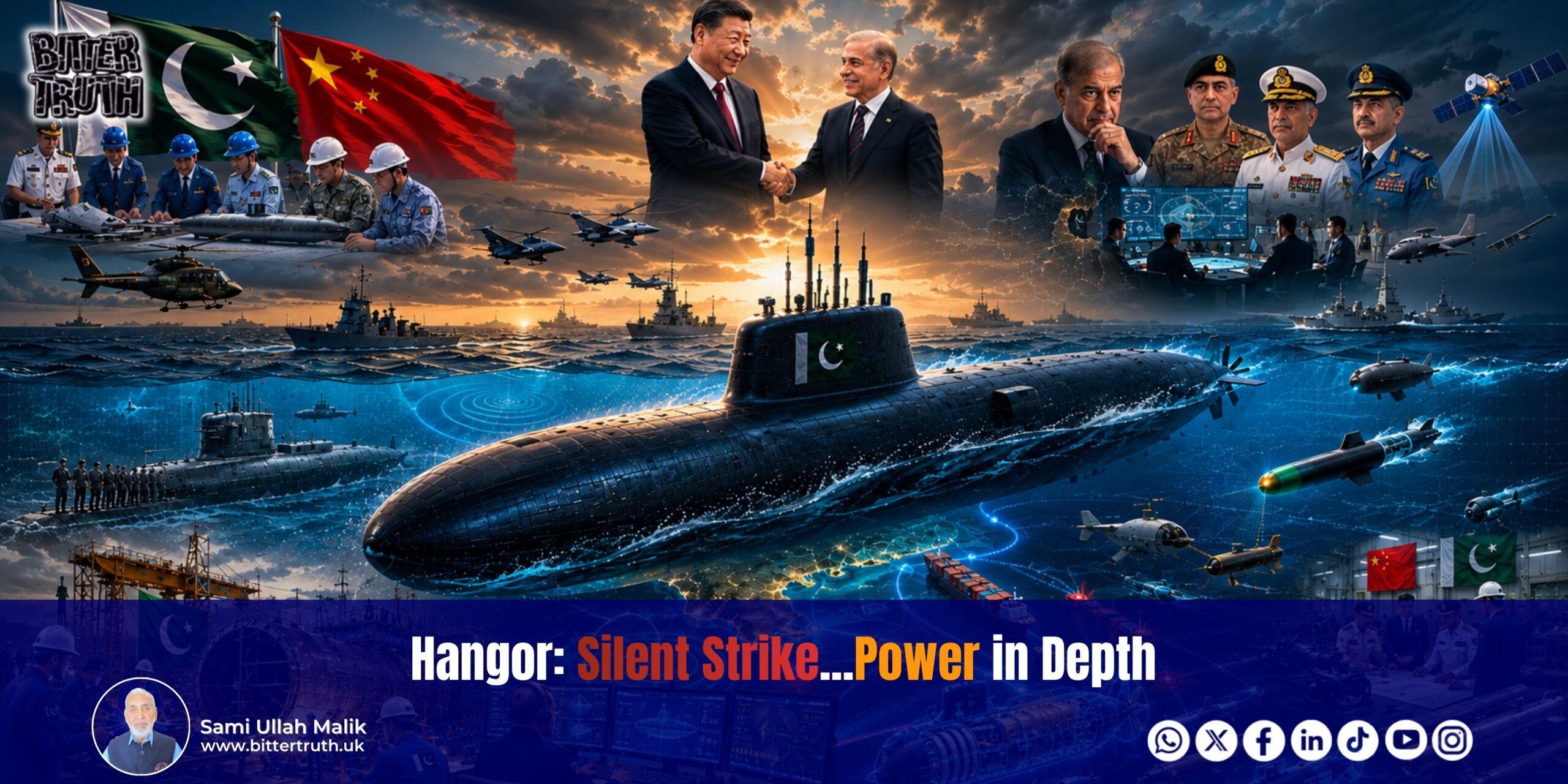
The emergence of the new Hangor-class submarines upon Pakistan’s maritime horizon heralds not merely an addition to naval inventory, but the advent of a renewed era of latent power. It is at once a declaration and a reconstitution—where the continuity of history, the consciousness of politics, and the discipline of science converge to give rise to a fresh strategic doctrine. It is a continuum that binds the pride of the past to the exigencies of the present and the imperatives of the future, a point at which science, strategy, and national resolve are brought into deliberate alignment.
In the vocabulary of military affairs, certain names transcend identification and assume the character of psychological instruments. The reappearance of “Hangor” after fifty-five years is not merely a technical progression; it is the reawakening of national memory. Hangor is no mere word—it is a symbol, an idiom of patience, concealment, and the sudden, telling strike. Its revival after half a century constitutes, in essence, the reclamation of a strategic consciousness. It sustains a psychological continuity through which memory is transmuted into present strength, ensuring that a quiet apprehension lingers in the mind of any adversary.
The events of 1971, wherein Hangor struck its target with singular courage and precision, remain an enduring chapter in naval history. Today, that very name once more inscribes itself upon the breast of the waves—again as a metaphor for silence, endurance, and decisive action. In modern warfare, psychological ascendancy is as vital as material capability, and such a name serves to reinforce that intangible yet critical dimension.
In the realm of international relations, military cooperation extends far beyond the mere exchange of armaments; it encompasses the transfer of knowledge, expertise, and trust. The submarines acquired under this programme represent not simply assets, but the manifestation of a broader industrial and technological partnership—where the engineering prowess of one nation harmonises with the operational requirements of another to produce an integrated system. These vessels are the fruit of strategic cooperation between Pakistan and China. Equipped with advanced sensors, stealth technologies, and Air-Independent Propulsion (AIP) systems, the project signifies not only defence preparedness but a measured advance towards industrial and technological self-reliance. It affirms a fundamental truth: that modern military systems are not merely purchased—they are learned, internalised, and ultimately mastered. Joint engineering, joint training, and joint production—these three pillars alone render any defence initiative durable.
Behind every military development lies a deeper necessity. Maritime routes constitute the arteries of the global economy, and their protection—or control—remains indispensable to any sovereign state. Shifting regional dynamics, the intensification of naval activity, and the rapid acceleration of technology have necessitated a new form of preparedness—one defined not by reaction, but by anticipation. This is not solely a military question; it is one interwoven with geography, politics, and technological change. The increasing activity in the Indian Ocean, coupled with regional tensions and the obsolescence of ageing platforms, has rendered such a capability not optional, but inevitable.
Yet this initiative is not emblematic of aggression; rather, it reflects an effort to maintain what may rightly be termed a strategic equilibrium. Enhanced maritime surveillance, the safeguarding of trade routes, and the secure transmission of energy supplies all demand a capability that is discreet yet effective—silent, yet resolute.
In the world of submarines, the nature of propulsion defines their essential character. Some operate within limited means; others extend their endurance through advanced chemical or mechanical systems; still others possess the capacity for prolonged, sustained operation. This distinction shapes their operational doctrine. For the general reader, one might put it thus: some submarines must periodically “breathe” at the surface; others can remain concealed for extended durations; and a select few can remain submerged for extraordinarily long periods. This divergence arises from their energy systems. Broadly speaking, submarines fall into three principal categories: diesel-electric, Air-Independent Propulsion (AIP), and nuclear-powered vessels.
The nuclear submarines maintained by major naval powers create an enduring sense of presence. Their two principal types—those designed for offensive operations and those configured for long-range strategic deterrence—play a pivotal role in the global balance of power. They represent, in effect, a form of silent deterrence. Like vigilant sentinels that never sleep, they combine speed, endurance, and reach, albeit at immense cost and complexity. It is for this reason that attack submarines (SSNs) and ballistic missile submarines (SSBNs) form the cornerstone of nuclear strategy among great powers.
From the modest beginnings of the 1960s, with the induction of Tench-class submarines, through the acquisition of Daphne and Agosta classes, and now culminating in the Hangor class, Pakistan’s naval journey tells a story of gradual yet deliberate evolution. It is a narrative that begins with dependence, advances through the acquisition of maintenance expertise, and matures into partial self-reliance. Over time, Pakistan has not only learned to operate submarines, but has developed the capacity to maintain, upgrade, and partially manufacture them—capabilities that are foundational to any credible naval force.
International agreements are never mere formalities; they are instruments that shape the trajectory of the future. At a time when global politics was growing ever more intricate, the decision to embark upon a long-term naval programme reflected both foresight and diplomatic acuity. Such initiatives are conceived with decades in view. Indeed, the foundation of this project was laid during President Xi Jinping’s visit to Pakistan in 2015—an agreement for eight submarines, half of which are to be constructed domestically.
The design of these new submarines reveals a sophisticated synthesis of acoustic engineering, hydrodynamics, and materials science. The Hangor-class, with its refined structural innovations, is equipped with modern sonar, radar, optronic systems, and low-noise technologies—affirming the central maxim of undersea warfare: that invisibility is strength. The hull is shaped not to cleave the water, but to dissolve into it. Its rounded contours and specialised coatings minimise resistance and absorb sound, reducing acoustic signatures to the barest whisper. In such design lies the essence of modern maritime strategy: to remain unheard, unseen, and therefore, unassailable.
In one sense, these submarines serve as the unseen intelligencers of the sea. Their function is not confined to the theatre of open conflict; rather, their more enduring role lies in the quiet accumulation of knowledge—in vigilance without spectacle. They trace the movements of adversaries, observe maritime boundaries, and establish an invisible rampart of security. They are not merely instruments of war, but silent custodians: watchful over hostile manoeuvres, guardians of vital sea lanes, and gatherers of concealed intelligence.
Modern submarine technology has been transformed by the advent of Air-Independent Propulsion, a system that reduces reliance upon atmospheric oxygen and permits prolonged submerged operation. By employing alternative sources of energy, this innovation allows a vessel to remain beneath the surface for weeks, even months, without the need to emerge. In the simplest terms, it enables a submarine to endure beneath the waters without “drawing breath”. Technically, such systems generate power through fuel cells or closed-cycle engines, thereby extending both survivability and operational reach to a remarkable degree.
Yet true superiority lies not merely in concealment, but in the sustained exercise of effectiveness. The stealth philosophy embodied in the Hangor class represents a disciplined continuity of silence. Stealth is not simply the reduction of noise; it is an entire doctrine of engineering refinement. Every submarine possesses its own acoustic signature, as distinctive as the human voice. In modern vessels, elaborate measures are taken to diminish this signature: machinery is isolated upon specialised mountings, propellers are shaped with precise geometries to minimise cavitation, and hull forms are carefully contoured to ensure the smooth passage of water. These elements converge to produce what may be termed acoustic invisibility—rendering detection by sonar a task of formidable difficulty.
The armament of contemporary submarines is no longer an assemblage of discrete weapons, but an integrated system of coordinated lethality. Heavyweight torpedoes, anti-ship missiles, advanced warheads, and multi-spectrum sensors combine to form the character of a maritime predator. Fire-control systems, target-tracking algorithms, and guidance mechanisms operate in concert. The modern torpedo, in effect, is an autonomous missile beneath the sea—capable of seeking its target, altering speed and depth, and discerning deception. Missiles, once launched, navigate with precision through successive phases of guidance until they reach their objective. Cruise systems, in particular, extend the reach of maritime strike far beyond the immediate horizon.
The new submarines do not merely replace the old; they redefine capability itself. Enhancements in speed, range, and decision-making efficacy multiply their operational value many times over. At the heart of this transformation lies the fusion of sensors—systems that serve as the eyes and ears of the vessel, gathering data from diverse sources and integrating it within a central analytical framework. The true sophistication, however, resides in the synthesis: algorithms that distinguish signal from noise, filtering irrelevance and constructing a coherent operational picture. In doing so, they furnish the commander with the clarity required for timely and precise judgement.
Every submarine is bound by the limits of its structural endurance. Its operational lifespan depends upon the integrity of its hull, its resistance to corrosion, and its tolerance to fatigue. The pressures of the deep are immense; at a depth of three hundred metres, the force exerted upon the hull may amount to hundreds of tonnes per square metre. To withstand such conditions, specialised alloys are employed, high-strength steel is fashioned with exacting care, and welding is executed to the most exacting standards. Even so, the passage of time introduces microscopic fractures—subtle yet consequential—which demand complex and meticulous repair. With older vessels surpassing their viable service lives, the introduction of the Hangor class represents not an increment, but a necessity.
Across the Indian Ocean, naval powers maintain a delicate equilibrium shaped by the interplay of technology. Speed, stealth, weapon range, and detection capability—these are the determinants of advantage in a domain where numerical strength alone is insufficient. In modern naval warfare, silence, reach, and precision assume decisive importance. Within this regional context, Pakistan’s navy, among the earliest operators of submarines in these waters, continues a long-standing tradition by embracing advanced technology in the service of strategic balance.
The concept of area denial does not seek to render an adversary’s advance impossible; rather, it seeks to render it perilous. It is a strategy of deterrence by risk—of making entry into a given space so fraught with danger that it is prudently avoided. It is, in essence, a doctrine of prevention before confrontation. The Hangor class lends substance to this principle. Deployed at chokepoints, shipping lanes, and strategic corridors, submarines impose a latent threat that constrains the freedom of movement of any opposing force.
These vessels introduce new dimensions to covert operations, intelligence gathering, and maritime defence. Communication between a submerged submarine and its command structure remains a formidable challenge, as water severely limits conventional transmission. To overcome this, extremely low-frequency and very low-frequency signals are employed—channels capable of conveying limited information, yet preserving the essential quality of secrecy.
The success of any submarine fleet rests not solely upon its technology, but upon the resilience of its supporting system. Supply chains, maintenance facilities, the availability of spare parts, and the presence of skilled personnel constitute an unbroken continuum without which even the most advanced systems would falter. Past constraints have imparted a clear lesson: that strategic autonomy demands reliable partnerships. In this regard, China stands as a significant and steadfast pillar.
When a nation acquires the capacity to construct submarines—whether partially or in full—it achieves not merely a military milestone, but an industrial transformation. Such capability stimulates progress in metallurgy, electronics, software engineering, and systems integration. It advances scientific inquiry and generates employment. The construction undertaken at Karachi Shipyard, the training of engineers, and the cultivation of indigenous expertise elevate this programme beyond procurement; they render it a national asset of enduring consequence.
The future of undersea warfare points inexorably towards greater automation, the integration of artificial intelligence, and the deployment of unmanned underwater vehicles. Projects such as the Hangor class lay the groundwork for that future, wherein the convergence of human judgement and machine precision will shape a new maritime doctrine. In the years ahead, intelligent, autonomous submarines will assume an increasingly central role in decision-making and operational execution.
Half a century ago, Hangor was an achievement; today, it is an idea—a doctrine in its own right: strength in silence, wisdom in patience, and advantage in depth. It is not merely a weapon, but a manifestation of maritime sovereignty, technological progress, and strategic foresight.
A submarine moving through the depths of the sea resembles a silent composition—each line measured, each word balanced, each pause deliberate. In this composition, a new chapter is now being written: one in which the echoes of history, the courage of the past, the necessities of the present, and the promise of the future are heard in unison. In the annals of history, certain names transcend language; they become epochs. The Hangor class is emblematic of a quiet revolution—one that makes no clamour yet leaves an enduring mark.
It is more than a structure of steel; it is an idea, a strategy, a force that may remain unseen, yet possesses the capacity to redirect the course of events. Hangor is not merely a vessel—it is an intellectual horizon, a national resolve, and the realisation of a technological aspiration. It stands as a covenant: an echo within the silence of the sea that carries the voice of a nation’s determination. For it reminds us of an enduring truth—that true power seldom declares itself; more often, it resides in depth, concealed yet decisive.