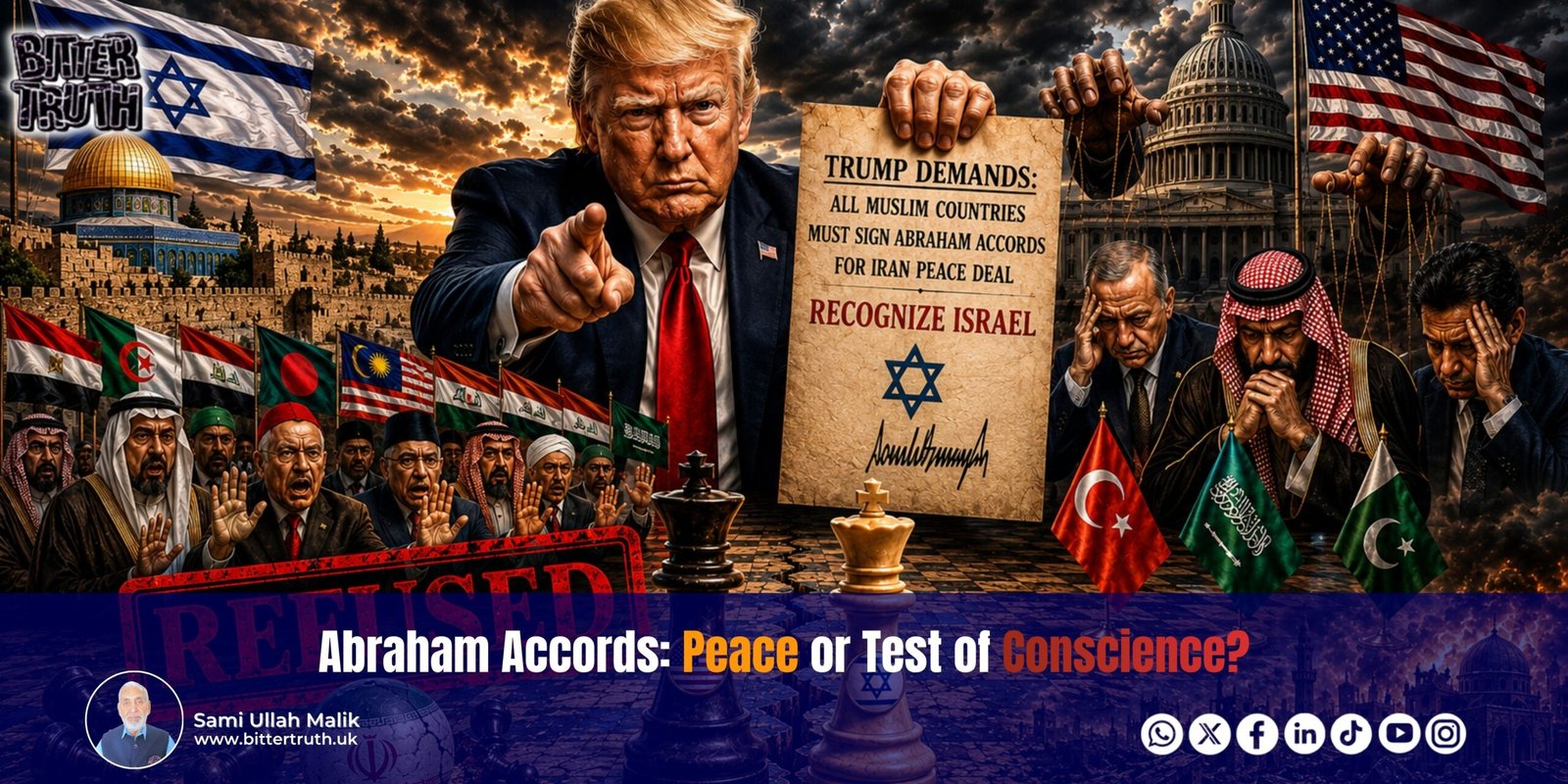
Abraham Accords: Peace or Test of Conscience?
Power, Principles, and the Judgment of History

At this hour upon the horizon of world politics, there gathers a spectacle scarcely less formidable than a Deluge. Decisions are being forged in the vaulted chambers of power whose reverberations shall not fade with the passing season but will echo across generations yet unborn. Ours is not merely an age of events; it is an age of interpretations—an era in which the meaning of events may prove as consequential as the events themselves. The lines now inscribed upon the parchment of history are no idle strokes of the pen; they are, rather, the deliberate engraving of nations’ destinies.
In this unfolding drama, Donald Trump’s attempt to tether an Iran accord to the framework of the Abraham Accords emerges as one more link in a tightening chain—a stratagem in which diplomacy, power, interest, and ideology are so intricately entangled as to resemble the labyrinthine alleys of some ancient Syrian bazaar. It is not a mere policy proposal, but a design of calculated complexity.
To condition an agreement with Iran upon alignment with the Abraham Accords is, in truth, a move upon a grand chessboard—one in which both the pieces and the board itself are arranged by the same hand. This is no passing diplomatic utterance; it is emblematic of a deeper intellectual, civilisational, and political contest. Within this contest, the Muslim world finds itself compelled to strike a precarious balance between identity, dignity, and strategy. Why, one must ask, has the recognition of Israel been yoked to the question of Iran? And can nations such as Saudi Arabia and Pakistan refuse? Will the broader Muslim world bow beneath the weight of such pressure, or will it preserve the flickering flame of principle? In that question lies one of the defining trials of our age.
This is not merely a diplomatic dilemma; it is the mirror of a civilisational and ideological struggle. Trump’s design is less a policy than a web—intricate, expansive, and without any easily discernible thread by which it may be unravelled. By linking peace with Iran to the recognition of Israel, a pressure is exerted that seeks to compel a new alignment across the Muslim world.
It is, ostensibly, a condition laid in the name of peace—yet one cannot help but observe that within it, the spirit of justice appears faint, while the gleam of interest shines all too brightly. For states such as Saudi Arabia and Pakistan, the decision demanded is not merely political; it requires a delicate equilibrium between historical positions, public sentiment, and religious affiliation. Refusal is conceivable—yet the cost of such refusal would be far from trivial.
It is therefore necessary, albeit briefly, to revisit the conception, context, and reality of the Abraham Accords themselves. Concluded in 2020, these agreements marked the inauguration of a new chapter, wherein certain Arab states, under intense American pressure, established diplomatic relations with Israel. They were heralded as a historic breakthrough—an apparent step towards peace. Yet beneath this surface lay the beginnings of a new geopolitical alignment.
The Accords were presented as diplomatic bridges—structures intended to span divides and secure peace. But like many such bridges, they concealed beneath them the swift and restless currents of competing interests. They were not merely instruments of reconciliation; they were also mechanisms through which the politics of the Middle East might be recast into a new mould.
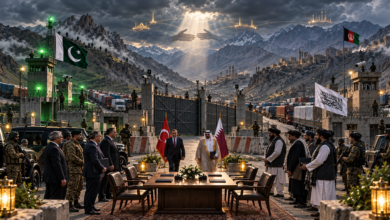
It was, in many respects, a moment when history shifted its course. A long-standing principle—that Israel would not be recognised until the resolution of the Palestinian question—was, for the first time, openly challenged. The notion now advanced of “New Abraham Accords” appears as an extension of that same trajectory—an attempt, as it were, to complete an unfinished chapter. By drawing in countries such as Saudi Arabia and Pakistan, the ambition is to construct a regional alignment which, though outwardly adorned with the language of peace, may in substance lay the foundations for a new political order.
Trump’s recent overtures must be understood within this continuum. The invocation of “New Abraham Accords” is not merely rhetorical; it signals the application of renewed pressure. The effort to incorporate Saudi Arabia, Pakistan, Qatar, and others forms part of a broader strategic design—one that suggests the United States no longer aspires merely to mediate, but to direct. It is akin to a master of chess advancing several pieces in a single, seemingly simple move—yet one laden with concealed complexity. Or perhaps it resembles the attempt to turn the course of a river against its natural flow—conceivable in theory, but fraught with resistance from the very laws of nature.
Pakistan’s position with regard to Israel is rooted in its ideological foundations. The question of Palestine is not a mere territorial dispute; it is an ethical and historical issue of profound significance. From the very outset, Pakistan’s stance has remained clear and unwavering: recognition of Israel is contingent upon the establishment of a Palestinian state. This position has been consistently affirmed—not as a matter of expediency, but as one of principle. It is anchored not only in diplomatic reasoning, but in moral conviction, and its roots extend deep into the philosophical origins of the Pakistani state itself. Islamabad has long regarded this issue as a matter of the collective conscience of the Muslim Ummah, rather than a bilateral dispute between two entities.
If anything, Saudi Arabia’s position is even more delicate. It is not just a state among states. It holds a unique place as the spiritual heart of the Islamic world. As the Custodian of the Two Holy Mosques, its decisions resonate far beyond the realm of politics, which carry religious and cultural weight throughout the Muslim world. So, for Riyadh, the issue is not just political; it is also linked to questions of faith, legitimacy, and security.
Its insistence that Israel cannot be recognised prior to the establishment of a Palestinian state is not merely a negotiating posture; it is the expression of a historic responsibility. Such a decision bears not only political consequence, but also the imprint of civilisational dignity and religious obligation. And it is for this reason that any step taken will be measured with the utmost care—for its repercussions will be felt across the breadth of the Muslim world.
So why do Muslim countries persist in refusing to recognize Israel? This refusal is neither the fruit of stubbornness nor the anxiety of anxiety. Rather, it is the expression of a principled position that is linked to the establishment of a Palestinian state. The collective conscience of the Muslim world sees Jerusalem not simply as a city but as a symbol – in which history, faith, and identity merge with a single intensity. Until the Palestinian people get their due, this refusal will persist not as a deviation, but as a moral obligation.
Can, then, all states be drawn into such an arrangement? On the surface, the prospect appears improbable; yet beneath the surface, each nation is governed by its own internal compulsions and external constraints. Some may, under the pressure of expediency, acquiesce; others, however, would find in such a step a departure so profound from their ideological moorings as to render compliance untenable.
The ongoing negotiations between Iran and the United States have now entered a most delicate phase. There appears, at least outwardly, to be an atmosphere of conciliation; yet even as such appearances are cultivated, the shadows of conflict lengthen across the horizon. Covert military actions, conducted beyond the theatre of formal diplomacy, betray a sobering truth: the foundations of trust remain fragile. The dissonance between American strikes and Iranian declarations lays bare the reality that this prospective accord rests not upon confidence, but upon a precarious equilibrium of interests.
Indeed, the contrast between negotiation and confrontation reveals a profound axis of international politics—that words and deeds rarely match. One moment, the table of diplomacy is laid with all the ceremony of peace. The next, the field of conflict is raging. It is a state of affairs that is aptly described as peace declared by day and pursued by conflict by night.
Is this, then, a strategy of pressure? Assuredly so. A close reading of Trump’s approach discloses a calculated fusion of inducement and coercion, undergirded by a palpable assertion of power. On one hand, there is the language of peace, the invitation to agreement; on the other, the resumption of military action, accompanied by the implicit threat of escalation. It is the familiar policy of the carrot and the stick—a double-edged instrument by which a preferred geopolitical design is sought to be imposed.
Trump’s insistence that all nations should, without delay, append their signatures to the Abraham Accords amounts to a demand at once sweeping and contentious. It places Muslim states in a stark dilemma: to recognise Israel, or to risk imperilling the prospects of regional peace. Such a proposition constitutes a snare from which escape is neither simple nor without consequence. The international response has been marked by a curious blend of silence and unease. Many states tread cautiously, aware that the decision at hand transcends diplomacy, touching upon domestic stability and the temper of public opinion.
It is necessary, therefore, to ask why Trump seeks to bind an Iran accord to the Abraham Accords in the first place. The answer lies within a broader strategic vision—one that aspires to recast the political architecture of the Middle East. The concept may possess a certain superficial allure; yet in practice, it is fraught with complexity. By extending these accords, Trump seeks not merely policy success, but the construction of a historical legacy—an enduring imprint by which his tenure might be remembered.
The assertion by Senator Lindsey Graham that Muslim nations possess “no option but success” reflects less a sober assessment of reality than a projection of desire. It reveals a cast of mind inclined to interpret global politics through the singular prism of power. Yet history bears witness to a more intricate truth: nations do not act solely under pressure; they act in accordance with principles, animated by a collective consciousness and a deeply rooted sense of dignity. Peace is not secured by agreements alone; it is sustained by justice. Such pronouncements, therefore, appear less as statements of fact than as expressions of aspiration.
Pakistan’s own history attests to its willingness, on occasion, to diverge from American preferences. It would not, therefore, be unreasonable to suppose that refusal remains within the realm of possibility. Yet such a course would not be without consequence. Diplomatic pressures and economic challenges would inevitably follow—trials with which Pakistan is not unfamiliar. The decision would be akin to walking the edge of a blade, demanding foresight, resilience, and preparation in equal measure.
Public opinion, in Pakistan, Saudi Arabia, and across the broader Muslim world, constitutes a factor of profound importance. In Pakistan and elsewhere, sentiment on this question is deeply sensitive, with a clear majority opposed to normalisation with Israel. To a certain extent, Saudi Arabia’s decision carries a guiding weight within the region. Should Riyadh alter its position, the pressure upon Islamabad would undoubtedly intensify; yet the final determination would remain contingent upon Pakistan’s internal conditions and the will of its people.
It must also be recognised that any government venturing towards recognition would likely encounter a formidable public backlash. Public sentiment, though often subdued, possesses a latent قوة which, when awakened, is capable not only of reshaping policy but of unsettling the very foundations of power.
Israel’s recent actions in Gaza, Lebanon, and Syria have deepened mistrust and heightened suspicion. In such an environment, restoring relations cannot be achieved through diplomatic declarations alone. It is a much more difficult task. Trust, after all, is a fragile mirror: once shattered, it cannot be easily restored, and even when it is, time must first carry many waters under the bridge before it begins to crumble.
Although Egypt, Jordan, and Turkey maintain formal diplomatic relations with Israel, the aftermath of recent conflicts has cast a perceptible chill over these ties. What once bore the semblance of engaged diplomacy has now receded into a largely ceremonial formality, bereft of that vital warmth which gives diplomacy its animating spirit. These relationships endure, but they do so as shadows of their former selves—present in structure yet diminished in substance.
By the exertion of force, Trump appears intent upon supplanting one conception with another—an assertive attempt to recast the region within a newly imagined order, and to give shape to a reconstituted Middle East. It is a vision in which Iran is constrained to the margins, while Israel assumes a position of central prominence. Such a design may, at first glance, carry a certain allure; yet its practical consequences are likely to prove intricate, and perhaps profoundly destabilising.
In pursuit of this vision, Trump has, in part, renewed military action against Iran, notwithstanding prior commitments to ceasefire arrangements. This recourse to force signals a deeper frustration—that events are not unfolding in accordance with expectation. Indeed, some observers interpret these strikes not as demonstrations of strength, but as indications of constraint: a tacit admission that where persuasion falters, coercion is summoned in its stead.
Seth Frantzman, a contemporary analyst of considerable repute with extensive expertise in the conflicts and strategic dynamics of the Middle East, has characterised the notion of “New Abraham Accords” as fundamentally detached from present realities. In his assessment, the region is not advancing towards stability but rather drifting towards heightened tension. The expansion of such agreements, therefore, appears improbable, particularly in the absence of justice as an integral component. For peace is not sustained by agreements alone; it must be anchored in fairness. His analysis underscores a wider disjunction between political narrative and conditions on the ground—a gap as revealing as it is consequential.
In the context of the conflict with Iran, it is conceivable that new alignments could emerge. Turkey, Saudi Arabia, and Pakistan could, under certain circumstances, unite in a common front—an alignment that, if realized, could present itself as a new and productive force in the wider theater of global politics.
There are, moreover, those who contend that the United States is, whether implicitly or otherwise, advancing the notion of a “Greater Israel”—a regional configuration in which Israel occupies a central and pre-eminent role. Such a conception, already a source of unease, carries within it the potential to exacerbate tensions and to give rise to further disputes, not only within the region but beyond it.
The record of past commitments—particularly those extended to Pakistan and subsequently set aside in the aftermath of the Soviet withdrawal—serves as a reminder that, within the calculus of international politics, interests are seldom subordinate to sentiment. Alliances, it would seem, are rarely permanent; they endure only so long as they serve a purpose. The history of American engagement offers ample testimony to the swiftness with which yesterday’s partners may find themselves relegated to the margins once their utility has been exhausted. The question that presents itself, therefore, is whether such lessons have been sufficiently absorbed.
The deepening strategic partnership between the United States and India constitutes a further challenge for Pakistan, altering the balance of power within the region. When an American Secretary of State observes that India cannot be set aside in favour of Pakistan, the implication is unmistakable: priorities have shifted, and a new orientation of power is in the making.
For Pakistan, the lesson is both clear and urgent. It must eschew impulsive decision-making in favour of deliberation and prudence. The abandonment of peripheral entanglements, and the prioritisation of national interest, are no longer matters of preference but of necessity. A foreign policy grounded in realism, calibrated with care, and oriented towards long-term stability offers the only secure path forward. For history, in its final reckoning, accords its regard not to those who waver, but to those who remain steadfast in principle.
This, then, is a moment that calls for unity within the Muslim world. The question of participation in the Abraham Accords is but a fragment of a larger inquiry: shall principles be upheld, or shall they yield before expediency? Are these decisions guided by justice, or merely shaped by the imperatives of power? If justice is neglected, peace will remain but a mirage. If principles are bartered away, any immediate gain will prove fleeting, for the judgement of history inclines invariably towards those who stand upon conviction.
History does not remain silent. It records, with unwavering loyalty, the measure of every action. The decisions made today will shape the legacy of generations to come. It teaches us that nations endure not by force alone but by these principles. If the Muslim world abandons these principles, it risks the loss of its identity. Yet, if it can bind itself together with unity, wisdom, and conviction, it can emerge from this crisis with dignity and dignity. Otherwise, this moment too will pass into the annals of history as a lost possibility – an opportunity missed.
The hour demands sobriety of judgement. For if foresight is neglected, it is not the present alone that shall bear the cost, but the future, whose verdict may prove far less forgiving.
And so, all these questions converge on one big question: Is the world moving towards an order?
Based on justice, or is it simply becoming more entangled in a competition for power? If principles are held firmly, a new dawn can rise after this storm. If not, the night may be longer and its pace more intense.