A Turning of the Muslim World
The Question of Islamic Unity

There are seasons in the life of nations when history itself becomes interrogative—when Time, no longer a silent witness, raps upon the door and demands an answer. There are hours in the chronicle of civilisations when the pulse of events quickens and even the cartography of continents seems to tremble. The Muslim world now stands at such a turning of the hinge. The political horizon is heavy with cloud; yet behind those darkened masses their flickers, unmistakably, the lightning of possibility.
The strained atmosphere of the Middle East, the re-alignment of global powers, and the restless search for a new equilibrium in the regional balance—these forces together have revived a notion to which some have given the name “Islamic NATO.” The phrase is not merely terminological. It is at once an aspiration, an unease, and a strategy: a sign that beneath the surface of disquiet there stirs a will toward collective agency.
The question before the Muslim polities is therefore not technical but civilisational. Shall they continue, as scattered geographical units, to confront the tides of world politics in isolation? Or shall they assume the form of an organised and dignified strategic community? At such an anxious juncture the idea of an “Islamic NATO” has once again appeared upon the political firmament—not as a settled blueprint, but as a proposition that demands sober examination.
The mounting tensions in the Middle East; the fresh alignments of great powers; the geopolitics of energy; and the undisputed military superiority of Israel have together rekindled discussion of collective defence. The strained relations between the United States and Iran, and the international diplomacy that circles around Tehran’s nuclear and missile capabilities, have given rise to the apprehension that the region may be edging toward a wider conflagration. Should any campaign be undertaken to neutralise Iran’s strategic capacities, its reverberations would not be confined within national frontiers; they would send tremors across the breadth of the Muslim world.
In such circumstances the question becomes unavoidable: can Muslim states secure their collective safety through a defensive and political compact? Or is this proposal merely the offspring of present anxiety? Will it embody the prudence of foresight, or the reflex of alarm?
History is a stern tutor. Alliances are not born of sentiment alone; they arise from convergent interests, sustained political will, and institutional solidity. If an “Islamic NATO” were conceived merely in fear of an imminent strike, its foundations would be brittle. But if it were anchored in the principles of collective security, strategic self-reliance, and political sovereignty, it might yet assume the proportions of a durable structure. Otherwise, it risks becoming another of those paper citadels that the first gust of adversity reduces to fragments.
It is in this context that the remarks of President Recep Tayyip Erdoğan, urging Muslim nations to unite in the face of Israel’s expansionist designs, acquire their fuller meaning. His was not a casual diplomatic aside but a signal of Ankara’s evolving foreign policy—one in which Turkey seeks to present itself not merely as a bridge between worlds, but as a centre of strategic gravity. Shortly thereafter, Pakistan’s Defence Minister, Khawaja Muhammad Asif, gave explicit voice to the term “Islamic NATO,” proposing a military arrangement modelled, in part, upon the structures of the Atlantic alliance.
Such language may prove ephemeral; yet it may also herald the opening of a more sustained strategic discourse. Pakistan, as a nuclear-armed state with considerable military experience, could lend weight to any serious undertaking. Concurrently, the steady improvement of diplomatic relations among Turkey, Egypt, and Saudi Arabia over the past two years—alongside evolving bilateral defence understandings—suggests that new axes of cooperation are not beyond imagination. Turkey’s assertive diplomacy, Egypt’s pivotal location at the confluence of the Mediterranean and Africa, and Saudi Arabia’s financial and political influence together form a triad whose coordination could materially affect the balance of the Middle East.
Yet power in the modern age is no longer measured solely in battalions and armour. Technology, economic resilience, institutional coherence, and political resolve are now pillars as decisive as any arsenal. If the concept of an “Islamic NATO” is to move beyond rhetoric, it will require each participating state to contribute its distinctive strengths within a clearly articulated legal and doctrinal framework.
The first stone of any credible alliance is ideological clarity married to juridical precision. A common defensive charter would need to declare, unequivocally, that its purpose is protection, not aggression; that an attack upon one shall be regarded as an attack upon all—while remaining consonant with the principles of the United Nations Charter and the broader fabric of international law. A permanent joint secretariat, endowed with authority for policy coordination and crisis management, would be indispensable if lofty declarations are to be translated into operational capacity.
It must also be acknowledged that the ideal of unity is not alien to Islamic history. From the era of the early caliphate to the long centuries of the Ottoman polity, political consolidation once furnished the Muslim world with both military strength and cultural self-confidence. Yet the advent of the modern nation-state fractured that unity into discrete sovereignties. Regional organisations have since emerged, but many defence pacts have remained ink upon parchment rather than instruments of effective coordination. The lesson is plain: unity proclaimed is not unity achieved. It demands institutions, shared interests, and leadership of steadiness and vision.
Thus the matter stands poised between possibility and illusion. An “Islamic NATO” could become a disciplined architecture of collective security, reflective of strategic maturity and civilisational self-respect. Equally, it could dissolve into slogan and sentiment. The decisive factor will not be the eloquence with which the idea is advanced, but the sobriety with which it is constructed.
In moments such as these, history does not merely observe; it adjudicates. Whether the Muslim world remains a constellation of solitary actors or matures into a coherent strategic community will depend upon choices made not in the heat of alarm, but in the calm of deliberation. For alliances forged in prudence endure; those fashioned in haste seldom survive the first trial of events.
The political significance of the proposed “Islamic NATO” lies not merely in its architecture, but in the narrative of leadership it presupposes—and in the burdens it would necessarily assign. Foremost among these is the role of Pakistan. To be the first nuclear power in the Muslim world is not an ornament of prestige; it is a mantle of grave responsibility. Nuclear capability, in such a context, must be presented as deterrence—never as an instrument of coercive diplomacy.
Pakistan’s missile technology, its experience in counter-terrorism, and the professional depth of its armed forces constitute assets of considerable strategic value. Shared judiciously with partner states—through training missions, doctrinal exchanges, and technical cooperation—they could strengthen the sinews of any collective defence arrangement. A joint forum on nuclear safety and research might further ensure that advanced technologies are stewarded with prudence, harmonising standards for their peaceful and defensive application. In assuming such a role, Pakistan would not claim primacy; it would accept trusteeship. It would become not the commander of the enterprise, but the custodian of its gravest responsibilities.
Speculation in segments of the Arab press has lent the proposal both colour and contour. The London-based daily Rai al-Youm has suggested that President Recep Tayyip Erdoğan’s visits to Riyadh and Cairo form part of a design to lay the foundations of a political and military Islamic alliance. Al-Quds Al-Arabi has characterised the idea as a prospective “defensive umbrella,” while Turk Press has described the growing proximity among Egypt, Saudi Arabia, and Turkey as the harbinger of a new regional compact. Conversely, Arabic Defence and the Egyptian daily Youm7 have counselled caution and gradualism—urging that differences be frozen, if not resolved, while common interests are advanced.
Thus, one discerns an emergent realism supplanting rhetorical fervour. Yet a space still yawns between narrative and fact. Much of what circulates in the media remains conjectural—ramparts of rumour rising before the first stone of institutional foundation has been laid.
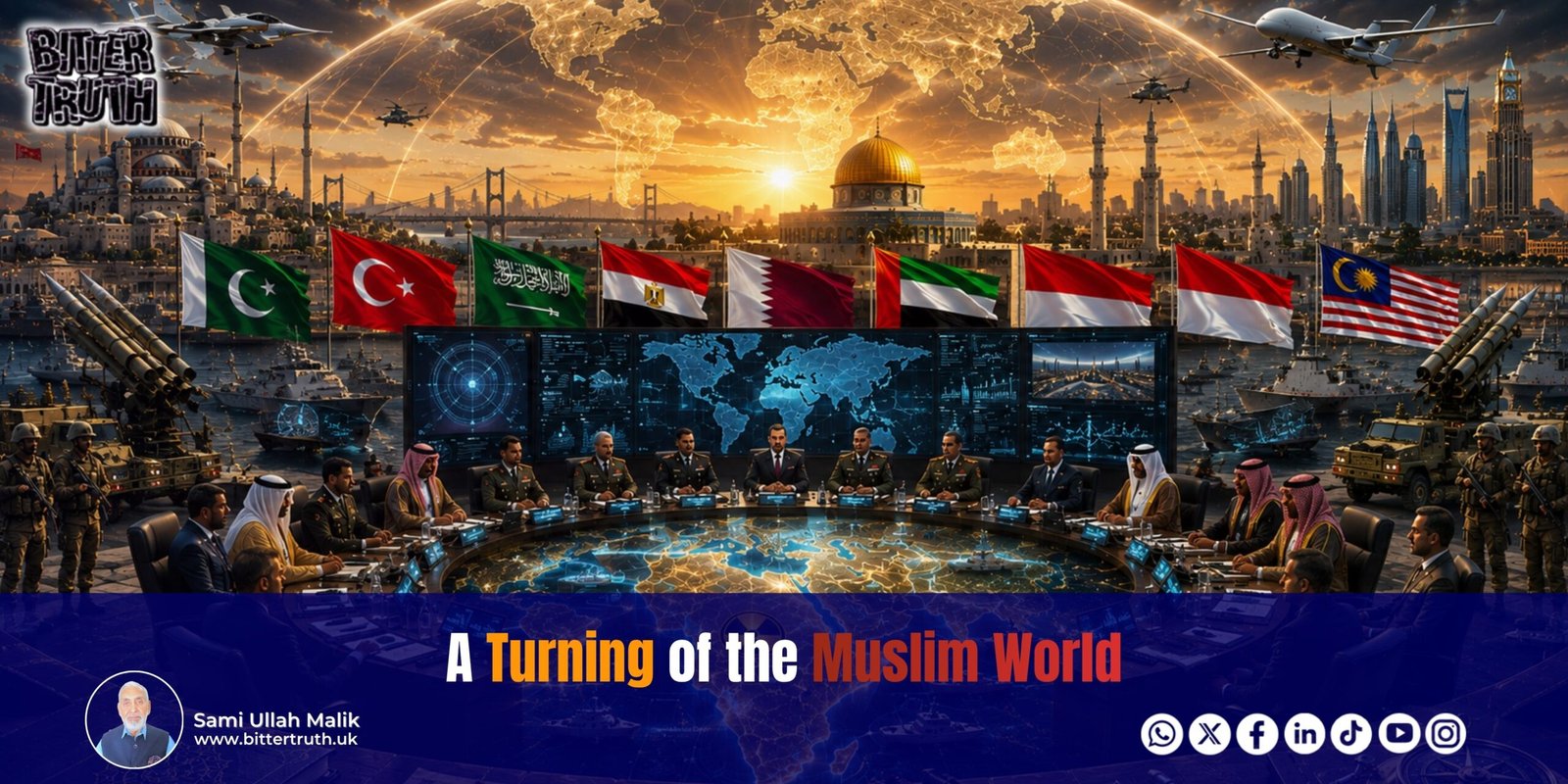
Certain Arab reports indicate that the Saudi leadership has formally denied the existence of any concrete “Islamic NATO” blueprint encompassing Turkey and Pakistan. Nonetheless, the names most frequently invoked—Turkey, Egypt, Pakistan, and Indonesia—span three continents. Were these states to cohere within a common defensive framework, they would form a strategic belt stretching from the Mediterranean to the Pacific: a geography of consequence, if animated by unity of purpose.
Pakistan’s role in such a constellation would be pivotal, yet delicate. Its missile capabilities and military experience could confer strategic depth upon the alliance; but its nuclear status must remain strictly deterrent in character. Continued development and testing of advanced systems, undertaken without provocation yet with unmistakable resolve, would sustain credible deterrence while avoiding escalatory theatrics. Pakistan’s experience in counter-terrorism, professional military education, and technological adaptation is a reservoir from which partners might prudently draw. A shared nuclear safety forum could further align protocols and reinforce collective security norms.
Turkey, for its part, has made notable strides in drone warfare, armoured vehicles, and naval defence systems. It could propose the establishment of joint industrial zones dedicated to defence production, coupled with structured programmes of technology transfer and collaborative research and development. Through defence exhibitions and combined exercises, operational interoperability might be cultivated not in theory but in practice. Turkey’s trajectory offers a salutary lesson: that political resolve married to industrial policy can, over time, liberate a nation from strategic dependency.
This assertive posture has been interpreted by the Ankara-based think tank SETA Foundation as emblematic of Turkey’s evolving global role—no longer content to serve as a bridge between regions, but aspiring to function as a strategic pivot.
The Gulf states—Saudi Arabia, Qatar, and the United Arab Emirates among them—command formidable energy wealth. Properly marshalled, such resources could underwrite an “Islamic Defence Investment Fund,” dedicated to long-term investment in indigenous defence industries, technology parks, and military academies. Capital, when conjoined with foresight, lends endurance to power. Egypt, situated at the confluence of Africa and the Arab world, brings to the table both naval and land force experience, as well as stewardship of the Suez Canal—an artery of global commerce whose security is of universal concern. Cairo could assume a central role in maritime coordination and in fostering defence linkages with African partners.
Indonesia and Malaysia, seasoned in maritime security and defence manufacturing, would extend the alliance’s geographical breadth into Southeast Asia, lending operational balance to its architecture. A joint maritime fleet for the protection of sea lanes, alongside expanded cooperation in cyber security and electronic warfare, would speak to the evolving character of power in the twenty-first century. Yet domestic political priorities, economic constraints, and regional rivalries remain obstacles that no rhetoric can dissolve. The essential question persists: is this convergence a transient diplomatic thaw, or the prelude to genuine strategic alignment?
According to Rai al-Youm, an incremental approach may be contemplated—beginning with a trilateral nucleus of Turkey, Egypt, and Saudi Arabia, to be joined subsequently by Pakistan and Indonesia. Such gradualism would echo aspects of the European experience; wherein limited cooperation expanded through confidence-building measures into broader integration. If an initial framework were to focus upon joint exercises, intelligence sharing, and defence coordination, it might cultivate the trust upon which enlargement depends. Foundations first; superstructure thereafter.
Yet history counsels sobriety. Many defence pacts in the Arab and wider Muslim world have remained declaratory rather than operational, undone by internal rivalries and mutual suspicion. Should this initiative remain confined to communiqués, its fate will differ little from its predecessors. Moreover, powerful external actors—including the United States and Israel—may perceive such an alliance as adverse to their interests, potentially responding with diplomatic pressure, economic sanctions, or political intervention.
Any enduring structure, therefore, must rest not solely upon military hardware but upon diplomatic dexterity and economic resilience. A common defensive charter would need to articulate clearly that the alliance seeks regional stability, not confrontation. A centralised command-and-control centre, annual joint exercises across air, land, and sea, and a shared defence university for officers and scientists could embed cooperation within durable institutions. Economic coordination—trade in local currencies, specialised banks for defence projects—would further insulate the enterprise from external leverage.
For alliances are not erected in a day. They are constructed brick by brick, in the slow masonry of confidence. The dream of collective security will not be realised by proclamation alone; it demands method, patience, and a constancy of purpose that outlives the excitements of the hour. Whether this vision matures into a coherent strategic community, or dissolves into another chapter of unrealised aspiration, will depend less upon the ardour of its advocates than upon the discipline of its architects.
If the proposed alliance is to endure, its architects must wed military design to diplomatic prudence and legal rectitude. It must be presented before the community of nations not as an aggressive bloc but as a framework of defence and regional stabilisation. Fidelity to the Charter of the United Nations and scrupulous respect for international law would not merely be ornamental clauses; they would be the very warranty of legitimacy. A coordinated diplomatic front should ensure that, in the event of unlawful action against any member state, a collective and measured response is marshalled—firm in tone yet anchored in law.
It would be naïve to suppose that powerful actors such as the United States or Israel would regard such a compact with indifference. They may well construe it as adverse to their interests. Hence, alongside military coordination, there must be a strategy of diplomatic balance—an art of reassurance without submission, of clarity without provocation.
According to Arabic Defence, the emerging proximity among certain Muslim capitals is less the fruit of ideological harmony than of political realism: interests, rather than sentiment, are drawing states together. Yet the destination of a comprehensive strategic union remains distant. Analysts cited in the Egyptian daily Youm7 have described the present convergence as the seed of a broader compact—a gradual journey in which reconciliation begets cooperation, and cooperation, in time, matures into alliance. Immediate institutional integration, they caution, is improbable. Internal political instability, unequal distribution of resources, external pressure and sanctions—these are impediments that cannot be conjured away. Their remedy lies in transparency, gradualism, and leadership of constancy rather than impulse.
In this light, a model of “flexible coordination” appears more realistic than instant federation: joint exercises, intelligence-sharing, and collaboration in defence industry as preliminary measures, capable—if sustained—of ripening into a comprehensive treaty. The obstacles are plain: historical mistrust, sectarian and ideological fissures, economic asymmetries, and the perennial contest for primacy. Only patient institution-building can transmute aspiration into structure.
Following the twelve-day conflict between Israel and Iran, debate within Arab media intensified markedly. The Egyptian platform Al-Urubah Al-Youm deemed such coordination increasingly indispensable, while discussions on Al Jazeera Mubasher linked the matter to the very question of regional survival. Former diplomats interviewed there spoke of a potential hinge of history—a moment from which either a path of renewed self-confidence might unfold, or the old roads of fragmentation might once again beckon. The concept, in other words, has begun to migrate from abstraction into the realm of security strategy.
Concrete proposals have accordingly surfaced. A joint Islamic command centre; annual combined exercises embracing air, naval, and land forces; a unified military academy or staff college for the shared formation of officers—these are the practical instruments by which rhetoric may be disciplined into capacity. Yet full institutional amalgamation cannot be conjured into being at once. Cooperation in exercises and defence production should precede any overarching pact. Gradualism, not grandiosity, promises durability.
For this alliance, if it is to be more than an arrangement of artillery and armour, must embody a deeper civilisational confidence. Its animating principles should be justice, mutual respect, and the preservation of sovereignty—not the dominance of one state over another. The London-based daily Al-Quds Al-Arabi aptly characterised the prospective compact as a “defensive umbrella.” The metaphor is instructive: collective security, wherein an assault upon one is regarded as an assault upon all. Yet such a clause acquires force only when political will and military preparedness are harmonised across the membership.
Self-reliance in defence industry will be indispensable. Joint arms production, collaborative drone and missile programmes, indigenous defence software, and technology-transfer agreements designed to diminish external dependency must form the industrial backbone of the enterprise. Scholarships and research grants for young scientists and engineers would invest in the intellectual capital without which strategic autonomy is a chimera. Thus, the alliance would signify not merely a martial compact, but a renewal of intellectual and technological confidence.
Turkish leaders have, on occasion, invoked the experience of the European Union to repudiate any politics of hegemony. The lesson implied is clear: neither Turkish predominance, nor Arab, nor Persian—but responsible partnership. Whether the Muslim world can rise above its historical quarrels to forge a platform of equitable cooperation remains the cardinal question. An alliance grounded in parity will command greater legitimacy than one shadowed by suspicion of dominance.
Economic integration must accompany defence coordination. A joint financial institution to fund strategic projects; expanded trade in local currencies to mitigate external pressure; mechanisms to arbitrate disputes among members—these are not ancillary measures but structural supports. The history of the Islamic world bears witness to how contests for leadership have sundered promising coalitions. Any new architecture must therefore guard against the corrosion of rivalry.
Analysts associated with the Ankara-based SETA Foundation argue that Turkey is shedding the passive role of bridge and embracing a more activist politics of alliances. Exports of Turkish military equipment to Egypt, alongside prospective Saudi investment, illustrate an effort to translate discourse into deed. The destination remains distant; yet foundations, however modest, are discernible.
At the multilateral level, member states would need to articulate a unified position in international forums, ensuring that the alliance is perceived as a stabilising framework rather than an adventurist bloc. Should unlawful measures be directed against any member, a coordinated diplomatic response—measured yet unmistakable—would be required.
The cautionary lessons of history are severe. Previous collective defence agreements in the Arab and wider Muslim world—whether under the auspices of the Arab League or through other regional mechanisms—too often languished as parchment pledges, undermined by deficient institutions and wavering political resolve. At times, signatories found themselves at odds with one another. Such precedents inscribe a question mark upon every new design.
Moreover, resistance from external powers, shifting domestic politics, and ingrained mistrust constitute thorns along the path. If the alliance is conceived merely as a reaction, it will prove ephemeral. It must instead rest upon a positive agenda of economic and defence integration. A standing mediation council could address intra-member disputes; sectarian and ideological differences must be managed through political prudence rather than polemic; and safeguards must ensure that no single state converts partnership into preponderance.
In the final reckoning, the success of such an undertaking will depend not upon the fervour of its proclamations but upon the steadiness of its construction. Alliances worthy of endurance are built in law, sustained by institutions, and animated by a shared conviction that collective dignity is inseparable from collective responsibility. Should those elements converge, what now appears as conjecture may yet assume the outline of history. Should they fail, the project will recede into the long catalogue of unrealised ambitions—another footnote in the annals of unrealised unity.
Yet sobriety compels acknowledgement that differences persist among Turkey, Egypt, and Saudi Arabia on a range of regional questions. Nor can it be ignored that powerful actors—most notably the United States and Israel—may interpret such an alignment as inimical to their interests. Should external pressure intensify, latent internal frailties could swiftly be exposed. The ultimate success of any alliance, therefore, will depend less upon proclamations abroad than upon cohesion and self-reliance at home.
A researcher at the Arab Eurasian Studies Center has argued that the most practicable course lies in what she terms “flexible coordination”: not immediate institutional fusion, but thematic cooperation as a point of departure. Defence industry collaboration, intelligence-sharing, structured political consultation, and joint exercises might form the initial perimeter—eschewing, for the present, a binding and comprehensive military treaty. It is a gradual path, yet one consonant with political realities. From modest beginnings, evolution may proceed toward a more integrated accord.
Such gradualism must be accompanied by the cultivation of a constructive public narrative. Through media and educational institutions alike, the alliance should be framed not as an engine of confrontation, but as a covenant for peace and stability. In an age when perception often precedes policy, legitimacy in the court of public opinion is no trivial asset.
Recent developments hint at practical foundations. Turkey’s reported defence agreement with Egypt, valued at approximately $350 million, and Saudi interest in expanded military cooperation suggest that defence industry may serve as the cornerstone of a broader architecture. Joint production, technology transfer, and partnership in arms manufacturing are not mere commercial undertakings; they are structural beams upon which a future edifice might securely rest. The most effective response to external pressure will be internal consolidation: reducing economic dependency, strengthening transparency, and building trust through accountability.
Nevertheless, formidable challenges loom. Political instability, mutual suspicion, economic fragility, and the persistent shadow of external influence may impede progress. Absent serious efforts to surmount these impediments, the alliance will remain an eloquent narrative rather than an operative reality. Some analysts caution that pro-Israel lobbying networks may seek to obstruct or discredit the initiative, potentially precipitating diplomatic turbulence. Hence the alliance must fortify its legal and diplomatic foundations with scrupulous care.
The most plausible near-term scenario is not the sudden birth of a fully fledged “Islamic NATO,” but the emergence of a layered and flexible framework of cooperation—multilateral, incremental, and adaptive. If leadership is exercised with sincerity and foresight, such an arrangement could transcend the merely military and become a symbol of renewed civilisational confidence. If, however, it is confined to the heat of rhetoric, history will record it as yet another unfulfilled aspiration.
It bears repeating that an Islamic defence compact, were it to materialise, would signify more than martial coordination. Pakistan’s nuclear deterrent; Turkey’s expanding defence industry; the financial resources of the Gulf states; Egypt’s commanding geography; and the industrial capabilities of Southeast Asia—taken together, these elements could establish a balance resilient against external interference. But this will occur only if the enterprise escapes the psychology of reaction and embraces the discipline of deliberation. Alliances are not forged in the clangour of artillery, but in the concord of intention.
The idea of an “Islamic NATO” is, in truth, a question addressed to history: can the Muslim world transmute pressure into possibility? Can unity arise from the embers of division? If statesmanship prevails—tempered by insight and sustained by prudence—this undertaking might herald not only a security arrangement but a wider civilisational renewal. Otherwise, it will join the catalogue of noble yet unfinished dreams.
The strength of any union lies not in its arsenals, but in the integrity of its purpose and the coherence of its strategy. Even the grandest treaty, absent alignment of interests and maturity of leadership, remains but ink upon parchment. Yet when resolve is united and design is clear, dispersed forces can redirect the current of history itself; the shifting sands of circumstance may harden into enduring stone.
Let such an alliance, if it is to be conceived, embody the wisdom of consultation rather than the vanity of dominance; the pledge of security rather than the spectacle of power. History has more than once afforded nations the opportunity to pass from fragmentation to fellowship. The notion of an Islamic military partnership is neither mere fantasy nor immediate fact. It is a path—demanding political insight, economic sagacity, military preparedness, and cultural confidence in equal measure.
Should these elements converge under a balanced and gradual strategy, a new equilibrium of power may yet emerge. But the condition is unaltered: the project must be shaped by reflection rather than impulse. If so fashioned, it may announce not only a defensive arrangement, but the dawn of renewed dignity. If not, it will repose in the archives of history as a beautiful yet incomplete tale.
The final question, then, is stark: will the Muslim world recognise this moment? If it does, the alliance may signify not merely an alignment of arms, but the morning of a restored self-respect. If it does not, the vision will fade—as others have faded before—preserved in the annals as a graceful, but unfinished, chapter.