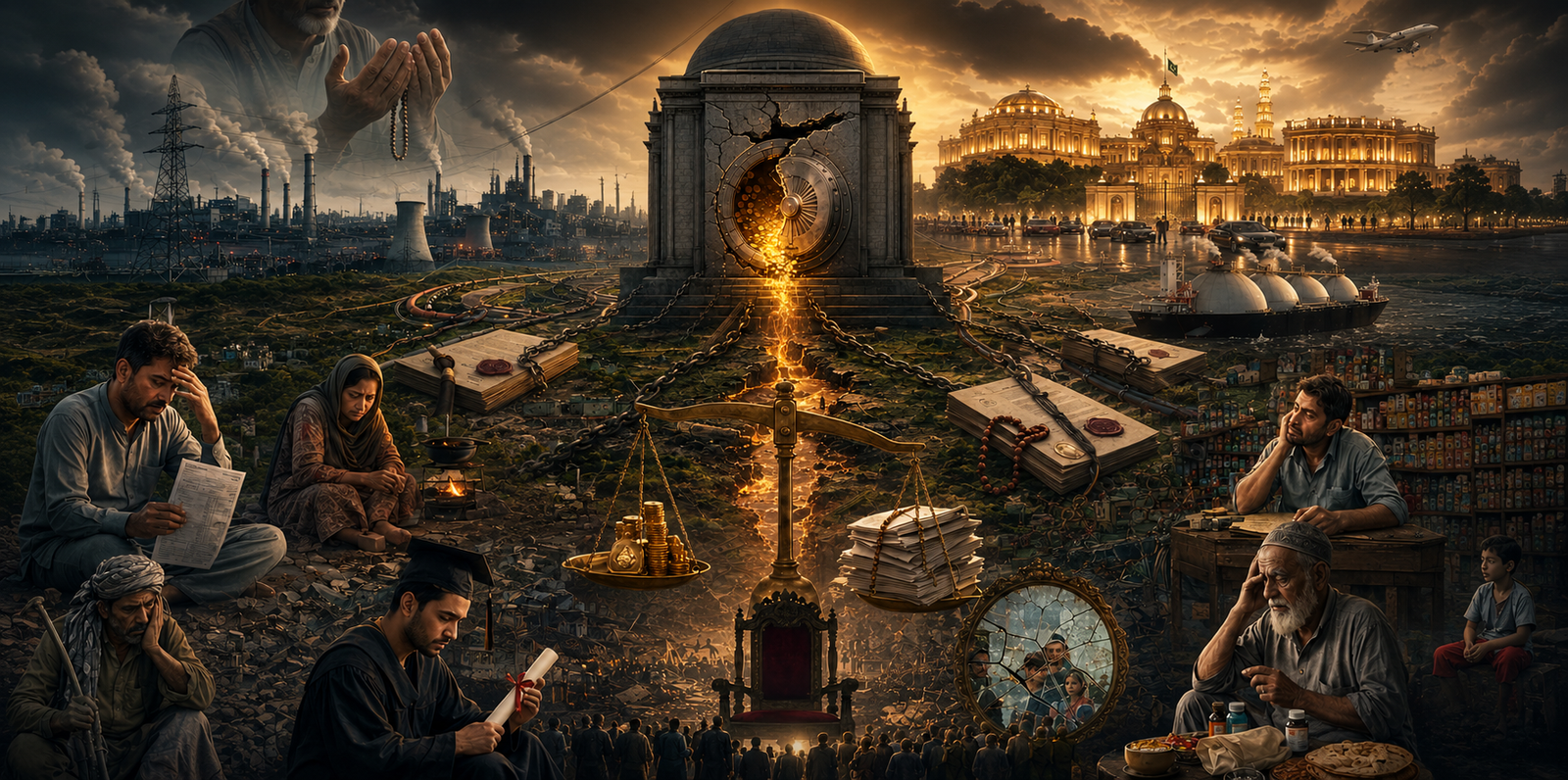
The Silent Auction of the National Treasury
A Lament for Governance, Contracts and Public Accountability

The history of nations is not written solely upon the tablets of conquest, in the splendour of palaces, the chambers of power, or the chronicles of rulers. Some of its most enduring chapters are inscribed elsewhere: in the cold hearths of hungry homes; in the sweat of the labourer; in the unuttered sigh of the widow; in the wages of the workman; in the bowed brow of a father burdened by debt; and in the uncertainty of a young graduate who holds a degree in his hand, yet no assurance of a future.
If the state is a great and sheltering tree, the national treasury is the water that courses unseen through its roots — water distilled, in the last reckoning, from the toil and sacrifice of its people. Every rupee collected in tax is more than a figure in an account. It is part of a shopkeeper’s earnings, a portion of a salaried worker’s pay, the bread of a labourer’s children, or the price of medicine for a woman of modest means. The first moral obligation of those who govern, therefore, is not to parade their beneficence before the nation, but to regard every penny of public money as a sacred trust.
The points under consideration amount, in effect, to a national questionnaire. Written in its margins are questions of electricity, gas, debt, taxation, extravagant public expenditure, energy contracts and governmental accountability. The original document makes forceful claims concerning certain figures and political responsibilities. Independently establishing those claims is not the purpose of this essay. The political, moral and constitutional questions that arise from them, however, are questions from which no living society can easily avert its gaze.
1. Energy Contracts: A Lamp for Which the Nation Buys the Oil, Yet Receives No Light
For some time, Pakistan’s public discourse has been preoccupied with private power producers — the IPPs — and, in particular, with the practice of capacity payments. The public was already confronted with an uncomfortable question: why should payment remain due even when electricity is not actually consumed?
Against that background, the document before us opens a second door, raising a comparable concern about LNG arrangements and capacity charges.
According to the document, a position attributed to a government minister suggests that certain payments remain payable whether or not the LNG is ultimately received. The text further refers to a monthly sum of US$15 million and claims that payments amounting to US$3 billion have so far been made.
If terms of this nature do indeed exist in state contracts, the question can no longer be confined to the amount of money paid. The more serious questions are these: Why was the contract entered into?
Who assessed the risks?
On what assumptions did the state calculate its requirements and its capacity to pay?
And, above all, if the arrangement proved ineffective or financially damaging, where was responsibility supposed to rest?
When a government purchases even an ordinary article from the market, those entrusted with the public purse are expected to examine its price, quality and necessity. How, then, can contracts worth billions of dollars be treated as though they were mere sheets of paper upon which a few signatures may place another stone of debt upon the shoulders of generations yet unborn?
The tragedy here is not merely monetary. It concerns the very culture of state decision-making. In a country where millions of households revise the entire month’s budget when the electricity bill arrives, every clause of such an agreement ought to possess the clarity of a trust inscribed upon the arch of a sanctuary. The treasury does not belong to the government. It belongs to the nation. Governments are merely its temporary custodians.
2. The Question of Responsibility: When the Throne Changes, Do the Obligations of a Signature Change With It?
The second point in the original document raises a still more fundamental question. It notes that during the periods in which the relevant energy agreements were concluded, the Pakistan Muslim League (N) was also in government. Referring to the then Petroleum Minister Shahid Khaqan Abbasi, Ishaq Dar and others occupying positions of economic responsibility, the text asks where collective responsibility for those decisions ultimately lies.
Yet this question ought never to be imprisoned within the politics of one party, one individual or one administration.
In a democracy, a cabinet is not a ceremonial gathering assembled for a photograph. An Economic Coordination Committee is not merely an office for stamping files. A Ministry of Finance is not an interpreter’s chamber in which numbers are translated from one ledger to another. These are pillars of national decision-making, and upon them rests the architecture of governmental responsibility.
When a policy succeeds, governments seldom hesitate to claim the laurels. Advertisements appear in the newspapers; speeches glow with the rhetoric of achievement; ribbons are cut; and projects are crowned as monuments to political foresight.
Why, then, when the same decision becomes a burden upon the national exchequer, does responsibility suddenly become an orphan?
It is one of the more painful habits of our political history that success discovers a hundred fathers, whilst failure appears to have none.
States do not grow strong under such a system.
They grow strong when those who make decisions understand that ten years hence they may still be required to answer:
Why did you sign?
What benefit did you promise the nation?
What were the risks?
What alternatives were available?
And if your judgement proved mistaken, what lesson was learnt?
A system that treats questions as crimes eventually turns mistakes into traditions.
3. Cabinet and Prime Minister: Power in the Mirror of Collective Responsibility
The third point in the document refers to the then Prime Minister, Mian Nawaz Sharif, and his cabinet. It argues that major national agreements cannot simply be laid at the feet of one minister or official whilst the wider political system absolves itself of responsibility. It asks whether an agreement of such importance could realistically have reached completion without the knowledge and approval of the Prime Minister and the cabinet.
The question touches upon one of the elementary truths of political life: authority and accountability cannot be divorced from one another.
If authority is the throne, accountability is its shadow.
Whoever desires the sunlight of power must also accept the shadow of scrutiny.
Democracy is not monarchy dressed in altered garments, where a decree is issued and all questions cease. Collective cabinet government exists precisely so that decisions of consequence may become matters of institutional responsibility rather than personal whim. Ministers, advisers, secretaries, committees and cabinets exist so that many eyes may inspect a decision, many minds may test it, and many hands may bear responsibility for it.
But when everyone wishes to partake of authority and, at the hour of reckoning, points towards somebody else, the machinery of state begins to resemble the crew of a ship on which all help raise the sails, yet when the vessel strikes the rocks, every sailor protests that the helm was never in his hands.
Countries cannot be governed in this fashion.
What is required is an institutional memory for major economic agreements: which cabinet took which decision; which committee made which recommendation; what financial risks were identified; whether dissenting notes were recorded; and what consequences emerged in subsequent years.
The nation should not merely be told that an agreement was made. It has the right to know why it was made — and who accepted responsibility for making it.
4. We Pay — and We Endure Load-Shedding: What Manner of Bargain Is This?
The fourth point in the document contains a brief but bitter observation: the public must bear the payments, and the public must also bear the load-shedding; gas may remain unavailable, yet the money continues to be paid.
In that single sentence lies almost the entire portrait of an economic tragedy.
The ordinary citizen does not demand from the state an elaborate seminar in economic philosophy. His questions are considerably simpler.
If I have paid the electricity bill, why is there no electricity?
If I have paid my taxes, where are the services?
If the price of gas has risen, why has the gas not reached my stove?
If the country has borrowed money, why can I not see its reflection in hospitals, schools, clean water, employment and infrastructure?
The most perilous moment in the economic life of a state arrives when the relationship between price and service begins to disintegrate.
When citizens repeatedly feel that they are paying without receiving; taxed without being protected; enduring inflation without economic stability; sacrificing whilst the habits of those in power remain untouched — the crisis ceases to be merely economic. The bond of trust between citizen and state begins to fray.
And trust is like a mirror: once cracked, it may be repaired, but the fracture remains visible.
Those who govern must understand that electricity and gas are not mere commodities. They are the blood coursing through the veins of modern life.
The wheel of the factory, the lamp of the student, the oxygen system of the patient, the livelihood of the small trader, the hearth of the household — all depend upon them.
An error in energy policy is therefore not merely an error in an office. It exacts its price from the time, money and hopes of millions of human beings.
5. Mountains of Debt and Chambers Empty of Questions
The fifth point concerns the country’s mounting debt and asks, with evident anguish, whether no institution exists that can keep watch over such financial decisions. In the words cited by the document, the poor are living lives of “sobs and suffering”.
Debt is not, in itself, necessarily an evil. Nations borrow to build infrastructure, develop industry, finance productive investment and enlarge the economic capacity of the future.
But debt becomes a chain when, instead of financing tomorrow’s productivity, it is consumed in paying for yesterday’s mistakes.
When one loan becomes the shroud of another, and a third must then be raised merely to service the interest on the first two, the treasury descends slowly into a well: the light remains above, whilst the nation sinks below.
Pakistan possesses a Parliament, auditors, ministries, committees, courts, regulatory institutions and administrative structures. The true question is whether the combined strength of those institutions gives the ordinary citizen any confidence that the nation’s financial decisions are under continuous and serious scrutiny.
Accountability ought not to begin only after a scandal has erupted.
The highest form of accountability asks questions before the damage is done.
“Who is responsible?” is an indispensable question. But an earlier question is more important still:
“How was this allowed to happen?”
If a system repeats the same error every ten years under a new name, the problem is no longer merely one of personalities. Reform then demands not a change of faces, but a change in the machinery by which decisions are made.
A nation requires institutions that stand not with whichever government happens to be in office, but with the enduring interests of the state and its people.
6. If Rulers Themselves Become a ‘Capacity Charge’, Where Is the Public to Turn?
The sixth point offers a particularly cutting satire. At times, the author suggests, it seems as though the nation pays its rulers a form of political capacity charge: whether they perform or not, the public must continue to bear the taxes, official expenditure, foreign travel, privileges and delegations.
But the analogy is more than satire. It contains a serious political question.
Are rulers servants of the state — or is the state an institution established for their maintenance?
Is power an office of service, or an entitlement to comfort?
If ministers and officeholders occupy public positions, every official expense must possess a moral as well as an administrative justification. If a foreign visit secures investment, resolves a diplomatic crisis, expands trade or demonstrably advances the national interest, the public may reasonably accept its cost.
But when citizens see no result — only delegations, protocol and expenditure — questions are inevitable.
Here one principle deserves remembrance:
The finest speech ever delivered on austerity is austerity itself.
A ruler may repeat a thousand times that the treasury is empty; yet if the lamps of extravagance continue to blaze at his own gate, the speech loses its authority.
Those who demand economy from the nation must allow economy to be seen at their own table.
Those who ask sacrifice of the public ought to display some trace of sacrifice in their own lives.
Government is not merely the privilege of issuing commands. It is also the trial of setting an example.
When a poor mother must reduce the milk she gives her child; when a labourer walks because transport has become too expensive; when a middle-class household postpones medical treatment; when a young person works two jobs merely to keep the family afloat — ostentation in high office ceases to be merely a financial question.
It becomes a symbol of moral insensibility.
7. Declarations of Austerity, the Cost of Power, and the Ethics of Worship
The seventh point is perhaps the most symbolic. It questions the contrast between repeated announcements of austerity, claims that certain ministers serve without remuneration, expenditure associated with the Prime Minister’s House and the Presidency, foreign and religious travel, and the public impression created by all of these things.
The text also asks: if rulers speak publicly of sacrificing their salaries, where does substantial official expenditure actually go?
Care is necessary here. The document itself provides no independently verified numerical breakdown of expenditure by the Prime Minister’s House or the Presidency. Rather, it calls for transparent information concerning those costs.
And that, indeed, should be the national demand:
Publish the figures.
How much was spent?
On what was it spent?
How much more or less was spent than in the preceding year?
Was the expenditure independently examined?
And following declarations of austerity, how much was genuinely saved?
Once the figures are available, argument may replace accusation.
Transparency would also protect governments themselves from needless suspicion.
The same section offers a satirical criticism of the public display surrounding religious pilgrimages and the prayers of rulers, invoking Salahuddin Ayyubi as a moral illustration.
Worship is unquestionably a sacred matter between the human being and his Creator. But when politics begins to adorn itself with worship as an ornament of publicity, another question arises: what, in truth, does religion demand?
Islamic civilisation has taught us that worship consists not merely in lowering the forehead before God, but also in lowering the conscience before the rights of His creation.
Hands raised in prayer within the sanctuary are sacred; but restraining the hand that violates the rights of the people is an act of worship too.
Prayer beads are beautiful; but fidelity to the public treasury is no less beautiful.
Supplication is sublime; but giving justice to the oppressed is the practical interpretation of prayer.
A ruler may weep before the House of God; yet if children in his own cities weep from hunger, history records the account of his government before it records the tears upon his face.
A Final Word: Never Treat the Sigh of the Oppressed as a Trifle
O you who hold power:
Nations do not always rebel with noise.
Sometimes their most formidable protest is silence.
The silence that settles upon the face of a father holding an electricity bill in his hand.
The silence in the eyes of a woman who asks the price of food in the market and returns home empty-handed.
The silence that fills the room of an educated young man late at night when, after his hundredth application, no answer to his search for employment has arrived.
The silence that trembles in the fingers of an elderly pensioner forced to choose between medicine and food.
Such silences do not escape the pen of history.
Governments are sometimes tempted to believe that if the numbers have been brought under control, the country itself has been brought under control.
But countries are not governed by numbers alone.
They are governed by trust, justice, human sympathy and moral credibility.
If the treasury is empty, a nation may be prepared to hear the truth. But if the people are commanded to extinguish the lamp in their homes whilst chandeliers continue to glitter in the halls of power, the question is no longer poverty.
It is justice.
If the nation is told to sacrifice whilst power exempts itself from sacrifice, the question is no longer economics.
It is morality.
If citizens are told not to ask questions, not to examine contracts, not to demand accounts of expenditure, but simply to remain patient, the question is no longer administration.
It reaches to the very legitimacy of governance.
Many thrones have been bought and sold in the marketplace of history, and many crowns have changed heads; yet the reckoning of the oppressed has never been entirely erased.
Neither the prayer nor the lament of the wronged can be weighed upon the scales of political slogans. The moral teaching of the Islamic tradition is plain: never make light of the cry of the weak.
When a nation walks upon the burning coals of inflation; when its income contracts; when electricity, gas, food, medical care and education retreat further from its reach with every passing day, the most dangerous error a government can make is to regard its people’s suffering as merely another fluctuation in a statistical table.
These sighs do not strike the heavy curtains of palaces and vanish.
They enter the memory of time.
And time is the most merciless historian of kings.
What is required today, therefore, is not vengeance, but accountability; not clamour, but transparency; not emotional proclamation, but evidence and figures; not theatrical austerity, but genuine reform.
Let the nation be told the terms of its energy agreements.
Let it be told by what principles capacity payments are calculated and paid.
Let the public record show which government, which committee and which institution approved what, and at what stage.
Let the annual cost of maintaining the houses of power be made public.
Let the costs and measurable results of foreign visits be published.
Let those energy agreements that impose long-term burdens upon the national treasury be subjected to independent audit.
And above all, let one principle be restored to the centre of public life:
Wherever authority resides, accountability must reside beside it.
Then, perhaps, the politics of this country may begin its journey from accusation towards institution; from personality towards principle; from slogan towards system.
Otherwise, the day may not be far distant when the historian writes of our generation:
They possessed resources and institutions.
They possessed intelligent minds and industrious people.
Their soil was fertile; their nation was resilient.
Yet somewhere between trusteeship and accountability, a breach opened so wide that hearts began to empty before the treasury could ever be filled.
There is still time for those who govern.
Do not mistake the nation’s wounds for rhetoric.
Do not reduce its poverty to a box in a statistical table.
Do not regard its taxes as a treasury without account.
And do not imagine its patience to be infinite.
For when a people cease praying for their rulers and begin crying out because of them, the pillars of the throne may still appear upright — yet the damp of history has already begun to seep into their foundations.
Return to justice.
Return to trusteeship.
Return to transparency.
Return before the sobs of a nation condemned to walk day and night upon the embers of inflation become so loud that the walls of the chambers of power remain standing, yet the moral authority of those seated within them has disappeared.
The nation is not a body of subjects whose sole duty is to hear and obey.
The nation itself is the rightful owner of the state.
And the national treasury is not the property of rulers.
It is a trust held on behalf of generations yet to come.