Before the Ashes
After Victory, Only Ashes?

History has a habit, from time to time, of arriving at those fateful crossroads where the armies of empires, the calculations of chancelleries, and the ambitions of rulers converge to place a question mark over the destiny of mankind—one whose answer is sought not merely upon the battlefield, but by generations yet unborn.
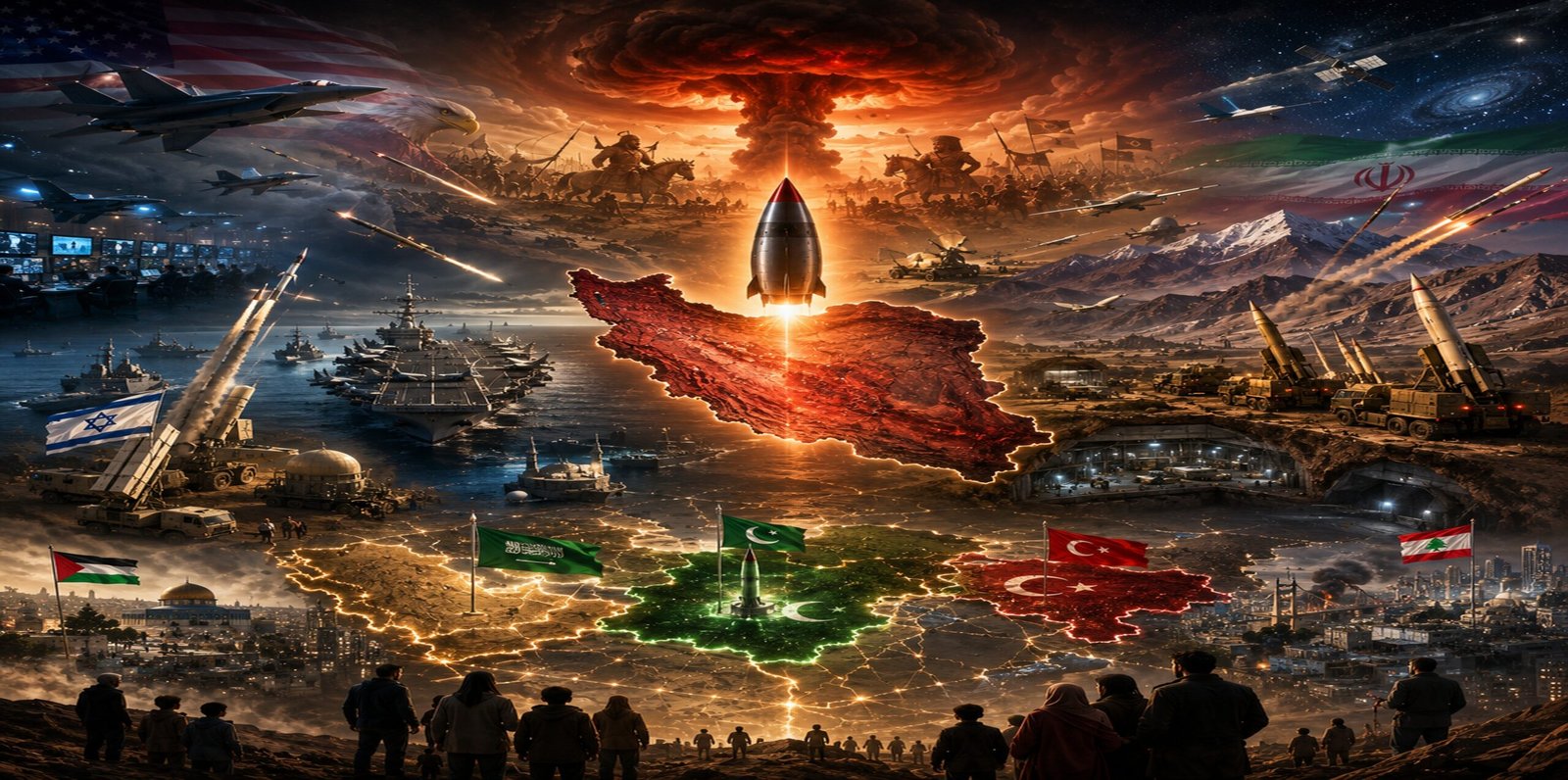
Recent threats attributed to certain American officials concerning the possible use of nuclear force against Iran have sent a tremor of anxiety through much of the world. Could the shadow of a nuclear strike upon Iran transform the present war in West Asia into a historic trial of the regional balance of power and of the Muslim world itself? Or might it become the prelude to a wider conflagration after which the world would resemble less an international order than a vision of apocalypse?
That, perhaps, is the most consequential question of the hour.The present struggle in West Asia ought not to be regarded merely as a military confrontation between Iran, Israel and the United States. It is, rather, a dangerous convergence of power, ideology, resistance, moral legitimacy and nuclear deterrence—a point at which a single miscalculation could propel an entire region towards destruction from which there may be no return.
I begin with the celebrated Battle of Ankara in July 1402, when Timur defeated the Ottoman Sultan Bayezid Yıldırım. Tradition relates that Timur, contemplating his vanquished rival, remarked upon the irony of human dominion: how strange that the fate of the world should have fallen into the hands of one lame man and another who was half-blind.
The anecdote is invoked here not as an ornamental curiosity of history, but because it supplies the intellectual foundation of the argument that follows.
If, in the Middle Ages, the personal ambitions of two rulers could alter the fate of thousands, how much more grave does the moral character of power become in an age in which the lives of millions may depend upon the decision to press a single nuclear button?
Once, wars were fought with horse, sword and mangonel. Today, buried nuclear arsenals, intercontinental missiles, satellites, drones and missile-defence systems have become decisive instruments of statecraft. Human power has expanded beyond anything the ancient conquerors could have imagined; yet the price of human error has risen in equal measure.
It is across this bridge of thought that the argument travels—from Ankara in the fifteenth century to West Asia in the nuclear age.
The traditional balance of power, it must be remembered, has already been considerably unsettled by the latest phase of conflict. Iran has not only, in large measure, compensated for its initial losses, but has reorganised its defensive infrastructure, missile capabilities and drone reserves. On the other side, heavy damage to certain American forward positions, radar installations and logistical centres has reportedly compelled the United States Navy to operate farther into the Indian Ocean, beyond the effective reach of Iranian anti-ship missiles. Meanwhile, a significant proportion of Israel’s missile-defence stocks has either been expended or sustained losses.
Modern warfare teaches a lesson that the intoxication of technological superiority too often obscures: the ability to strike first is not, by itself, the measure of supremacy. Survival, logistics, defensive reserves, industrial depth and the capacity to endure a protracted conflict are themselves forms of power.
The first blow in war may indeed be delivered by gun and missile, but the final verdict is often pronounced by reserves of patience, economic resilience, political will and industrial capacity. History is crowded with armies that appeared triumphant in the opening assault, only to discover that the sands of time had quietly converted victory into defeat.
Iran’s conduct, moreover, does not arise from geopolitics alone. Iran regards itself not merely as a state pursuing conventional interests, but as the bearer of an ideological tradition of resistance—one in which Karbala, solidarity with the oppressed, Palestine and Lebanon occupy a distinctive place in political consciousness.
To the Iranian leadership, retreat in the face of Israeli or American pressure is therefore liable to be interpreted not merely as a political reversal, but as defeat at the level of an entire ideological conception.
Here Karbala ceases to be merely an event preserved in the chronicles of history. It becomes a political symbol: an enduring metaphor for resistance despite material inferiority, for refusing submission before superior force, and for standing beside those perceived to have suffered injustice.
It is within this frame of historical memory that Iran remains unwilling to abandon the causes of Palestine and Lebanon.
Thus, on one side stands the logic of power; on the other, the force of faith and remembered history. When state strategy ceases to be confined to conventional national interest and becomes intertwined with religious or civilisational imagination, war itself ceases to be merely a dispute over territory. It becomes a struggle over identity.
And wars of identity are among the most difficult of all wars to bring to an end across a negotiating table. I regard Israeli strategy as being marked by ideological intensity of its own. Israel sees Iran as a regional power standing athwart its long-term regional conception, including what is described as the vision of a “Greater Israel”.
The central difficulty, therefore, is not simply that two states disagree. It is that each has increasingly come to regard the other as an existential obstacle to its most fundamental purposes.
Where war concerns territory or resources, bargains remain conceivable. A river may be divided. A frontier may be settled. A trade route may be shared.
But when one party comes to view another as a fundamental threat to its existence, ideology or future, the ground upon which compromise may stand becomes perilously narrow. It is at precisely this point that the language of diplomacy grows faint, and the language of explosives begins to speak more loudly.
There is, meanwhile, a fascinating contradiction at the heart of the American position. On the one hand, the United States remains Israel’s indispensable military supporter; on the other, Washington now appears reluctant to be drawn into another prolonged war.
Israel cannot embark upon a new and major phase of hostilities without American backing, while the next stage of such a war could prove substantially more expensive for the United States—politically, militarily and logistically—than what has gone before. Yet the American-Israeli alliance is sufficiently deep that Washington, however much it may desire strategic distance, may find complete detachment impossible.
This raises an older and more troubling question: can a great power become so tightly bound to the war of an ally that its own independent strategy is reduced to a secondary consideration?
History is not short of examples. Alliances may serve as shields; they may also become chains.
And so we arrive at the most frightening question: what might be different in the next war?
If another phase of conflict begins, what weapon could the United States and Israel employ against Iran that has not already been brought into the strategic equation? The argument advanced here is that radar systems, military bases, logistical facilities and the conventional instruments of warfare have already been extensively tested during the previous phases.
From this emerges a profoundly disturbing possibility: if conventional weapons fail to produce the desired result while the political objective of the war remains unchanged, the temptation to contemplate nuclear weapons may increase.
However hypothetical that proposition may be, the question itself is chilling.
Nuclear war is the door beyond which the very meanings of victory and defeat are transformed.
In conventional war, a city may be lost and later rebuilt. An army may be defeated and subsequently reconstituted. But in nuclear war, the soil, the bloodstream of generations, the water, the air, and even those yet unborn may become part of the battlefield.
There, even the victor carries the ashes of his victory upon his own hands.
A second and equally important consideration concerns nuclear deterrence—the silent sentinel of the atomic age.
Historically, nuclear war has generally been avoided for two principal reasons: either an adversary possessed the assured ability to retaliate in kind, or those entrusted with the decision remained constrained by moral and humanitarian limits.
Iran, however, does not possess deterrence of the first kind. It is here that the argument becomes more dangerous—and inevitably more controversial.
A state without the assured capability to deliver a retaliatory nuclear strike may be more vulnerable to nuclear coercion. Herein lies one of the bitterest paradoxes of modern international politics: the world describes nuclear weapons as a curse upon humanity, yet certain states regard those very weapons as the ultimate guarantee of survival.
Man has taken poison and named it medicine.
The intellectual essence of the matter is therefore more important than the personality of any one leader. If deterrence is weak and moral restraint over decision-makers becomes ineffective, the danger of nuclear use may increase.
To reduce so grave a problem to the temperament of a single individual would be to misunderstand its true scale. The larger question is whether the nuclear order of mankind ought ever to remain at the mercy of individual disposition, political pressure and the passions of a passing hour.
Fire confined within a lamp gives light. The same fire surrendered to a tempest may decide the fate of cities.
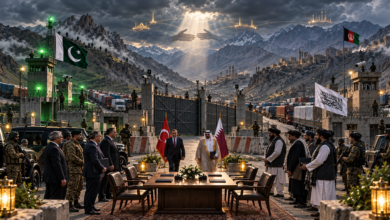
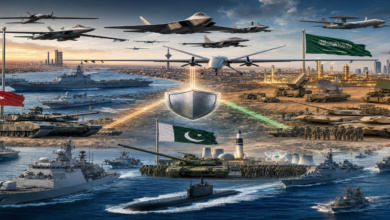
The present international landscape also directs attention, following the recent Mecca Agreement, beyond Iran and Israel towards Pakistan, Saudi Arabia and Türkiye. The wider world, in the argument advanced here, increasingly observes the possible relationship among these three states as the embryo of a bloc whose ultimate purposes are not yet entirely clear.
If Iran were indeed subjected to a nuclear attack, what position would these three major Muslim states adopt?
The collective political weakness of the Muslim world over Palestine has already become the subject of severe criticism. Statements, resolutions and protests in international institutions have not proved an adequate substitute for effective resistance.
Iran, Hamas, Yemen and Hezbollah, according to the interpretation advanced in this essay, have demonstrated forms of practical resistance against Israel from which much of the remainder of the Muslim world has abstained.
One may agree or disagree with that interpretation. But the question contained within it cannot so easily be dismissed:
Are civilisations united merely by a shared profession of faith, or does a common danger also require common action?
In the court of history, deeds are weighed beside intentions.
This leads to another difficult question: could Pakistan’s nuclear capability conceivably be associated with the provision of deterrence for Iran? If Iran possessed a credible retaliatory nuclear capacity, could that discourage a potential Israeli nuclear strike? And could the destruction of Iran ultimately place Pakistan’s own security in profound jeopardy?
This is the political opinion and strategic recommendation of the present essay; it is not a description of existing state policy.
Such a proposition would carry immensely complex legal, diplomatic, strategic and non-proliferation implications, all of which require a separate and far more detailed examination. God willing, I shall return to them in a subsequent essay.
For the present, this suggestion should be read as an emotionally charged strategic conception rather than as a simple or immediately actionable policy prescription.
Yet the fear underlying it is plain enough: if a precedent is established for the use of nuclear force within the region, the entire security architecture of West and South Asia could be transformed.
Beneath the surface of this argument lies a deeper historical anxiety.
Its true subject may not be whether Iran will or will not suffer a nuclear attack. The more fundamental question is whether the world is approaching an age in which nuclear weapons may once again come to be regarded as usable instruments of warfare.
Since 1945, mankind has lived beneath the memory of atomic devastation. Yet throughout the decades that followed, an unwritten terror restrained the hands of the great powers. Nuclear weapons remained symbols of ultimate strength, but their actual use came to be treated as the last and gravest of taboos.
Should that threshold be crossed, the consequences would not remain confined to Iran.
Once nuclear use is absorbed into the ordinary vocabulary of military strategy, every state that fears for its survival may feel compelled to enter a new race for deterrence. Non-proliferation treaties would weaken; diplomacy would lose authority; regional wars would become infinitely more dangerous.
At such moments history appears before us as a silent tutor.
Man has always possessed an unfortunate habit: he invents his weapons first and understands their consequences afterwards.
I leave, therefore, one final and important question before the reader—a question not easily dismissed.
If the confrontation among Iran, Israel and the United States does indeed reach the nuclear threshold, where will the rest of the world stand?
Pakistan, Saudi Arabia and Türkiye, in particular, would confront a dilemma extending far beyond the drafting of diplomatic communiqués.
Regional security, energy, trade, religious sentiment, relations with the United States, leadership of the Muslim world and each country’s own domestic national interest would all arrive at the table simultaneously.
At such an hour, politics ceases to resemble a game of chess. Every piece carries upon its shoulders the fate of an entire society.
Perhaps the greatest lesson for the Muslim world is that weapons, population, natural resources and geography alone do not make a civilisation powerful.
Power is born when, behind all these things, there stand political vision, intellectual capacity, technological self-reliance, a common strategy, and the moral courage to make consequential decisions.
Without these, even oceans of oil cannot quench thirst, and even nuclear arsenals cannot guarantee security.
It is worth recalling that President Donald Trump recently referred to an assassination attempt upon his life. The episode was not merely a matter of moments separating the life and death of a single man; it may stand as a symbol of the accidents by which history itself is sometimes redirected.
At times, an inch is enough to alter the course of an age.
Yet today the distance before us is greater than an inch. It is the distance between conventional war and nuclear war.
On one side stand the roar of missiles, ideological obstinacy, regional rivalry and the politics of power. On the other stand the lives of millions, the future of civilisations and the birthright of generations yet to come.
Rulers come and go. Empires rise and disappear. At one moment Timur is victorious and Bayezid lies defeated; at another, the standard of Rome flies proudly while the minarets of Baghdad fall silent.
But the earth remains.
It remains for the generations who must come after us and build their homes upon it.
In the nuclear age, therefore, the highest form of victory is not the annihilation of an enemy. It is the wisdom to avoid reaching that dreadful point at which victory and defeat alike are buried beneath the same mound of ashes.
Whether Iran will ever be subjected to a nuclear attack is a question to which no one can provide a certain answer. This essay offers instead an apprehension, a political argument and a warning.
But the echo of that warning travels far beyond the borders of any single state.
If prudence slips from the hand of power; if fear overcomes reason; if nuclear weapons cease to be the ultimate instruments of deterrence and become instead ordinary implements of war, then the issue will no longer concern one country, one nation or one conflict.
Humanity itself will have become the battlefield. And history—which always delivers its judgement late—may one day record that mankind had acquired the knowledge to reach the stars yet had failed to acquire the wisdom to govern its own anger.