Who Holds the Scales?
Fear on Trial

Islam, Social Questions and Democratic Justice
The maturity of a civilisation is measured less by the height of its buildings than by its willingness to hear an uncomfortable truth about itself and a favourable truth about its neighbour. When a society grows anxious, an easy course presents itself: give that anxiety the name of a conspicuous minority. A complicated history of housing, poverty, education, isolation, crime and politics is then reduced to a single face; distinct questions are entered in the ledger of one religion. The argument grows heated, but the truth no clearer.
The first duty of anyone responding fairly to The Economist’s article is to resist painting every part of it in the same colour. The report plainly says that Muslims, as Muslims, are not a threat. It seeks to distinguish hard-line political thinking from ordinary Muslims and acknowledges that Muslims themselves are among the victims of extremism. To overlook that distinction in replying would be to commit the very error for which some of the report’s arguments deserve scrutiny.
Indeed, the report’s strength may also be its weakness. On one page it raises a wall between the ordinary Muslim and the political extremist; through its arrangement of events, it repeatedly invites the reader to see that wall fall. Place an answer to a survey beside an organisation’s manifesto, the manifesto beside the population of a neighbourhood, and the neighbourhood beside a report of a crime, and each begins to look like evidence for the next. Yet the first obligation of inquiry is to examine them separately. Arrangement, too, is a form of argument, and a writer bears responsibility for its effect.
The difficulty arises when the distinction made at the outset becomes blurred by the impression left as a whole. If a threat of violence, an organisation’s political aims, an individual’s religious opinion, the composition of a neighbourhood and the ethnic make-up of a school all enter the same procession of apprehension, the reader may come away with a picture far larger than the evidence for any one event. The question is not merely what each sentence says when read alone. It is where the piece, taken together, leads its reader.
An old principle of editing is worth recalling here: explain the cause of fear; do not install fear in the place of a cause. To turn a local dispute into an emblem of a whole religion’s future before its particulars are known speaks more readily to the reader’s unease than to the reader’s judgement. The report itself mentions white extremism and prejudice against Muslims. That acknowledgement deserved equal weight throughout its argument.
The report describes a school which, according to its account, has not a single white British pupil. If the observation is accurate, it merits social investigation. Children from different backgrounds meeting one another is a valuable experience in a healthy society. But whose responsibility does the observation establish? The children who attend a school do not write its admissions rules. They do not set local house prices, decide where families move or determine the school’s capacity.
To understand a school’s composition, one must examine the population of its area, the number of applications, the places available, the admissions criteria and parental choice. England has rules governing school admissions. Where places are scarce, different priorities may apply; preference on religious grounds may arise under the rules of certain faith schools. To infer from a picture of one class that Muslims wish to keep others at a distance is to pronounce judgement before the inquiry has begun.
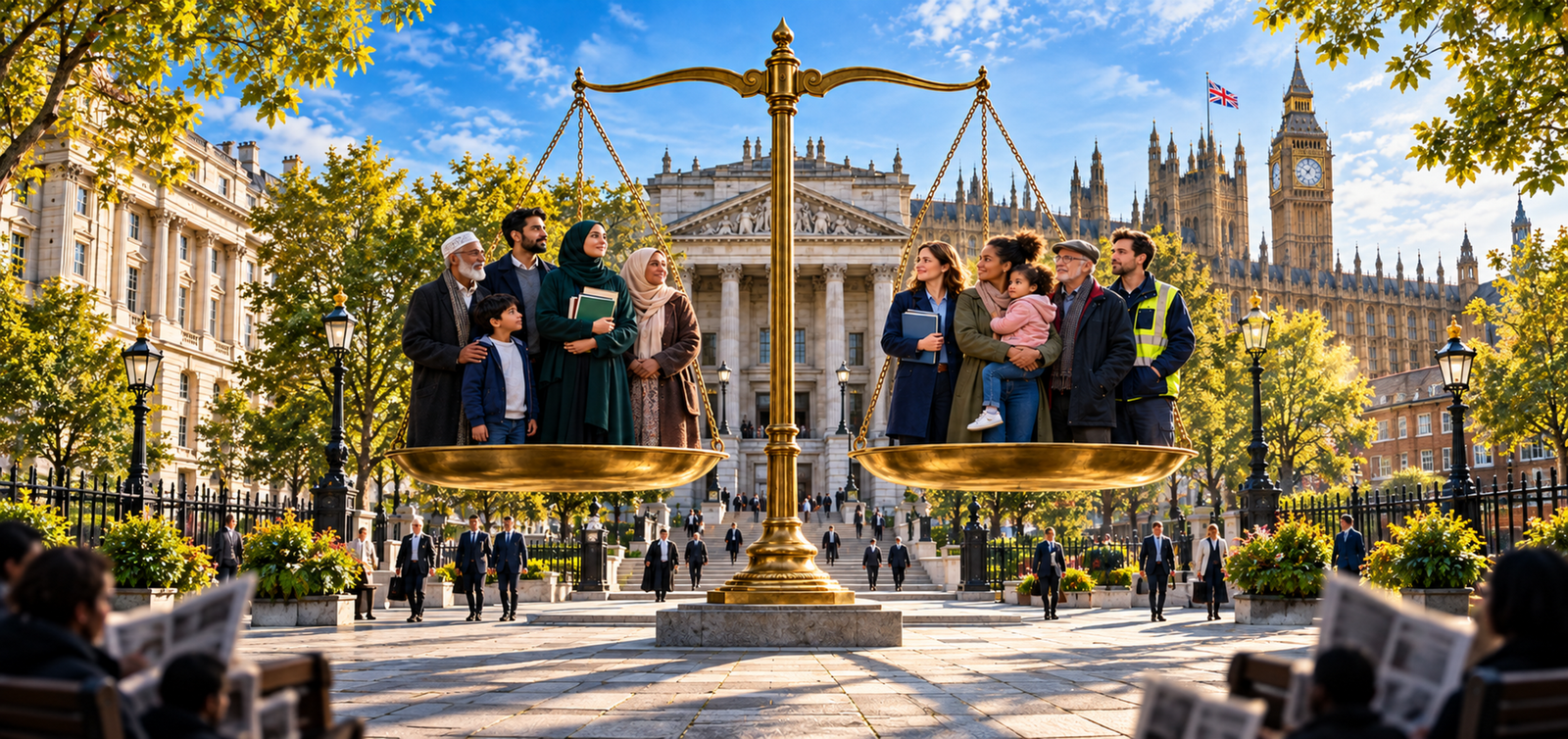
It is right to ask the question in the other direction as well. Are there schools where Muslim families find admission difficult? If so, is the reason capacity, catchment boundaries, priority criteria or discrimination? The answer lies in the records of applications, examples and decisions. Hearing that “admissions are closed” is not conclusive proof of religious discrimination. Equally, where a family has suffered discrimination, procedure must not become a screen behind which it is concealed. Confidence in justice depends upon everyone being weighed on the same scales.
Nor can the desire to live together be made into an instruction addressed to one side alone. It is easy to tell a newcomer to join society. The harder question is where society has made room for that person to join it, and on what terms of equality and respect. The question applies to every group. A shared civic life does not arise simply because different populations inhabit the same map. It is cultivated in schools, local institutions, workplaces and the encounters of ordinary days.
If a child in Bradford or Blackburn mistakes the ethnic make-up of their city for the whole of Britain, that is a question of education and social contact. The same principle applies to a child who has never known a Muslim classmate, teacher or neighbour and hears of Islam only through alarming news. Ignorance nourishes prejudice in both directions. The remedy is not to lay blame upon children, but to give them places in which they may know others as human beings rather than as headlines.
Hold the offender to account, not the religion
The report raises grave matters, including sexual exploitation, intimidation and pressure upon women. The suffering of those affected must never be diminished for the convenience of an argument. Those who committed crimes must answer before the law. Institutions that ignored complaints must answer for their failures. The safety of a girl, the freedom of a teacher and the right of a Muslim woman to choose all deserve equal seriousness.
Yet to derive the character of an entire religion from an individual’s conduct creates another injustice. If an offender’s identity is said to be a cause of the offence, that claim must itself be tested: how many cases, over what period, relative to which population, and compared with what similar offences? Police records, prosecutions, convictions and prison populations measure different things. No single figure can settle the moral character of a whole community. The existence of crime among other groups offers no excuse for overlooking a particular offence. Securing justice for the victim and protecting the innocent from collective blame are compatible duties.
This principle matters within Muslim communities too. If a woman’s voice is suppressed at home, if an influential person threatens others in religion’s name, or if a group frightens someone vulnerable, the wrongdoing must not be hidden as a matter of communal honour. Honour is upheld by standing with the wronged, not by denying the wrong. The most credible defence of Islam is to reject plainly an injustice committed in its name.
The moral record of Islamic history is relevant here. The social experiment of Medina is remembered for its language of covenant and responsibility among different groups. In later Muslim history, traditions of learning, medicine, philosophy and translation also flourished through encounters with other civilisations. It would be false to turn that history into a tale of a faultless age; it would be equally false to see in it nothing but coercion. A religion cannot be interpreted solely through its narrowest claimants. Its principles, its practice and its internal disagreements must all be considered.
On whose shoulders does the burden of family breakdown rest?
A larger question now presents itself: can every social anxiety fairly be directed towards Muslims without examining society’s own failings? Certainly not. Children’s mental health, financial pressure on families, parents’ shortage of time, the housing crisis and growing distance between generations cannot be explained by the presence of a single religious minority. Britain must consider them in the context of its wider social order.
There is, however, a principle we must uphold even when the argument seems to favour us. We cannot reject collective blame when it falls upon Muslims, only to impose it upon single mothers, unmarried parents or divorced families. A single mother may be carrying the work of two people alone; to treat her efforts as the cause of every difficulty her child encounters would be unjust. Nor can a child’s state of mind yield a simple verdict on the marital status of the parents. Income, persistent stress, secure housing, relationships at home, available support and many other circumstances matter.
Official figures describe many forms of family. They do not establish any one form as the definitive cause of every child’s success or failure. The census in England and Wales itself encompasses married couples, cohabiting couples and lone-parent families in its definition of family. The task of social policy is not to put these households in opposing docks, but to offer every child safety, attention and opportunity.
Marriage, responsibility within relationships, the upbringing of children and respect for elders are unquestionably prominent values in Islamic teaching. Their merits need no insult to another household. The better question is which practices serve a child well: mutual respect between parents, a refusal to make the child a weapon in disputes, an interest in education, material and emotional support, and help from family or community in difficult times. Wherever these practices are found, they deserve esteem; wherever they are absent, their absence should be felt.
What a child needs most is the assurance that, in a difficult hour, a trustworthy adult will be there. That adult may be a mother, father, grandmother, grandfather, teacher or guardian. Family tradition becomes a blessing when the vulnerable have a voice within it. The strongest case for resilient families, therefore, lies not in disparaging other families, but in building institutions and habits that give parents time, counsel and support.
It is heartening to hear the claim that Muslims have the lowest divorce rate because of a shared family system. To present it as an established British fact, however, requires reliable comparative data that take account of religion, age, length of marriage and other relevant factors, even if various surveys appear to lend it support. Nor is a simple comparison of the raw numbers of marriages and divorces in a younger population with those in an older one sound. The census shows that the age profile of the Muslim population differs from that of the population as a whole.
Such care does not diminish the value of family solidarity. In many households, elders listen to the young, resolve disputes and offer support through hard days. This is a resource worthy of respect. Elders may be agents of reconciliation; social pressure may also, at times, compel a woman or a man to remain silent in a harmful relationship. A successful family system must therefore be judged not solely by the avoidance of divorce, but by dignity, safety and consent within the home. The experience gathered by elders over a lifetime can then serve the generation that follows.
Even if sound research establishes a lower divorce rate in a particular group, it may admit several explanations: better mutual support, stronger relationships, economic dependence or social pressure against separation. A good researcher must distinguish among these possibilities first. That intellectual honesty lends credibility even to writing intended to speak in Islam’s favour.
A gathering for reconciliation works when both parties have an equal chance to speak, confidentiality is respected, and safety takes precedence where there is violence or coercion. The experience of elders is precious, but age is no substitute for justice. Anyone who invokes justice in the name of faith should demand it inside the home with the same conviction with which they seek it for themselves in the pages of a newspaper.
Care for parents occupies a high place in Islam’s moral vision. Many Muslim families regard it not merely as a social custom but as a religious duty. An elder’s presence at home can give children a source of language, history, memory and affection that no textbook can fully contain. It teaches a child that a person’s worth does not expire with earning power, youth or strength.
There are claims, supported by comparative evidence, about the religious background of most older people in care homes and about Muslim families’ reluctance to place parents there. Yet an older person’s residence in a nursing home is not, of itself, evidence of a child’s disloyalty. Some people need continuous medical supervision and care that even devoted relatives cannot provide alone. The true question is whether they are safe, respected, able to exercise choice and protected from loneliness.
The education of Muslim girls is another subject that deserves serious attention. If a community is portrayed only through restrictions and deprivation, the work of its pupils, teachers, researchers and professional women disappears from view. A father buying a book for his daughter, a mother making time for her studies and a girl advancing despite obstacles are all real features of Muslim social life.
Further inquiry must consider age, sex, ethnicity, household income and migration history together. The educational prospects of girls attending school today should not be confused with the formal qualifications of people who arrived in Britain decades ago. Nor can the results of pupils of Pakistani or Bangladeshi heritage in one area be made to stand for all Muslims: ethnicity, country of origin and religion are not interchangeable terms.
The achievements of Muslim girls must be viewed alongside their freedom and opportunities. One successful pupil does not erase another’s obstacles; a report of an obstacle in one household does not invalidate the aspirations of millions of others. Educational justice calls for admissions, attendance, results, access to higher education and the transition to work to be examined separately. Meetings between parents and teachers become meaningful only when language, scheduling and the difficulty of taking time off work are taken into account.
The report also presents survey questions about moral views, principles of Sharia, the law and responses to insult. To interpret the answers, one must distinguish the wording of a question, the possible meanings of a response and conduct in civic life. A person may believe in the moral teachings of a faith while respecting the legal rights of others; the two do not necessarily conflict. Peaceful criticism of a law is likewise distinct from an attempt to change it by force.
On violence, however, the language must be unequivocal. Profound offence concerning a religion, a prophet, a sacred book or any revered figure cannot justify threatening or harming another person. A Muslim citizen may express disagreement, protest and pursue a lawful demand. Others, too, have the right to criticise Islam and profess their own beliefs, although insult to faith should not be permitted. Peace will endure only if the law is subject to no one’s fear, and if mockery of religious sensibility is not mistaken for a mark of civic refinement.
The other side of the same principle is the protection of Muslims. To make a Muslim woman answer for her clothing, a man for his name, or a mosque for the acts of a few criminals is no exercise of liberty. It is both possible and necessary to distinguish criticism of Islam from discrimination against Muslims. A strong democracy is not afraid of that distinction; it makes it clear in law and public discourse.
Another caution is needed when reading the report’s figures. Set percentages from surveys conducted in different years, with different questions and different samples, side by side, and they can suggest a straightforward comparison. Change the wording of the question, however, and the answer may mean something different. Support for a law against damaging a religious text is not permission to attack a human being. Conversely, if a respondent has indeed said that violence in response to an insult is justified, that answer is troubling, whatever the respondent’s religion.
A question with longer consequences follows: do Muslims have representation proportionate to their share of Britain’s population? No single figure can answer it. Representation is found not only in parliamentary seats but in local councils, educational institutions, the police, the media and the places where policy is made. We must also ask whether those who reach such positions are treated as self-appointed spokespeople for an entire community, while women, young people and differing schools of thought within it recede from view.
In the census, 6.5 per cent of people in England and Wales identified as Muslim. That plainly raises a question about political participation. To turn the figure into an automatic entitlement to the same share of every elected seat across Britain, however, would flatten the complexities of its electoral system. Constituency boundaries, parties’ selection of candidates, voters’ preferences and electoral rules all affect the result. Nor should Muslims be treated as if they held a single political opinion. Like other Britons, they have differing economic interests and political convictions.
Yet obstacles to representation must not be accepted as ordinary facts of life. Do qualified candidates receive a fair opportunity in the major parties? Does a Muslim woman spend all her time answering questions about her headscarf while her views on education or health go unheard? Is a candidate considered suitable for a constituency with many Muslim residents but not for another? These are questions fit for democratic investigation. Their answers require figures on candidates, elected representatives and appointments, alongside an examination of what parties actually decide.
Democracy’s fault does not lie in its founding promise. The fault arises when those who profess that promise narrow its reach. Accepting a vote while regarding the voter’s voice with suspicion cannot build lasting political trust. Every citizen has the right to stand for election, disagree and bring a concern before Parliament. A Muslim’s political position on Gaza, Kashmir, education, housing or civil rights does not in itself make that person an extremist. The position and the means used to advance it may be criticised, as anyone else’s may be; citizenship should not have to be proved anew on every occasion.
Political participation, in this sense, extends beyond an election campaign. Representation also means that, when government makes policy concerning Muslim citizens, it hears Muslim women, young people and independent researchers who disagree with it, and makes the outcomes public. If only the loudest organisations have seats at the table, much of the community may remain unheard. No individual is the permanent spokesman for every adherent of a faith, whether the government confers that title or the individual claims it.
It is entirely right to expect British Muslims to obey the law, respect the rights of others and co-operate against crime. But repeatedly to demand proof of loyalty from them alone, as though every other citizen were exempt from the test by birth, weakens a shared national life. Belonging is expressed in ordinary acts: learning a country’s languages, taking part in its institutions, helping a neighbour, claiming rights under the law and fulfilling duties under that same law.
Muslims have work of their own to do in sustaining that belonging. They must make room for disagreement among themselves, listen to women and young people, refuse silence in the face of crime or coercion, and refrain from turning religious attachment into a claim of civic superiority. The wider British society has its part: it must not greet a Muslim with suspicion at the threshold. Fulfil these responsibilities together, and loyalty ceases to be a slogan. It becomes a daily practice of living in common.
The experiences of those who embrace Islam in Britain, particularly women, also deserve serious study. Their presence is no proof of a preconceived political conspiracy; nor should every conversion be attributed to one idealised explanation. Decisions of faith may grow from personal experience, study, relationships and spiritual searching. We should hear of them in the voices of those who make them. An independent adult woman is capable of speaking for her own religious choice. She should not be turned into a symbol of somebody else’s fear or wishful thinking.
To write fairly about Islam is not to forbid difficult questions about its followers. It is to put each question to the right person, on the right evidence, within the right bounds. If an individual has committed a crime, let the individual answer. If an institution has failed, let the institution answer. If distance is growing between people in a neighbourhood, examine housing, education and local policy. To invoke religion as a single answer to all these inquiries is easy enough. It is no route to the truth.
Equality at the bar of citizenship has a practical test. A Muslim subjected to a hateful attack should be able to approach the police with confidence. A Muslim frightened by an extremist’s pressure should be able to do the same. A non-Muslim who disagrees should be free to speak without threats. These three rights are branches of the same law. Cut away one, and the other two cannot remain in full leaf.
Britain will honour its plural tradition only when it grants a Muslim citizen neither an automatic certificate of innocence nor a perpetual warrant of suspicion. Muslims are subject to the same law as other citizens and entitled to the same protection it promises them. The light of civilisation is seen where the scales do not shift at the courthouse door according to a person’s name or dress. That should be the measure of justice in this debate. By it, Britain and all its citizens will be the stronger.