America, China and the Coming Storm
The Cold War for Resources

The world is entering an age in which the very grammar of power is being rewritten.
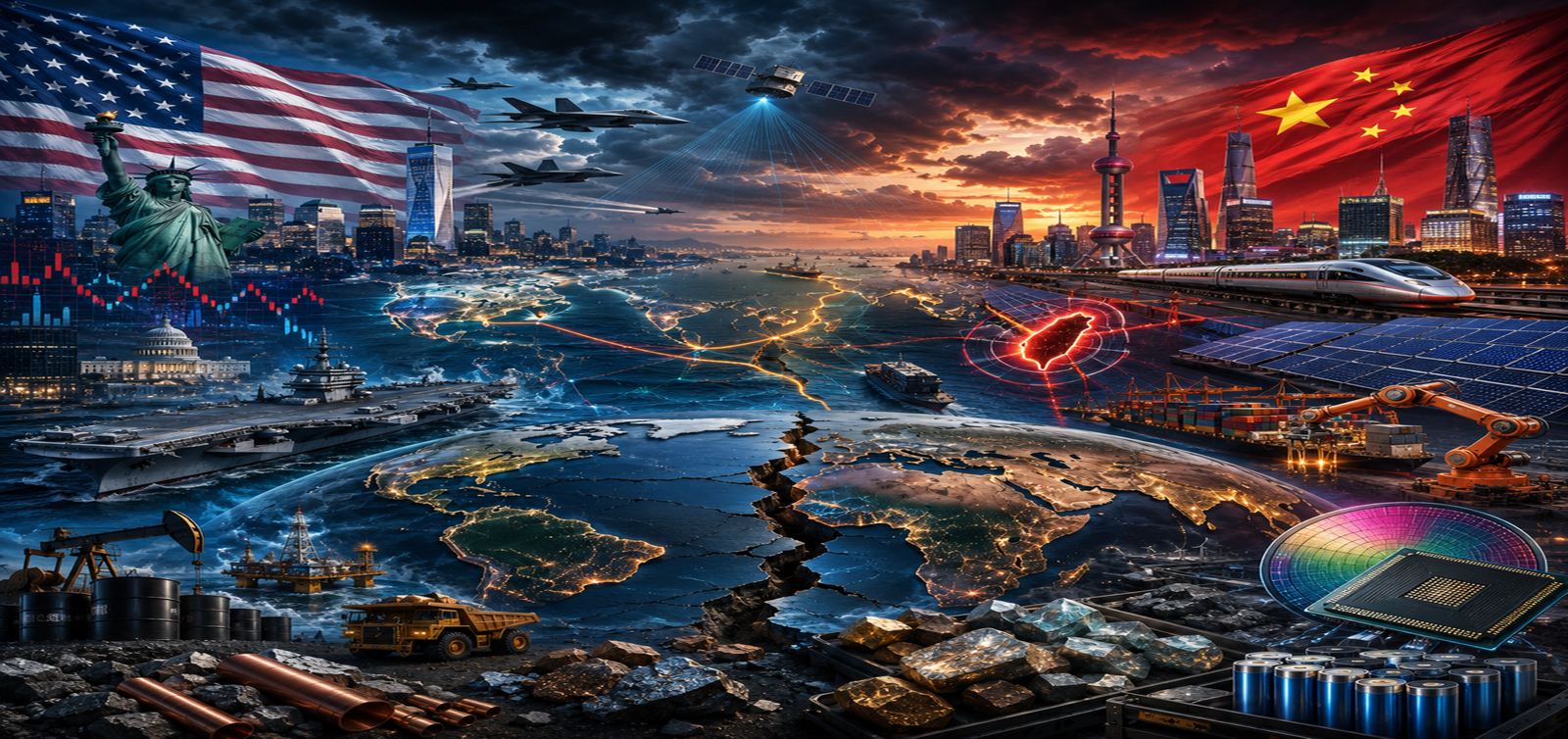
The Cold War of the twentieth century divided the international order with almost brutal clarity. On one side stood the United States and its allies; on the other, the Soviet Union and the communist bloc. For nearly half a century, ideological antagonism, military rivalry and political competition cast their long shadow over almost every region of the earth. Yet the contest now emerging between the United States and China belongs to a different historical species. Its battleground is not confined to armies, alliances or doctrines. It runs through resources and energy, trade and technology, supply chains and industry, minerals and markets, ports and data centres, currencies and the architecture of the global economy itself.
To describe the present Sino-American rivalry merely as a trade dispute is therefore to mistake the smoke for the fire.
The deeper question is who will write the rules under which the world economy operates in the decades ahead. Who will command the commanding heights of technology? Who will secure access to strategic minerals and the sources of future energy? Which power will exercise the greater economic and political influence across Asia, Africa, the Middle East and Latin America? Beneath the tariffs and diplomatic quarrels lies nothing less than a struggle over the shape of the coming international order.
From the Fall of the Wall to the Height of American Power
When the Berlin Wall fell in 1989, and the Soviet Union disintegrated soon afterwards, history appeared for a brief moment to have settled its argument.
The superpower that had confronted the United States for nearly half a century vanished with extraordinary speed. Washington emerged from the wreckage as the sole global power of truly universal reach.
From the 1990s into the opening decade of the twenty-first century, American influence expanded to dimensions seldom witnessed in modern history. Washington possessed immense weight in international financial institutions, global commerce, military alliances, technology, media and diplomacy. NATO enlarged. The dollar remained the central pillar of world trade. Silicon Valley came to symbolise the technological imagination of the age. The American armed forces possessed the ability to operate simultaneously in distant theatres across the globe.
The old Cold War was over; yet in its place arose another anxiety—the danger inherent in an international system dominated, to an unprecedented degree, by a single power.
America appeared to have won the Cold War. Time, however, has proved that victory less final than it first seemed.
The exertions of distant wars, internal political division, the erosion of portions of the industrial base, widening economic inequality, mounting debt, corporate influence and an increasingly embittered political culture gradually imposed their price. The long campaigns in Iraq and Afghanistan consumed treasure on a prodigious scale and inflicted costs upon America’s standing abroad that cannot be measured in dollars alone.
And while Washington was spending much of the post-Cold War dividend, another power was rising with patience, discipline and remarkable economic force.
That power was China.
The Chinese Ascent
China’s transformation stands among the great economic events of modern history.
Only a few decades ago, it occupied a comparatively modest place in the world economy. Yet reform, industrialisation, exports, infrastructure and sustained engagement with global trade carried it into the first rank of economic powers.
Nor did China remain merely the workshop of inexpensive goods. Over time, it acquired formidable capabilities in electronics, telecommunications, solar energy, electric vehicles, batteries, artificial intelligence, railway systems, shipbuilding and advanced manufacturing.
A considerable portion of the world’s critical supply chains now touches China directly or indirectly.
It is here that the interests of Washington and Beijing begin to grind against one another.
The United States fears that, should China continue to advance at sufficient speed, it may cease to be merely an economic competitor and acquire the power to alter the political and strategic architecture of the world. Beijing, for its part, increasingly regards American restrictions as part of a concerted attempt to arrest China’s ascent before it reaches full maturity.
Thus a rivalry is taking shape which resembles the old Cold War in atmosphere, mistrust and strategic calculation, yet differs from it profoundly in substance.
The battlefield is more intricate, more interconnected and, in some respects, more dangerous.
A Contest for Resources Rather Than Creeds
The Cold War between Washington and Moscow was, to a considerable degree, a quarrel between rival political faiths: capitalism and communism.
The present struggle certainly possesses ideological dimensions, but its foundations are more material.
The industries upon which the future will depend require resources that have acquired a strategic significance once reserved for oilfields, naval bases and arsenals. Lithium, cobalt, nickel, copper, rare-earth elements and the materials required for semiconductor production are no longer merely commodities to be bought and sold. They are becoming instruments of national power.
An electric vehicle, a precision missile, a smartphone, a satellite, an artificial-intelligence system, a wind turbine or a solar panel may appear to belong to wholly different worlds. Yet each rests upon chains of extraction, refining, processing, manufacturing and transport whose fragility has become a matter of national security.
The power that commands more of those chains will possess greater influence over the industrial civilisation now emerging.
China has secured a significant position in the mining, refining and processing of several critical minerals. The United States, increasingly conscious of the strategic consequences of dependence, is seeking alternative sources and more resilient networks.
And so the new Cold War is fought in unfamiliar trenches: in a mineral pit in Africa, a container terminal in Asia, a semiconductor plant in East Asia, a battery factory, a solar-panel assembly line or the contracts governing a distant port.
The struggle of our age is, in this sense, less a war of doctrines than a contest for the material sinews of power.
Tariffs as Instruments of Statecraft
The United States has in recent years-imposed tariffs and restrictions upon a range of Chinese goods.
Officially, such measures are often justified as safeguards for American industry and employment. Yet behind them stands a larger strategic calculation: to restrain the expansion of Chinese industrial power.
Solar panels offer an instructive example.
According to the information cited in the underlying account, Chinese commercial networks were able to employ a remarkably long alternative trade route passing through parts of Africa and South-East Asia in order to circumvent American tariffs, sustaining solar-related trade worth more than one hundred million dollars a month.
Whatever the particular mechanics of such routes, the larger lesson is unmistakable.
The world economy of the twenty-first century has become too intricate to be commanded by tariff walls alone. Companies may redirect shipments through third countries, establish new assembly operations, change ports, reorganise ownership structures or redesign the legal architecture of trade.
When one gate is closed, the global supply chain searches for another.
Thus, the tariff war has gradually become a war over the supply chain itself.
Economic restrictions remain formidable instruments of policy; but the capacity of a determined industrial power to adapt to them has exposed the limits of economic coercion. A tariff may wound; it may delay; it may raise costs. But it does not necessarily command surrender.
The Silicon Front
If nuclear weapons were among the supreme strategic currencies of the first Cold War, semiconductors and artificial intelligence are acquiring something of that status in the second.
Without advanced microchips, there can be no cutting-edge artificial intelligence, sophisticated combat aircraft, precision-guided missiles, modern cyber systems, supercomputers or vast data centres.
Technology has therefore ceased to be merely an arena of commercial competition. It has become an extension of national security.
Washington has repeatedly sought to restrict Chinese access to the most advanced chips and to the machinery required to manufacture them. The strategic intention is plain: to prevent China from obtaining computing capacities that could challenge American predominance in military and technological fields.
Yet such policies contain a paradox.
Pressure may weaken an adversary; but it may also teach him the necessity of independence.
China has consequently accelerated efforts to cultivate an indigenous semiconductor industry. Should it succeed, over years or decades, in reducing its dependence upon foreign technology in critical sectors, the coercive power of Western restrictions may gradually diminish.
Here lies one of the great ironies of the emerging Cold War: the very measures designed to preserve dependence may hasten the search for self-sufficiency.
Energy and the Industrial Future
China remains one of the world’s great importers of energy, while the United States has itself become a major producer. Yet the energy politics of the future cannot be understood solely through oil and gas.
Solar power, electric vehicles, batteries, green hydrogen and other forms of renewable energy are moving towards the centre of the world economy.
China has acquired formidable industrial strength in the manufacture of solar panels and batteries. If the global transition towards cleaner energy accelerates, a large part of the world may find itself dependent upon Chinese industrial capacity precisely at the moment when governments are seeking greater strategic autonomy.
Washington regards such dependence with unease.
Hence the renewed American effort to strengthen domestic industry through subsidies, tariffs, incentives and public investment.
Control over the technologies of energy transition is therefore becoming another principal front in the wider contest.
The great powers are no longer arguing merely about
who controls the oilfields of yesterday, but who will build the power systems of tomorrow.
The Global South Returns to the Centre of History
The contest between Washington and Beijing will not remain a private quarrel between two capitals.
Africa, Latin America, South-East Asia, Central Asia and the Middle East are acquiring immense importance in the geopolitics of the coming decades.
Africa, in particular, possesses substantial reserves of minerals indispensable to advanced technology: lithium, cobalt, copper, manganese and others. China has spent the past two decades financing and constructing roads, ports, railways, power projects and mining ventures across the continent.
The United States is now seeking to restore and deepen its own economic presence.
A similar competition is visible across Latin America, where deposits of strategic minerals sit alongside food, energy and expanding markets.
There is a historical irony here.
Countries which, during the first Cold War, too often became battlegrounds for ideological proxy struggles may now become the principal arenas of competition over investment, infrastructure, supply chains and mineral wealth.
The instruments have changed; the logic of power has not vanished.
Taiwan: Where the Cold War Might Become Hot
No point in the Sino-American rivalry is more dangerous than Taiwan.
China regards the island as part of its sovereign territory. The United States, although maintaining an unusual diplomatic framework, possesses substantial informal, economic and security ties with Taipei.
But Taiwan’s importance is not geographic alone.
It occupies an extraordinary place in the production of the world’s most advanced semiconductors. Those chips are indispensable to artificial intelligence, sophisticated weapons, smartphones, vehicles and high-performance computing.
A military confrontation around Taiwan would therefore not remain an Asian affair.
It could shake the global electronics industry, motor manufacturing, defence production and financial markets. Supply chains might fracture in days; the economic consequences could travel across continents before the first diplomatic communiqué had been drafted.
Taiwan is therefore more than a territorial dispute.
It is the place where an economic Cold War carries its most obvious risk of becoming a hot one.
Two Giants, One Fragile World
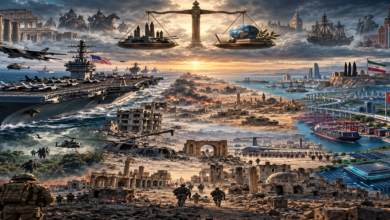
America and China may be imagined as two giants struggling upon a floor too fragile to bear their weight.
If they collide directly, much of the suffering will fall upon countries that neither sought nor desired the contest.
China stands at the heart of global manufacturing. The United States remains a central pillar of the financial and technological system. Were the two powers to divide the world economy into rival spheres, companies, governments and ordinary consumers would all pay the price.
The world might face two technological ecosystems, two supply-chain architectures, two financial blocs and, eventually, two political camps.
Yet there is one decisive difference between this emerging rivalry and the Cold War of the twentieth century: much of the world does not wish to choose.
Many countries rely upon the United States for security while regarding China as indispensable to their trade.
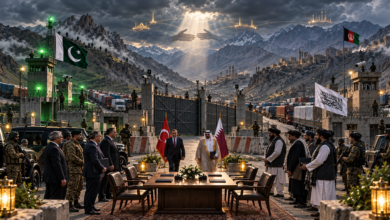
Saudi Arabia has long-standing relations with Washington, yet its economic engagement with Beijing has become increasingly important. Pakistan enjoys a deep strategic partnership with China but has little interest in severing itself from America and the wider West. The Gulf states maintain security links with Washington while expanding commercial relations with Beijing. India competes with China and draws closer to the United States yet remains reluctant to surrender the principle of strategic autonomy.
This is why the new Cold War, should that term endure, will be more fluid and more complicated than its predecessor.
The middle powers do not wish merely to stand beneath another empire’s banner. They seek room for manoeuvre.
Is America Really in Decline?
For all its difficulties, it would be a grave analytical error to pronounce the United States weak or irrelevant.
America remains among the most formidable military powers in history. It possesses an unrivalled web of alliances, world-class universities, immense influence within financial institutions, the continued power of the dollar, some of the planet’s most consequential technology companies and a remarkable capacity for research and innovation.
China, meanwhile, carries burdens of its own.
An ageing population, declining birth rates, debt, difficulties in the property sector, dependence upon external markets and mounting strategic rivalry with the United States all impose constraints upon Beijing.
The future, therefore, should not be reduced to a melodrama in which American decline mechanically produces Chinese triumph.
History seldom advances in so tidy a fashion.
What is occurring is not the simple transfer of a crown from one empire to another. It is the restructuring of the global balance of power.
The Security Dilemma
The greatest danger in this new Cold War is not the question of who ultimately prevails.
It is the possibility that relentless competition may create a world in which every defensive measure undertaken by one side is interpreted as an offensive preparation by the other.
One power strengthens its armed forces; the other perceives preparations for attack. One invests in new technologies; the other sees a threat to national security. One constructs alliances; the other tightens its own.
Thus, fear becomes policy, policy becomes counter-policy, and counter-policy produces still greater fear.
This is the classic security dilemma.
It was precisely such spirals of suspicion that brought the world, more than once, perilously close to nuclear catastrophe during the first Cold War.
Today both the United States and China possess nuclear weapons. Both command sophisticated missiles, cyber capabilities, space programmes and military systems increasingly intertwined with artificial intelligence.
A miscalculation over Taiwan, the South China Sea or another contested theatre might therefore transform an economic struggle into a military crisis with astonishing speed.
The Line Between Rivalry and Ruin
The coming decade may determine whether Washington and Beijing can contain their rivalry within limits that civilisation can endure.
Competition itself is unlikely to disappear. The two states will continue seeking advantage in technology, trade, energy, defence and diplomacy.
Yet there remains a vast difference between competition and war.
If that boundary is preserved, the new Cold War may remain a prolonged contest of economics, technology, influence and statecraft.
If it is erased, the consequences may be catastrophic far beyond the shores of America and China.
The decisive struggles of the twenty-first century may therefore not be fought on a single battlefield. They are already being waged in ports and microchip factories, data centres and mineral mines, solar-panel plants and shipping lanes, currencies, laboratories and the hidden architecture of artificial intelligence.
This is the true face of the emerging contest.
Its outcome may be determined not by which state possesses the largest number of tanks or missiles, but by which can most successfully bind resources, technology, capital, industry and alliances into a durable system of power.
If Washington and Beijing treat every gain by the other as an intolerable loss to themselves, the world may drift into a long and hazardous division.
But if competition can coexist with limited cooperation—particularly over nuclear restraint, climate change, global trade and artificial intelligence—the new Cold War need not become a new world war.
The question before us is therefore no longer simply whether another Cold War has begun.
The graver question is how far it will travel; how many fractures it will carve through the international order; and whether the United States and China can restrain their contest before the rivalry of factories, algorithms and trade routes becomes a contest of fleets, missiles and blood.
Upon the answer may depend on the character of the world order yet to come.