The Other Side of the Mirror
Behind the Veil of Fear

Islam and Europe Deserve a Fuller Account
The Economist’s “The Reality of Islam in Europe”, published in its edition of 12 September 2026, rightly rejects the fantasy of an Islamic takeover. Yet a fuller account requires more than an assurance that Muslims pose no demographic threat. Readers deserve to encounter the principles by which Islam itself asks to be judged.
A public argument becomes impoverished when a faith is discussed chiefly through the fears it arouses and the abuses committed in its name. Those fears may be sincerely held; those abuses must be confronted. But neither can stand as an adequate account of Islam. If journalism is to hold power to scrutiny, it must also resist the quieter distortion that occurs when a religious tradition’s governing principles are left outside the frame.
The Qur’an places justice at the centre of moral life. It requires believers to uphold it even against themselves, their parents or their kin (4:135). It warns them not to let hostility towards a people turn them away from justice (5:8). These are demanding injunctions, particularly when resentment offers an easier course. They give no warrant to excuse wrongdoing because its perpetrator is Muslim, or to diminish a victim because he or she is not.
The same moral seriousness applies to belief. The Qur’an declares that there is no compulsion in religion (2:256). It speaks of human communities as peoples and tribes who may come to know one another, while locating honour in moral conduct rather than ancestry (49:13). It permits kindness and justice towards those who do not wage war on Muslims or drive them from their homes (60:8). These passages do not settle every dispute about Islamic history or jurisprudence. They do, however, belong in any honest account of what the religion teaches. To omit them while cataloguing threats associated with Muslims is to leave readers with a portrait whose most illuminating features have been painted out.
Europe has good reason to ask how religious conviction lives alongside civil law, equal citizenship and freedom of conscience. Muslims must answer that question plainly. No family, school, charity or religious body should be allowed to intimidate dissenters, conceal abuse or place vulnerable people beyond the protection of the law. A girl harmed by men who claim a shared faith is owed justice, not a defence of communal reputation. A Muslim who departs from the expectations of a local religious leadership is owed the same freedom and security as any other citizen. These obligations arise from the equal rights of citizens; they also accord with Islam’s insistence that justice must prevail over loyalty to one’s own.
Yet scrutiny loses its integrity when the misconduct of particular people becomes a lens through which millions are perpetually examined. No serious observer would describe Europe’s political inheritance solely through its wars of religion, colonial rule or episodes of persecution. Those histories matter and must be told. So do the principles and reforms through which Europeans have challenged them. Islam deserves the same intellectual discipline: neither exemption from criticism nor confinement to its darkest episodes.
The distinction between a religion and a political movement can help, but labels alone do-little work. “Islamism” encompasses claims and organisations that differ greatly, and criticism should identify the particular action at issue. Is a group coercing people, misusing public authority, seeking a change in law through democratic argument, or merely expressing beliefs with which others disagree? Those questions lead to evidence and proportionate remedies. A loose label can instead make lawful civic participation appear suspect simply because it is visibly Muslim.
The same care is needed when discussing integration. It is reasonable to expect every resident to obey the law and respect the rights of others. It is unreasonable to treat integration as a demand that Muslims become inconspicuous before they may be considered loyal. European societies have long accommodated sharp differences of belief and practice. Their institutions are tested by whether they can protect that freedom consistently: for the devout and the secular, for minorities within minorities, and for those who wish to leave a community altogether.
Nor should disagreement over moral questions be confused with permission to harm. Religious believers and secular citizens may hold profoundly different views about sexuality, family life and the place of faith in public affairs. A democratic society allows those arguments to be voiced; it also protects people from threats, harassment and violence. The boundary is conduct, enforced equally. Muslim citizens can be expected to respect it without being required to surrender the right to argue from religious conviction.
History gives Europe little reason to despair of such coexistence, or to assume that it will maintain itself without effort. Relations between Muslim and European societies have included conflict and conquest, but also trade, scholarship, diplomacy and ordinary neighbourliness. To recall only the collisions is to mistake part of the record for the whole. To romanticise the past would be equally unhelpful. Its lesson is more exacting: people who differ deeply can build institutions that restrain power and make room for one another.
This is also a question of public policy. Governments should prosecute abuse, protect dissenters and apply the law without favour. They should listen to Muslim women and men in all their diversity, rather than appointing a narrow circle to speak for them. They should resist both the temptation to overlook coercion for fear of appearing prejudiced and the temptation to treat every mosque, school or association as a possible conspiracy. Either failure weakens the trust on which effective institutions depend.
The press has a related duty. It must report extremism and institutional failures without euphemism. It must also tell readers what Islam says about justice, conscience and the treatment of others, and allow Muslims to be heard as citizens rather than merely discussed as a problem. That is not an appeal for favourable coverage. It is a claim for a complete one.
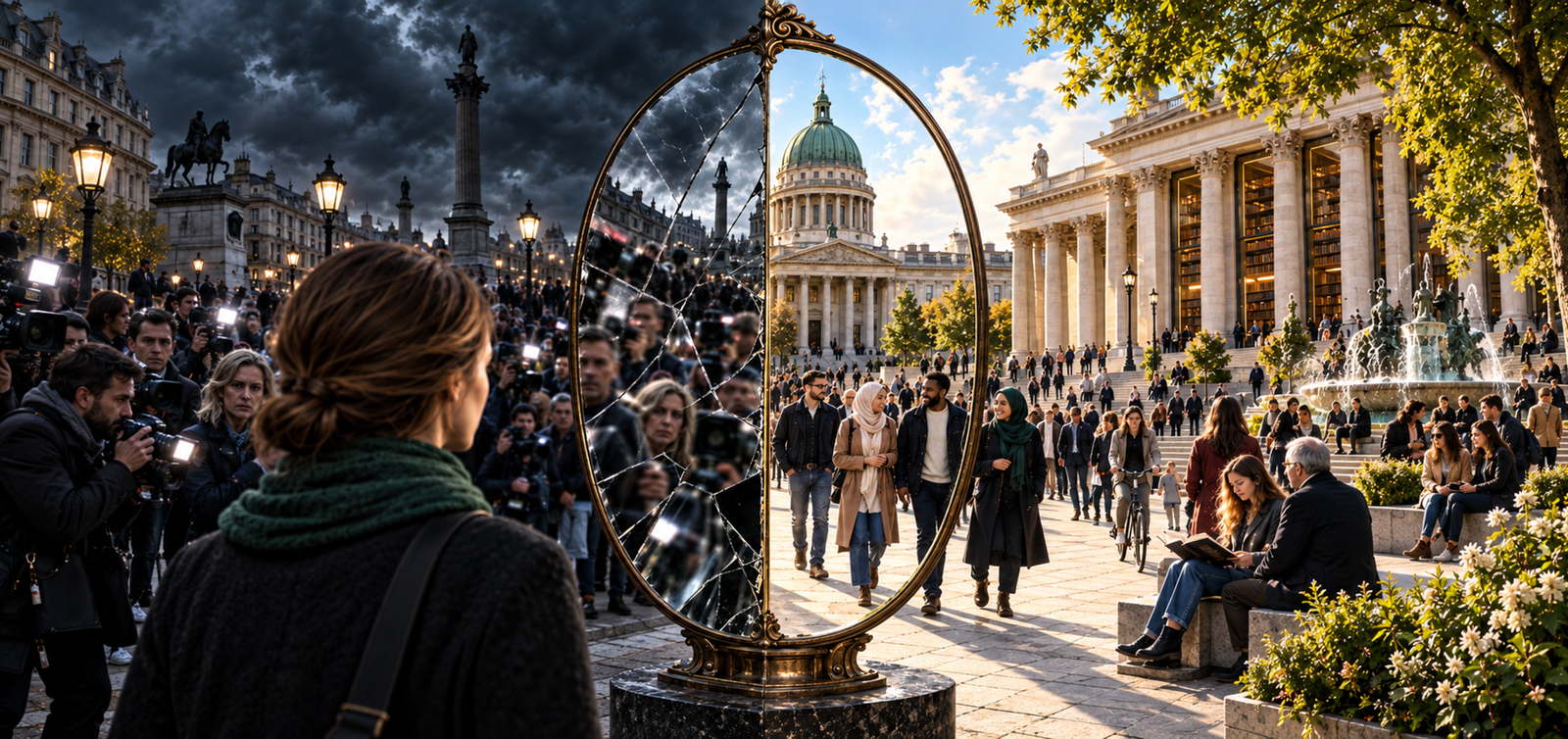
The principles of a faith cannot be kept out of sight while its alleged dangers remain permanently in view. Readers are entitled to see the other side of the mirror and to judge it critically for themselves. In doing so, they may find not a faith beyond question, but a moral tradition with which Europe can reason, disagree and share a civic life. Honest journalism should make that encounter possible.