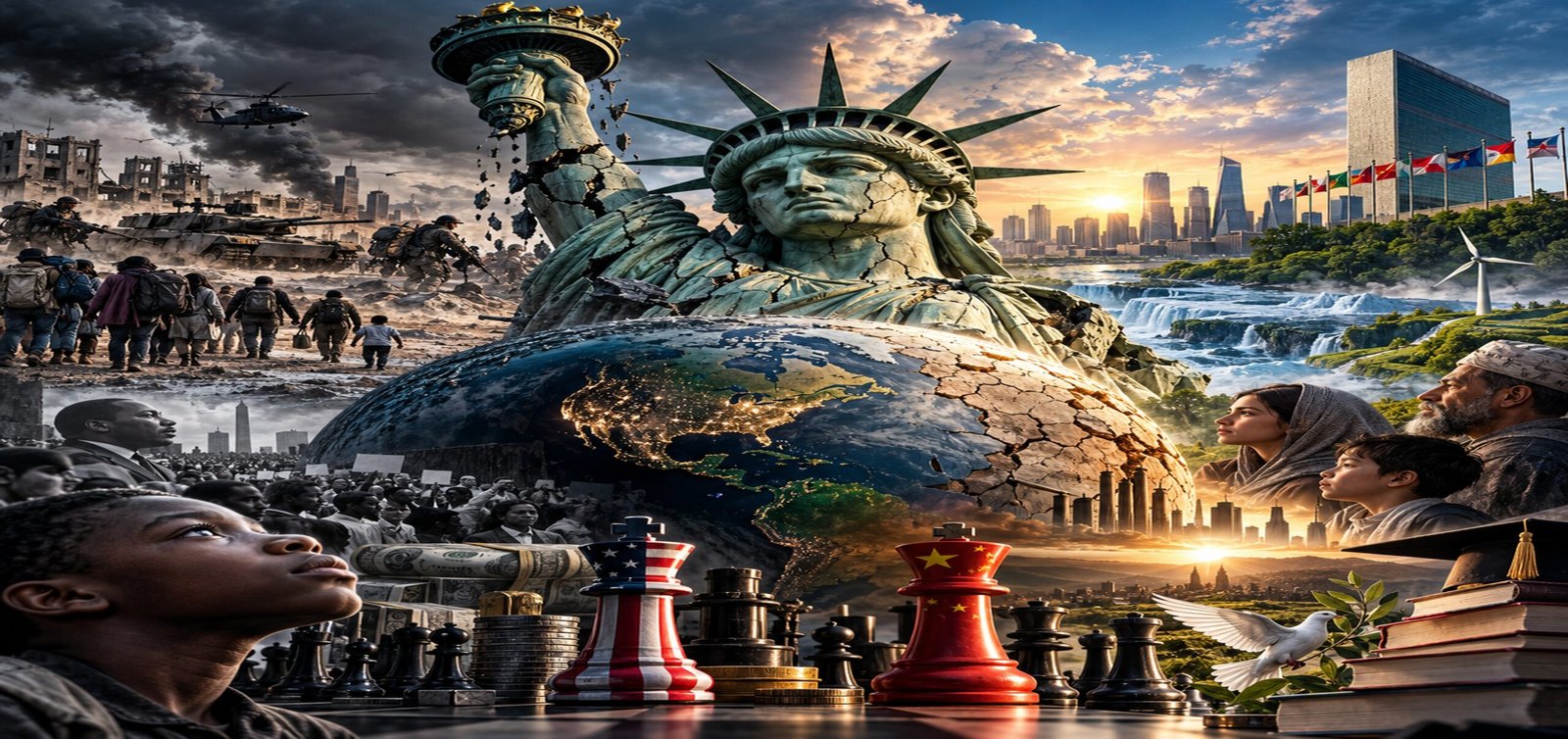
The Murmurs of Imperial Decline
America, Power, Civilisation and the Historical Tragedy of Resistance

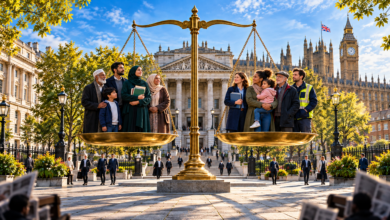
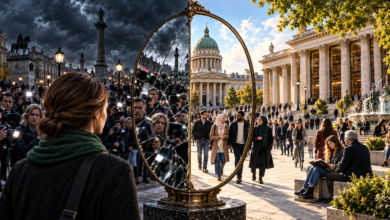
which grave questions are raised about American power, capitalism, military intervention, social inequality, racial justice and the future disposition of world politics. What follows, however, is neither a translation of that address nor an endorsement of every judgement pronounced by its author. It is, rather, an attempt to hold those questions before the mirror of history, to examine their political implications, and to ask what they may signify upon the shifting chessboard of our own age.
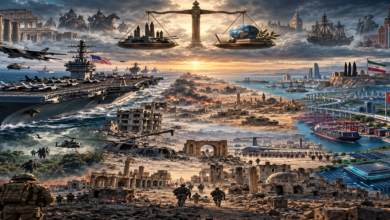
History possesses a curious habit. It seldom announces to empires, at the noon of their magnificence, the manner of their eventual decline. Yet once decline has begun, its symptoms appear with something of the clarity of writing upon the wall. The throne remains, but its awe begins to depart. Armies still march, yet the noise of their expense grows louder than the thunder of their boots. The sovereign’s image remains stamped upon the coin, while the marketplace quietly begins to question the power behind it.
It is at precisely this point that an empire’s most dangerous adversary may cease to be the army beyond its frontiers. Its greatest enemy becomes its own conviction that its greatness is permanent.
The central contention of the address under consideration is much the same: that America’s predicament cannot adequately be explained by a handful of mistaken policies, a single President, one political party, or even one disastrous war. The malaise, it argues, runs considerably deeper. Industrial decline, fiscal weakness, an immense military establishment and the concentration of corporate power are presented not as separate afflictions but as different manifestations of the same structural crisis. The further possibility is raised that, should the dollar’s privileged position within the international financial order substantially weaken, the pressure upon America’s military and financial power might become more severe still.
History immediately summons its witnesses: Rome and Athens; the Ottomans and the Spaniards; Britain and the Soviet Union.
Empires do not decline according to a single script. Yet certain rhythms recur with remarkable persistence. Wealth first creates power. Power, seeking protection, demands armies. Armies require bases. Bases breed commitments; commitments become wars; wars demand credit; and eventually the debt begins to consume the very wealth from which imperial power first arose.
The tree of power, one might say, begins to bend beneath the weight of its own shade.
When Military Power Supplants Political Judgement
The most ominous sign of imperial decline is not necessarily that an empire loses a war. It is that it begins to regard war as the first instrument with which problems ought to be solved.
A rising power usually understands when the sword must remain in its scabbard. A declining power is more easily seduced by the belief that every locked door may be opened with artillery.
It is this condition that some historians have described as a form of excessive militarism: the attempt to compensate for diminishing political influence through ever greater military exertion.
The address interprets Iraq and Afghanistan through precisely this lens, comparing them with the ruinous expeditions of ancient Athens and, in another historical register, with the Suez Crisis of 1956. Declining powers, it suggests, are repeatedly tempted by the fantasy that one swift military triumph might restore a prestige already slipping from their grasp. Yet the unforeseen cost of intervention, coupled with political failure, may instead accelerate the very decline the war was intended to reverse.
Nor is the lesson peculiarly American.
Whenever a ruling class has come to regard diplomacy as weakness and warfare as virility, the state has frequently wounded its own possibilities before its enemies could do so.
For Britain, Suez was more than a diplomatic reverse or a failed military adventure. It was a psychological revelation. London discovered that although the imperial silhouette remained visible upon the map, the political substance beneath it had altered. In the Soviet Union’s final decades, similarly, the enormous dimensions of military power could not indefinitely conceal economic exhaustion and social decay.
A gun may defend a frontier. It cannot stand sentry over a failing economy, restore confidence in discredited institutions, or command a people to hope.
It is a lesson powerful states generally learn last.
An Empire Is Sustained Not by Cannon Alone, but by an Idea
Every great empire possesses more than battleships. It possesses a story.
Rome carried with it an idea of law. Britain clothed its dominion in the language of civilisation, Parliament, education, maritime power and administrative competence. After the Second World War, the United States fashioned an extraordinary reservoir of soft power from freedom, democracy, human rights, prosperity, modernity, Hollywood, its universities, technological ingenuity and that most potent of modern myths—the American Dream.
For decades, that narrative accomplished what artillery could not.
The deeper crisis begins when an empire’s story and its conduct cease merely to differ and begin openly to contradict one another.
Human rights on one side; Abu Ghraib on the other. The rule of law proclaimed abroad, wars whose legal and moral foundations are questioned across the world. The language of liberty accompanied by drones, secret detention facilities and a history of interventions undertaken to alter foreign governments.
Such contradictions gradually consume the moral capital upon which soft power depends.
The address places this contradiction within the context of Abu Ghraib, the wars of the Middle East and the immense human devastation associated with them. It further argues that coercion practised abroad cannot indefinitely remain quarantined from the political and social habits of the society that practises it.
An ancient truth therefore returns in modern dress: once power loses its moral argument, it must employ ever greater force to sustain its authority.
An empire that was once admired, but has become merely feared, has already entered dangerous territory.
War Is Paid for Not Only by the Treasury, but by Society
The financial cost of war may be entered in a budget. Its full debt cannot.
One may calculate the price of an aircraft, a missile or a military base. But what ledger can calculate the corruption of a nation’s priorities?
If trillions are expended upon distant theatres while roads decay at home, schools weaken, healthcare becomes prohibitively expensive, workers live with permanent insecurity and the middle classes sink beneath debt, a quiet moral question begins to disturb the political order:
We set out to put the world in order—but to whom did we entrust our own house?
America is hardly the first great power to confront this question.
When the distance between imperial commitments and financial capacity grows too wide, a structure may retain its monumental exterior while becoming hollow within. The address connects precisely this danger with financial fragility and the reserve-currency status of the dollar, warning that profound economic dislocation may prepare the ground for political extremism and aggressive nationalism.
It is an old tragedy.
A hungry society listens more readily to a slogan than to philosophy. A frightened population tires of complicated answers to complicated problems and begins to search for someone who can offer three consolations: an enemy, a slogan and a simple cure.
The enemy may be the immigrant or the minority; the foreign country or the intellectual; the journalist, the religion, or the supposedly treacherous elite.
Economic crisis thus contracts the political imagination.
Corporate Capitalism and the Hollowing of Democracy
One of the great historical achievements of the modern West was its attempt to prevent capitalism from becoming wholly unrestrained. Markets were subjected—however imperfectly—to law, labour rights, welfare provision, progressive taxation, independent institutions and political accountability.
For much of the twentieth century, there remained an understanding that the market could be an exceptionally powerful servant, but that to enthrone it as master was to risk converting society itself into a marketplace.
Then came another creed.
The market, it was said, possessed an intelligence of its own. The further the state withdrew, the greater prosperity would become. Capital should cross borders freely, wealth would eventually trickle down, industry would migrate to wherever production was cheapest, and in time the world itself might be transformed into one enormous middle class.
It was a beguiling dream.
Every dream, however, has its morning.
The address offers a severe criticism of neoliberal globalisation. Industries migrated towards low-wage economies; the bargaining power of labour diminished; public services were privatised; while capital belonging to great corporations and financial elites acquired an unprecedented ability to move around the world.
It would be intellectually impoverishing to imprison this question within the old slogans of capitalism and socialism.
The more fundamental question is simpler:
What is an economy for?
If gross domestic product rises while life becomes less secure; if stock markets reach record heights while families cannot afford homes; if technology advances with astonishing speed while millions live in fear of the future; if individual fortunes become comparable to the economies of sovereign states while workers holding two jobs remain unable to meet elementary needs—then the statistics may testify to growth.
Society may testify otherwise.
The civilisational conception of economic balance found within Islamic thought rested upon a related moral intuition: property, but not property without obligation; commerce, but not commerce joined to oppression; wealth, but not wealth imprisoned perpetually within a few hands.
Societies are sustained not by wealth alone, but by the conviction that justice remains possible.
Trump: More Symbol than Solitary Phenomenon
Here the political argument reaches an important turning point.
Populist leaders do not descend upon societies from an empty sky. They place a finger upon a wound already present. Some attempt to heal it. Others discover that the wound itself may serve as a ladder to power.
The address interprets the rise of Donald Trump not as an accident, but as the consequence of decades of economic, political and cultural discontent. It also suggests that the populist impulses represented by Trump are by no means exclusively American; under different names and in different forms, they may emerge wherever similar conditions arise.
To reduce the matter to the familiar boxes of being “for Trump” or “against Trump” is therefore to diminish the question.
The deeper question is why tens of millions became so profoundly estranged from a system that had once helped create perhaps the most self-confident middle class in the world.
Why did the political centre weaken?
Why did civil disagreement yield to insult, conspiracy, humiliation and rage?
When established political parties repeatedly assure citizens that the system is fundamentally
sound while the texture of ordinary life appears to shout the opposite, politics becomes hospitable to the man who promises to overturn the table—irrespective of what remains of the room afterwards.
That is the tragedy of populism.
It often diagnoses the pain correctly and prescribes the wrong medicine.
Black America: History’s Unsettled Account
The warning directed towards Black Americans in the title of the original address cannot be understood outside the long and difficult history of the United States.
The African-American experience has been perhaps the severest test of the American democratic promise.
A republic whose Declaration of Independence proclaimed human equality preserved slavery upon the same soil for generations. The Civil War closed slavery’s legal door, but it did not end the history of racial domination. After the brief experiment of Reconstruction came Jim Crow, political exclusion, lynching, residential segregation, economic inequality and institutional discrimination—maintaining for generations the gulf between liberty as written in law and liberty as lived in life.
The Civil Rights Movement of the twentieth century attempted to narrow that gulf.
Martin Luther King Jr, Rosa Parks, Malcolm X and innumerable unnamed men and women did not ask America for a favour. They asked America to honour its own constitutional promise.
The distinction is fundamental.
The concluding portions of the address express anxiety that some of the rights for which African Americans paid with body and blood may be growing less secure, while fear, imprisonment and coercive policing could assume an enlarged role in mechanisms of social control.
To confine that concern to one party, one President or one election would be historically superficial.
The Black American experience reminds us that legal victory and social victory are not synonymous. A statute may prohibit discrimination, but centuries of economic and social inequality cannot be dissolved by decree. The vote may be guaranteed, yet if immense disparities persist in wealth, education, housing, health and justice, equality’s journey remains unfinished.
Civil liberty can therefore never safely be treated as inherited capital upon which succeeding generations may simply live.
Every generation must keep watch upon the citadel of freedom for itself.
A Multipolar World and the Question of What Comes After American Primacy
The twentieth century ended in an atmosphere of remarkable confidence. The Soviet Union dissolved; the United States emerged as the sole global superpower; and for one brief historical interval it seemed as though history itself had delivered a final political verdict.
History, however, has never been particularly respectful of declarations announcing its conclusion.
China’s economic ascent, the eastward movement of economic gravity, Russia’s return to international politics, the desire of Türkiye, India, Brazil and other middle powers to pursue more autonomous foreign policies, and the increasingly assertive political voice of the Global South have produced a world far more intricate than that imagined in the first years after the Cold War.
The address entertains the possibility that diminished American predominance may either permit China to assume a larger role or lead towards a genuinely multipolar international order.
One misconception must nevertheless be resisted.
Relative American decline does not necessarily imply absolute Chinese supremacy.
The transfer of power in history is not always like lifting a crown from the head of one monarch and placing it upon another.
Sometimes the entire court changes.
The twenty-first century may prove to belong not to one empire but to a complicated constellation of great powers, regional alliances, multinational corporations, financial networks, technology companies and non-state actors, in which authority is no longer concentrated within a single capital.
Such a world might become more equitable.
It might also become more dangerous.
For the end of one power’s monopoly does not guarantee liberty. It may merely inaugurate the rivalry of several powers.
Globalisation’s Wounded Human Being and the Return of Identity
Modernity has bestowed extraordinary comforts upon humanity, but progress, too, exacts its psychological price.
Traditional societies were profoundly imperfect, yet they supplied human beings with forms of belonging: family, neighbourhood, faith, occupation, custom, language and place. The modern capitalist city bestowed freedom, but freedom has sometimes been purchased at the price of solitude.
When a factory closes, it is not merely employment that disappears. An entire local civilisation may die with it.
When people migrate from village to metropolis, they do not merely change their address; the geography of memory itself is altered.
And when the marketplace ceaselessly tells a person that his worth is measured by consumption, visible success and economic productivity, the individual who falls behind may cease merely to feel unsuccessful.
He may begin to feel unnecessary.
Here identity politics finds fertile ground.
A man deprived of confidence in the future is easily persuaded to sanctify the past.
He begins to yearn for a golden age—even when that golden age never quite existed.
Nationalism, religious extremism, racial supremacism, hostility towards immigrants and other radical movements cannot adequately be dismissed with the single word “ignorance”. Within them may also reside wounded psychology, displacement, humiliation, exclusion and a crisis of belonging.
To understand, however, is not to excuse.
Oppression does not cease to be oppression merely because the hand that commits it was once oppressed.
The Mirror of Violence
Perhaps the bitterest intellectual question raised by the address concerns the moral relationship between the violence exercised by the West and that employed by its enemies.
Its argument is that when great powers employ indiscriminate bombardment of civilian populations, torture, secret imprisonment or unrestrained state violence as instruments of political communication, their adversaries may begin to imitate the same logic in forms of their own. Iraq, Afghanistan and other theatres of war are invoked as examples of this dangerous process of moral mimicry.
This is neither an apology for terrorism nor an absolution of crimes committed by states.
The question is more demanding:
Are we prepared to apply to ourselves the moral standards by which we judge our enemies?
That is one of civilisation’s oldest tests.
It is easy to rage against the cruelty of an adversary. It is considerably harder to recognise cruelty when power has placed the weapon in our own hand.
The Qur’anic injunction concerning justice is exacting for precisely this reason: hatred of another people must not be permitted to seduce one away from justice.
Civilisation is tested more severely in victory than in defeat. The weak possess limited means with which to institutionalise oppression; the powerful possess the capacity to turn it into a system.
The Environmental Crisis: An Enemy Without an Army
In the classical story of imperial decline, the adversary usually possessed a face.
Rome confronted Germanic tribes. Byzantium faced rising powers. Colonial empires confronted movements of national liberation.
The twenty-first century confronts an enemy with neither flag nor capital, neither embassy nor army.
Climate change.
Its soldiers are drought, flood, wildfire, hurricane, water scarcity, food insecurity and forced migration.
The final part of the address links ecological crisis to political and social breakdown: collapsing ecosystems, displaced populations and the instability likely to follow them.
Here lies one of the great political ironies of our age. Nations expend immense resources defending their frontiers, while the environmental forces that may one day drive millions of desperate human beings towards those same frontiers recognise neither passports nor customs posts.
Before nature, even the nuclear arsenal becomes strangely irrelevant.
No bomb can persuade a dying river to flow again. No missile can make a desert green. No aircraft carrier can command a glacier not to melt.
Humanity may therefore be approaching the point at which it must finally acknowledge that, on certain questions, the wall separating national interest from human interest has ceased to exist.
Resistance: Morality Before Victory
Were this panorama to end only in darkness, it would cease to be history and become an elegy.
Yet history’s greatest surprise is the stubborn capacity of human beings to rise even when reason appears to announce their defeat.
Slavery once appeared permanent. It ended.
Colonial empires seemed eternal. They broke apart.
Racial segregation possessed the authority of law. It became an offence against law.
Votes for women were once dismissed as absurd. They became ordinary.
Every ruling order in history has possessed roughly the same confidence in its permanence that today’s powerful possess in theirs.
The value of resistance, therefore, cannot be measured solely by immediate victory.
Sometimes resistance achieves no more—and no less—than keeping one candle of truth alight during an age of falsehood.
The address itself concludes by presenting hope not as a romantic flight from reality, but as remembrance of the other half of human history: compassion, sacrifice, courage and kindness.
That distinction matters profoundly in our own time.
We have reduced politics so thoroughly to power, elections, seats and governments that the politics of character has almost vanished from view.
Yet every great political transformation begins first within the conscience.
The moment a person decides that he will not call falsehood truth merely because the liar is powerful, politics has already begun.
When a journalist asks the forbidden question despite fear; when a teacher teaches an unpopular truth against fashionable prejudice; when a citizen defends even an opponent’s elementary rights; when a majority stands for the rights of a minority; when a religious believer refuses to permit faith to become fuel for the commerce of hatred—these, too, are forms of resistance.
Is America Truly in Decline?
History has not yet authorised us to deliver a final verdict.
The United States still possesses extraordinary universities and research institutions, technological power, capital, innovation, geographical advantages, agricultural capacity, immense military strength and global cultural influence.
Great states neither rise nor fall in straight lines. Some pass-through profound crises and emerge transformed.
The most important question, therefore, may not be:
When will America end?
It may instead be:
How will America address its contradictions?
Will it attempt to preserve global power at the expense of domestic democracy?
Will it accept extreme concentrations of wealth as the natural expression of liberty?
Will racial and social deprivation be managed through police power, imprisonment and political slogans?
Will a changing international balance be accommodated through diplomacy, or will the attempt to recover a fading unipolar supremacy produce new adventures abroad?
And, above all:
Will America continue to regard power as a right—or learn to regard it as a responsibility?
This question does not belong to Washington alone.
It belongs to China.
To Russia.
To India.
To Europe.
To the Muslim world.
And to every state that seeks power.
For history does not possess one law for America and another for everybody else.
A Final Reflection
Empires do not die on the day their last soldier abandons the field.
Their decline begins earlier: when justice comes to be regarded as an encumbrance upon power; when truth is treated as a danger to national honour; when dissent becomes synonymous with treason; when wealth ceases to serve and begins instead to rule; and when war appears easier than diplomacy.
At such an hour, the guns may remain silent.
Decline is speaking, nevertheless.
But history carries another message.
No decline is inevitable so long as human beings retain the capacity to recognise their errors.
Nations, like individuals, are capable of repentance—not the repentance of words, but of deeds: repairing institutions; restoring a voice to the dispossessed; subordinating wealth to responsibility; making law equal for the powerful and the weak; treating war as the final remedy rather than the first impulse; and remembering that even an adversary remains a human being.
Perhaps this is the defining struggle of our age.
Not Washington against Beijing.
Not East against West.
Not white against black.
The deeper contest is between power and justice; fear and understanding; avarice and moral balance; self-deception and truth.
The lifespan of nations cannot finally be measured by the number of their guns.
A civilisation remains truly alive only for as long as there remain within it men and women possessed of sufficient courage to look into the mirror rather than smash it when they dislike the face reflected there.
And perhaps it is here that the American crisis ceases to be merely American and becomes a mirror held before humanity itself.
America is not the only face reflected in that glass.
Look a little longer.
We are all there.