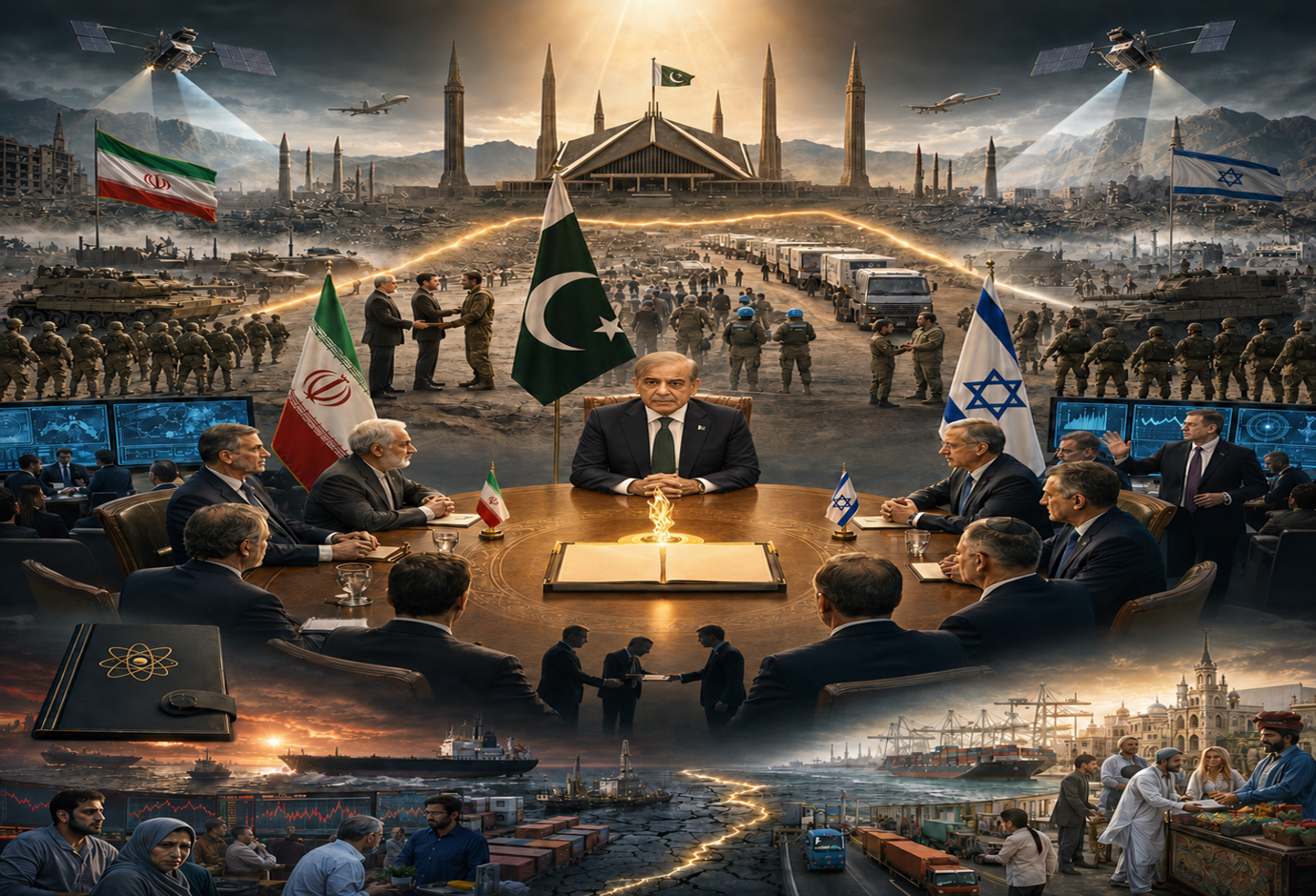
The Fragile Flame of Peace
The Quiet Cost of War

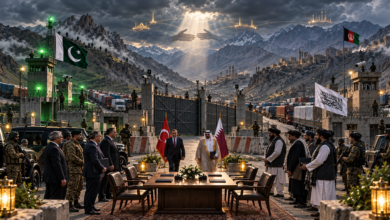
When the air of Islamabad stirs with the turning of history’s pages, there emerge moments that defy the modest label of mere diplomatic episodes. These are rare and weighty hours in which the destiny of nations slips, however briefly, from the austere and unyielding corridors of power into the subtler yet firmer grasp of intellect, discernment, and deliberation. The Islamabad Peace Accord stands as one such luminous instance—a chapter not confined to the annals of political history alone, but one that reflects the deeper tensions of intellectual, civilisational, and global consciousness. It is a moment in which words, for a fleeting interval, subdued the thunder of arms, though the echo of unanswered questions continues to hover in the atmosphere of time.
There resides within this accord a certain quiet symbolism, wherein not only the written word but also silence itself becomes eloquent. When the lamps of diplomacy are lit upon the horizon of this city, their glow illuminates not merely the formal texts of agreements, but also the fragile filaments of hope that promise a more tempered and humane future. One is compelled to sense that this covenant is not a mere aggregation of clauses and signatures, but a living intellectual and practical narrative—each sentence resonating with the pulse of history, each line offering a faint yet perceptible glimpse of what lies ahead.
It is in this spirit that the various dimensions of the accord may be articulated with such clarity and distinction that no element lapses into repetition, and each point assumes its rightful place within a coherent and complete tableau—a tableau in which the gravity of politics, the dignity of history, and the grace of literature appear in harmonious conjunction.
At first glance, the Islamabad Peace Accord may present itself as a straightforward diplomatic document. Yet beneath this apparent simplicity lie multiple strata of global politics and intricate strategic calculations. Its primary objectives encompassed an immediate cessation of hostilities, the dignified exchange of prisoners, a gradual easing of border tensions, and the establishment of a comprehensive framework through which long-standing disputes might, in time, be resolved through sustained dialogue. Alongside these provisions, humanitarian measures—such as the opening of relief corridors, access to affected regions, and the supervision of international observers—were accorded central importance, ensuring that the demands of peace were not confined to political abstractions but found tangible expression at the human level.
Simultaneously, the architecture of the agreement reflected a measured progression and a discerning strategic design. Under the principle of “phased confidence-building,” both parties were encouraged to curtail military activity, to establish demilitarised zones in sensitive regions, and to render immediate flashpoints temporarily inert. Moreover, the restoration of economic and commercial ties was conceived as a potent instrument of peace, guided by the enduring belief that the avenues of trade often succeed in softening the clamour of artillery. Thus, the accord was not merely a declaration of halted conflict, but the foundation of a gradual process—an attempt to keep the fragile flame of peace alight even amidst the gusts of uncertainty.
The pursuit of peace, as history repeatedly reminds us, seldom proceeds along a clear and untroubled highway; it winds instead through thorn-laden paths where each step is shadowed by trial. The Islamabad Peace Accord, too, emerged through such a labyrinth of complexities. Chief among its impediments was the profound deficit of mutual trust—deepened further by historical antagonisms, competing political interests, the reservations of military establishments, and the intensity of public sentiment. This agreement was not the mere outcome of formal negotiations; it was shaped also by those unseen currents of power that quietly determine the direction of global affairs.
Such delicate circumstances compelled matters to a juncture at which American leadership found it necessary to issue a stern warning to Israel. This warning was no perfunctory diplomatic gesture; it carried within it a message of unmistakable clarity—that the great powers were not prepared to countenance any unforeseen military escalation. Within this admonition there was both the unmistakable imprint of power and a discernible undertone of concern: that any violation of the spirit of the accord would not remain confined to the region but might well imperil the broader fabric of global peace. It was, in essence, a moment in which moral appeal and political interest appeared to speak in a single, measured breath.
A careful examination of the points advanced by Iranian sources reveals a dimension of striking significance—the conspicuous absence of any reference to the nuclear question. This silence does not appear accidental; rather, it reflects a deliberate and nuanced diplomatic strategy. On the surface, such omission may suggest a void, yet in truth it harbours an entire realm of meaning, wherein the unspoken exerts a force more profound than the declared.
It would seem that Iran has consciously chosen to exclude its nuclear programme from the ambit of this agreement, reserving it instead for a separate and more robust diplomatic arena. At the same time, the emphasis placed upon regional sovereignty, the rejection of external interference, and the primacy of internal stability suggests a carefully delineated hierarchy of priorities. In this light, the accord assumes for Iran the character of a provisional diplomatic bridge rather than a comprehensive settlement—a bridge that enables forward movement towards larger strategic objectives without prematurely placing its core strengths upon the negotiating table.
History offers an unyielding lesson: when the foundations of trust begin to erode, agreements are reduced to little more than ink upon paper. The Islamabad Peace Accord was subjected to precisely such a trial, and the eventual resurgence of conflict served as a stark indication that, at some level, its spirit had been compromised. Yet within the realm of international politics, the assignment of “blame” often remains obscured, for truth is veiled beneath competing narratives, and each party constructs around its position a formidable edifice of justification.
At times, an incident of modest proportion—one that might, with prudence and patience, have been quietly resolved—acquires, in the current of events, a force and severity that herald a far greater conflagration. It is at this delicate juncture that the gentler instruments of diplomacy recede into the background, and the harsher accents of militarism come starkly to the fore. One cannot but sense that history, in its sombre irony, is once again rehearsing an all too familiar script—where the authority of words falters, the language of arms prevails, and the once luminous lines of agreement grow dim beneath gathering clouds.
It is, therefore, both pertinent and necessary to ask whether the Islamabad Peace Accord contained within it any clear and enforceable mechanism to restrain or penalise a party found in violation. In the absence of such a firm and credible structure, upon what foundations might the durability of the accord ultimately rest?
The record of international politics suggests that agreements seldom endure by virtue of legal clauses alone. They are sustained, rather, by a confluence of moral pressure, diplomatic isolation, the weight of global opinion, and, where necessary, the spectre of economic sanctions. Yet this very system harbours an inherent frailty: when national interests, domestic compulsions, or the imperatives of power assert themselves with sufficient force, moral exhortation and diplomatic censure are not always equal to the task.
The true trial of the Islamabad Accord lies precisely here—whether its signatories can rise above the temptations of immediate advantage and honour the spirit that underpins it, or whether the perennial contest between power and expediency will erode its substance. For history bears consistent witness that peace agreements are not fortified by signatures alone; they endure through trust, political wisdom, and a sustained sense of responsibility. Where these elements falter, even the most carefully drafted instruments may be consigned to the dust of time, and it is at this threshold that a profound question mark emerges over the future of this accord.
International agreements are not chiselled in immutable stone; they evolve in response to changing circumstances, emerging challenges, and shifting political realities. Should the parties aspire to transform this accord from a temporary cessation into the cornerstone of lasting peace, there remains ample scope for the incorporation of more robust and clearly articulated provisions.
Such refinements might include stringent systems of oversight, modern methods of digital monitoring, the establishment of joint investigative bodies, clearly defined and actionable responses to violations, and effective mechanisms for rapid mediation—so that disputes may be addressed before they harden into renewed confrontation.
Yet enduring peace cannot be secured by official agreements and diplomatic clauses alone. It rests equally upon the patient cultivation of trust at the level of peoples. Through the fostering of public engagement, cultural exchange, and human proximity, the chasms that so often deepen political conflict may be meaningfully narrowed. For experience teaches that the distances which separate hearts are, at times, more perilous than those marked upon maps.
If, therefore, this accord is strengthened in accordance with the demands of its time, anchored in principles of transparent oversight, and supported by a genuine process of confidence-building, it may transcend the character of a temporary pause and instead lay the foundation of a new architecture of peace within the region.
In the realm of international diplomacy, it is frequently the case that the most consequential decisions are shaped behind closed doors, their formal announcement arriving only later upon the pages of history. Quiet exchanges, informal encounters, and discreet diplomatic channels often achieve what open negotiations cannot. These back channels are, in truth, the silent rivers of diplomacy—unseen to the eye, yet capable of bringing a vital moisture of possibility to the otherwise arid landscape of global politics.
Behind the Islamabad Peace Accord, too, the diplomatic engagements and discreet efforts of not only Pakistan but also other regional and influential global actors played a significant role. This is the chessboard of diplomacy where the decisive moves are seldom visible, yet their consequences unfold with far-reaching effect. Through such quiet conduits, messages are conveyed between parties, crises are managed at moments of acute tension, misunderstandings are dispelled, and the doors of dialogue are kept from closing altogether.
Indeed, the enduring strength of back-channel diplomacy lies in its very discretion. Here, words are sparing and gestures speak with greater eloquence; at times, a carefully measured phrase or a silent meeting may open pathways that protracted formal negotiations fail to uncover. It is for this reason that, in the resolution of global crises, such unseen diplomacy has long been regarded as an indispensable and effective instrument.
The continuation of war seldom remains confined to the battlefield alone; its tremors reverberate through every chamber of the global economy. Should tensions persist, uncertainty in energy markets, fluctuations in the price of oil, disruptions to trade routes, and a contraction in investment flows may together exert severe pressure upon the international economic order.
The economic world rests upon a delicate equilibrium, wherein a crisis in one region can generate profound unease across markets far beyond its immediate vicinity. A single spark may set in motion waves that travel across continents, their effects felt in economies thousands of miles removed. Alongside the spectre of an energy crisis come the instability of currencies, rising inflation, and the mounting economic strain upon ordinary lives—silent consequences of war that often endure far longer than the thunder of guns.
In truth, war is not waged upon frontiers alone; its cost is exacted in the markets, the factories, the avenues of employment, and the daily existence of ordinary men and women. It is for this reason that global peace is not merely a political desideratum, but an economic imperative, for the vessel of the world’s economy can pursue its course securely only upon the calmer tides of peace.
For Pakistan, the Islamabad Peace Accord represents not simply a diplomatic advance, but a stern trial, a historic opportunity, and a solemn responsibility. While it endeavours to consolidate its role upon the international stage as a proponent of peace and a responsible state, it must simultaneously contend with domestic political contestation, economic pressures, security challenges, and a multiplicity of internal trials. It is precisely at this juncture that the success of diplomacy depends not solely upon external strategy, but equally upon internal stability and national cohesion.
The cost of this accord cannot be measured merely in the currency of diplomatic exertion, negotiations, and international engagement; it demands, at the domestic level, sacrifice, prudence in decision-making, and an uncommon degree of foresight. Pakistan is required to maintain a delicate equilibrium in which every step must be taken with measured care, for in the realm of international politics even a minor miscalculation may yield consequences of considerable magnitude.
It must not be forgotten that success upon the external front is attainable only when the internal ranks are strong, united, and possessed of confidence. A divided nation cannot effectively raise its voice in the councils of the world, whereas unity, political sagacity, and national consensus furnish any diplomatic endeavour with a firm and enduring foundation.
Ultimately, the Islamabad Peace Accord is not merely a diplomatic instrument, but a test of national intention, of the wisdom of leadership, and of the collective conscience of humanity. If advanced with sincerity, prudence, responsibility, and fidelity to the principles of peace, it may assume the character of a luminous chapter in the chronicles of history; yet, should expediency, mistrust, and transient political demands prevail, it may remain no more than an unfulfilled promise—one among many agreements that fade into obscurity beneath the dust of time.
In conclusion, it may be said that the Islamabad Peace Accord is not a mere collection of pages, but a historical narrative in which hope and apprehension, deliberation and contradiction, diplomacy and power, all stand revealed in a single frame. It is emblematic of an attempt to secure peace within a region long overshadowed by distrust, conflict, and geopolitical rivalry. Here, every agreement is never merely an arrangement of words; it carries within it the interests of nations, the aspirations of peoples, the calculations of great powers, and the destinies of generations yet to come.
The accord, though akin to a solitary flame, reminds us that illumination alone does not ensure arrival at one’s destination. History bears witness that such a flame must be vigilantly guarded against the tempests that threaten to extinguish it. Its true sustenance lies not in signed parchment alone, but in the trust established between parties, the wisdom that guides difficult decisions, and the shared sense of responsibility that rises above immediate interests to uphold the broader cause of peace.
All aspects of this accord remind us that the path to peace is seldom an easy one. Even after the cessation of hostilities, the true test lies in the building of trust; for fragile trust may unsettle even the most robust agreements. It is therefore imperative that effective systems of oversight, clear mechanisms for addressing violations, sustained dialogue, and continuous diplomatic engagement be maintained, so that no minor disagreement may once again escalate into a greater conflict.
The role of global powers in the background of this accord is equally a matter of consequence. The diplomatic posture of the United States, the measured pronouncements of Iran, the interests of regional actors, and the discreet efforts of Pakistan and others collectively illustrate that, in the modern world, no regional crisis remains confined to its immediate geography. Energy, trade, security, and the global economy are so intricately interwoven that unrest in one region may reverberate across the entire international system.
It must also be recognised that the true strength of any peace accord lies not in external guarantees alone, but in the internal resolve of its parties. Should political leaderships demonstrate the courage to subordinate immediate advantage to broader national and regional interests, should public sentiment be guided from hostility towards trust, and should diplomacy be accorded its rightful place as a genuine alternative to war, then this accord may well lay the foundation of a new era.
For Pakistan, too, this moment carries the weight of historic responsibility. To play a meaningful role in the process of peace is not merely a diplomatic success; it requires internal stability, national unity, and a balanced foreign policy. Only a strong and cohesive Pakistan can exercise an effective influence upon the global stage, for success abroad is invariably rooted in strength at home.
In the final reckoning, the Islamabad Peace Accord imparts a fundamental lesson: that the highest expression of power lies not in the triumph of war, but in the preservation of peace. History has consistently reserved its esteem for those nations that employ their strength not for destruction, but for construction, justice, and the advancement of human welfare.
If this accord is carried forward with sincerity, wisdom, transparency, and a shared sense of responsibility, it may stand not merely as a regional achievement, but as a beacon of hope for the wider world. Yet, if mistrust, power politics, and transient interests come to dominate its course, it too may become one of those many entries in history that were once inscribed with hope, only to be lost to time through the failure of action.
For the greatest lesson of history remains this: peace is not born of signatures alone; it lives through intention, character, and sustained endeavour. If power is the lamp, wisdom is its light; and if peace is the destination, trust is the path without which no nation may hope to arrive.