The Mecca Defence Pact, Saudi Investment in Afghanistan, and the Region’s New Strategic Chessboard
A Historical and Political Inquiry into the Interlocking Relations of Pakistan, Afghanistan, Saudi Arabia, the United States and Iran

On the chessboard of international politics, certain agreements acquire significance not so much from the words inscribed upon them as from the hour in which they are concluded, the place in which they are signed, the identities of those gathered around the table, and the silences that accompany the ceremony. In diplomacy, a handshake is rarely only the meeting of two hands. Behind it may lie the unspoken calculations of several capitals, economic necessities, anxieties of national security and designs intended to shape not merely the next season, but the next generation.
Afghanistan is one such country upon whose soil history has repeatedly reopened old chapters beneath new headings. Once it was the arena of Anglo-Russian rivalry; later, a furnace of the Cold War; thereafter, the principal theatre of America’s “War on Terror”. Now, in a different age, it appears to be becoming a confluence of energy, mineral wealth, regional corridors, militancy, Gulf capital and the quieter contest of great powers.
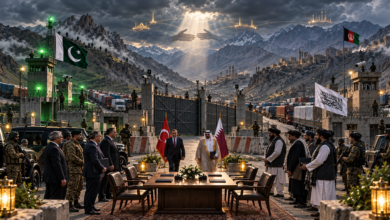
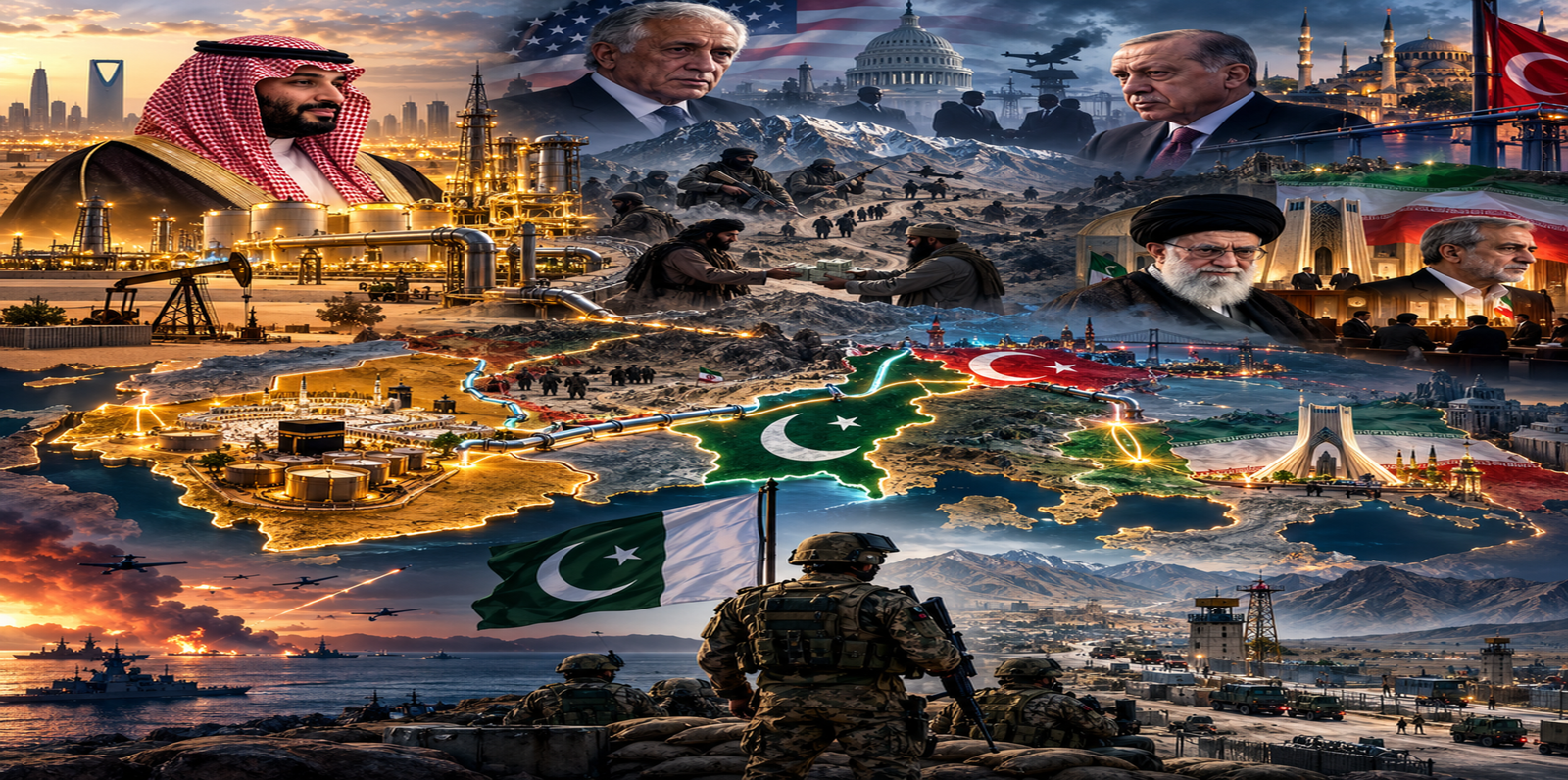
It is against this background that the recent defence arrangement associated with Pakistan, Saudi Arabia and Türkiye, Saudi investment in Afghanistan, the conspicuous presence of Zalmay Khalilzad, developments on the Yemeni front, anti-Pakistan armed groups, and apparently divergent voices emanating from within Iran ought to be examined not as isolated episodes, but as different shades within a single, larger canvas.
Yet the first discipline of serious inquiry is never to mistake inference for evidence, nor probability for fact. In politics, what appears at first glance to be one link in a single chain may, upon closer examination, belong to two entirely separate sequences of events.
The first question, therefore, is unavoidable: is Saudi investment in Afghanistan primarily an economic undertaking, an exercise in strategic encirclement, or an instrument of pressure upon Pakistan?
The answer should begin not with emotion, but with the actual character of the investment under discussion.
According to informed accounts, the Saudi-based Delta Energy Group has entered into agreements with Afghanistan’s Ministry of Mines and Petroleum for oil and gas exploration. The project reportedly encompasses the exploration of hydrocarbon resources across roughly nine thousand square miles of western Afghanistan, an assessment of the use of natural gas in Herat, and a proposed gas pipeline extending for approximately 435 miles.
What is particularly noteworthy is that the company in question is described not as an arm of the Saudi government or the Saudi sovereign wealth apparatus, but as an independent energy group based in Saudi Arabia.
That distinction is not trivial.
In international affairs, investment undertaken by a Saudi company cannot automatically be equated with direct strategic investment by the Saudi state. It is true that, in the Gulf, the relationship between the state, private capital and foreign policy may sometimes appear more intimate than in Western capitalist systems. Yet geographical association alone cannot be elevated into conclusive proof of a state-directed conspiracy.
The proposed pipeline, under the recent Saudi-Afghan arrangement, is said to run from a point near Herat to Spin Boldak in the Kandahar region—bringing the project to the immediate vicinity of the Pakistani frontier. Estimates have suggested that investment in the pipeline could reach as much as ten billion dollars over the course of a decade.
Here an intriguing contradiction presents itself.
If the principal object of this investment were to encircle Pakistan economically, or to “twist its arm”, then carrying an energy corridor as far as Spin Boldak might, paradoxically, create a future avenue of economic interdependence with Pakistan itself. Geography, after all, is often more obstinate than politics. Afghanistan is landlocked. Access to major markets and seaports must ultimately depend upon one or another of its neighbours—Pakistan, Iran or the states of Central Asia.
The first plausible interpretation, then, is that Saudi commercial interests may be viewing Afghanistan as a future frontier economy in energy and mineral resources. Another possibility is that Riyadh wishes to enlarge its economic presence in Afghanistan so that Kabul does not fall entirely within the orbit of Pakistan, China, Qatar or Iran. In this sense, the policy need not be anti-Pakistan at all; it may instead represent strategic diversification.
The difficulty for Pakistan arises where economic interests begin to collide with security interests.
For more than four decades, Pakistan has hosted millions of Afghan refugees. Yet Islamabad has also argued for years that Tehreek-e-Taliban Pakistan and certain other armed actors maintain sanctuaries inside Afghanistan. The Taliban authorities, for their part, have repeatedly disputed Pakistan’s interpretation of the matter.
Thus emerges a difficult moral and political question.
If Afghan territory continues to pose serious security threats to Pakistan while substantial Gulf investment flows into Afghanistan, will such investment moderate Kabul’s behaviour—or will it give Kabul greater confidence that prolonged tension with Pakistan can be endured?
That is the question which ought to lie at the heart of Pakistani concern.
It would be premature to describe Saudi investment as a “project against Pakistan”. Yet Islamabad is entitled to ask how much weight Riyadh attaches to Pakistan’s security concerns even as it develops closer economic ties with Kabul. The measure of an ally is not only what he says when you are in difficulty; at times, one must also observe the terms upon which he conducts business with your adversary.
The second major question concerns the presence of Zalmay Khalilzad: is the American shadow once again lengthening across Afghanistan?
This question is subtler still.
Khalilzad was present in Kabul at the signing ceremony connected with these agreements. His attendance inevitably bestowed upon the occasion a conspicuous geopolitical dimension.
Khalilzad is no ordinary former diplomat. His name is intertwined with almost every major turning point in Afghanistan’s recent political history. He has been a prominent figure in American diplomacy, negotiations with the Taliban, and the political process that accompanied the United States’ withdrawal from Afghanistan. His appearance at the moment of a major economic agreement between the Taliban authorities and a Saudi-based energy group therefore naturally raises questions.
But here again a line must be drawn between fact and suspicion.
Khalilzad is presently a private citizen and holds no official position in the United States government. Nevertheless, his presence alongside Taliban Deputy Prime Minister Abdul Ghani Baradar and senior representatives of Delta Energy, both in meetings and at the ceremony itself, invites inquiry into the nature of his role.
Three broad possibilities suggest themselves.
The first is that, drawing upon decades of Afghan connections and personal networks extending through Washington, the Gulf and Kabul, he may simply be acting as a facilitator or intermediary.
The second is that American policymakers, rather than re-establishing formal official relations with the Taliban, may be relying upon former diplomats, private institutions and allied countries to maintain a form of indirect engagement with Kabul.
The third, and more consequential, hypothesis is that a new form of American strategic influence may be emerging in Afghanistan without the return of an American military presence.
Yet the third possibility cannot, at present, responsibly be described as an established “American plan”. We can see Khalilzad’s presence; we cannot, on the evidence available, establish that he was acting as a representative of the United States government. This is precisely where political analysis so often goes astray: men see a shadow and presume they have identified the tree.
The United States has withdrawn militarily from Afghanistan, but Afghanistan has not disappeared from Washington’s strategic vocabulary. To its north lies Central Asia; to its east, China; to its west, Iran; to its south, Pakistan. Russian influence, China’s Belt and Road Initiative, Iranian security interests and Pakistan’s nuclear status together form a geopolitical chessboard from which no major power can remain entirely detached.
To disregard Khalilzad’s presence would therefore be politically naïve. To proclaim it proof of a secret Washington design would be equally unsatisfactory,
replacing inquiry with a conclusion reached in advance.
The proper questions are more exacting: why was he there? In what capacity? Who invited him? Who financed his involvement? What practical role, if any, did he play in the negotiation of the agreement?
Should documentary answers to those questions one day emerge, a firmer judgement regarding the American dimension may become possible.
The third, and equally important, question concerns Houthi attacks, Saudi unease and the possibility of financial bargaining over anti-Pakistan militant groups in Afghanistan.
This requires the greatest caution, for temporal proximity does not, by itself, establish causation. Even if it were shown that Houthi attacks against Saudi Arabia increased after a particular defence arrangement, the mere fact that one event followed another would not demonstrate that the latter was caused by the former.
Yemen, Iran, the Red Sea, Israel, the United States and Saudi Arabia inhabit a security theatre with its own history and motivations. Afghanistan’s energy prospects, terrorism and frontier tensions with Pakistan belong to another geographical setting.
Great powers may, of course, seek balances across several fronts simultaneously. But to thread every two coincidental events upon the same hidden string is to risk transforming analysis into fiction.
The question of Afghan Taliban demands for financial assistance to relocate anti-Pakistan armed elements away from frontier areas can no longer be dismissed merely as newspaper speculation or an unsubstantiated political allegation. The matter has entered discussion at parliamentary and official levels in Pakistan, while the Pakistani Defence Minister has also indicated that the Afghan Taliban have raised the issue of resources and financial support for the relocation of such elements.
Islamabad has not entirely excluded the possibility that limited assistance might be considered if a structured arrangement could demonstrably reduce genuine threats to Pakistan’s security.
But the central question is not the amount of money involved. It is the nature of the security guarantee obtained in return.
If the prevention of terrorism becomes conditional upon payment, an uncomfortable question arises: is Pakistan purchasing a durable solution to a security problem, or laying the foundations of a precedent in which security itself becomes a commodity?
If money is paid today to move one-armed group away from the border, what prevents another price being demanded tomorrow for another group, another sanctuary or another manufactured crisis? A sovereign responsibility may gradually be transformed into a financial transaction.
Suppose Pakistan were to provide substantial financial assistance and anti-Pakistan militant elements were moved from Kunar, Nangarhar or other frontier districts to some remote part of Afghanistan. The immediate border threat might appear to diminish. But would relocation also destroy their fighting capacity?
Would their command-and-control structures be dismantled? Would their financing be severed? Would their weapons be confiscated? Would their training infrastructure be closed? Above all, would the Afghan authorities accept obligations that could subsequently be tested, monitored and verified?
Unless the answer to these questions is clearly affirmative, geographical relocation alone would not solve the problem. It would merely move the danger from one place to another.
The power of an armed organisation lies not solely in the location of its camp. It resides in its networks, finances, ideology, local facilitators, intelligence connections, sanctuaries and ability to operate across borders. If these remain intact, a distance of a few hundred miles can offer no meaningful security guarantee.
For this reason, Pakistan should insist that any prospective financial arrangement must not become merely the price of moving individuals from one district to another. It should instead be tied to a comprehensive, phased and verifiable security framework.
Such a framework would require the ability to verify the numbers, locations and movements of the relevant armed elements; to demonstrate materially that their capacity for cross-border operations had been neutralised; to restrict their financial and military infrastructure; and to establish predetermined diplomatic, political or financial consequences in the event of violation.
Pakistan, in other words, would need an arrangement in which the price is not paid today while the guarantee is deferred to an indefinite tomorrow.
There is also a fundamental legal and moral dimension.
A state is, in principle, responsible for ensuring that its territory is not used for armed attacks against a neighbouring country. If Kabul argues that financial resources are required to relocate or restrict anti-Pakistan armed groups, Islamabad may reasonably ask whether this is merely an administrative difficulty for which temporary assistance may be justified—or whether Pakistan is being asked repeatedly to pay another state to discharge a sovereign responsibility that properly belongs to that state itself.
Between those two propositions lies a gulf.
Pakistan and Afghanistan do not share the history of ordinary neighbours. For more than four decades, Pakistan has hosted millions of Afghan refugees and absorbed the effects of Afghanistan’s political disorder, war, weapons, narcotics, frontier instability, terrorism and economic dislocation.
Against that historical background, resentment within the Pakistani state and society would be unsurprising if Pakistan were now expected to finance the relocation of armed elements operating against it from Afghan territory simply in order to secure its own safety.
Yet statesmanship cannot be governed by emotion alone.
If a limited, transparent, conditional and monitorable financial arrangement could genuinely produce a significant reduction in terrorist attacks, save thousands of lives and bring durable stability to Pakistan’s western frontier, rejecting it solely in the name of inflexible principle would not necessarily be prudent.
But such assistance must not amount merely to “buying peace”.
Pakistan should seek not purchased peace, but verifiable peace.
To buy peace is to pay money, receive a promise, and then hope that the promise is honoured. Verifiable peace is of another order: explicit conditions, phased payments, continuous monitoring, intelligence confirmation, measurable outcomes, and agreed consequences in the event of breach.
If the Afghan Taliban genuinely seek a serious security arrangement with Pakistan, they too must be prepared to accept this degree of accountability. Verbal assurances alone cannot suffice for Islamabad, not least because the region’s recent history contains too many instances in which promises, agreements and realities on the ground have stood some distance apart.
The substitute for trust is not simply more trust. It is verification.
This is the point at which Saudi Arabia’s growing economic interest in Afghanistan acquires a different political significance.
If Riyadh is establishing substantial economic interests in Afghanistan, the prudent course for Pakistan is not merely to ask why Saudi Arabia is investing in Kabul. A more useful approach would be to seek to connect Saudi Arabia’s growing economic influence with expectations of responsible Afghan regional behaviour.
If Kabul wishes to benefit from Saudi capital, energy investment, infrastructure and economic partnership, Pakistan can reasonably argue that such advantages ought not to be separated from Afghanistan’s responsibility to ensure that its territory is not used for armed activity against neighbouring states.
Saudi investment might thereby become not an instrument of pressure upon Pakistan, but a means of encouraging more responsible conduct in Kabul.
Pakistan, in this regard, requires more calculation than anger, more strategy than reaction.
In politics, closing a door is often the easiest course. The more effective art is to arrange the interests of those standing on the other side so that cooperation with you becomes profitable and violation becomes costly.
Pakistan must approach Afghanistan by precisely this principle.
If financial support is ever provided, it should not be payment for relocation alone, but part of an arrangement to dismantle the broader infrastructure of militancy. Moving armed men from one Afghan province to another is not enough. Their organisational structures, training facilities, financial networks, weapons, cross-border links and operational capacities must be neutralised. Otherwise, the danger changes its address but not its nature.
A serpent carried from one corner of the courtyard and placed in another does not render the house safe.
Thus, the proper question for Pakistan is not simply, “Should money be paid or not?” The more serious question is: if money is paid, what incontrovertible security architecture will be obtained in return—one capable not merely of suppressing terrorism temporarily, but of constraining it structurally?
Without a clear, documented and verifiable answer, financial assistance may become less a solution than a dangerous precedent for future coercion.
A fourth major issue arises from the aftermath of this defence arrangement: the differing tones of Iran, Mohsen Rezaei and the Iranian Foreign Ministry. Does Iran, as some have suggested, effectively contain “two governments”?
A fundamental historical correction is required here.
The coexistence of an elected government with powerful religious and revolutionary institutions is not a recent discovery in Iran. It lies at the heart of the constitutional and institutional order created after the Revolution of 1979.
The President, cabinet and Foreign Ministry form part of the elected political administration. Yet the Supreme Leader, the Islamic Revolutionary Guard Corps, the Guardian Council, the Expediency Council and senior security institutions exercise exceptional influence over foreign and defence policy.
Thus, when the statement of an important Iranian figure differs in tone from that of the Foreign Ministry, this does not by itself prove the sudden emergence of “two governments”. It may simply reveal one aspect of Iran’s composite structure of authority.
If, on the one hand, Mohsen Rezaei stated that Iran had not been taken into confidence over the Mecca arrangement, while, on the other, Foreign Ministry spokesman Esmaeil Baghaei maintained that Pakistan had continued to provide information to Iran and that Tehran welcomed Pakistani mediation efforts, at least three interpretations are possible.
The first is that a genuine difference of policy or information exists between Iranian institutions. The second is that Rezaei’s remarks constituted a bargaining position for domestic political purposes—that Iran, by signalling displeasure, sought a stronger position within emerging defence arrangements.
The third is that the Foreign Ministry deliberately adopted a more measured tone in order to prevent unnecessary damage to relations with Pakistan.
Foreign policy sometimes allows a single state to speak in two registers at once: one for a domestic audience, another for the diplomatic table. This need not always signify disorder. At times, it may amount to calculated strategic ambiguity.
If, however, Iran genuinely seeks the standing of a “founding participant” in such a defence arrangement, the strategic consequences would be profound.
Tehran is unlikely to welcome the emergence of a Gulf-Pakistan-Türkiye security architecture in which Iran remains merely an observer outside the room. For Iran, the question would extend far beyond Saudi Arabia. It would touch Israel, the United States, Gulf security, Iraq, Syria, Yemen and Iran’s own eastern flank.
Saudi Arabia, meanwhile, may be reluctant to embrace a defence framework in which Iran’s full participation creates new complications in Riyadh’s relations with Israel, the United States or other Gulf countries.
Pakistan may therefore stand before a difficult yet historic opportunity.
Its defence relationship with Saudi Arabia is longstanding. Iran is its neighbour. Türkiye is an important defence partner. China is a major economic and strategic partner.
If Islamabad proceeds with judgement, it could become a bridge between these different axes. If emotion or factional politics prevails, the same geography could instead turn Pakistan into terrain pulled between competing blocs.
If the defence arrangement under discussion genuinely includes the principle that “an attack upon one shall be regarded as an attack upon all”, the true meaning of that sentence will not lie in its rhetorical power, but in its legal definition.
Here begins the real test of any “Mecca defence” concept.
What constitutes an “attack”?
Only a direct assault by the armed forces of another state?
Or the action of a proxy organisation?
A drone strike?
A cyberattack?
An act of terrorism?
Cross-border firing?
And, most importantly, once an attack upon one member is established, what obligations fall upon the others? Must they intervene militarily? Or are they merely required to consult, exchange intelligence, supply arms, provide air defence, or offer diplomatic support?
Even the world’s most developed collective-defence arrangements do not rest upon a single sentence. They are sustained by legal definitions, command structures, intelligence protocols, joint exercises, financial commitments and political procedures.
To hear the phrase “an attack upon one is an attack upon all”, therefore, and immediately infer the existence of a complete military alliance would be premature.
If Pakistan wishes such an arrangement to become a genuine pillar of national security, it must ensure that non-state terrorism and cross-border proxy violence are explicitly incorporated within the alliance’s conception of security.
Otherwise, the arrangement may become a shield against spectacular interstate aggression while remaining a silent spectator before the everyday violence of terrorism.
Conclusion
Afghanistan remains the same historical gateway upon which empires once knocked; only the garments of those who approach it have changed.
Once, one heard the thunder of cavalry. Today, one sees pipelines.
Once, fortresses were captured. Today, influence is established over energy reserves and commercial corridors.
Once, armies altered the map. Today, capital, ports, mineral wealth, drones and intelligence networks have become the new vocabulary of power.
For the present, it would be unsound to describe Saudi investment in Afghanistan as an anti-Pakistan conspiracy. The material available points more convincingly towards a major energy project with both economic and geopolitical consequences.
Zalmay Khalilzad’s presence, however, unquestionably merits attention. To dismiss him merely as a former diplomat or private citizen would itself be an excessively simple interpretation. His decades-long connections with Afghanistan, the Taliban, Washington and the capitals of the Gulf mean that his appearance can reasonably be viewed as evidence of an informal American footprint.
That does not mean that Khalilzad was acting under a written governmental mandate or formally representing the United States. International politics frequently employs former diplomats, special envoys and well-connected intermediaries as informal channels through which states can test an environment, sustain contacts and examine possibilities without assuming the burden of formal responsibility.
A cautious but meaningful conclusion, therefore, would be that Khalilzad’s presence is not conclusive proof of an American state project, but it may nevertheless be regarded as a significant indication of continued American strategic interest, informal access and residual influence in the region.
In a country as sensitive as Afghanistan, the appearance of such a figure at precisely the moment of a major Saudi-Afghan economic arrangement should not be dismissed as mere coincidence if political analysis is to retain any seriousness.
The reported Taliban demand for financial support to relocate anti-Pakistan groups—if conclusively established by authoritative documentation—should not be treated as an ordinary diplomatic bargain. It would raise grave questions concerning security and sovereign responsibility.
Similarly, divergent Iranian statements are better understood not as proof that “two governments” have suddenly arisen in Tehran, but against the background of Iran’s longstanding dual or composite structure of authority, its internal factions, and the presence of multiple institutional voices in foreign policy.
For Pakistan, the decisive question is not who stands with it and who stands against it.
The decisive question is whether Pakistan can integrate its geography, defence, commerce, diplomacy and domestic stability so effectively that ignoring Pakistan becomes costly to others, while cooperation with it becomes advantageous.
The strength of nations does not issue from the mouth of the cannon alone.
It is born also in the university laboratory, the furnace of industry, the dockyard of the port, the diplomat’s chamber, the soldier’s resolve, the rule of law and the collective intelligence of a people.
History offers a persistent lesson.
Nations that leave their destiny to the interpretation of other states’ intentions spend their lives searching for conspiracies. Nations that strengthen their own institutions, knowledge and power learn to make their way even in the presence of conspiracy.
Pakistan’s proper response to this emerging regional landscape is therefore not anxiety, but strategic self-possession: friendship with Saudi Arabia, respect for the imperatives of neighbourliness with Iran, defence cooperation with Türkiye, an insistence upon clear accountability from Afghanistan, and before every great power a line marking Pakistan’s national interest so plainly that neither the warmth of friendship can erase it nor the cold of pressure move it.
For those who understand statecraft know that in the affairs of nations, permanent friends and permanent enemies are comparatively rare.
What endures is national interest, geography—and the long memory of history.