The Gulf’s Silent Clash
Two Allies, Two Paths

In the history of nations, not every quarrel announces itself with the thunder of cannon and the crack of gunfire. Some disputes are first heard in the hushed window of a bank, in the faltering pulse of commerce, in the studied architecture of diplomatic language, and in the subtle alteration of a media tone. Relations between states are, in this respect, not unlike relations between men: when the first fissure appears in the edifice of trust, the windowpanes may begin to tremble long before the doors are finally shut.
For several decades, Saudi Arabia and the United Arab Emirates were regarded as embodiments of proximity, partnership and shared interest within the political, economic and security order of the Gulf. Yet reliable sources now describe a landscape in which their relationship appears no longer confined to the bounds of friendly rivalry. Financial scrutiny, commercial uncertainty, Yemen, Iran, the politics of oil, confrontation through the media, and differing visions of regional alignment have together subjected that relationship to a new and more searching trial.
Nor is this merely a disagreement between two Arab states. In the architecture of Gulf politics, Saudi Arabia and the United Arab Emirates are two principal pillars; a shift in the bearing of either may disturb the equilibrium of the entire structure. If the priorities of Riyadh and Abu Dhabi continue to diverge, the consequences may cast their shadow far beyond their bilateral relationship—across oil markets, Yemen, Iran, Israel, Pakistan, Türkiye, and indeed the wider Muslim world.
Saudi Arabia is reported to have tightened scrutiny over financial transfers bound for the United Arab Emirates, a development being interpreted as the latest sign of mounting tension between the two countries—a quiet knock at the door of disagreement. In economic relations, the movement of money is what the circulation of blood is to the human body. When the gates of commerce remain ostensibly open, yet the banking system begins fastening the locks of caution, the issue ceases to be one of regulation alone; confidence itself comes under question.
Diplomacy, moreover, often speaks through action before it speaks through proclamation. An ambassador need not be recalled; no resolution need be passed; no public quarrel need erupt. Sometimes the prudence of bankers is enough to tell us what sort of weather may be approaching.
If, therefore, this increase in financial scrutiny has indeed arisen against the background of political disagreement between the two states, it would be difficult to dismiss it as an exclusively technical measure. It may indicate that the accumulated capital of interstate confidence, painstakingly built over many years, has itself entered the ledger of cautious calculation. The essential point is that trade between Saudi Arabia and the United Arab Emirates is not merely bilateral business; it forms part of the interlocking structure of the Gulf economy. A tightening of financial regulation may therefore travel, by degrees, into trade, investment and the confidence of the private sector.
Enhanced financial scrutiny is ordinarily associated with jurisdictions regarded as presenting higher risks in relation to illicit financial transfers. According to the sources cited, the United Arab Emirates has been placed within such a category in the Saudi system. In its outward form, this is a matter of financial regulation. Yet in relations between states, words possess not merely lexical weight but political gravity. To place a close ally within a higher category of financial risk—if such a classification has indeed been formally made—is no longer a matter of bureaucratic paperwork alone. It becomes a heavy weight upon the scales of trust.
Here, however, caution is indispensable. According to the sources, these measures were not formally announced. They should therefore be understood not as established Saudi state policy, but as a situation attributed to the information supplied by those sources. Even so, the symbolism is difficult to ignore. States may continue to speak the language of friendship while their institutions begin quietly redrawing their lists of risk. It is at precisely such moments that the diplomatic smile and institutional distrust find themselves seated at the same table. A high-risk financial classification, after all, may be read as something considerably more than a regulation: it may also carry the character of a political message.
The report in question cites several business figures who say Saudi banks delayed or returned payments associated with the United Arab Emirates and denominated in various currencies. The Saudi central bank, by contrast, denies the existence of any direct restriction against a particular country, while Emirati officials say they have received no reports of unusual difficulties from the private sector. Here one encounters a curious but familiar condition in diplomacy: the market tells one story, the institutions another.
In international affairs, an official denial is not invariably proof that no difficulty exists on the ground; equally, a private complaint is not invariably irrefutable evidence of an organised policy of state. Between these two poles lies an extensive grey country in which regulation, caution, political signalling and commercial uncertainty overlap.
The true danger begins when investors lose certainty. Capital is a traveller governed by apprehension; once the road ahead becomes obscured by mist, it rarely hesitates long before choosing another destination. If the distance between the complaints of business and the assurances of officialdom continues to widen—and if firms begin to suspect that financial movement between Saudi Arabia and the United Arab Emirates may itself become hostage to political conditions—they will inevitably begin seeking alternative routes, new banking centres and contingency arrangements.
It should also be remembered that differences of interest between Saudi Arabia and the United Arab Emirates did not arise yesterday. They have existed for years. Yet recent disputes concerning oil, Yemen, Iran and the wider regional conflict have watered roots that were already present and brought them more visibly to the surface.
Disagreements among allies seldom begin with enmity. More often, they begin with a divergence of priorities. So long as the destination remains common, differences over the road can be endured. But when the destinations themselves begin to part company, even an old alliance comes under strain.
Oil remains a principal foundation of the power of both Saudi Arabia and the United Arab Emirates. Precisely for that reason, questions of production, price, market share and influence over the global energy market may make them partners on one day and competitors on another. Nor have their interests in Yemen been identical at every stage. When powers fighting in the same war cultivate relationships with different local groups, a second front can quietly emerge within the first.
The present circumstances also suggest two distinct approaches towards Iran: one more assertive, the other comparatively cautious and conciliatory. That difference may yet prove consequential, for it has the potential to reshape the very idea of Gulf security.
Concern has been expressed that delays or obstructions affecting transfers from Saudi Arabia into certain UAE accounts could damage trade between the neighbouring states. The real test of relations between governments does not always take place beneath the chandeliers of summit meetings; sometimes the verdict is delivered in the accounts department of a company.
When a business cannot know when its funds will arrive, whether a payment will be returned, or when it will finally clear, political tension begins to acquire an economic price. It is at that point that disagreement leaves the chambers of the political elite and enters the marketplace.
If Saudi and Emirati companies are required to produce greater documentation, endure longer delays, undergo additional banking checks or face increased payment risks in dealing with one another, supply chains may suffer and fresh investment decisions may be postponed. An economy resembles glass: it may appear formidable and polished, yet a single blow to confidence can send fine cracks travelling across its surface. In a Gulf economy distinguished by speed and by its ability to attract capital, delays in financial transfers are not small blemishes. They may lengthen into dangerous shadows over trade.
Reports have emerged since May of payments sent by Saudi banks to companies based in the Emirates, and to accounts held by certain individuals in Dubai, being stopped or returned. The detail matters. If such difficulties cease to resemble isolated transactions and begin instead to create the impression of a wider pattern, a political disagreement may appear to be advancing towards the institutional level.
States have many ways of expressing displeasure with one another. Sometimes it takes the form of a diplomatic statement; sometimes a commercial regulation; sometimes border policy; sometimes financial surveillance. In the modern world, the banking system itself has become one of diplomacy’s quieter instruments.
Yet because the Saudi central bank has denied imposing restrictions upon any particular country, it would be inaccurate to describe the present situation as an “announced financial sanction”. The more careful formulation is that the information supplied refers to a number of incidents—including alleged returns of payments since May—which have given the tension an institutional hue and strengthened suspicions within business circles that political motives may lie behind them.
One account cited concerns a Dubai-based company in the health sector. According to one of its officials, several payments from a longstanding Saudi customer were stopped and returned from the middle of May onwards. The truth of a great political contest sometimes reveals itself most clearly in a very small incident. One company, one customer and a handful of returned payments may appear trivial upon the vast canvas of world politics. In the commercial world, however, such incidents are precisely the bells that sound an alarm.
If a business relationship sustained over many years suddenly becomes entangled in financial obstruction, the company involved will inevitably ask whether the problem is merely technical or whether some wider alteration in the policy of the state lies behind it. This is why economic mistrust can magnify political disagreement many times over. Governments may resume speaking to one another; but once merchants have recalculated the risks upon which they conduct their affairs, restoring confidence becomes a considerably harder undertaking. A small mirror of a larger dispute can itself become a warning of dangers yet to come.
A December incident has likewise been cited as an especially visible manifestation of Saudi–Emirati tension. It concerned reported Saudi action against a shipment of military equipment intended for Yemen’s Southern Transitional Council, an organisation with which the United Arab Emirates is described as being aligned.
For years, Yemen has ceased to be merely a war of Yemenis. It has become a meeting ground for the interests, security anxieties and political designs of regional powers. If two allies operating in the same country begin to favour different local forces, contradiction at the foundations of the alliance becomes almost unavoidable.
The incident was followed by a fierce war of words among Saudi and Emirati media outlets, commentators and influential social-media accounts. There was even mention of the UAE restricting certain Al Arabiya accounts on X. When differences between governments spill into the media, one may reasonably conclude that the silence behind the curtain is beginning to weaken. The press frequently becomes the drum of a conflict to which diplomacy is not yet prepared to give a name. In this case, the Yemen question appears to have travelled from the battlefield into the very heart of relations within the Gulf.
According to the information provided, the United Arab Emirates adopted a comparatively more assertive posture in the war against Iran, and its practical involvement was deeper than initially assumed. If that claim is considered within the framework of Saudi–Emirati relations, it points towards a fundamental difference in their conceptions of security.
The UAE’s regional strategy appears more activist, more direct and more willing to accept risk. Within such a conception, a geographically small state may seek to acquire the stature and identity of a much larger power.
Yet every display of power carries its own bill. Direct confrontation with Iran in the Gulf could expose trade, energy, maritime routes and major urban centres to exceptional danger. A region that has erected the architecture of prosperity upon the foundations of stability must recognise that even one spark of war may conceal a palace of gold behind a wall of smoke. Were confrontation with Iran and an assertive Emirati posture to provoke retaliation, God forbid, even the smallest tremor of war amid forests of towers and skyscrapers could foreshadow ruin on a scale resembling a minor apocalypse.
Saudi Arabia’s posture, by contrast, appears more cautious and more finely balanced. Riyadh condemned attacks attributed to Iran against Gulf states and expressed willingness to allow United States forces to use King Fahd Air Base at Taif; yet at the same time, it continued efforts, through Islamabad, to pursue dialogue with Tehran.
It is the diplomacy of holding the sword in one hand and the olive branch in the other.
For Saudi Arabia, Iran is not merely a rival; it is also a neighbour whom geography cannot remove. States may change their enemies; they cannot change their neighbours. For Riyadh, therefore, the cost of total war may exceed the value of any limited political victory.
The appearance of Pakistan as a diplomatic intermediary is significant for the same reason. Pakistan possesses longstanding ties with Saudi Arabia while sharing both a border and a diplomatic relationship with Iran. Islamabad has consequently been able to act as a bridge across which parties reluctant to walk directly to one another’s door have nevertheless been prepared to pass.
Elsewhere, a claim concerning Emirati withdrawal from OPEC and the politics surrounding oil was striking to observers of international affairs: namely, that after nearly sixty years of membership the United Arab Emirates had left OPEC and subsequently increased its oil production substantially. Because independent external verification of this specific claim was not possible during the preparation of the source report, it should be read as a reported assertion rather than as an independently established fact. Its significance within the political argument, however, is considerable.
OPEC is not merely a technical forum for oil-producing states. For decades it has represented a form of collective power capable of influencing energy and, through energy, the world economy. Saudi Arabia has traditionally been regarded as the most influential centre of that arrangement.
If the priorities of a major Gulf producer were indeed to detach themselves from that collective discipline, the issue would cease to concern the number of barrels alone. It would raise a more consequential question: is the politics of Gulf energy moving away from a shared order and towards a harsher competition among national economic interests?
The oil well may be sunk in the earth, but its shadow falls across the chambers of diplomacy.
The relationship between Saudi Arabia and the United Arab Emirates might thus be described as an economic war of attrition—a contest in which no bullet need be fired, yet whose economic repercussions may be severe enough to disturb markets far beyond the Gulf. Businesses, anticipating the possibility of further deterioration, were reportedly already preparing alternative arrangements.
The phrase contains within it an entire political history. Modern states do not conduct every struggle upon a battlefield. Ports, investments, airlines, financial centres, tourism, technology, regional corporate headquarters and oil production may all become instruments of competition.
If Saudi Arabia seeks to diversify its economy, attract international investment and establish itself as a regional commercial centre, while Dubai simultaneously strives to preserve the commercial supremacy it already enjoys, competition between the two is natural. Yet the line dividing competition from antagonism is a narrow one. When businesses begin drawing up contingency plans, it is a sign that the marketplace has begun taking political risk seriously.
One must also recall the murder of the journalist Jamal Khashoggi at the Saudi consulate in Istanbul on 2 October 2018, an event that convulsed media across the world and was followed by widely publicised allegations against the Saudi government as well as Saudi denials.
Some sources have also referred to a claim that a covert Emirati intrigue lay somewhere in the background of the episode, intended to discredit the Saudi leadership. At this point, historical caution is not merely desirable but essential.
The murder of Khashoggi was real and provoked intense international reaction. The alleged Emirati conspiracy referred to in connection with the present tensions, however, cannot be presented as established fact. It is more properly described for what it is: a claim or report that has circulated in certain quarters in the shadow of the Khashoggi murder and the conspiracy narratives surrounding it.
Rumour, too, can become a weapon in politics. Once suspicion takes root between two allied states, old events begin to acquire new meanings. What was dismissed yesterday as conjecture may return tomorrow dressed as political accusation. This is among the most dangerous stages in the deterioration of a relationship: the moment when mistrust begins rewriting the past.
The United Arab Emirates, meanwhile, embraced the Abraham Accords and rapidly expanded its diplomatic, commercial and tourism relations with Israel. The Accords, the relationship with Israel, and the cultivation of a distinct Emirati identity may all be read in connection with Abu Dhabi’s wider effort to establish itself as an autonomous centre of power within the region.
That decision altered an old convention of Gulf politics. For a long period, Palestine served as one of the central points of reference in the collective political identity of the Arab world. The establishment of direct relations with Israel demonstrated that some states were now prepared to define national interest separately from older conceptions of a common Arab position.
The source article argues that this policy has sharply reduced the UAE’s popularity among sections of Muslim public opinion. That judgement is political in character, but it nevertheless gives rise to a larger and more enduring question: can economic progress, diplomatic agility and proximity to the great powers ever be sufficient for a state to disregard dissatisfaction within the broader civilisational and popular constituency to which it belongs?
The strength of a state is not contained in its treasury alone. Some of it lies in reputation, some in trust, and some in that less measurable moral capital which is accumulated through the sentiments of generations.
Here, perhaps, lies the largest question of the entire argument: can the United Arab Emirates sustain its power while standing apart from the wider Muslim world?
If its regional alignments carry it progressively further from broad currents of Muslim public sentiment, for how long can it maintain its position as a distinct power in its own right?
Alongside this question comes discussion of a possible new defence alignment touching upon Israel, Syria, Türkiye, Pakistan and Saudi Arabia. Here, principle is more useful than prophecy. No small or medium-sized state becomes a great power by wealth alone. Geography, population, military capability, diplomatic relationships, public legitimacy, trade routes and the confidence of allies together form the architecture of power. If several of those pillars begin to weaken, wealth by itself cannot indefinitely hold up the roof.
If Pakistan, Saudi Arabia and Türkiye are indeed moving towards closer cooperation in matters of security, a new axis may be taking shape upon the political chessboard of the Gulf and the Middle East. Yet without independent verification of the reported trilateral defence arrangements and the military developments referred to in the source material, they should be treated as elements of a political scenario rather than as settled fact.
History does, however, permit one conclusion of a more durable kind: lasting peace in a region is not secured by a balance of power alone, but by a balance of interests. The day states place their immediate advantage above the collective stability of the region is the day clouds of war begin gathering upon the horizon.
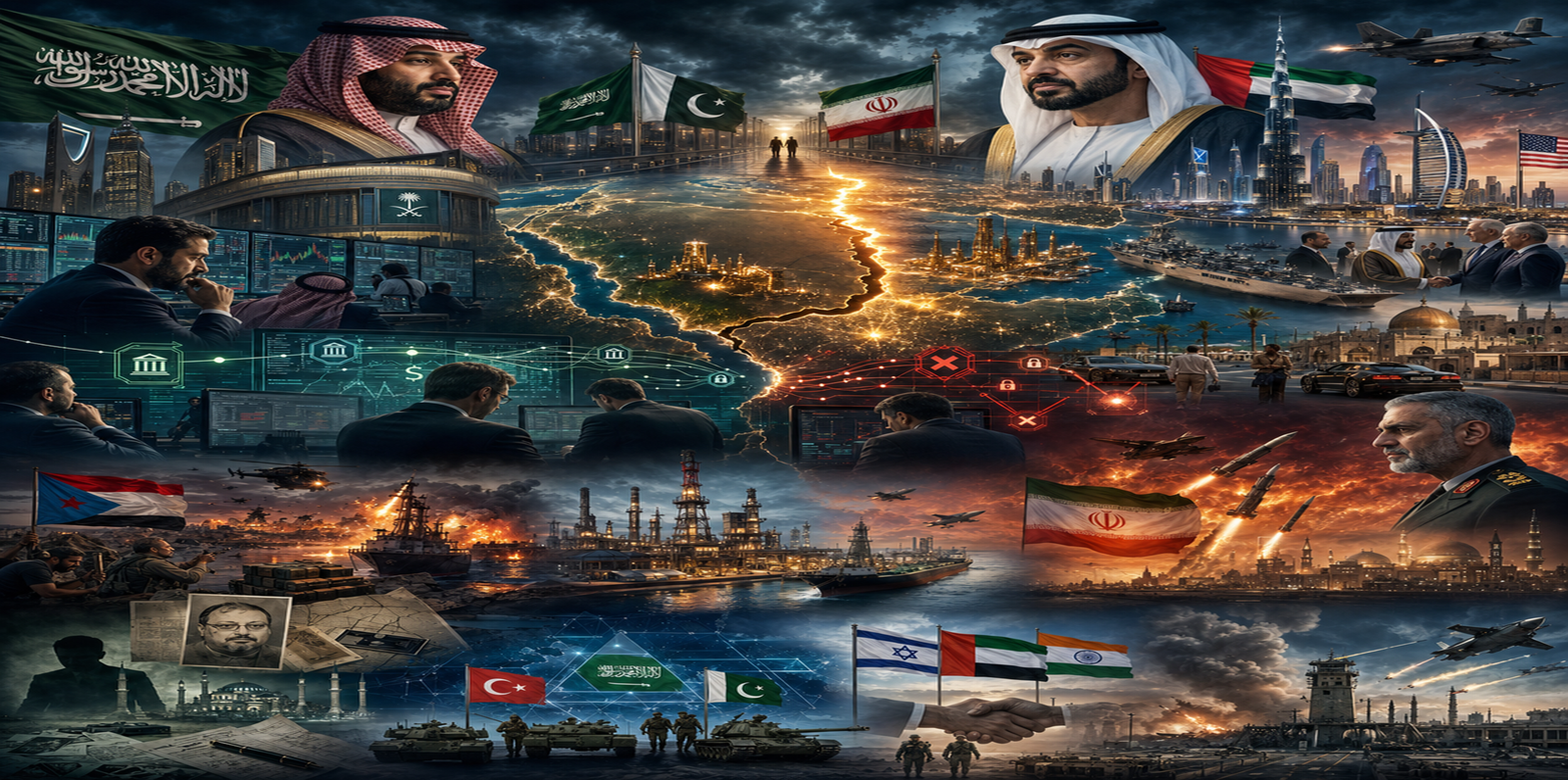
The present picture of Saudi–Emirati relations is therefore the story of an alliance in which new windows of competing interest have opened. Financial scrutiny, complaints of banking obstruction, divergent priorities in Yemen, differing approaches towards Iran, the politics of oil, conflict in the media and relations with Israel are not isolated islands. They are waves belonging to the same sea.
The central question is not whether Riyadh and Abu Dhabi will sever themselves from one another altogether. Relations between states resemble a chessboard, not a marriage contract that is annulled forever upon the first quarrel. Trade, geography, security and common interests bind the two countries by cords too strong to be snapped by a single tug.
The greater question is where the very idea of leadership in the Gulf is now heading.
Will the coming era be one of renewed Saudi centrality? Will the United Arab Emirates further consolidate an independent global identity? Could deeper security cooperation among Türkiye, Pakistan and Saudi Arabia produce a new political axis within the Muslim world? And will Arab states maintaining close relations with Israel succeed in reconciling those relationships with the sentiments of their own peoples and of the wider Muslim community?
These questions remain open before the scribe of history. Time does not deliver its verdicts at once. Sometimes it takes decades to discover that what appeared to be an inconsequential banking regulation was in truth the opening movement of a great political age; that what seemed a temporary souring between allies was merely the first page of a new regional alignment.
The Gulf today possesses greater wealth and power than at almost any previous moment. Yet the greater the power, the wider becomes the circumference of responsibility. If the states of the region can prevent competition from hardening into hostility, and instead make cooperation, prudence and common security its foundations, the Arab world may yet cross the threshold of a new era.
But if the vessels of national interest cast off entirely from the common shore, the great towers of wealth may remain standing even as the lamp of tranquillity grows dim upon the political horizon.
History has taught the lesson often enough: the loftiest ramparts of power are not secure without wisdom, and the deepest treasury cannot purchase what is contained in a mere handful of the soil of trust.
The greatness of states lies not merely in making the world fear them. Greater still is the state whose judgements command weight, whose friendship inspires confidence, and whose power is felt to contain within it some element of the common good.
And perhaps that is the greatest lesson contained in the Gulf’s present crisis.