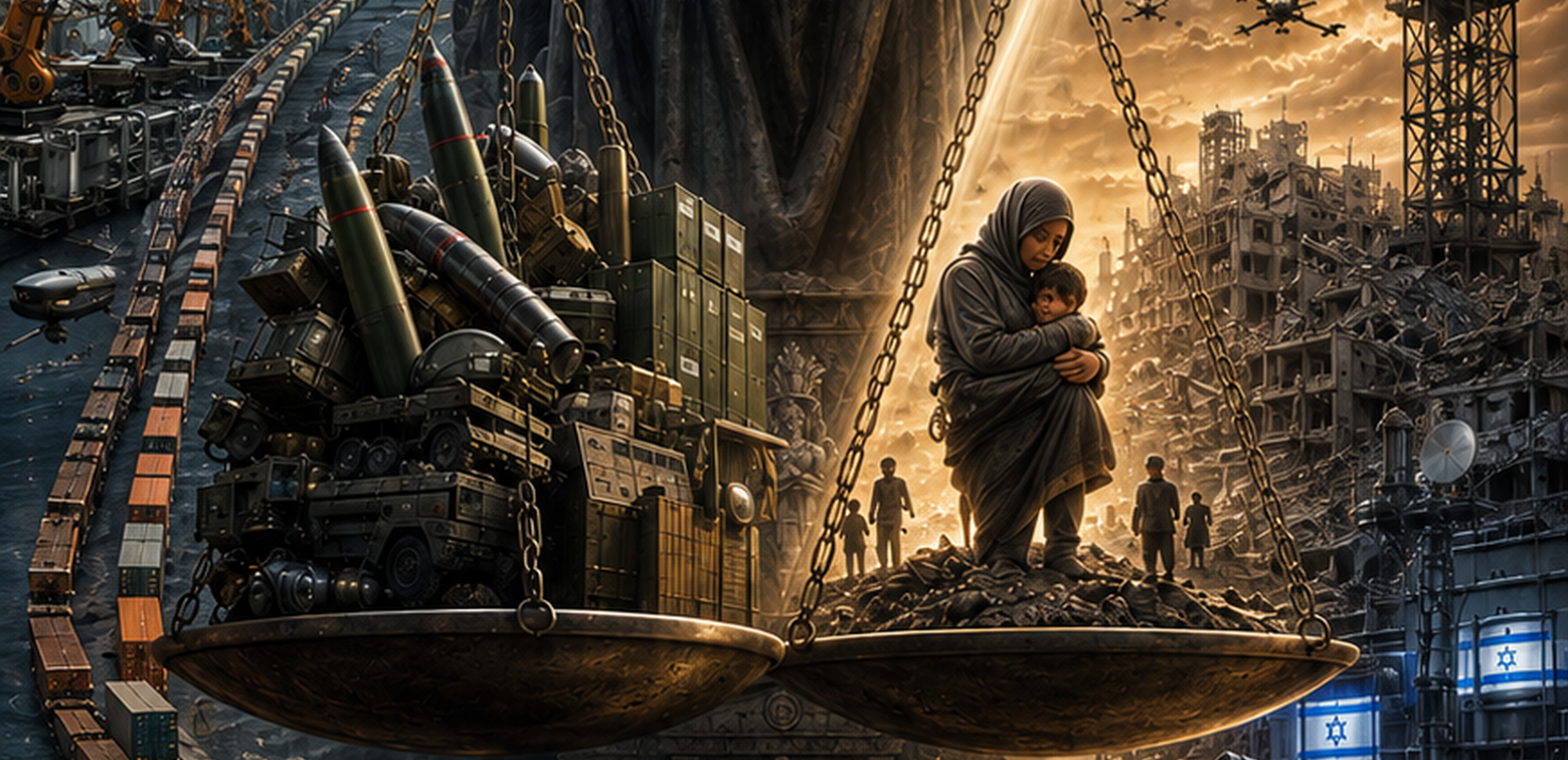
Power Before the Tribunal of History: The Trial of Arms, Interests and Humanity
The Mystery of 2,596 Shipments: Arms, Politics and History’s Coming Verdict

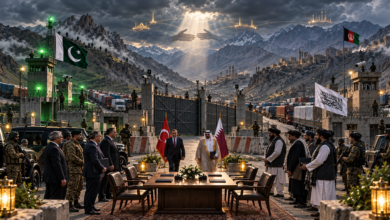
When the pages of history are stained with drops of blood, they do not merely chronicle the lamentations of the slain; they inscribe, in their margins, the names of those silent onlookers, the merchants of expediency, and the decision-makers enthroned in chambers of power. These are the figures who, under the guise of neutrality, quietly bend the currents of their age to suit their interests. Such are the moments when question marks appear upon the brow of time itself, and history, assuming the austere dignity of a judge, summons humanity to the dock—demanding to know: where were you when injustice reached its zenith? In whose favour did your silence weigh? Which settlements did your decisions lay to waste, and which generations did they consign to unmarked graves?
The land of Gaza—once a confluence of civilisations, a sanctuary of spiritual resonance, and a living testament to endurance—now endures an era of profound trial. Its earth trembles under the weight of explosives, while its skies are heavy with the echoes of innocent cries. Here, it is not merely buildings that collapse but hopes buried beneath the rubble; not only bodies that perish, but dreams interred; not simply blood that is spilled, but the very dignity of humanity that is desecrated. This is not merely the story of a geographical territory—it is the reflection of a global order in which power has come to eclipse law, and expediency to supersede morality.
In such a moment, when a report by Amnesty International comes to light, it does not speak with the sterile detachment of an official document; rather, it emerges as a resonant voice—one that knocks upon the shuttered windows of conscience, that rends the heavy drapery of global politics, and that compels us to recognise that statistics are never mere numbers. Each figure carries within it a human story; every consignment is the prelude to potential devastation; every agreement a decision whose reverberations may be felt across generations.
This report, in essence, constitutes a moral petition—one in which humanity stands both as plaintiff and defendant. It confronts us with the sobering truth that in the modern world, wars are not fought solely on battlefields: they are conceived amid the clamour of factory machinery, they breathe within documents laid upon diplomatic tables, and they are nurtured in closed rooms where decisions are taken, even as ignorance of their consequences is professed. There, a single agreement may presage the loss of thousands of lives; a solitary signature may inscribe a new tragedy into the annals of history.
This, then, is not merely a moment for analysis, but for accountability; not simply an occasion for commentary, but a summons to moral awakening. The question is not where the war is being waged—the question is where humanity itself stands. Does it align with power, or with justice? Does it seek refuge in the silence of convenience, or does it strive to find itself in the clarion call of truth? For when history delivers its verdict, it does not defer to power nor to wealth—it recognises only truth, and it is truth alone that it endows with permanence.
I. The Transfer of Arms: A Narrative Concealed Within Numbers
The figure of 2,596 consignments cited in Amnesty International’s report may, at first glance, appear as a cold, lifeless statistic. Yet when illuminated by the light of human understanding, it reveals itself as a deeply tragic narrative. These are not mere numbers—each digit is a cry, each shipment a sigh, each transfer the prelude to a calamity not yet fully inscribed upon the pages of history. The explosives, metals, and technologies contained within these consignments are not inert materials; they are silent forces capable, in mere moments, of reducing thriving communities to ruins, transforming smiling faces into sites of mourning, and burying hope beneath debris.
These are arms that may be cloaked in the rhetoric of border security, yet in their potential application they remain inextricably linked to the existential peril of a besieged and defenceless people. The matter at hand is not merely the transfer of weaponry, but the consciousness that informs such decisions. Can a state that considers itself a responsible member of the international community remain oblivious to the destinations of its arms, and to the bodies they may ultimately strike?
This question transcends the technical or diplomatic; it is, at its core, ethical and civilisational. Trade, no doubt, is an indispensable component of relations among states. Yet when such trade becomes entwined with the loss of human life, it ceases to be a mere transaction and begins to resemble a form of conscious complicity. One is compelled to ask whether these consignments were simply instruments of economic exchange, or whether they formed part of a broader strategy aimed at consolidating influence within the architecture of global power—even at the cost of human lives.
Thus, these 2,596 consignments may be read as 2,596 question marks—each asking whether, in the relentless pursuit of power and progress, humanity has been reduced to a secondary consideration. Have the faces that bear the direct consequences of such decisions been obscured by the glare of statistics? Has the global conscience become so captive to expediency that it translates cries into numbers, thereby dulling their resonance?
The story is not yet complete. Yet even its opening chapters are so heavy with consequence that one senses the very pages of history straining beneath their weight.
II. The Crisis of International Law and Moral Responsibility
There are, in the course of human history, certain documents that transcend their physical form to become symbols of civilisation’s collective conscience. The Geneva Conventions and international laws pertaining to genocide stand among such instruments—manifestations of humanity’s aspiration to impose moral limits upon its own destructive capacities, to subject power to the discipline of law, and to keep alight the lamp of humanity even amidst the darkness of war. These frameworks arise from the recognition that, unless power is restrained by ethical principle, the world risks devolving into a domain governed solely by might—where the lives of weaker nations are sacrificed at the altar of decisions made in distant halls of authority.
The warning issued by Amnesty International’s Secretary General, Agnès Callamard, resounds as a grave and deliberate knock upon the doors of the global conscience. Her assertion—that the provision of arms may expose a state to serious questions regarding its obligations under international humanitarian law and the prevention of genocide—is not a mere legal contention. It is, rather, a summons to moral reckoning. It invites us to confront a fundamental question: when the foreseeable consequences of an action are bound up with the loss of human life and the violation of basic rights, can that action be justified solely on the grounds of commercial gain or diplomatic expediency?
Here lies a juncture at which the imperatives of state interest and the claims of human values stand in stark opposition. On one side are the demands of national security, the defence industry, economic advantage, and diplomatic alignment; on the other, the sanctity of human life, the cause of global justice, and the burden of moral responsibility. History bears witness that powerful states have often chosen paths in defence of their interests which, in later years, stand subject to searching scrutiny. Thus persists a quiet yet enduring contest between law and power, wherein the voice of principle is too often drowned beneath the clamour of interest.
The central philosophy of the Geneva Conventions rests upon a simple yet profound premise: that even in war, there must remain certain limits of humanity. Even upon the field of enmity, there must endure principles that safeguard civilians, the innocent, and the vulnerable. Yet when states themselves begin to disregard these principles, the law is stripped of its spirit and reduced to a theoretical abstraction, preserved in texts yet absent in practice. One is left with the uneasy impression that the scales of justice remain in place, yet their balance is increasingly swayed by the weight of power.
The voice of Agnès Callamard, in this light, rings as a bell intended to rouse a slumbering global awareness. It speaks not merely of one nation or a single episode but addresses the very architecture of the international order. It asks whether international law is indeed applied equally to all. Are powerful states subject to the same standards of accountability as those imposed upon weaker nations? Or has the application of law become selective—reserved for those whose political and economic strength is insufficient to resist its reach?
These questions transcend the realm of political debate; they strike at the very future of human civilisation. For if the spirit of law is allowed to wither, and power is presumed to stand above moral accountability, then justice itself is reduced to little more than an elegant slogan. History has repeatedly reminded us that while empires may endure through strength, it is only through justice that they secure honour and permanence.
Thus, the true test of international law lies not in the aftermath of war, but in its conduct. The essential question is not what the powerful can do, but what they choose to refrain from doing. For the mark of a civilised world is not the magnitude of its strength, but the moral restraint by which that strength is governed.
III. “Made in India”: The New Geography of Interest
In the modern world, the label “Made in” signifies far more than a place of origin; it encapsulates an entire narrative of economic ambition, political alignment, and strategic design. Industry and politics are no longer separate domains; they have become so intricately intertwined that goods produced within factories now carry, alongside their material value, the weight of diplomatic messages, political priorities, and the shifting balance of global power.
Viewed through this lens, the report emerging under the rubric “Made in India” points to a reality in which relations between India and Israel have evolved far beyond formal diplomacy or routine partnership. Over time, they have matured into a deep and multifaceted collaboration encompassing economic, industrial, and defence spheres. This relationship now constitutes a complex system in which technology, capital, defence production, and political interests are so closely interwoven that to disentangle one from the other is no simple task.
This web of defence industry reflects a defining feature of contemporary global politics. Here, arms
are not merely instruments of war; they are vehicles of economic interest, employment, research, industrial advancement, and state influence. Profit becomes the lifeblood of this system, sustaining its continuity and expansion. Yet when this same industry is confronted with questions of human rights and moral responsibility, the contradictions concealed beneath the sheen of progress and commerce begin to surface.
In such a context, trade ceases to be a neutral exchange. It assumes the character of a tacit partnership, wherein every component, every technology, and every instrument of war carries with it an ethical implication. For while the hands that manufacture weapons and those that deploy them may differ, history seldom overlooks the connection between the two.
This defence partnership resembles a great tree, its roots sunk deep in the soil of economic interest, its branches extending across the horizon of global politics. It is nourished by capital, technology, and diplomatic necessity. Yet beneath its shade, an unavoidable question arises: does every economic success equate to a moral success? Can each stride in industrial progress claim exemption from the obligations of human responsibility?
The defence industry is, without doubt, regarded by states as a pillar of security and self-reliance. But when it becomes entangled with global conflicts, military operations, and human suffering, its nature is transformed. It ceases to be merely a matter of production and trade; it becomes inseparable from a larger moral inquiry—one that asks at what cost this march of progress is sustained.
Thus, “Made in India” emerges not merely as an industrial designation, but as a symbol of a new geography in global politics—one in which factories, diplomatic chambers, and theatres of war are inextricably linked. It is a geography shaped not only by territory, but by interests, alliances, and decisions; and it is within this landscape that history will one day determine whether such partnerships are remembered as triumphs of economic ambition, or as profound tests of the human conscience.
IV. Evidentiary Findings: The Reality of Military Hardware
History is not written solely through proclamations and assertions; it is fashioned from the enduring imprint of evidence, documentation, and fact—those traces which, with the passage of time, rise into clarity. The findings brought forth by Amnesty International belong to this very order. They reveal a sustained and methodical pattern of arms and defence transfers spanning the period from 23 October 2023 to 2025, pointing not to an isolated occurrence but to a continuous and organised process.
According to the investigative report, the military hardware supplied from India to Israel encompassed drone warheads, artillery shell casings, components for armoured vehicles, missile parts, and other instruments of defence. These are not marginal adjuncts within modern warfare; they constitute its very foundation. Contemporary conflict is no longer confined to the clash of soldiers upon open fields; it is increasingly defined by technology, surveillance systems, precision-guided capability, and the capacity to act from afar with calculated exactitude.
For this reason, drone warheads, missile systems, and similar advanced components cannot be dismissed as mere fragments of metal or the by-products of industry. They represent instruments of power capable of reshaping the nature, pace, and consequences of war itself. A drone, controlled from a distant command centre thousands of miles away, transfers the theatre of conflict from the physical battlefield to the realm of technology—yet its effects upon those who dwell beneath it remain immediate, tangible, and devastating.
The evidence suggests that these supplies were neither incidental nor temporary but formed part of an integrated chain of defence production, technical collaboration, and operational necessity. In modern warfare, such equipment significantly amplifies the capabilities of military operations and exerts a direct influence upon strategic decision-making.
Yet the most intricate and sensitive dimension of this entire landscape is the human one. When such instruments of war are deployed in regions densely inhabited by civilians—children, women, and those who bear no part in combat—each strike ceases to be merely a military action and assumes the weight of a profound moral question. To what extent do those who wield technologically advanced power prioritise the protection of human life?
It is a bitter truth that in modern warfare the distinction between target and non-target grows ever more indistinct. Once, war was imagined as confined to battlefields; now its consequences permeate cities, homes, hospitals, and the fabric of civilian existence. Technology may claim greater precision, yet the question of human loss remains unresolved, persistent, and deeply troubling.
Thus, the transfer of military hardware cannot be confined to the sphere of industry or commerce alone; it carries with it a wider moral and legal responsibility. For the maker, the supplier, and the user of arms are, in the ledger of history, inscribed upon the same page. The pen of time records not only the decisions taken upon the battlefield, but also the networks of collaboration and responsibility that lie behind them.
In this light, the evidentiary findings compel us to recognise that in the modern world, war does not begin where bullets are fired alone. Its origins lie also in the factories where weapons are forged, in the agreements where decisions are made, and in the policies where the choice is drawn between humanity and interest.
V. The Defence Industry and Human Rights: A Relationship in Tension
The defence industry has long been associated with the imperatives of state security, sovereignty, and national protection. Its fundamental purpose has been understood as enabling a state to safeguard its borders, its citizens, and its interests. Yet when this industry extends beyond the confines of national defence and becomes embedded within a global market shaped by commercial ambition and international influence, its character begins to change. Arms cease to be instruments of defence alone; they become commodities within a global trade where profit, politics, and power converge.
The observations advanced by Amnesty International point to this intricate tension: that certain defence enterprises, driven by commercial imperatives, may enter a sphere in which economic gain and human responsibility stand in uneasy opposition. At this juncture, a question arises with renewed force—can corporations engaged in the pursuit of profit absolve themselves entirely of responsibility for the ultimate use of the weapons they produce, and for the human consequences that follow?
The products fashioned within the factories of the defence industry may outwardly appear as assemblages of metal, technology, and machinery; yet beneath their surface lies a force capable of
shaping human destinies. The smoke that rises from industrial chimneys is no longer merely a symbol of progress; at times, it serves as a forewarning of the human tragedies that such products may one day engender.
Herein lies the central paradox confronting the modern defence industry. On one handstand research, technological advancement, industrial growth, and the creation of livelihoods; on the other, the destructive potential inherent within those very achievements. It is a landscape in which the celebration of engineering triumphs coexists uneasily with the suffering that may arise from their application.
Within a global system governed by profit, there persists a constant danger that arms manufacturers may come to regard their products as ordinary commodities. Yet weapons are not akin to other goods; they bear a direct and immediate relationship to human life, to the conduct of war, and to the fragile prospects of peace. For this reason, the trade in arms carries with it an additional moral burden—one that extends beyond compliance with law and enters the realm of conscience itself.
This condition resembles a mirror in which the double visage of modern civilisation is starkly revealed. On the one hand, mankind takes pride in its intellect, its inquiry, and its scientific ascent; on the other, that very ascent—once surrendered to unrestrained interests—may become an instrument of ruin. The question, therefore, is not one of technology itself, but of the purpose it is made to serve and the moral vigilance that governs its use.
Thus, the relationship between the defence industry and human rights is, in truth, a continual trial. It is a trial not only for states, but for industries, and indeed for the entire community of nations. For history does not merely record the weapons that were forged; it also preserves the decisions that determined the ends to which those weapons were put.
In the final reckoning, the question remains: shall man remain the master of the power he has created, or shall he become enslaved to it, surrendering his moral principles at its altar? It is at this very juncture that the defence industry must stand not only as a reflection of power, but as a mirror of humanity itself.
6. Domestic Response: The Echo of Conscience
The true portrait of any society is not painted solely by its official narratives, its state policies, or the halls of power. It is equally shaped by the voices that rise within it—by dissent, by moral inquiry, and by the courage to question. History bears witness that in every age there have been individuals and groups who have stood against prevailing narratives, choosing instead to heed the call of conscience. Such dissent is the mark of a living society; for where questions cease, awareness itself begins to wither.
The responses that have emerged within India in relation to the findings of Amnesty International reflect precisely such an inner contest. The remarks of Congress leader Pawan Khera signify a disquiet that arises in a society long associated with traditions of non-violence, tolerance, and peace. His assertion—that every injustice inevitably begets a response—serves as a reminder of an enduring truth of history: oppression may be silenced for a time, but it can never be extinguished altogether.
This statement transcends the bounds of mere political disagreement or partisan criticism. It may equally be regarded as an act of moral protest—a voice from within that questions its own society: where, amid national interests, diplomatic alignments, and economic gains, do human values and ethical responsibilities truly stand?
Every nation, at some juncture in its journey, confronts such questions—moments when it must reconcile the principles of its past with the decisions of its present. It is then that a society must ask itself whether its ideals are confined to books and speeches, or whether they find expression in the choices it makes.
For societies that take pride in traditions of non-violence, the question becomes even more profound: where is the line to be drawn between the exercise of power and adherence to moral principle? For the greatness of a nation is measured not merely by the strength it possesses, but by the purpose for which that strength is employed.
The response of Pawan Khera forms part of this wider human discourse. It is a voice that may not resound within the lofty chambers of power, yet it carries weight in the realm of conscience. Time and again, history has shown that voices once deemed faint or inconsequential have later come to define the central questions of their age.
Ultimately, the moral journey of any nation is complete only when it possesses the courage to examine its own decisions, to question its own actions, and to listen to the stirrings of its own conscience. Power may yield immediate effect, but honour in history is reserved for those societies that uphold justice, humanity, and moral responsibility—not merely in word, but in deed.
7. Defence Cooperation: A Tale of Three Decades
The history of defence relations between India and Israel is, in essence, a narrative of gradual yet unceasing evolution—one that, over the past three decades, has progressed from formal diplomatic engagement into a deep strategic and industrial partnership. Following the establishment of official diplomatic ties in 1992, these relations did not remain confined to political exchanges or ceremonial declarations. Rather, they opened a new chapter encompassing defence, technology, research, and joint production.
With the passage of time, this relationship has come to resemble a bridge—linking two distinct geographies, two differing economic systems, and two sets of defence imperatives. The foundations of this bridge have been laid upon the exchange of technology, defence agreements, collaborative ventures, and industrial cooperation. Israel has contributed its expertise in defence systems, advanced technologies, and operational experience, while India has brought to bear its expansive industrial capacity, workforce, and manufacturing strength, thereby advancing the partnership on a considerable scale.
This cooperation has moved beyond the simple mechanics of purchase and sale, evolving instead into a system of joint production and technical collaboration in which the interests of both nations have become increasingly intertwined. Israel, with its proficiency in advanced defence technologies, surveillance systems, missile development, and electronic warfare, and India, with its vast industrial base and production capabilities, have each harnessed this relationship to serve their respective strategic aims.
A notable feature of this partnership lies in the division of technological and production processes between the two countries in certain defence projects. On one side, Israel provides its technical expertise and research capabilities; on the other, India contributes large-scale manufacturing and production. In this manner, a cycle is sometimes formed in which defence equipment, having passed through multiple stages across different territories, ultimately returns to the very region where its deployment or utilisation is determined.
This reality illustrates the intricate nature of the modern defence industry, wherein weapons are no longer the sole product of a single nation. Instead, they emerge from the combined forces of technology, capital, research, and industrial capability drawn from multiple countries. In the present age, defence cooperation has become an integral element of the broader architecture of global politics—where each agreement reflects not only military necessity, but also diplomatic priorities and strategic intent.
Yet this partnership bears another aspect—one that invites searching questions in the arena of global discourse. When defence cooperation becomes entangled with a conflict in which human rights, the laws of war, and the protection of civilians are under scrutiny, it ceases to be merely a technical or economic arrangement. It assumes, instead, the character of a moral and political question of considerable weight.
Thus, the defence relationship between India and Israel may be seen as a journey composed of many strands—interests, technology, diplomacy, and the shifting currents of international politics. It is a bridge that draws two nations closer; yet upon that bridge travel not only agreements, weapons, and decisions, but also the enduring questions of history. For the future will not judge solely what technologies were devised, but also to what ends such power was ultimately applied.
8. Covert Commerce and the Subtlety of Global Politics
Within the world of international politics, there exist decisions shaped less by the illumination of official declarations and more by the quiet pathways of diplomacy—by private consultations, closed-door deliberations, and undeclared arrangements. The trade in defence matériel belongs to this realm, where state interests, national security, diplomatic priorities, and economic advantage intertwine so closely that full transparency is often relegated to the margins.
Israel’s defence industry, whose scale is frequently estimated in the range of twenty to thirty billion dollars, represents a segment of the modern global economy in which technology, capital, and strategic interests appear inextricably linked. It is not merely a system for the manufacture of weapons, but a vast network encompassing research, defence technologies, international partnerships, and political influence.
The defence cooperation between India and Israel forms part of this intricate global landscape. Many of the agreements, joint ventures, and instances of technical collaboration between the two nations are conducted within a limited sphere of disclosure. This is often justified by the imperatives of national security; yet it is equally true that, in the practice of global politics, certain truths are deemed too sensitive to be laid fully before the public gaze.
The nature of defence trade differs markedly from ordinary commercial activity. The consequences of any such agreement do not remain confined to markets or industries; they extend to the balance of regional power, the tenor of diplomatic relations, and the alignments of global politics. For this reason, states frequently pursue defence cooperation with caution, discretion, and a measured flow of information.
This veil of secrecy is no mere accident, but a feature inherent in the conduct of international affairs. Powerful states often prefer to confine such matters within restricted circles, lest the full disclosure of details provoke domestic political reaction, inflame regional sensitivities, or complicate diplomatic engagements.
Yet the question of transparency endures. For when defence trade intersects with human conflict and the realities of war, there arises a growing public desire to understand the extent of its consequences and the forms those consequences may take. It is here that the necessity emerges to strike a delicate balance between national interests and broader ethical responsibilities.
In this light, the narrative of defence commerce between India and Israel is not solely a tale of weapons, technology, and agreements. It is also a reflection of the complex temperament of global politics, wherein many decisions are fashioned not in the full light of day, but within the half-shadows. Experience suggests that those matters once concealed behind such veils often, in time, re-emerge as the most pressing questions of history.
9. A Changing Middle East and New Alignments
The Middle East has long stood as a focal point of world politics, where history, civilization, faith, energy resources, and the interests of major powers are intertwined. It is not simply a region defined by geography, but a sensitive axis of global balance, where even subtle changes can leave profound marks on the political map of the world. For centuries, this role has witnessed the rise and fall of civilizations, and it occupies a central place on the map of international affairs.
In recent years, transformations within the political climate of the Middle East have ushered the region into a new geographical and strategic phase. Heightened tensions surrounding Iran, a range of regional conflicts, the restoration of relations between certain Arab states and Israel under the Abraham Accords, and the evolving diplomatic priorities of the Arab world have begun to reshape longstanding conceptions of power. The politics of the region are no longer confined to traditional rivalries and alliances; economic interests, energy imperatives, security concerns, and global partnerships have all contributed to the emergence of new alignments.
This evolving landscape resembles a vast chessboard upon which each state advances its moves with the utmost caution. Here, a single decision does not merely alter the policy of one nation but may influence the balance of the entire region. A diplomatic accord, a defence partnership, or a gesture of political proximity may, in the years to come, give rise to new centres of power.
Within this intricate environment, the role of India has likewise assumed increasing significance. India appears as a participant marked by caution yet growing engagement. It is neither the principal actor upon this stage nor a detached spectator. Its energy requirements, economic linkages, relations with the Gulf states, defence cooperation with Israel, and its efforts to balance interests among global powers have placed it in a position where even its quieter diplomacy carries discernible meaning.
Though this role may seem outwardly restrained, silence itself is often a form of strategy in international affairs. At times, states advance their interests not through grand declarations, but through measured and deliberate action. It is for this reason that India’s position within the shifting politics of the Middle East cannot be overlooked.
Yet the most significant feature of this emerging realignment is that the decisions shaping the region are no longer confined to regional powers alone. The United States, Russia, China, European nations, and other global actors are all engaged upon this strategic chessboard, each advancing its interests according to its own calculations. Thus, the Middle East has once again become a theatre of competition among great powers, where influence, ambition, and strategic necessity converge.
This is a moment in which every step may carry consequences far beyond its immediate horizon. If diplomacy, mutual respect, and regional stability are placed at the centre of this transformation, these shifting alignments may become instruments of greater security and understanding. Yet if the balance of power is constructed solely upon calculations of advantage, the very same arrangements may become the seeds from which future conflicts emerge.
Ultimately, the unfolding story of the Middle East offers a timeless lesson: in the realm of international affairs, no nation exists entirely in isolation. Every alliance, every agreement, and every decision made in silence becomes woven into the larger fabric of history. The coming years will determine which moves upon this changing chessboard open the path towards peace, and which ones unlock the gates to new crises.
Conclusion: Power, Interest, and Humanity Before the Tribunal of History
This entire narrative is not merely a report, a collection of figures, or an account of diplomatic transactions. It is, rather, a profound question addressed not to a single nation or a particular region, but to the conscience of the entire international community. It places a mirror before those states that proclaim themselves guardians of human rights, justice, and global moral responsibility. And within that mirror is reflected not merely the face of one country, but the collective conscience of the world itself.
The fundamental question is not how many agreements were signed, how many weapons were produced, or how much commerce was conducted. The deeper question is this: at what cost is this journey of progress being pursued? Can human values be sacrificed upon the altar of industrial advancement, economic ambition, and political influence? Can the worth of human life diminish within the glittering marketplace of global commerce? And can the voices rising from the great halls of power forever silence the cries of those who suffer?
History does not deliver its verdict solely upon the scales of strength; it renders judgement upon the balance of moral truth. Empires, at the height of their grandeur, often appear invincible. The chambers of power seem unshakeable, and the fortresses of interest appear beyond challenge. Yet the long procession of history bears witness to one undeniable reality: every power, regardless of its magnitude, must eventually answer before the judgement of time. Voices that appear fragile today may, in future generations, become the most compelling testimony of an age.
The cry of the oppressed possesses a quality that transcends the boundaries of time. It may be suppressed temporarily; it may be concealed beneath the noise of political rhetoric; yet it cannot be erased forever. For every tear preserved within the memory of history, every cry unheard, and every injustice committed eventually returns as a question demanding an answer.
The report of Amnesty International serves as a reminder of this enduring truth: the world must once again decide which path it chooses to follow. Will it stand with power, or with justice? Will it embrace the silence of convenience, or listen to the voice of humanity? For the measure of a civilised world is not found in the strength of its armies, the scale of its economy, or the reach of its political influence; it is found in the courage with which it defends the dignity of the vulnerable.
The pen of history is never still. It records the decrees of rulers and preserves the pleas of the powerless. It chronicles the decisions that shape wars, and it reveals the intentions concealed behind those decisions. Time moves forward, faces change, and centres of power shift, yet the deeds inscribed upon the pages of history remain.
And whenever history finally delivers its judgement, its ink contains far more than words. Within it echo the voices of centuries—the voices of those who witnessed suffering, the voices of those who dared to question, and the voices of those who struggled to keep the flame of humanity alive even amidst the darkness.
In the final reckoning, the question is not merely what the world did; it is also what the world allowed to happen. For future generations will not ask only who possessed power. They will ask a far more profound question: when humanity itself stood upon trial, who stood beside it?