One Muslim People in Defence of the Sacred Sanctuary
New Strategic Consciousness Emerging from Makkah

Iqbal’s Idea of the Ummah, the Unity of the Muslim World, and the New Strategic Consciousness Emerging from Makkah
When Allama Muhammad Iqbal wrote:
ایک ہوں مسلم حرم کی پاسبانی کے لیے
نیل کے ساحل سے لے کر تا بخاکِ کاشغر
Let the Muslims be united in guarding the Sacred Sanctuary,
From the banks of the Nile to the distant soil of Kashgar,
He was doing far more than clothing sentiment in verse. He was giving poetic form to a civilisational argument: an argument about identity, responsibility, solidarity and the political destiny of the Muslim world.
Iqbal’s conception of Muslim unity was never an invitation to erase nationality, abolish cultural distinction or dissolve sovereign interests into some colourless uniformity. He understood too well that nations are formed by history, language, memory and circumstance. His vision was altogether more mature. Muslim peoples, in his understanding, could remain firmly rooted in their own countries and cultures while simultaneously recognising that they belonged to a wider moral and civilisational community, united by certain common interests, shared responsibilities and a deeper consciousness of historical kinship.
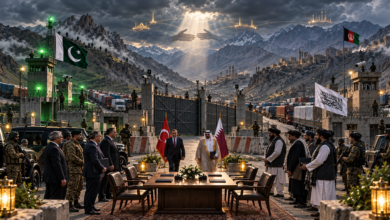
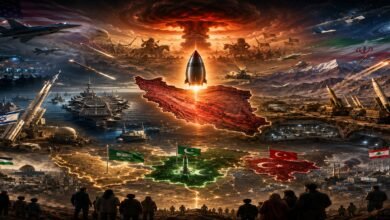
It is against this larger horizon that the expanding defence co-operation between Pakistan, Saudi Arabia and Türkiye deserves to be examined.
To describe it merely as an arrangement of military convenience between three governments would be to reduce a potentially consequential development to the vocabulary of routine diplomacy. The more serious question is whether significant Muslim states are beginning, however gradually, to reconsider the manner in which their military capacity, technological competence, economic strength and strategic resources might be brought into closer relation with one another.
If they are, then the implications extend well beyond the immediate interests of three capitals. Pakistan, Türkiye and Saudi Arabia each bring to the table a different form of power.
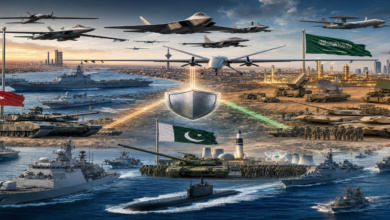
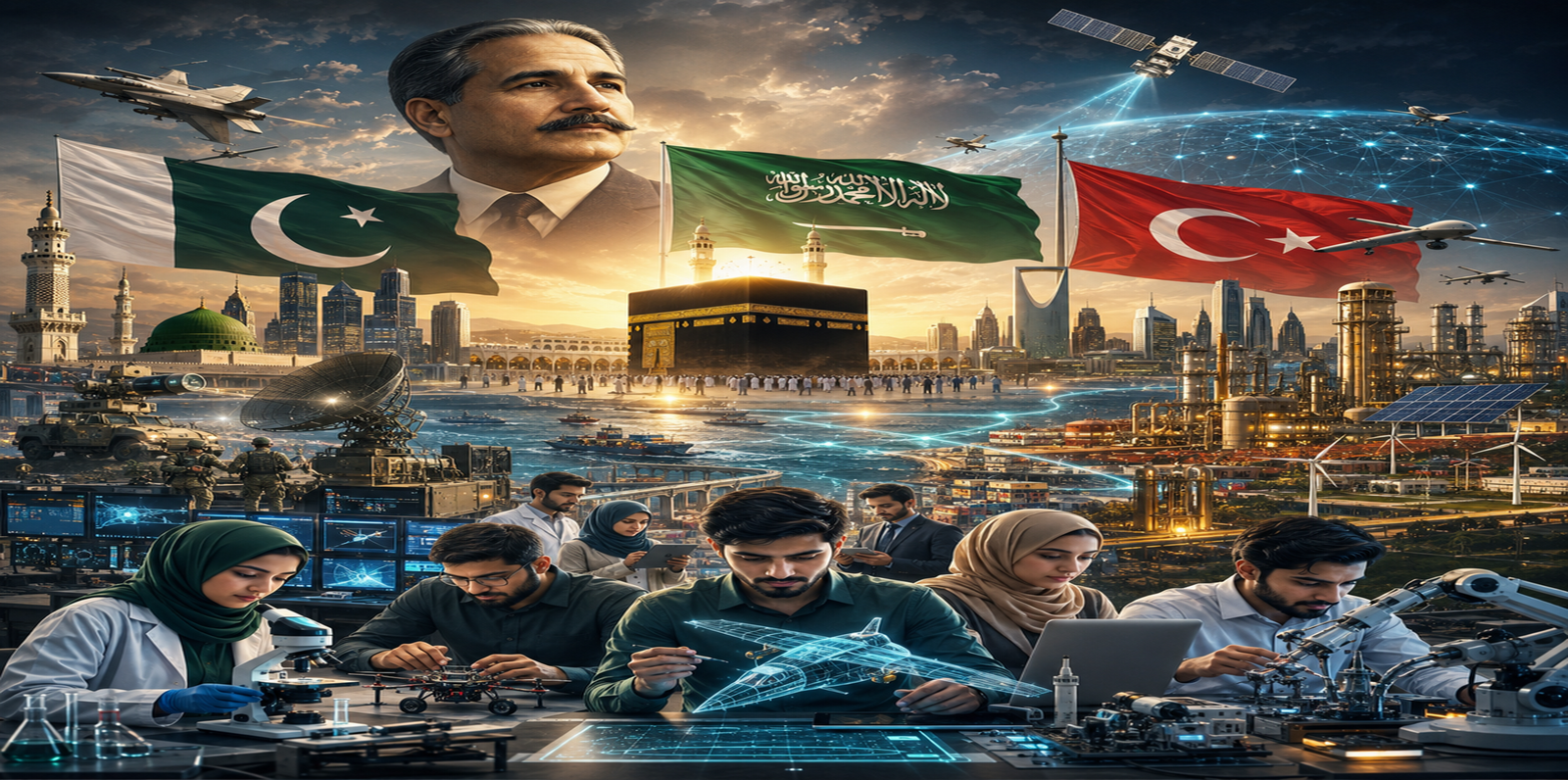
Pakistan possesses extensive military experience, significant defence capability and a geographical position of exceptional strategic importance. Türkiye has, in recent years, advanced remarkably in defence production, unmanned systems, aviation, electronics and indigenous military technology. Saudi Arabia possesses immense economic and energy resources, considerable financial capacity and a political and religious standing in the Muslim world which few other states can claim. Separately, each of these strengths is formidable.
Together, if governed by prudence, continuity and clear purpose, they could point towards something larger: not merely co-operation between states, but the beginnings of a more serious philosophy of collective self-reliance.
And here the political relevance of Iqbal’s doctrine of Khudi becomes difficult to ignore.
Khudi, in Iqbal’s philosophy, does not signify conceit. It is not pride swollen into arrogance, nor strength exercised for the humiliation of others. It is the disciplined cultivation of character, intellect, confidence and independence until a person—or a nation—possesses the moral and material capacity to stand upon its own feet.
For nations, as for individuals, dependence easily becomes habit. True sovereignty is therefore not secured merely by constitutional declaration, diplomatic recognition or the possession of a flag. A nation becomes meaningfully sovereign when it can take fundamental decisions according to its own judgement, protect its legitimate interests without perpetual reliance upon external patrons, and build its future with resources and capabilities increasingly under its own command.
The modern history of the Muslim world offers more than enough evidence that treaties, promises and external guarantees, however impressive in times of tranquillity, are no permanent substitute for indigenous strength.
The worth of a security arrangement is seldom revealed at the signing ceremony. It is revealed when danger knocks at the door. For that reason, the success of co-operation among Pakistan, Saudi Arabia and Türkiye should not be judged only by the dramatic question of whether one state would fight on behalf of another in an hour of war. That question matters, but it is not the whole question.
More fundamental is whether these countries can establish sustained co-operation in defence production, military training, intelligence, cybersecurity, strategic research, technological innovation and crisis decision-making. Can they create relationships which survive changes of government, shifts in international fashion and the pressures of competing alliances? Can they move from purchasing capability to producing it, from temporary co-ordination to institutional competence?
For the nature of power itself has changed. The vocabulary of warfare in the twenty-first century is no longer confined to tanks, artillery, infantry and combat aircraft. Satellites, drones, artificial intelligence, electronic warfare, cyber operations, intelligence networks and the manipulation of information have become instruments of strategic consequence.
A malicious line of code may sometimes achieve what once required a squadron of aircraft. A campaign of disinformation may weaken public confidence without a shot being fired. A sophisticated cyber-assault may cripple financial systems, infrastructure or communications before an opposing army has crossed a frontier.
The battlefield, in other words, has entered the laboratory, the server room, the university, the media space and the human imagination. Any meaningful defence co-operation among Muslim countries must therefore move beyond the marketplace of weapons.
The deeper foundations of strength lie in joint research, indigenous production, technology transfer, advanced training, scientific education and the steady accumulation of knowledge. Nations that merely purchase the instruments of modern power remain, to some degree, dependent upon those who design, manufacture, maintain and upgrade them. There is, however, an equal danger in allowing strategic seriousness to be overtaken by rhetorical
excitement.
It would be premature to proclaim every new understanding among Muslim states as the creation of an aggressive military bloc, or to decorate it instantly with the fashionable expression “Muslim NATO”.
International politics has never been so simple. Saudi Arabia has historic defence relations with Pakistan, while maintaining substantial economic and commercial interests with India. Türkiye has its own regional priorities, its own diplomatic calculations and its own strategic geography. Pakistan, likewise, must contend with a distinct set of security pressures and national requirements.
States do not cease to possess separate interests merely because they possess areas of common purpose. The important task, therefore, is not to invent a dramatic name for a developing relationship, but to understand its direction.
If that direction is towards greater strategic maturity—towards understanding one’s own vulnerabilities, setting one’s own priorities, integrating complementary capabilities and reducing the assumption that an external great power must forever serve as the ultimate guarantor in every emergency—then a significant intellectual shift may indeed be under way. Yet even here a vital distinction must be made. The purpose of genuine defence is not the glorification of war.
It is the prevention of war.
The highest achievement of deterrence is not to destroy an enemy after the first shot has been fired. It is to persuade a potential aggressor that the shot should never be fired in the first place. A credible defence posture succeeds when the likely cost of aggression becomes so obvious, so formidable and so uncertain that the aggressor hesitates before embarking upon it.
That hesitation is not weakness.
It is the political fruit of strength.
True power is not merely the power displayed after a city has been destroyed. It is the power that prevents the city from being destroyed at all. And genuine victory does not always belong to the army that fires most effectively. At times it belongs to the system of deterrence that ensures no army finds it profitable to fire.
For precisely this reason, a defence consciousness symbolically associated with Makkah should not be interpreted as the raising of a sword against an imagined enemy. It is better understood as the possibility of a security architecture whose object is stability, whose instrument is deterrence and whose ultimate justification is peace.
But this leads us to a still greater question.
Can Muslim strength be constructed by military co-operation alone?
Plainly, it cannot. Modern national power rests upon a much wider foundation.
A resilient economy is power. Energy security is power. Competent diplomacy is power. Geography is power when intelligently employed. Intelligence capacity is power. Universities are power. Scientific research is power. Advanced technology is power. Trustworthy institutions are power. Social cohesion is power. And mutual confidence among nations is itself a strategic resource. A state may possess advanced weaponry and yet remain fundamentally vulnerable if its economy depends excessively upon decisions made abroad.
It may possess combat aircraft, but if it lacks the capacity to design and develop its own technologies, much of its sovereignty remains borrowed.
It may import sophisticated systems, yet if its younger generation is trained chiefly to consume the technologies of others rather than create technologies of its own, strategic dependence will merely have acquired a modern appearance.
It is at this point that Iqbal’s message ceases to be merely philosophical and becomes urgently practical for the Muslim youth.
He wrote:
افراد کے ہاتھوں میں ہے اقوام کی تقدیر
ہر فرد ہے ملت کے مقدر کا ستارہ
The destiny of nations lies in the hands of individuals;
Each person is a star in the constellation of the nation’s fate.
There is profound political wisdom in these lines.
The security of a nation is not defended solely by the soldier who watches the frontier. It is also defended by the scientist who discovers, the engineer who designs, the teacher who cultivates thought, the researcher who creates knowledge, the economist who understands national capacity, the software developer who builds digital systems, the industrialist who strengthens productive independence, the honest civil servant who protects institutional integrity and the responsible journalist who refuses to trade truth for sensationalism.
National security, properly understood, is the combined moral, intellectual, technological and economic competence of a society. If the Muslim world wishes to speak seriously of self-reliance, its universities must become centres not merely for the transmission of knowledge but for its creation. Research must cease to be ceremonial.
Investment in artificial intelligence, cybersecurity, biotechnology, advanced engineering, defence technology, energy, digital infrastructure and modern industry must become a central part of long-term national thinking.
A civilisation cannot recover its place in history merely by remembering that it once possessed one. The younger generation cannot be nourished indefinitely upon tales of vanished magnificence. Pride in the achievements of ancestors may inspire, but it cannot substitute for the achievements of descendants.
The youth must be given the intellectual discipline, scientific competence and institutional opportunity required to create a future worthy of the past they are so often invited to celebrate.
And here again Iqbal’s moral architecture deserves attention.
He wrote:
سبق پھر پڑھ صداقت کا، عدالت کا، شجاعت کا
لیا جائے گا تجھ سے کام دنیا کی امامت کا
Learn once more the lessons of truth, of justice and of courage;
For you shall be called to undertake the leadership of the world.
The sequence is no accident.
Truth comes first.
Then justice.
Then courage.
The order itself contains a political philosophy.
Courage without truth may become fanaticism. Strength without justice may become oppression. Power without character may acquire impressive machinery while losing all moral purpose. In the Islamic conception of authority, strength is not sanctified merely because it is strength. It is justified by the principles it protects and by the justice with which it is exercised.
Any future Muslim framework of strategic co-operation must therefore be judged by this standard.
Its purpose should not be conquest.
Its purpose should not be intimidation.
Its purpose should not be to reproduce, under another banner, the very habits of domination against which weaker nations have so often protested. Its foundations ought to be defensive capability, sovereignty, peace, mutual respect, justice and collective responsibility. The symbolic place of Makkah lends this argument an extraordinary depth.
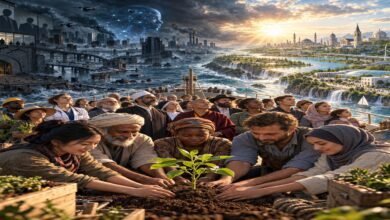
The Sacred Sanctuary is one of the few places in human experience where the usual distinctions of status, nationality, race, language and geography are deliberately made secondary. The Pakistani and the Turk, the Arab and the African, the Asian and the European stand in the same direction, before the same Creator, within the same human rank.
That scene is not merely devotional.
It carries a civilisational lesson.
If Muslims can stand before one Qiblah in worship, must they remain permanently fragmented in the pursuit of knowledge?
If they can recognise spiritual brotherhood, why should they find scientific co-operation so difficult? If they can share a sacred direction, why should they not strengthen one another in technology, education, economic development and collective security?
Unity need not mean uniformity.
Indeed, genuine unity rarely does.
Pakistan has no need to become Türkiye. Türkiye has no need to become Saudi Arabia. Saudi Arabia has no need to imitate Pakistan.
The strength of meaningful co-operation lies precisely in difference made complementary.
Pakistan may bring its military experience.
Türkiye may contribute technological and industrial innovation.
Saudi Arabia may employ its economic resources and capital.
Other Muslim countries may contribute scientific research, manufacturing capacity, energy resources, investment, geography, markets and human talent. The object should not be to force different nations into a single mould, but to turn their finest individual capabilities into instruments of shared stability and progress.
Yet no diplomatic agreement, however promising, can by itself accomplish this transformation. Its success will depend more profoundly upon the character of the generation that inherits it. The Muslim youth of the present age therefore face a series of choices which are, in truth, questions of civilisation.
Will they remain users of technologies created elsewhere, or become creators whose technologies others must use? Will they be satisfied merely to read the research of foreign universities, or will they produce scholarship which those universities must themselves study? Will they devote their lives solely to searching for employment, or will some among them build the institutions, industries and enterprises that provide employment to thousands?
Will they surrender their intellectual energy to sectarian quarrels, narrow nationalism and internal division, or will they make knowledge, discipline, invention and constructive work the distinguishing marks of their generation?
Iqbal’s ideal young Muslim does not spend his life standing before the monuments of the past.
He builds.
He learns.
He questions.
He disciplines himself.
He acquires knowledge, strengthens character and converts inherited pride into future achievement. And perhaps herein lies the most consequential promise of greater co-operation between Pakistan, Saudi Arabia and Türkiye.
The Muslim world must learn to carry the burden of its own security—not through weapons alone, but through science, economic resilience, technological mastery, institutional integrity, intellectual confidence and trust among its peoples.
Iqbal’s celebrated verse therefore returns to us today not merely as a poetic memory, but as an interrogation:
ایک ہوں مسلم حرم کی پاسبانی کے لیے
نیل کے ساحل سے لے کر تا بخاکِ کاشغر
Let the Muslims be united in guarding the Sacred Sanctuary,
From the banks of the Nile to the distant soil of Kashgar.
But what does it truly mean to guard the Sanctuary? Surely it cannot mean merely guarding stone, walls and gates. To guard the Sanctuary is also to guard what it symbolises: unity without erasure, dignity without arrogance, freedom without isolation, faith joined to knowledge, power restrained by justice, and a civilisation conscious enough of its inheritance to assume responsibility for its future.
If the Muslim world grasps this larger meaning, defence agreements will no longer remain diplomatic papers bearing formal signatures.
They may become the opening pages of an intellectual transformation. They may mark a movement from dependence towards competence; from consumption towards creation; from political fragmentation towards practical co-operation; from nostalgia towards achievement. But none of this is inevitable.
History does not grant permanence to nations merely because they possess a glorious memory. Every generation must earn its place. If the younger generation acquires knowledge, understands history without becoming imprisoned by it, masters modern technology, strengthens its moral character and chooses construction over division, the Muslim world of the coming decades may indeed look markedly different from the Muslim world of today.
The book of history is not yet closed.
Its final chapters have not been written.
And therefore, the decisive question is not simply what future generations will find written upon its pages.
The question is far more demanding:
Will we remain a generation content merely to read history—
or shall we acquire the courage, knowledge and character to write it?