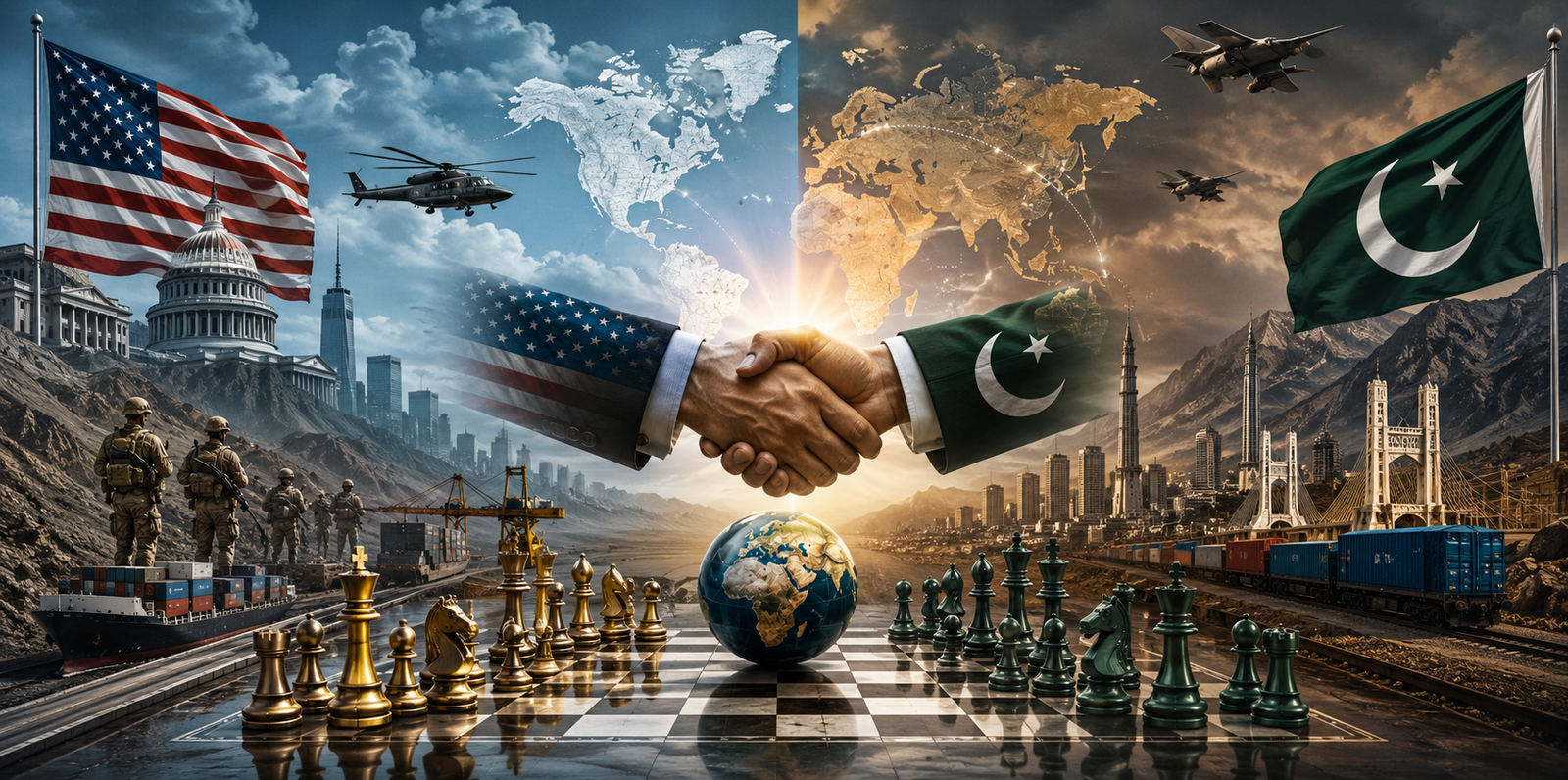
Friendship or Interest?
Alliance or Mirage?

Pakistan and the United States: Between Alliance, Interest and Strategic Autonomy
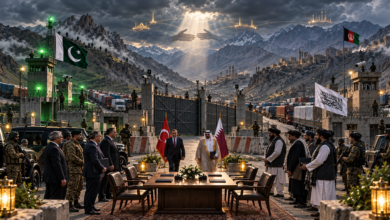
The relations between nations sometimes bear a curious resemblance to the relations between individuals. Yet beneath the outward courtesies of diplomacy there operates a sterner calculus: interest weighs more heavily than sentiment, expediency more than sincerity, and power more than friendship. In the drawing rooms of international politics, a smile is not always evidence of affection, a handshake is not invariably a pledge of trust, and even behind the luminous clauses of treaties there may move shadows of interest that only the long gaze of history can fully discern.
The relationship between Pakistan and the United States belongs to this intricate register of statecraft. At one moment there has been warmth, at another estrangement; here military cooperation, there sanctions; in one season the accolade of “front-line ally”, in another the bitter vocabulary of suspicion. It has never travelled in a straight line. Its history resembles, rather, a tide that now embraces the shore and now recoils from it after striking the very coast towards which it had advanced.
The central contention of this essay is therefore that Pakistan–United States relations ought not to be read through the sentimental language of permanent friendship, but through the changing geometry of interests, regional balances of power and the strategic calculations of great powers. America, in this reading, has often appeared as an ally whose intimacy with Pakistan was governed less by constancy than by circumstance. To understand that judgement, one must look across more than seven decades of history.
When Pakistan emerged as an independent state in 1947, it faced not merely the formidable task of nation-building, but acute economic difficulties, military weakness, the unresolved dispute over Kashmir and a regional balance heavily weighted in India’s favour. Meanwhile, the world itself was hardening into the rival camps of the Cold War, led respectively by the United States and the Soviet Union.
Pakistan’s leadership moved comparatively early towards close defence relations with the Western world, and particularly with Washington. During the 1950s, Pakistan became associated with security arrangements such as SEATO and CENTO. To the United States, Pakistan was an important geographical link in the chain designed to contain Soviet influence; to Pakistan, America appeared a potential source of military equipment, financial assistance and political support.
It was here that the essential architecture of the relationship first became visible. The two states may have sat at the same table, but they did not necessarily arrive with the same appetite. Pakistan sought security against India; Washington kept its principal gaze fixed upon Moscow. Their first substantial convergence of interest was therefore less a union of strategic destinies than a marriage of convenience: the same roof sheltered both parties, but each dreamt a different dream.
1965: The First Deep Crack in the Glass of Trust
The Indo-Pakistan War of 1965 planted a lasting question in both the Pakistani state and the public imagination. A powerful perception took hold that the defence relationships and alliances regarded as guarantees of security had failed, in the hour of trial, to provide the assistance that had been expected of them.
American restrictions on arms strengthened the belief in Pakistan that great powers dealt with
smaller states less according to abstract principle than according to the demands of their own global calculations. This was not merely a passing diplomatic episode. It engraved itself upon Pakistan’s political memory, and in later decades the memory of 1965 repeatedly returned whenever relations with Washington deteriorated.
History possesses a peculiar manner of teaching. It rarely pronounces its verdicts from a trumpet, yet it leaves such marks upon the collective memory of nations that even generations not yet born may one day learn to read them.
Washington and Islamabad remained in contact throughout this period, and Pakistan also served as an important diplomatic bridge in the historic opening between the United States and China. Yet in Pakistan profound disappointment arose over the American role during the final stage of the war.
Once again, the same question presented itself with melancholy force: can friendship with a great power ever become an enduring fortress of security for a smaller state?
A nation that places the key to its survival in another man’s chest must always wonder whether, when the hour of necessity comes, that chest will indeed be opened.
Afghanistan, the Soviet War and the Return of Strategic Necessity
After the Soviet Union entered Afghanistan in 1979, Pakistan—towards whose nuclear programme Washington had been developing increasing reservations—suddenly became strategically indispensable once more.
During the Afghan jihad, Pakistan became a central theatre of American, Saudi and wider Western strategy. Money flowed, weapons arrived, intelligence cooperation expanded, and Pakistan acquired the status of a front-line state in the struggle against Soviet expansion.
But when Soviet forces withdrew from Afghanistan, the geopolitical climate changed with almost equal speed.
During the 1990s, the Pressler Amendment and sanctions associated with Pakistan’s nuclear programme once again chilled the relationship. Within Pakistan, the conviction deepened that American proximity often lasted only for the season of necessity; once the season changed, the shade itself seemed to withdraw.
This historical background is essential to understanding the Pakistani conception of an alliance shaped by circumstance and self-interest—although intellectual fairness requires that each period be judged according to its own peculiar conditions.
9/11: Alliance Beneath a Cloud of Suspicion
The attacks of 11 September 2001 redrew the map of world politics. The United States went to war against the Taliban government in Afghanistan, and Pakistan once again became an indispensable component of American strategy.
Pakistan received major non-NATO ally status, billions of dollars in assistance, and deeper military and intelligence cooperation. Yet the same period imposed a grievous burden upon Pakistani society: terrorism, domestic extremism, displacement, suicide bombings and political disorder exacted a heavy price.
Washington repeatedly accused Pakistan of pursuing a “double policy” in relation to the Taliban and the Haqqani Network. Pakistan, in turn, maintained that the sacrifices it had made in the war against terrorism—including the loss of thousands of lives—had never been adequately acknowledged.
Thus, the two countries remained allies in appearance, while each seemed to keep its sword upon the table of trust. The lamp of friendship continued to burn, but the mist of suspicion upon its glass was never entirely wiped away.
The American operation against Osama bin Laden in Abbottabad in 2011 precipitated an extraordinary crisis. In the United States, the question was asked: how could bin Laden have been present in Pakistan? In Pakistan, another question was raised with equal severity: how could the sovereignty of an allied state be violated without prior notification?
The Salala incident, drone strikes and disagreements over Afghanistan further compounded the mistrust.
These episodes demonstrated that cooperation and suspicion could inhabit the same relationship at the same time. This is hardly unknown in international affairs. Power and necessity may at times resemble two horses upon which states attempt to ride simultaneously, though the animals do not always gallop in the same direction.
China, CPEC and Gwadar: A New Strategic Landscape
From the second decade of the twenty-first century onwards, China’s economic and strategic rise became one of the central questions in the global balance of power. Pakistan’s longstanding defence relationship with China entered a new economic and geographical phase through the China–Pakistan Economic Corridor.
For Pakistan, CPEC is not merely a collection of roads, power projects and infrastructure. Its advocates connect it with a much larger vision of economic connectivity, industrial development and regional commerce. Gwadar Port has given this vision even greater strategic significance.
The essay also advances the proposition that American strategy seeks to delay the full operationalisation of CPEC and Gwadar and to restrict China’s comparatively easier access to the Indian Ocean.
Yet here the scales of scholarship must remain firmly in hand. Strategic competition between the United States and China is an established reality, and Washington has publicly expressed reservations regarding certain financial and strategic dimensions of CPEC. But to attribute every internal crisis in Pakistan directly to this project is an altogether larger claim and one requiring proportionately stronger evidence.
It is precisely this distinction that separates serious inquiry from political declamation.
Washington and New Delhi
Over the past two decades, strategic proximity between the United States and India has increased
markedly. Civil nuclear cooperation, defence agreements, the Indo-Pacific strategy and
arrangements such as the Quad have contributed to strengthening India’s international position.
In American strategic thinking, India—especially in the context of balancing China’s growing influence—has become an important Asian partner.
For Pakistan, this development naturally gives rise to concern, because every major alteration in the South Asian balance of power bears directly upon its security calculations.
American diplomatic language concerning Kashmir is also interpreted within this larger transformation and is sometimes cited as evidence of the limited depth of the Pakistan–United States relationship. Yet it would be unwise to treat any single diplomatic statement as a perfect mirror of an entire policy.
In the language of great powers, words themselves sometimes move like pieces upon a chessboard: one sentence may be intended for one audience, another for a different capital altogether.
Allegations of a Wider Strategic Design—and the Burden of Proof
Among the gravest allegations directed at Washington is the claim that American leadership has sought to entrap Pakistan through a strategic deception in which Israel, India and the United Arab Emirates are also alleged to participate. In the same line of argument, terrorism within Pakistan, economic weakness and political instability are connected to a wider external design.
Such allegations are, by their nature, exceedingly serious.
The dignity of scholarship lies precisely in refusing to clothe conjecture in the robes of certainty where documentary evidence is absent. Covert cooperation between states, intelligence operations and proxy struggles have long been features of international politics. But to attribute a particular wave of terrorism or an internal political crisis definitively to a coordinated international design requires official documents, credible intelligence evidence, judicial material or corroboration from multiple independent sources.
It is therefore more responsible to treat such a proposition as an analytical hypothesis rather than a settled conclusion.
Suspicion may open the door to inquiry; but when suspicion, unsupported by evidence, is transformed into judgement, the door to inquiry is closed.
Palestine, Israel and the Changing Middle East
In Pakistan’s foreign policy, Palestine is not merely another compartment in the filing cabinet of external relations. It is bound deeply to history, religion, morality and public sentiment.
Pakistan has long supported Palestinian self-determination and the establishment of a viable Palestinian state. For this reason, the question of recognising Israel has always possessed exceptional sensitivity in Pakistani political life.
The essay notes a continuing narrative, propagated by Pakistan’s adversaries, that Washington seeks to use Pakistan’s influence in the Middle East, together with its relations with Iran and other Muslim states, to draw Islamabad into the wider political environment of the Abraham Accords. It
also acknowledges that no clear evidence establishing such a proposition has yet emerged.
In examining this contention, one must recognise that the Middle East no longer conforms to the old moulds. Saudi Arabia, Iran, Türkiye, the United Arab Emirates, Qatar, Israel and the United States have all been constructing new arrangements around their respective spheres of interest.
Pakistan’s challenge is therefore twofold: it must neither drift unthinkingly into an alignment that compromises its historic positions, nor retreat into an emotional isolation that damages its economic and diplomatic interests.
Wisdom, more often than not, travels along the narrow road between two extremes.
Pakistan’s Geography and the Imperative of Strategic Autonomy
Geography has placed Pakistan at a remarkable crossroads. China, India, Iran, Afghanistan, the Arabian Sea and the Gulf all form part of its immediate strategic environment.
Iran is a neighbour. Saudi Arabia and the Gulf states are connected to Pakistan through profound economic, religious and human ties. The United States remains consequential within the global financial and military order. China has become Pakistan’s most prominent strategic partner.
Under such circumstances, Pakistan’s foreign policy cannot afford to become the servant of a single axis.
A ship that attempts to cross an entire ocean upon a single anchor is unlikely to survive the first great storm.
What Pakistan requires above all is strategic autonomy: a foreign policy in which there are relationships without dependence, cooperation without subordination, and friendship without the surrender of national interest.
Was America, then, truly and invariably “untrustworthy”?
That question demands an answer not from emotion, but from the scales of history.
It is fair to say that Pakistan–United States relations have repeatedly experienced severe fluctuations; that American policy has frequently been governed by wider global interests; and that Pakistan has, on several occasions, felt abandoned once Washington’s strategic priorities changed.
Yet history possesses another side.
At various times the United States has been a major trading partner of Pakistan, a source of development assistance, a defence partner, a centre of educational opportunity and an important connection within the international financial system. Military, diplomatic, commercial and people-to-people relations between the two countries have endured for more than seven decades.
The real question, therefore, may not be whether America is a “friend” or an “enemy”. The deeper question is how far Pakistan itself has managed the relationship through a realistic understanding of national interest—and how far policy has at times been subordinated to personalities, temporary concessions or immediate political needs.
That question also opens the door to Pakistan’s own internal reckoning.
The Deeper Question: Foreign Policy or Domestic Weakness?
When every failure is attributed to an external hand, nations may cease to examine the weaknesses of their own.
The deeper question is therefore this: where does the true vulnerability lie—in foreign policy alone, or in domestic fragility?
It is exceedingly difficult to sustain a fully sovereign foreign policy upon the foundations of a weak economy. In the councils of the world, the voice of the state that asks for loans does not carry the same weight as the voice of the state that extends them.
Political instability, weak institutions, energy crises, inadequate exports, inconsistency in policy and internal division all widen the space through which external powers may exercise influence.
If Pakistan wishes its relations with Washington, Beijing, Riyadh, Tehran, Ankara or Abu Dhabi to rest upon national interest, the first battle must be won not in a foreign capital, but at home.
Economic self-reliance, institutional stability, the rule of law, national consensus and investment in human capital are fortifications whose durability may exceed that of missiles.
The Qur’anic principle is clear:
“Indeed, Allah does not change the condition of a people until they change what is within themselves.”
The destiny of nations is not written solely by foreign hands. Many of its lines are inscribed by their own conduct, their own institutions, and their own willingness—or refusal—to reform.
What, then, must Pakistan do to guard against the dangers before it?
The choice is not between anti-Americanism and Americanism. Pakistan must choose Pakistan.
There can be cooperation with the United States in trade, investment, technology, education and counter-terrorism. Partnership with China in CPEC, defence and industrial development can continue. Border security and trade with Iran can be improved. Cooperation with Saudi Arabia, Türkiye and the Gulf states can deepen.
None of these relationships need cancel the others—provided that the compass of policy in Islamabad points not towards any foreign capital, but towards Pakistan’s enduring national interest.
CPEC and Gwadar, likewise, must be rescued from the realm of slogan and converted into genuine economic activity.
A port is not merely concrete laid beside the sea. It must be connected with railways, highways, industry, energy, security, the participation of local communities and international commerce. Otherwise, even the grandest highway drawn across a map remains little more than a dream upon the landscape of the real economy.
Conclusion: Friendships Pass; Interests Endure
More than seventy-five years of Pakistan–United States relations offer a lesson both simple and costly: in international politics, permanent affections are rare; enduring interests are far more common.
The United States has drawn close to Pakistan when American interests required it. Pakistan, equally, has cooperated with the United States in pursuit of its own defence, economic and diplomatic objectives.
The problem lies not in cooperation. It begins when cooperation is mistaken for permanent allegiance.
States are not monasteries of dervishes in which relationships are sustained by selfless devotion. They belong rather to the marketplace of politics, where calculation may lie behind every smile and the pulse of interest may be felt beneath every handshake.
Yet this truth must not become an excuse for universal suspicion, diplomatic isolation or the habit of discovering conspiracy behind every misfortune.
Wisdom occupies higher ground than extreme.
Pakistan is served neither by a credulous romanticism in which every American promise is mistaken for an eternal covenant, nor by an unbridled suspicion that sees Washington’s hand behind every crisis.
National wisdom requires the capacity to read both the smile of a friend and the silence of a rival; to examine not only the printed line of a treaty, but the unspoken calculation in its margin.
Whether the question concerns China or the United States, Gwadar or CPEC, Kashmir or Palestine, Iran or the Gulf, Pakistan must carry the same lamp along every road: its national interest, its economic strength, its political sovereignty and fidelity to its principles.
For history’s river has little mercy upon fragile vessels.
Nations that greet every new sail upon the horizon as a deliverer are often condemned merely to drift with the wind. But those that strengthen the keel of their own ship, keep the compass true and ensure that the helmsman understands the destination may yet carve a passage through the storm.
The ultimate question for Pakistan, therefore, is not how long America will remain its friend.
The question is when Pakistan will become sufficiently strong, self-respecting, economically resilient and politically stable that neither the friendship nor the displeasure of another country can determine its national destiny.
That question allows the present to behold its own face in the mirror of the past—and at the same time knocks upon the door of the future.
And perhaps this is history’s most trustworthy counsel:
When a nation takes the pen of its destiny into its own hand, the world is eventually compelled to stop writing decisions for it—and to begin making decisions with it.