Iqbal’s Thought and Pakistan’s Role in the Peace of the World
A Reflective and Statesmanlike Appraisal

إِنَّ الْحَمْدَ لِلَّهِ نَحْمَدُهُ، وَنَسْتَعِينُهُ، وَنَسْتَغْفِرُهُ، وَنُؤْمِنُ بِهِ، وَنَتَوَكَّلُ عَلَيْهِ، وَنَعُوذُ بِاللَّهِ مِنْ شُرُورِ أَنْفُسِنَا، وَمِنْ سَيِّئَاتِ أَعْمَالِنَا، مَنْ يَهْدِهِ اللَّهُ فَلَا مُضِلَّ لَهُ، وَمَنْ يُضْلِلْ فَلَا هَادِيَ لَهُ، وَأَشْهَدُ أَنْ لَا إِلٰهَ إِلَّا اللَّهُ وَحْدَهُ لَا شَرِيكَ لَهُ، وَأَشْهَدُ أَنَّ مُحَمَّدًا عَبْدُهُ وَرَسُولُهُ ﷺ تَسْلِيمًا كَثِيرًا۔
أَعُوذُ بِاللَّهِ السَّمِيعِ الْعَلِيمِ مِنَ الشَّيْطَانِ الرَّجِيمِ۔
بِسْمِ اللَّهِ الرَّحْمٰنِ الرَّحِيمِ۔
(المائدہ:32)”وَمَنْ أَحْيَاهَا فَكَأَنَّمَا أَحْيَا النَّاسَ جَمِيعًا”
صَدَقَ اللَّهُ الْعَلِيُّ الْعَظِيمُ۔
رَبِّ اشْرَحْ لِي صَدْرِي، وَيَسِّرْ لِي أَمْرِي، وَاحْلُلْ عُقْدَةً مِنْ لِسَانِي، يَفْقَهُوا قَوْلِي۔
رَبَّنَا تَقَبَّلْ مِنَّا إِنَّكَ أَنْتَ السَّمِيعُ الْعَلِيمُ، وَتُبْ عَلَيْنَا إِنَّكَ أَنْتَ التَّوَّابُ الرَّحِيمُ۔
آمِينَ يَا رَبَّ الْعَالَمِينَ۔
Indeed, all praise belongs to Allah. We praise Him, seek His help, and seek His forgiveness. We believe in Him and rely upon Him. We seek refuge in Allah from the evils within ourselves and from the bad consequences of our deeds. Whoever Allah guides, none can misguide him; and whoever He allows to go astray, none can guide him. And I bear witness that there is no deity worthy of worship except Allah alone, without any partner. And I bear witness that Muhammad ﷺ is His servant and His Messenger. May Allah’s abundant peace and blessings be upon him.
I seek refuge in Allah, the All-Hearing, the All-Knowing, from the rejected Satan.
In the name of Allah, the Most Merciful, the Especially Merciful.
“And whoever saves a life, it is as if he has saved all of mankind.” (Al-Ma’idah 5:32)
Allah, the Most High, the Most Great, has spoken the truth.
O Allah, expand my chest (grant me confidence and ease), make my task easy for me, and loosen the knot from my tongue so that they may understand my speech.
O Allah, accept from us; indeed, You are the All-Hearing, the All-Knowing. And turn to us in mercy; indeed, You are the One Who accepts repentance, the Most Merciful.
Ameen, O Allah, of all the worlds.
Mr President, distinguished scholars, esteemed ladies and gentlemen,
Peace be upon you, and the mercy and blessings of Allah SWT.
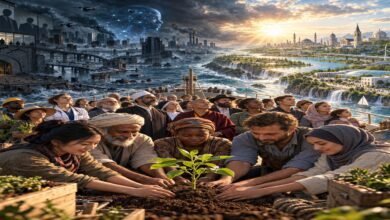
It is with a profound sense of honour—and, indeed, of responsibility—that I rise to address this august gathering on a subject which transcends the ordinary confines of academic discourse. The theme before us is not merely an intellectual inquiry, nor a speculative meditation of the mind; rather, it is a guiding light for a new epoch, a moment pregnant with consequence, and a solemn trust that bears upon the destiny of a nation, a state, and humanity at large.
For this is not simply the narration of a diplomatic episode, nor an abstract philosophical proposition. It is, in essence, an appeal—an appeal that resounds within our collective conscience, reverberates through our political institutions, and beckons our civilisational ethos to respond. When the world is caught in the maelstrom of uncertainty; when the equilibrium of power is disturbed; when the tempests of expediency threaten to extinguish the lamps of moral restraint—what role ought a principled state, such as Pakistan, play in the light of its intellectual inheritance, particularly the enduring philosophy of Allama Iqbal?
This inquiry, therefore, seeks to illuminate a pressing question: when the world is beset by the clash of powers, political estrangement, and the looming spectre of war, what ought to be the conduct of a state that is at once ideological in foundation, nuclear in capacity, and peace-oriented in disposition? In approaching this subject, we are called not only to revisit the teachings of a towering thinker but also to examine how, in the contemporary global climate, Pakistan may translate those ideas into a constructive and conciliatory role—particularly in relation to tensions between major powers such as the United States and Iran, and the steps necessary to render such efforts durable and meaningful.
In truth, this theme is the confluence of three grand currents:
on the one hand, the eternal message of peace embodied in the Holy Qur’an;
on the other, Iqbal’s philosophy of selfhood and universal humanity;
and finally, Pakistan’s historical and geographical responsibility upon the stage of nations.
Ladies and gentlemen,
The study of human history reveals a sobering truth: wars are not born merely upon battlefields—they are conceived in the recesses of the human mind. When thought is constricted, when vision is clouded by prejudice, and when the heart is seized by avarice, swords are drawn almost of their own accord. It was precisely this moral and spiritual dislocation that Islam sought to redress.
The Holy Qur’an does not regard peace as a mere political expedient; it elevates it to the rank of a moral imperative. Justice is declared the foundation of peace, and benevolence its crowning perfection. The Islamic conception of peace is not a passive condition defined by the absence of war; rather, it is an active and living state—comprising justice, tolerance, dialogue, and mutual respect. It is upon such intellectual and ethical foundations that a truly civilised international order may be constructed.
Islam has consistently preferred peace over war, justice over oppression, and dialogue over confrontation. The verse with which I commenced carries precisely this meaning—that the preservation of a single life is tantamount to the preservation of all humanity. The Qur’an declares:
وَلَا تَعْتَدُوا ۚ إِنَّ اللَّهَ لَا يُحِبُّ الْمُعْتَدِينَ
(Surah Al-Baqarah 2:190)
“Do not transgress; indeed, Allah does not love the transgressors.”
Distinguished audience,
Global peace can only be sustained when states subject their power to the higher principles of justice, responsibility, and humanity. The essential message of Islam is one of peace, equity, and compassion. The Qur’an further proclaims:
وَإِنْ جَنَحُوا لِلسَّلْمِ فَاجْنَحْ لَهَا وَتَوَكَّلْ عَلَى اللَّهِ
(Surah Al-Anfal 8:61)
“And if they incline towards peace, then incline towards it [also] and place your trust in Allah.”
This verse reminds us that even the exercise of power must remain bound by moral restraint. In Islam, war is never the objective; peace is the destination. The true excellence of power lies not in confrontation but in resolving conflicts with wisdom, patience, and deliberation.
Likewise, the Qur’an teaches:
وَجَعَلْنَاكُمْ شُعُوبًا وَقَبَائِلَ لِتَعَارَفُوا
(Surah Al-Hujurat 49:13)
“And We made you into nations and tribes so that you may know one another.”
Herein lies a profound civilisational principle: diversity among nations, cultures, and peoples is not ordained for conflict, but for recognition, cooperation, and dialogue.
Honoured guests,
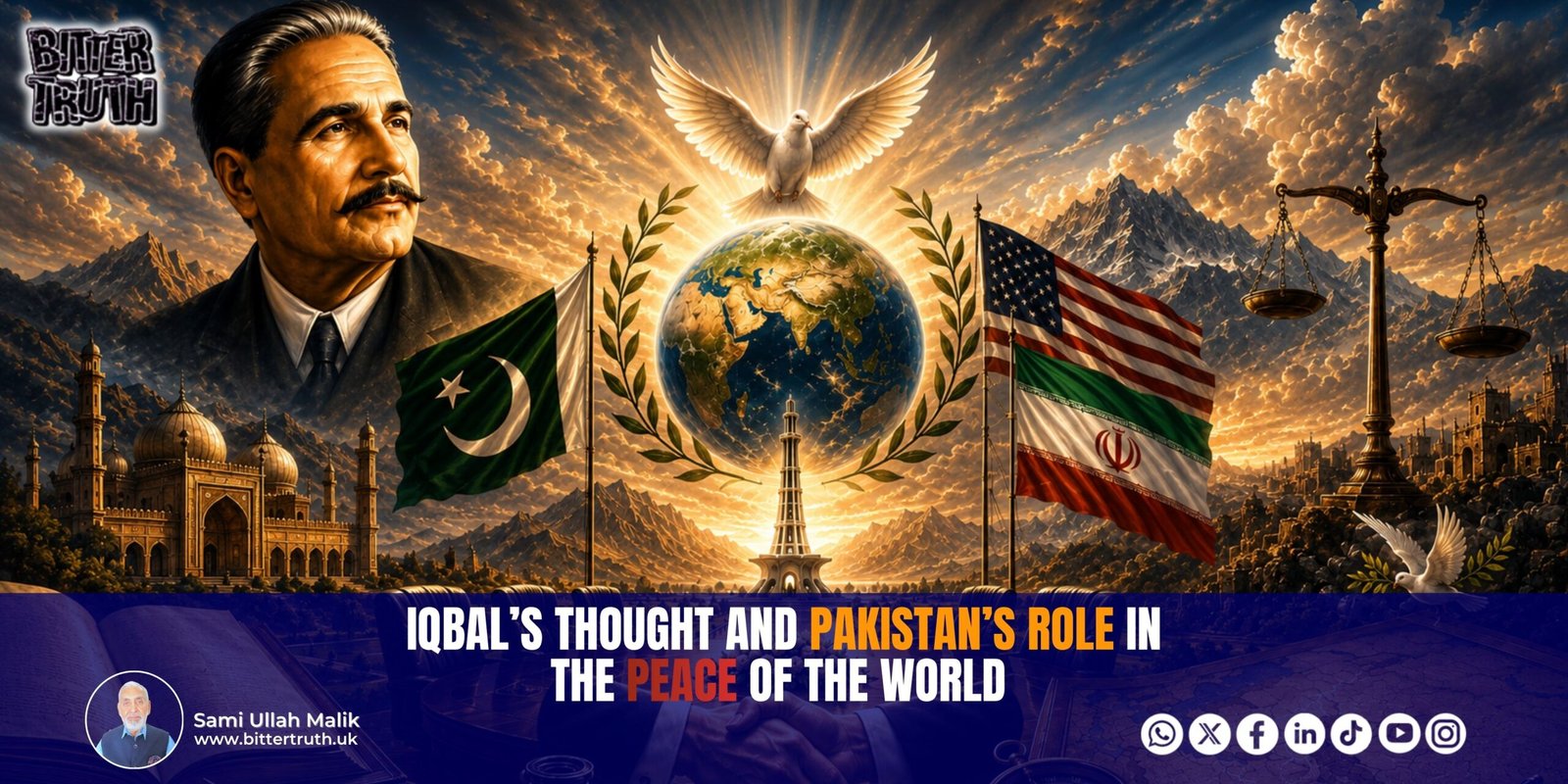
When we view this Qur’anic vision through the intellectual lens of the twentieth century, we encounter a figure of remarkable stature—Allama Muhammad Iqbal. It was he who, through the eloquence of poetry and the depth of philosophy, translated these eternal truths into a living discourse for the modern world.
Iqbal was not merely a poet; he was an architect of civilisation, a physician of the intellect, and a guide of the spirit. His thought possesses a rare vitality—it speaks equally to the heart and to the mind.
He envisioned a world in which man would not remain a mere subject of power, but would rise as the bearer of moral dignity, intellectual excellence, and spiritual grandeur. To understand Iqbal is to understand that his central concern was the elevation of the human being. His philosophy revolves around three cardinal ideas: the realisation of the self (khudi), the brotherhood of humanity, and the establishment of global peace.
For Iqbal, peace is not confined to political arrangements; it is a comprehensive harmony of the human condition. The root of disorder, in his view, lies in the inner defeat of man. When man becomes estranged from his true self—when he forgets his spiritual worth—he begins to equate domination over others with success.
Iqbal restored to man his lost identity. He taught that man is neither merely a material entity nor a political instrument; he is, above all, a moral and spiritual being whose purpose is to advance goodness and restrain evil. It is precisely this conception that may serve as the foundation of
enduring global peace.
A salient feature of Iqbal’s thought is the idea of the unity of mankind. Rising above the narrow confines of nationalism, he regarded humanity as a single moral community. For him, distinctions of race, colour, language, and geography were instruments of recognition—not of division. It is this very vision that the modern world, fractured as it is, most urgently requires.
Ladies and gentlemen,
In Iqbal’s view, the identity of a Muslim is not confined to ritual devotion; rather, it extends to embodying justice, goodness, and peace in the world. He observed that the destiny of nations is shaped by their resolve, their character, and their consciousness. In one of his celebrated verses, he warns:
جلالِ پادشاہی ہوکہ جمہوری تماشاہو
جداہودیں سیاست سے تورہ جاتی ہے چنگیزی
“Whether it be the splendour of monarchy or the spectacle of democracy,
If religion is divorced from politics, what remains is tyranny unrestrained.”
This poetic insight offers a profound lesson: when politics is severed from morality and spirituality, peace becomes unattainable. It is precisely this deficiency that afflicts much of contemporary global politics.
Distinguished audience,
The present global order reveals a disquieting reality: the balance of power has been disturbed. Major powers, in pursuit of their strategic interests, often transform smaller states into arenas of contestation. In such circumstances, the world is in dire need of a voice that is not only impartial but principled—and it is here that Pakistan may assume a meaningful role.
Pakistan itself was conceived as an ideological state. Quaid-i-Azam Muhammad Ali Jinnah envisioned it not merely as a territorial entity but as a moral experiment—a state that would stand for peace, justice, and international cooperation. It was to be a polity that would serve its citizens with fairness and contribute positively to the global community.
Geographically, Pakistan occupies a position of singular importance. Bridging the West, the Middle East, Central Asia, and the wider Muslim world, it is uniquely placed to serve as a natural diplomatic bridge—a mediator, a facilitator, and a reconciler.
Esteemed listeners,
A survey of contemporary international affairs reveals numerous conflicts that threaten global stability. Some of these are not merely regional disputes but carry implications of a far wider magnitude. In such a milieu, Pakistan must not remain a passive observer; it must emerge as an active participant in the cause of peace.
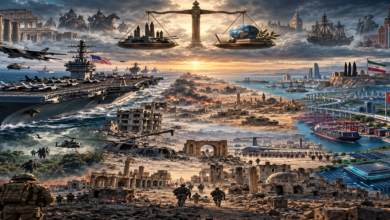
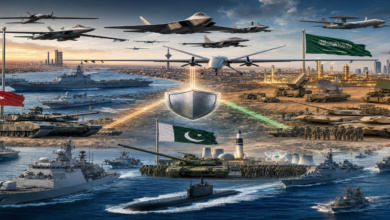
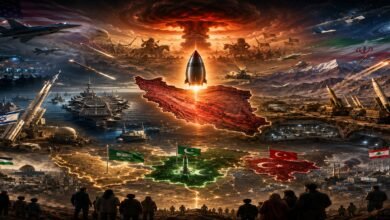
Among these tensions, the strained relations between the United States and Iran stand as a matter of grave concern. This discord imperils not only the Middle East but the broader fabric of global peace. Pakistan, as a nuclear power, a significant member of the Muslim world, and a responsible state, possesses both the capacity and the credibility to play a mediatory and conciliatory role.
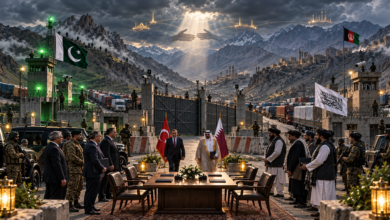
In this context, the diplomatic endeavours undertaken in Islamabad have conveyed a clear and hopeful message: even amidst the shadows of conflict, the door of dialogue must never be closed. Pakistan has presented itself as a conduit for communication—a state capable of facilitating engagement between contending parties.
Guided by the teachings of Iqbal, Pakistan has sought to adopt a balanced, constructive, and conciliatory posture. Through sustained and patient efforts, it has encouraged back-channel diplomacy between the United States and Iran, enabling both sides to articulate their concerns free from coercion. In doing so, the world was, for a moment, drawn back from the precipice of a wider catastrophe.
Yet, as history so often reminds us, the path to peace is seldom linear. Forces of disruption continue to seek the undoing of such efforts. Nevertheless, both Pakistan and the wider international community recognise that the journey towards lasting peace demands perseverance, foresight, and steadfast resolve.
Iqbal never counselled blind opposition nor unthinking allegiance. His summons was to a sterner discipline:
سبق پھرپڑھ صداقت کا،عدالت کا،شجاعت کا
لیاجائے گاتجھ سے کام دنیاکی امامت کا
Relearn the lessons of truth, of justice, of courage;
For upon you shall rest the burden of guiding the world.
In our own hour, these lines may well serve as a lodestar for Pakistan’s foreign policy. If that policy were grounded in Iqbal’s principles, it would not only gain in effectiveness but in dignity. He taught us that self-respect, justice, and truth are the pillars upon which a resolute nation stands. Pakistan must therefore refuse to confine its diplomacy to the narrow calculus of expediency; it must instead align its interests with enduring moral principles. This is not to neglect national interest, but to ennoble it.
Pakistan’s role ought not to be that of a partisan, but of a proponent of peace. In seeking to ease tensions between the United States and Iran, three foundational principles, drawn from Iqbal’s thought, ought to be held firmly in view: dialogue, justice, and respect for sovereignty.
Iqbal’s conception of human fellowship teaches that disputes are best resolved not through collision but through conversation. In his philosophy, dialogue and intellectual freedom occupy a place of primacy. Disagreement need not descend into enmity. Pakistan has, at various junctures, encouraged diplomatic engagement between these nations, where measures to build confidence have been explored. Yet the first condition of such engagement is fidelity to commitments. Peace is not secured by ink upon paper alone, but by the honouring of promises. When trust is broken, the consequences do not remain confined to two states; they reverberate across entire regions, breeding instability.
The second principle is justice. In Iqbal’s view, peace can only endure where justice prevails. Pakistan must adopt a posture marked by fairness, balance, and principled resolve. It should act as an impartial intermediary, attentive to the perspectives of both sides, and strive to advance a settlement that is equitable rather than expedient.
The third principle is the primacy of humanity. Iqbal’s message transcended geography; he regarded the human being as such, not as a mere subject of territorial divisions. Respect for sovereignty is thus indispensable. He consistently raised his voice against subjugation and external domination. Pakistan must therefore pursue a balanced approach—mindful of Iran’s sovereignty and the global role of the United States—without surrendering its independence of judgement.
History, however, offers a sober warning: the path to peace is seldom smooth. Whenever efforts are made to restore harmony, there are forces—driven by political, economic, or strategic motives—that seek to undermine trust. In such circumstances, the true test lies not in signing agreements, but in sustaining the confidence upon which they rest.
In the present climate, Pakistan possesses several practical avenues to strengthen its role. It may intensify its diplomatic engagement, playing an active part in international forums and presenting constructive proposals for a durable resolution of tensions. It may promote confidence-building measures, recognising that mistrust is the chief impediment to peace. Such trust must extend beyond official channels to the wider public sphere, through informal dialogues, intellectual exchanges, and scholarly collaboration. A culture of dialogue must be cultivated—one in which dissent is tolerated, inquiry is not suppressed, and reasoned argument is given precedence. It is in such an atmosphere that peace may take root.
Economic cooperation constitutes another vital dimension. Stability in the economic sphere is inseparable from stability in the political. A robust and self-reliant economy not only fortifies the nation internally but enhances its standing abroad. By fostering regional trade, expanding economic ties, and initiating joint development projects, Pakistan can help redirect rivalries into partnerships.
Equally important is the promotion of religious and cultural harmony. Religion, regrettably, is too often associated with extremism, though its true message is one of balance, mercy, and peace. As a nation with a rich intellectual and cultural heritage, Pakistan is uniquely placed to present a narrative that binds faith with tolerance and moderation. In Iqbal’s vision, religion is a living force—one that awakens the individual, instils responsibility, and guides humanity towards the good. The destiny of nations, he reminds us, is shaped in the hands of individuals; each person is a star in the firmament of the collective.
Peace cannot be secured by statecraft alone; it demands effort at the intellectual and cultural level as well. Pakistan’s civilisation, its language, and its literary inheritance all speak of compassion and coexistence. In the modern world, influence is no longer derived solely from military strength. Intellectual, cultural, and diplomatic resources now carry equal, if not greater, weight. If Pakistan were to draw upon Iqbal’s philosophy as a source of such influence, it could present itself not merely as a state among others, but as a persuasive voice for peace.
In practical terms, Pakistan may offer impartial mediation, facilitate discreet negotiations, propose shared economic initiatives, and convene regional peace conferences. Such measures would be in harmony with Iqbal’s vision of the unity of humankind.
Today we stand at a critical juncture in world affairs. A single misunderstanding, a momentary misunderstanding, can precipitate a grave crisis—yet the instruments of salvation remain at hand: steadfast faith, persistent effort, and the spirit of human fellowship. These are the forces that can avert disaster.
Power itself has changed its character. It is no longer confined to arms and arsenals; it resides also in ideas, in culture, and in diplomacy. If Pakistan can achieve a balance among these dimensions, it may yet play a constructive and respected role upon the global stage.
In conclusion, Iqbal’s thought is not a relic for libraries, but a guide for action. It is not merely a literary inheritance, but a living framework for policy and conduct. If we were to embody these principles in our institutions and our collective life, we might not only resolve our own difficulties but offer an example to others. By adhering to such a course, Pakistan could secure stability at home and contribute meaningfully to peace abroad.
May Pakistan be granted the strength to stand for peace, justice, and the common good; and may we be granted the wisdom to understand and act upon the enduring message of Iqbal. May all nations be guided away from conflict towards dialogue, from strife towards peace, and from division towards a shared humanity.
وما علینا الا البلاغ And we are not responsible except for clear notification.
Addressing a seminar at Iqbal Academy Lahore on July 14, 2026