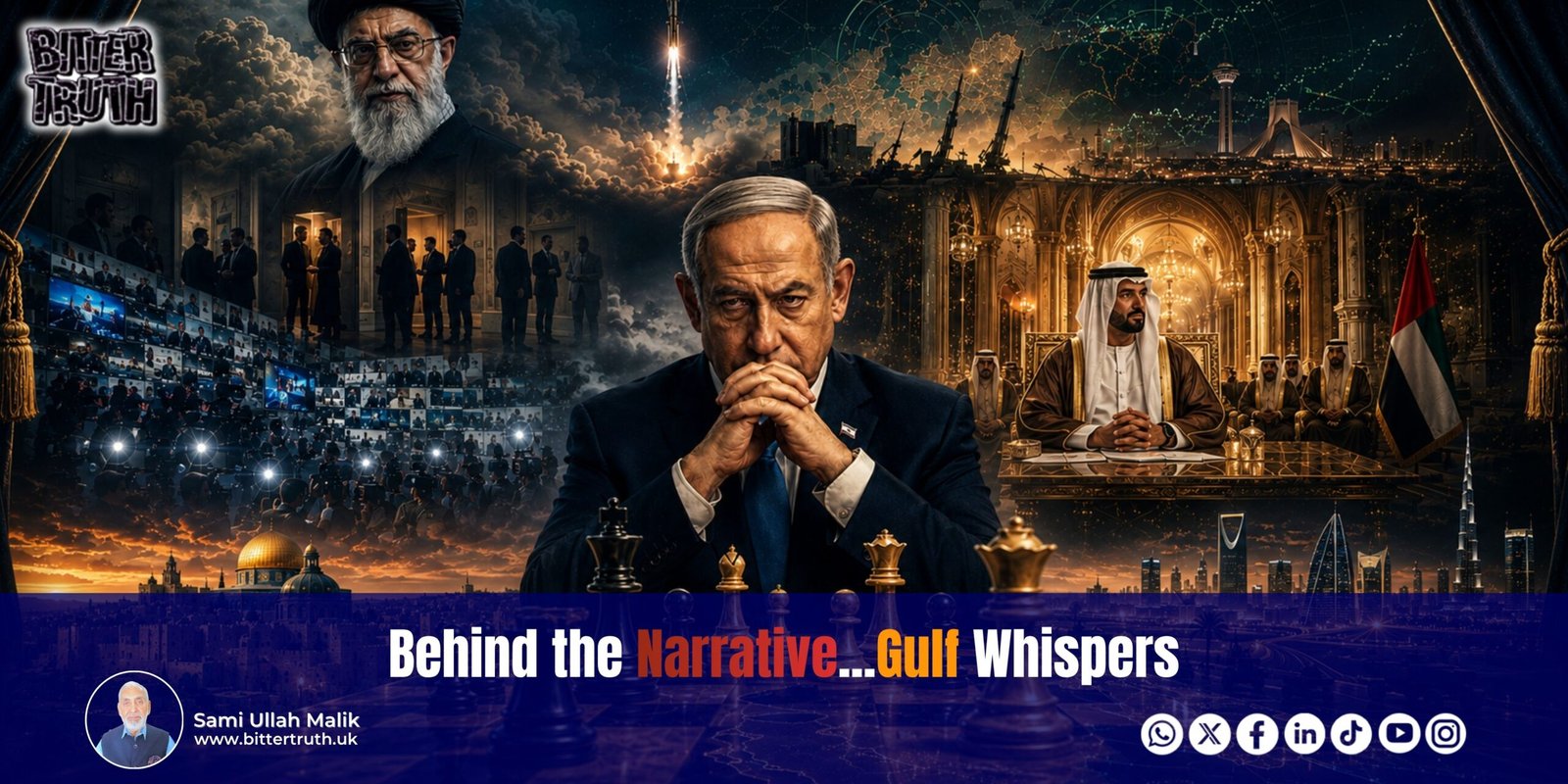
Behind the Narrative
Gulf Whispers

The politics of the Middle East is not a mere procession of events; it is an ocean of meanings—an expanse whose surface reveals only restless waves, while beneath it flow deeper currents of civilisation, power, fear, and interest, perceptible only to the most discerning eye. It has ever been a theatre of intimations and stratagems, of prudence entwined with intrigue, of the visible and the concealed interwoven into a narrative at once intricate and elusive. Here, a word seldom remains merely a word; it matures into a signal, a gesture laden with implication. Silence, too, acquires a peculiar eloquence, often speaking more profoundly than the most emphatic declaration.
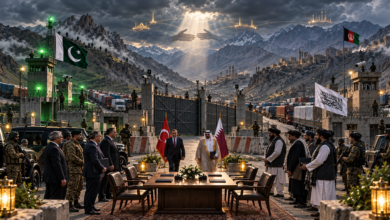
If one were to compress the politics of this region into metaphor, it would appear as a heavy curtain—dense, impenetrable—behind which actors move in ceaseless motion, while before it, only their shadows are cast. Decisions are forged in closed chambers yet proclaimed in open arenas; and between the act and its announcement there yawns a distance so vast that reality and perception often diverge into separate worlds. The recent episode—the alleged clandestine visit of the Israeli Prime Minister and the swift, categorical denial issued by the United Arab Emirates—is but a living illustration of this duality. It is not merely a report and its refutation; rather, it is a complex alloy of power, narrative, regional equilibrium, and psychological diplomacy. It marks yet another chapter in this unfolding chronicle, wherein multiple layers shimmer beneath the political veil. The purported visit of Mr Netanyahu is but a surging wave upon this sea—one beneath which quieter, more consequential currents continue their unseen course.
Political history instructs us that, at times, the event itself is of lesser consequence than its announcement. So it is here. The pertinent question is not whether the visit occurred, but why its disclosure was made at that precise juncture. It came at a moment when Israel found itself under internal strain and, in regional terms, increasingly isolated. In such circumstances, the proclamation of a discreet diplomatic success becomes a psychological instrument—one that reassures the public that authority remains firmly in command of events.
That the narrative shifted within the span of two hours is itself evidence that, in the theatre of modern diplomacy, time has become a weapon. The alacrity with which the Emirati Ministry of Foreign Affairs responded was not mere reaction; it was pre-emptive defence—a carefully drawn perimeter within which no rival narrative might take root. The Israeli announcement, followed so swiftly by the Emirati denial, was not simply a sequence of claim and counterclaim; it was an act of strategic positioning. It amounted, in effect, to a diplomatic assertion of sovereignty: that Abu Dhabi alone shall author the narrative of its foreign policy. In plain terms, it was a declaration that any story unfolding upon its soil shall be written with its consent, and that the chronicle of its diplomacy cannot be composed by another’s pen.
Over the past decade, the foreign policy of the United Arab Emirates has been recast in a distinctive mould. It is neither anchored in absolute silence nor in overt alignment; rather, it treads a middle course—what might be termed a diplomacy that is perceptible, yet not always visible. Hence, when the Israeli announcement threatened to disturb this delicate equilibrium, the Emirati response was both swift and firm. It was, in essence, the defence of a principle: that relationships may exist, but their disclosure shall occur only on terms determined in Abu Dhabi.
Within Israel’s announcement there lingers the scent of domestic political unease, yet it also conveys a subtle, though deeply resonant, signal to Saudi Arabia. It is a message delivered in hushed tones but rich in implication: the pathways stand open; it remains for you to advance—or to remain where you are.
When an Emirati scholar of repute dismisses this narrative as an artefact of imagination, his intervention transcends the realm of mere opinion and assumes the character of an intellectual redoubt. Such a rebuttal constitutes, in effect, an academic ratification of the state’s position. Here, knowledge becomes the arm of politics, conferring legitimacy upon the chosen narrative. By designating the account as political fiction, he reminds us that statesmen, at times, are less chroniclers of reality than authors of it.
The Gulf states—most notably the Emirates and Saudi Arabia—sustain a delicate psychological equilibrium within their foreign policies. They operate simultaneously upon three planes: at the public level, the preservation of Arab and Islamic identity; at the pragmatic level, cooperation with Western powers and Israel; and at the regional level, the careful management of tensions with Iran. To balance these three spheres is an art of the utmost subtlety. Any premature revelation of covert ties risks unsettling this finely wrought arrangement.
The confirmation offered by Zeev Elkin tells yet another story, one that introduces an intriguing dissonance. The grandeur and ceremonial splendour described therein serve, above all, as psychological balm for a domestic audience—an attempt to soothe anxieties and reinforce confidence. Here again, the essential question is not whether the event transpired, but why it was narrated in such terms. In truth, it answers a political necessity: the need of leadership to fortify its narrative and sustain its authority.
For Israel, the gravest danger is not confined to the military sphere; diplomatic isolation looms as an equally formidable threat. Should the impression take hold that relations with the Arab world are normalising, it would constitute a significant strategic gain. It is for this reason that such announcements are made—to convey, whether explicitly or by implication, that Israel does not stand alone, but is accompanied, however discreetly, by influential actors within the region.
No understanding of this episode is complete without reference to Iran. Iran is not merely a regional power; it is an ideological force, with which the Gulf states maintain a relationship suspended between tension and necessity. Were the Emirates to render its ties with Israel too conspicuous, it could provoke a renewed strain in its dealings with Tehran. Thus, denial becomes not merely expedient, but essential. The statements emanating from the Iranian Foreign Ministry are emblematic of this quiet contest—one that flows beneath the surface of Gulf politics. They represent a chapter that may appear tangential, yet is, in truth, central to the narrative. In the strategic imagination of the Gulf, Iran remains a presence that casts its shadow across every decision.
This region is no longer defined solely by geography; it has become a chessboard upon which every move reverberates across multiple dimensions, and where each gesture—whether seen or unseen—carries consequences far beyond its immediate form.
According to analysts in Jerusalem, the announcement bore the unmistakable imprint of domestic political expediency—a stratagem born of pressure rather than confidence. When leadership finds itself encircled by strain, it has long been the instinct of statesmen to weave tales of external triumph, thereby veiling internal fragility. As the ground beneath political authority begins to tremble, narratives of foreign success are summoned to steady the edifice of public trust.
This is by no means the first occasion upon which reports of clandestine visits or discreet encounters have surfaced. The annals of covert diplomacy abound with such precedents—whether in the secret contacts that preceded the Camp David accord between Egypt and Israel, or in the concealed negotiations that gave rise to the Oslo agreement. The distinction in our present age lies not in the existence of secrecy, but in its fragility. The velocity of modern media ensures that few secrets remain shrouded for long.
As elections draw near, every fragment of information is transmuted into an instrument of contest. For Mr Netanyahu, this announcement was not a mere communiqué; it formed part of a broader political campaign—an attempt to cultivate the impression of continued relevance and dynamism upon the world stage. It bears all the hallmarks of an electoral season artefact. It was imperative, therefore, that he present himself as a statesman capable of unlocking the gates of the Arab world.
In our own time, the media has ceased to function as a passive conduit of information; it has become a formidable engine of narrative construction. Israeli, Western, and regional outlets alike shape their accounts according to distinct priorities and sensibilities. Thus, the essential question persists: what we read or hear—does it reflect reality, or merely a version of it refracted through a particular lens?
The invocation of missile defence systems serves to illuminate a depth of relationship that does not fully reveal itself upon the surface. It is at this juncture that politics and security become inextricably entwined. Were it indeed the case that such systems had been employed in defence of the Emirates, it would signal a profound level of cooperation—yet precisely for that reason, it is a matter Abu Dhabi would prefer not to parade before public view. States, after all, are sustained not by power alone, but by reputation. In recent years, the Emirates has cultivated the image of a moderate, sovereign, and forward-looking polity. To be perceived as a concealed participant in conflict would risk diminishing that carefully constructed standing. The denial, therefore, was not merely a rebuttal; it was an act of reputational preservation.
Abu Dhabi is acutely aware that overt proximity may provoke renewed strain in its relations with Tehran. Its policy appears to rest upon a principle of equilibrium: maintain relationships yet avoid spectacle. It is, in essence, a doctrine of quiet advantage—derive benefit, but refrain from proclamation.
For Mr Netanyahu, there has long been a consistent thread within his political method: the answering of domestic challenge through the projection of foreign success. When opposition gathers strength or public confidence wavers, the manufacture of external achievement becomes a familiar recourse. Such appears to be the governing logic at work here.
The reports themselves resemble a misted mirror, within which each party discerns the reflection it prefers. Western coverage further complicates this tableau, rendering reality at times sharply defined, at others obscure. Each account arrives bearing its own angle, and each angle reveals but one facet of a larger, more intricate truth.
Within this entire narrative, the role of Saudi Arabia appears outwardly restrained, yet is in fact of profound significance. For Israel, the ultimate objective has long been Riyadh, for any rapprochement with it would herald a transformation across the broader Arab and Islamic world. This announcement may well be read as an attempt to exert subtle psychological pressure in that direction.
The denial itself may thus be understood as an expression of power in defensive form—a shield designed not only to safeguard political credibility but also to preserve the delicate equilibrium of the region. The Emirates has made it plain that it is not prepared to serve as a mere appendage to another’s narrative.
To portray the Emirates as a covert ally would entail consequences of no small magnitude: domestic unease, regional mistrust, and an altered perception of its international role. It was therefore imperative that such a notion be swiftly repudiated. Had the visit been acknowledged, the Emirates might have been cast as a discreet partner operating behind a veil. The denial extinguished that possibility, reaffirming instead its standing as an autonomous actor.
Modern diplomacy is no longer governed by rigid alignments; it has become a discipline of remarkable flexibility. States now maintain concurrent relationships with competing forces, deploying them in accordance with their interests. The Emirates, it would seem, seeks to embody this new diplomatic paradigm—yet for the present, it prefers that such relationships remain concealed behind iron curtains. It was Israel, however, that appeared to rend that curtain.
Nor is this the first instance in which sensitive relationships have been leveraged for political gain. Within such political traditions, diplomatic disclosures have long served as a tested instrument. Narrative construction itself has been elevated to an art. It is well understood that in politics, truth often acquires legitimacy not by its essence, but by its acceptance. Should the Emirati leadership have concluded that a boundary had been crossed by such an announcement, it would suggest that even covert relationships possess limits—and that those limits demand observance.
The internal strains within Israel, coupled with impending elections and a climate of political uncertainty, have given rise to this narrative. When the lamp within burns dim, it is deemed necessary to display illumination without. When discord intensifies at home, the external front is brought into sharper relief. Such a strategy appears unmistakably at work here. Yet episodes of this nature may, in time, erode trust. If one party elects to deploy confidential ties in pursuit of its own political advantage, it risks imperilling the very relationships upon which future engagements depend.
The Gulf region, at present, rests upon a delicately poised equilibrium—one in which each step must be measured with the utmost care, for a single miscalculation may set in motion forces capable of unsettling the entire landscape. The announcement of Mr Netanyahu’s purported clandestine visit to the Emirates was, in essence, a diplomatic whisper—an oblique communication whose implications far exceeded its form. It spoke not directly, yet with unmistakable intent. To Riyadh, in particular, it conveyed a subtle but weighty suggestion: if Abu Dhabi may advance, why should you remain still?
Even the most formidable states cannot wholly disregard the temper of public opinion. It is for this reason that certain decisions are consigned to the shadows, shielded from premature exposure lest they provoke unwelcome reaction. Such a method is hardly novel; it has been rehearsed repeatedly across the pages of history. The underlying objective remains constant: by accentuating divisions within the Arab world, Israel has sought to consolidate its diplomatic position. The logic is as old as statecraft itself—foster divergence and thereby extend influence.
Herein lies one of the central paradoxes of contemporary Middle Eastern politics. At the level of declared principle, the Palestinian question and the ideal of Arab solidarity are invoked with solemnity; yet at the level of practice, relationships are forged in accordance with interest. This dissonance is not incidental—it is structural. Within such a climate, the remarks of Anwar Gargash assume the character of intellectual equilibrium. His assertion that the region must move forward through cooperation rather than confrontation stands as a measured intervention—a lamp of reason amid turbulence. It is, in effect, a reminder that power unguided by wisdom seldom secures enduring stability.
In the realm of modern diplomacy, truth and narrative have become distinct, if occasionally convergent, realities. At times they intersect; at others they proceed along parallel courses, never fully meeting. The Emirati denial and the Israeli announcement each possess their own internal validity; yet the fuller truth lies somewhere in the interstice between them. From this episode emerges a lesson of no small consequence: in the politics of the coming age, narrative may well eclipse fact in its potency. The state that master’s the art of presenting its account with conviction and coherence will command the greater influence upon the global stage.
This entire episode reveals, with unusual clarity, that the politics of the Middle East is not merely an arena of power, but a domain shaped equally by perception, narrative, and psychological design. It reminds us that this region is not a simple aggregation of events, but a complex web of interests, anxieties, aspirations, and calculated judgements. Here, words are not mere vehicles of expression; they are instruments of power. Silence, likewise, is never empty—it is a statement in its own right. Every utterance is weighed before it is delivered; every pause is deliberate; every denial serves not as an end, but as the beginning of another story, and the opening of yet another path toward affirmation.
One might, therefore, conceive of the Middle East as a book whose pages are never complete. Each event inscribes a new line, and each line conceals within it a multiplicity of meanings. It is a narrative in which every chapter remains unfinished, and every actor advances the story bearing his own version of truth. At times, the region appears less a fixed geography than a grand stage—a civilisational drama of politics, where curtains rise and fall in perpetual succession, yet the play itself resists conclusion. Every occurrence becomes the prelude to another chapter; every denial gives birth to a fresh reality.
And yet, even behind the veil of denial, the Emirates appears unable entirely to obscure its evolving posture. Its emerging domestic and external policies suggest the gathering of more uncertain winds ahead—currents that, if left unchecked, may carry with them the spectre of a more profound isolation in the years to come.