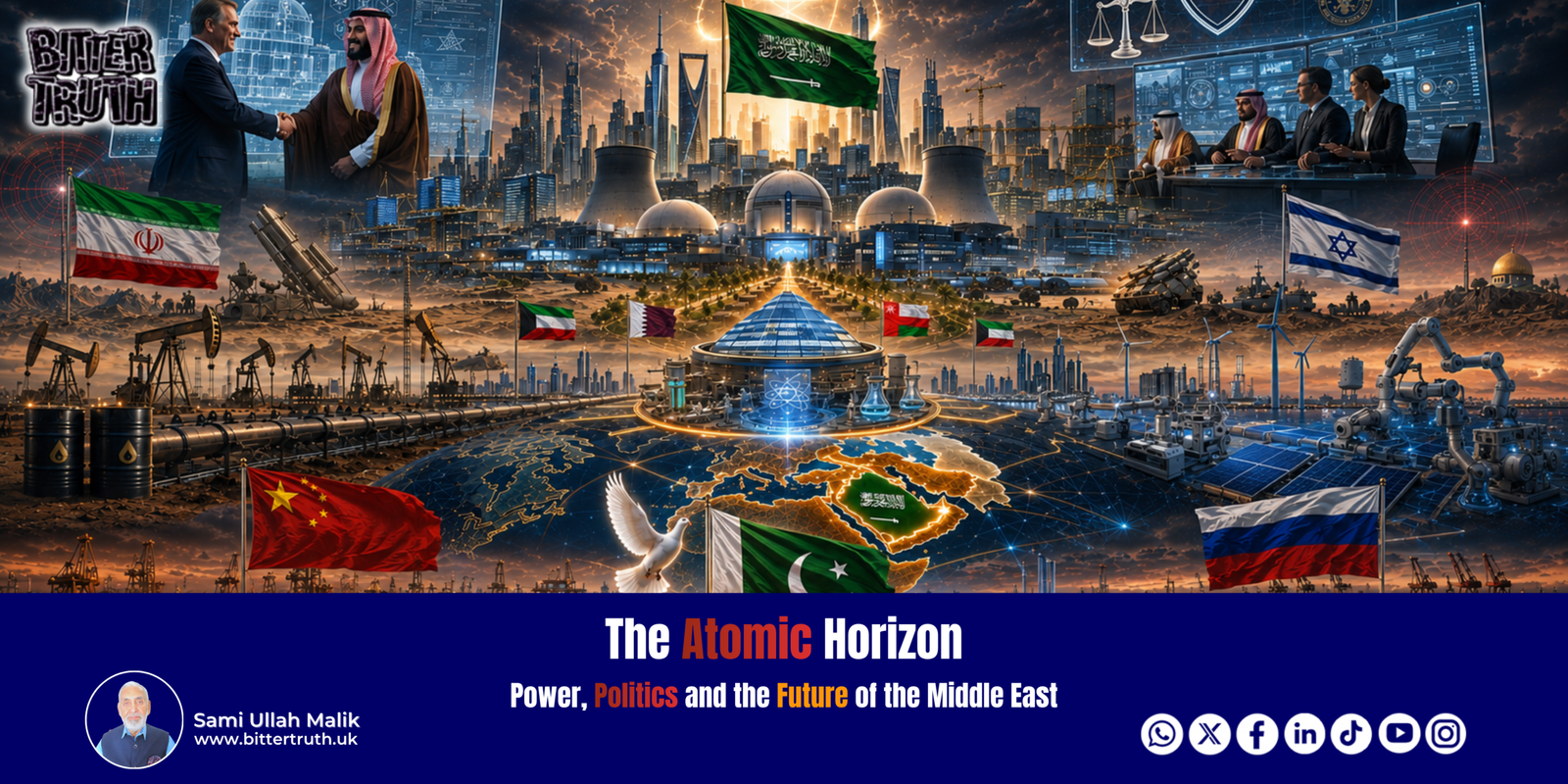
The Atomic Horizon: Power, Politics and the Future of the Middle East
The Atom’s Promise, The Shadow of Power

The Atomic Horizon: Energy, Power and the New Strategic Calculus of the Middle East….Energy, Civilisations and the Architecture of Global Power
Throughout human history, energy has never been merely a means of producing light or powering industries. It has always been one of the fundamental forces that shaped the rise and decline of civilisations, determined the strength of states, accelerated economic transformation, and influenced the course of international politics. Energy has been, in many ways, the hidden current beneath the visible tides of history — an invisible force that has propelled nations towards prosperity, competition, and sometimes confrontation.
The coal that fuelled the Industrial Revolution did far more than warm homes and operate factories; it transformed the very structure of human society and gave birth to a new economic order. The power of steam reshaped global commerce, altered patterns of production, and created industrial empires whose influence extended far beyond their geographical borders. Likewise, oil became the defining strategic commodity of the twentieth century, shaping the architecture of global geopolitics and influencing the decisions of the world’s most powerful nations.
Yet the twenty-first century is witnessing the emergence of a new paradigm. The future of power is no longer defined by a single resource alone. Instead, it is being forged through the convergence of energy, technology, scientific advancement, and strategic capability. The nations that will shape the coming decades will not necessarily be those with the largest reserves of traditional resources, but those capable of transforming knowledge, innovation, and technological mastery into instruments of national strength.
The world has entered an era in which the true measure of a nation’s power is no longer confined to the size of its military arsenal, the abundance of its natural resources, or the extent of its territory. Rather, the decisive question is whether a state possesses the vision and capacity to integrate energy security, scientific research, artificial intelligence, advanced technology, and modern industry into a coherent national strategy.
Power in the modern age is no longer merely accumulated; it is engineered. It is within this rapidly transforming global landscape that the Middle East once again finds itself standing at a critical historical crossroads. For centuries, this region has been a theatre where civilisations met, trade routes flourished, empires rose and fell, and global powers competed for influence. The sands of the Middle East have witnessed the footsteps of ancient kingdoms, the movement of caravans carrying the wealth of continents, and the struggles of modern states seeking security and strategic relevance.
In such a region, no major agreement can ever be regarded as a simple diplomatic arrangement between two governments. Every significant decision carries consequences that extend beyond borders, influencing the political, economic, and security architecture of the wider region. The emerging question of nuclear cooperation between the United States and Saudi Arabia represents precisely such a moment.
At first glance, it appears to be a programme centred on peaceful nuclear energy — an initiative designed to diversify energy sources, strengthen industrial development, and open new possibilities for future economic growth. Yet, when examined through the deeper lens of international politics, this issue reveals dimensions far beyond electricity generation or energy supply. Beneath the surface lies a complex intersection of strategic influence, national security, diplomacy, regional equilibrium, and the broader contest for global power.
Saudi Arabia, a nation that for decades has stood as one of the central pillars of the global oil market, is now seeking to redefine its place in the international order. Riyadh increasingly recognises that the future of global economic power cannot be secured solely through vast petroleum reserves. The coming era will belong to those who command knowledge, technology, scientific innovation, artificial intelligence, renewable energy, and advanced industrial capabilities.
The old foundations of wealth are being challenged by new foundations of influence.
It is within this broader vision that Saudi Arabia has introduced Vision 2030 — an ambitious national transformation strategy designed to move the Kingdom beyond its historical identity as merely an oil-producing state and towards becoming a diversified, investment-driven, technologically advanced global centre.
Nuclear energy forms a significant component of this wider transformation.
However, the journey towards nuclear capability has never been merely a scientific or economic undertaking. The force contained within the atom carries a profound duality: it can become a source of illumination and progress, yet it can also represent one of humanity’s most consequential risks. This paradox is what makes nuclear energy fundamentally different from all other forms of power.
On one hand, nuclear energy possesses the extraordinary ability to generate vast quantities of electricity from relatively small amounts of fuel. It can contribute to reducing carbon emissions and provide a long-term solution to the growing challenges of energy security. For nations seeking sustainable development and industrial expansion, it represents a powerful technological opportunity.
On the other hand, nuclear technology carries sensitive dimensions that cannot be overlooked. Nuclear knowledge, the nuclear fuel cycle, uranium enrichment, and related technological capabilities extend beyond the boundaries of energy production. They are directly connected with national security considerations and the delicate balance of global strategic power.
This is precisely why international attention has been drawn towards US–Saudi nuclear cooperation.
The fundamental question is not simply why Saudi Arabia seeks access to nuclear energy. The deeper question is whether this undertaking will remain exclusively a pathway towards economic development, technological advancement, and peaceful energy transformation.
Will it progress under the principles of international oversight, transparency, and responsibility? Or could it become the beginning of a new strategic competition in an already fragile Middle Eastern landscape?
Every step into the nuclear age carries with it a mirror — a mirror that reflects both humanity’s extraordinary achievements and the weight of its responsibilities. The cooperation between Washington and Riyadh stands before that mirror as a defining historical moment, where science, politics, and human judgement confront one another in a profound dialogue about the future.
For Saudi Arabia, nuclear energy is not merely an electricity programme; it is a component of a much larger vision of national renewal.
A state whose economic identity has long been associated with petroleum exports now finds itself navigating a rapidly changing global economy. The transformation of energy markets, the pressures of climate change, the rise of new technologies, and the intensifying competition for industrial leadership have compelled nations across the world to reconsider their economic strategies.
Saudi Arabia is no exception.
Its nuclear ambitions are driven by several fundamental objectives.
First, the Kingdom seeks to diversify its energy portfolio and reduce its dependence on oil and gas alone. A resilient economy of the future requires a balanced and diversified energy foundation — one capable of withstanding fluctuations in global markets and reducing vulnerability to external pressures.
Second, nuclear development represents an opportunity to stimulate scientific and industrial advancement. Nuclear energy is not simply about generating electricity; it creates an ecosystem of engineering expertise, research institutions, medical applications, advanced industries, scientific education, and human capital development.
Third, nuclear capability forms part of the practical foundation of Vision 2030 — the ambition to build an economy where investment, knowledge, technology, and innovation occupy a central position.
The nuclear sector, therefore, is not an isolated project. It is a thread woven into the larger fabric of Saudi Arabia’s transformation.
Yet this journey cannot be viewed solely through the prism of domestic requirements. Any major shift in the global energy landscape inevitably carries international consequences. Energy has always been inseparable from geopolitics.
And it is at this point that the role of the United States enters the equation.
To view US–Saudi nuclear cooperation merely as a response to Riyadh’s energy needs would be to see only a fragment of a much larger picture. The reality is that this development is deeply connected with Washington’s broader Middle East strategy, the evolving competition among major powers, and the shifting foundations of the international order.
The atom, in this context, is not merely a source of energy. It is also a symbol of influence, a measure of strategic confidence, and a reflection of the changing balance of power in the twenty-first century.
The Atomic Horizon: Energy, Power and the New Strategic Calculus of the Middle East
Washington, Riyadh and the Fragile Balance of the Nuclear Age
For the United States, Saudi Arabia has, for several decades, remained one of its most significant partners in the Middle East. Although the relationship between the two nations has passed through periods of uncertainty, disagreement, and public scrutiny — particularly concerning questions of human rights, regional policies, and political differences — the enduring pillars of cooperation in energy, defence, trade, and regional security have continued to bind Washington and Riyadh together.
The proposed nuclear cooperation agreement may therefore be viewed as an attempt to carry this longstanding partnership into a new and more complex era.
For Washington, the significance of such cooperation extends far beyond the construction of reactors or the expansion of energy capacity. It carries several broader strategic implications: preserving America’s historic influence in the Gulf region; deepening Saudi Arabia’s integration with American technological expertise and investment networks; responding to the expanding presence of China and Russia in the wider Middle East; creating new opportunities for American industries in energy, research, and advanced technology; and reaffirming the United States’ role in shaping the future political order of the region.
Yet beneath this strategic alignment lies a profound contradiction.
The United States seeks a stronger strategic partnership with Saudi Arabia, but it is also regarded as one of the principal guardians of the international system designed to prevent the spread of nuclear capabilities. This tension represents the most delicate diplomatic challenge surrounding the entire agreement.
If Washington grants Riyadh greater freedom in developing its nuclear sector, it must simultaneously ensure that such cooperation does not create pathways that could, in the future, complicate regional security calculations or alter the existing balance of power in unpredictable ways.
For nuclear technology is not merely another branch of industrial development. It occupies a unique place in international affairs — where scientific achievement intersects with strategic influence, and where technological progress carries consequences far beyond the laboratory.
Every great scientific breakthrough brings with it two companions: the promise of extraordinary possibilities and the quiet shadow of profound responsibility.
Nuclear energy stands as perhaps the clearest example of this enduring human paradox.
The force contained within the atom opened the gates to an entirely new age of possibility. It transformed medicine, agriculture, industry, and electricity generation, providing humanity with tools that were once beyond imagination. Yet the same discovery also confronted mankind with a sobering truth: some achievements do not merely open doors to progress; they also create new tests of wisdom, restraint, and responsibility.
This is precisely what makes US–Saudi nuclear cooperation so complex. It is emerging in a region already marked by security anxieties, historic rivalries, competing ambitions, and unresolved questions of strategic balance.
In the Middle East, sensitive technologies rarely remain the exclusive concern of a single state. They rapidly become part of wider regional calculations and global security debates.
The fundamental question surrounding nuclear capability has always been the same:
Where does a peaceful nuclear programme end, and where does strategic capability begin? It is this uncertain boundary that has compelled the international community to approach nuclear development with extraordinary caution.
History has demonstrated that once a nation acquires advanced nuclear knowledge, the consequences do not remain confined to electricity production alone. The nuclear fuel cycle, scientific research, enrichment capabilities, and associated technical expertise possess a dual character. They can serve as instruments of economic development and scientific advancement, but they can also become foundations of strategic power.
For this reason, international institutions do not assess emerging nuclear programmes solely through the lens of economic progress. They also examine their potential implications for regional stability, security calculations, and the broader architecture of global power.
Iran, Saudi Arabia and the Politics of Strategic Suspicion
No serious examination of US–Saudi nuclear cooperation can be complete without considering the Iranian dimension.
For decades, the rivalry between Iran and Saudi Arabia for regional influence has shaped the political landscape of the Middle East. In Syria, Yemen, Iraq, Lebanon, and the wider security environment of the Gulf, the interests of the two nations have frequently moved in opposing directions.
Although recent years have witnessed signs of diplomatic engagement and a gradual improvement in relations, the legacy of mistrust and strategic competition has not entirely disappeared. Within such an environment, Saudi Arabia’s nuclear ambitions cannot be viewed by Tehran as merely an energy initiative.
If Iran perceives that the regional balance of power is shifting against its interests, its response could have significant consequences for the security environment of the entire Middle East. The central danger, therefore, lies not only in the possession of nuclear capability itself, but in the expansion of suspicion and uncertainty among competing states.
International politics has repeatedly demonstrated that nations often shape their policies not solely according to the present intentions of others, but according to their fears of what those states might be capable of doing in the future.
A measure that one country regards as a defensive necessity may be interpreted by another as a potential threat.
This is precisely where the importance of confidence-building becomes paramount. Saudi Arabia has consistently maintained that no state in the region should possess capabilities that create insecurity for others. However, in the harsh realities of international politics, intentions alone are rarely sufficient. Perceptions often carry equal, and sometimes greater, weight. When trust becomes fragile, even legitimate intentions can become surrounded by suspicion.
Israel and the Changing Architecture of Middle Eastern Security Within the existing power structure of the Middle East, Israel occupies a distinct and exceptional position. Although Israel has maintained a policy of strategic ambiguity regarding its nuclear capabilities, its role in the region’s security calculations has remained highly significant.
Saudi Arabia’s nuclear advancement is therefore viewed in Israel as a sensitive matter, not merely because of technological concerns, but because it touches upon the wider question of maintaining the existing security framework and strategic advantage within the region.
While diplomatic possibilities between Saudi Arabia and Israel have emerged in recent years, the issue of nuclear capability introduces additional layers of complexity involving trust, security guarantees, and regional equilibrium.
The foundation of Israeli concern is not simply that Saudi Arabia may acquire nuclear technology. It is also the possibility that other countries across the region could seek to follow a similar path, thereby fundamentally transforming the existing balance of power in the Middle East.
History offers a clear lesson: major strategic transformations rarely remain confined to a single nation.
The emergence of new capabilities by one state often compels others to reconsider their own security policies and strategic priorities. Should Saudi Arabia establish a comprehensive nuclear programme, it is conceivable that other Gulf states may eventually seek to incorporate nuclear ambitions into their own energy and security strategies.
Such a development could create a paradoxical situation: every state may seek greater protection for itself, yet the collective result may be a region that becomes increasingly uncertain and vulnerable.
The bitter lesson of history is that arms races are often born in the name of security. Nations frequently begin such pursuits believing they are safeguarding their future, yet over time these competitions can generate deeper fear, greater mistrust, and a cycle of rivalry from which escape becomes increasingly difficult.
The tragedy of strategic competition is that every nation may believe it is building a shield, while collectively constructing a storm. And in the fragile landscape of the Middle East, where history has repeatedly shown how quickly suspicion can replace cooperation, the true challenge is not merely acquiring power — but ensuring that power remains guided by wisdom, restraint, and responsibility.
The New Global Chessboard: America, China, Russia and the Strategic Role of Pakistan
The politics of the Middle East can no longer be understood merely through the narrow lens of rivalry among regional powers. The region has now become part of a much wider global contest — a vast arena where the great powers are shaping their strategies for energy security, trade, technological advancement, defence, and diplomatic influence.
The question of US–Saudi nuclear cooperation must therefore be viewed within this larger transformation of world affairs, where the emerging strategic competition between the United States, China, and Russia has become increasingly visible.
Throughout history, the centres of global power have never remained fixed. They have shifted with the changing foundations of human civilisation. There was a time when control of maritime routes determined supremacy among nations. There was an age when industrial production became the measure of national strength. Later, oil emerged as the defining force of twentieth-century geopolitics, shaping alliances, conflicts, and the ambitions of powerful states.
But the twenty-first century has created a far more intricate definition of power. Today, the true strength of a nation is determined not by a single resource or a single dimension of capability, but by its ability to combine energy security, advanced technology, artificial intelligence, scientific research, defence capacity, economic influence, and diplomatic skill into a coherent national vision.
This is why the question of nuclear energy in the Middle East cannot be reduced to the simple matter of producing electricity. It is also connected to the wider question of how the balance of global power will evolve in the decades ahead.
In recent years, China has significantly expanded its economic and diplomatic presence across the Gulf region. Through energy partnerships, infrastructure development, investment programmes, and long-term economic cooperation, Beijing has established itself as an increasingly influential actor in the Middle East.
For China, the Gulf states represent far more than sources of energy. They are vital partners within a broader vision of global commerce, investment, and future economic strategy. The relationship between China and Saudi Arabia must therefore be understood within this wider context. Riyadh is no longer seeking complete dependence upon a single global power. Instead, it is pursuing a more balanced diplomatic approach — one designed to maintain partnerships with multiple centres of influence while avoiding exclusive reliance on any one of them.
This has become a defining principle of Saudi Arabia’s emerging foreign policy:
Partnership with many; dependence on none.
Through this approach, Saudi Arabia continues to deepen security and technological cooperation with the United States, expand economic relations with China, and maintain constructive engagement with other major powers.
This represents a significant transformation in the traditional patterns of Middle Eastern diplomacy. The region is moving away from an era where influence was often determined by exclusive alliances and towards a more complex environment of strategic balancing.
Russia, too, continues to seek a meaningful role in the Middle East.
Through energy cooperation, defence relationships, and diplomatic engagement in regional affairs, Moscow has preserved its position as an important participant in the region’s strategic landscape. Although Russia does not possess economic resources comparable to those of the United States or China, its involvement in conflicts and political developments — particularly in Syria — has demonstrated that Moscow continues to regard the Middle East as a significant theatre of global competition.
Within such an environment, US–Saudi nuclear cooperation represents more than a bilateral arrangement between Washington and Riyadh. For the United States, it carries a broader geopolitical message.
That message is that America remains a central force in Gulf security, advanced technology, and strategic partnership. It is a declaration that despite the changing international landscape, Washington continues to regard the Middle East as a region of enduring strategic importance.
Pakistan and the Question of Regional Balance
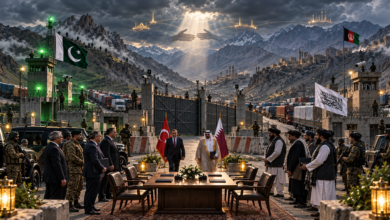
Within this changing framework of Middle Eastern power relations, Pakistan’s role also deserves careful consideration. Pakistan is a nuclear-armed state with longstanding historical, defence, economic, and fraternal ties with Saudi Arabia. For decades, Islamabad has maintained significant engagement with Gulf security matters and has remained connected to the wider strategic concerns of the region.
Although US–Saudi nuclear cooperation is fundamentally a matter between two states, Pakistan cannot be overlooked when examining the broader security environment of the region, given its experience, diplomatic relationships, and strategic connections. For Pakistan, this development represents a delicate diplomatic balancing act. On one side, Islamabad must preserve its longstanding friendships and partnerships. On the other, it must remain mindful of the principles of nuclear responsibility, regional stability, and international security.
Pakistan’s potential contribution may not necessarily lie in direct involvement in nuclear cooperation, but rather in diplomacy, confidence-building, dialogue, and the promotion of regional peace. In a region where strategic competition carries the risk of misunderstanding and escalation, Pakistan possesses the potential to serve as a bridge — drawing upon its historical experience and diplomatic relationships to encourage communication rather than confrontation.
This role is particularly significant because Pakistan understands, perhaps more than many nations, that nuclear capability is not merely a technological achievement.
It is a profound responsibility.
The history of the nuclear age has shown that possessing such power requires not only scientific expertise but also political maturity, restraint, and wisdom.
Trust: The Foundation of Nuclear Cooperation
The most important pillar of any nuclear partnership is not technology alone.
It is trust.
Across the world, nuclear programmes are closely connected with strict supervision, transparency, and international standards because even a minor failure in this field can produce consequences of extraordinary magnitude.
For the United States, the greatest challenge will therefore be finding a careful balance between Saudi Arabia’s legitimate aspirations for energy development and the global principles of nuclear responsibility.
If monitoring systems remain strong, information-sharing remains transparent, and international institutions maintain an effective role, nuclear energy can become a remarkable instrument of development.
It can illuminate a path towards cleaner energy, scientific advancement, industrial growth, and economic transformation.
But if trust weakens — or if the perception emerges that nuclear technology is becoming a tool for regional competition rather than peaceful progress — the same project could become a source of tension.
The future of nuclear energy will not ultimately be determined only by reactors, fuel supplies, or technical expertise.
It will be determined by the political and moral environment in which that technology is placed.
The question raised by US–Saudi nuclear cooperation is therefore one of the deepest questions of the modern age:
Is everything humanity is capable of achieving necessarily something humanity should pursue without restraint?
This is not merely a scientific question.
It is a question of ethics, politics, and human wisdom.
Nuclear technology stands among the greatest achievements of human intelligence. It has transformed medicine, agriculture, industry, and energy production. It has opened doors that earlier generations could scarcely imagine.
Yet the same technology becomes a source of danger when it is captured by fear, rivalry, and the relentless pursuit of power.
The true measure of modern strength is not simply the ability to acquire advanced technology.
It is the wisdom to use that technology responsibly.
For Saudi Arabia, the ultimate test will not be whether it can achieve nuclear capability, but whether it can demonstrate that genuine greatness lies not merely in possessing power, but in exercising that power with restraint and responsibility. For the United States, the challenge is not simply to strengthen an alliance, but to build a framework where strategic interests and international principles reinforce rather than undermine each other.
Because history does not judge nations only by the strength they acquire.
It judges them by the wisdom with which they use that strength.
The Atomic Horizon: Energy, Power and the New Strategic Calculus of the Middle East
Part IV — The Atomic Choice: Power, Responsibility and the Future of the Middle East
Yet there remains another possible path — one in which regional mistrust deepens, and the very project intended to promote development becomes a symbol of strategic rivalry.
In such a scenario, Iran may further tighten its security calculations; other Gulf states may seek similar advanced capabilities; and the already fragile tensions of the Middle East could become even more deeply entrenched.
This is why the ultimate outcome will not be determined by technology alone.
It will be shaped by the political wisdom, diplomatic foresight, and responsible leadership that surround this technology.
The true question before the region is not simply who possesses advanced capabilities, but whether those capabilities become instruments of progress or catalysts for competition.
US–Saudi nuclear cooperation therefore represents far more than a diplomatic achievement or an economic opportunity for Washington. It is also a test of strategic balance.
The United States seeks, on the one hand, to strengthen its longstanding relationship with Saudi Arabia, a nation that remains a central pillar of political, economic, and security affairs in the Gulf. On the other hand, Washington carries the responsibility of preserving the principles of nuclear restraint, transparency, and regional stability that have long formed the foundation of international security.
This is where the true test of American policy begins. If the United States places immediate strategic interests above the requirements of oversight, transparency, and safeguards, it may invite accusations of inconsistency and weaken confidence in the very principles it seeks to defend. But if Washington succeeds in creating a model where peaceful access to advanced nuclear technology is accompanied by rigorous safety standards, effective international supervision, regional confidence-building, and a firm commitment to responsible use, then this cooperation could become an important precedent for the future.
The greatest achievement will not lie merely in signing an agreement. It will lie in creating a structure of trust strong enough to endure for generations.
The Middle East at a Historical Crossroads
The history of the Middle East teaches a powerful lesson: every major strategic transformation gives birth to new questions.
This region is not merely a land of resources. It is also a meeting place of civilisations, cultures, traditions, and global pathways. Decisions made here rarely remain confined within government
offices or diplomatic chambers; they influence the lives and futures of millions of people.
If Saudi Arabia’s nuclear programme remains focused upon energy development, scientific research, and economic progress — advancing in accordance with international principles and contributing to regional confidence — it could become a positive example for the wider Middle East.
It could demonstrate that a nation blessed with natural resources can transform itself into a society built upon knowledge, innovation, and scientific achievement.
However, if such a programme is perceived as an instrument of regional power competition, the consequences could be profoundly different.
The Middle East has already endured decades of mistrust, conflict, and geopolitical rivalry. In such an environment, new strategic capabilities, if interpreted through the language of competition rather than cooperation, could deepen instability rather than reduce it.
The central challenge, therefore, is clear:
Nuclear energy must become a pathway towards development and peace, not another arena for confrontation.
The New Meaning of Power in the Twenty-First Century
The very concept of power is undergoing a fundamental transformation. In previous centuries, power was largely associated with military strength, territorial expansion, and control over natural resources. But in the modern age, true national strength belongs to those states capable of transforming technology, economic capacity, energy security, education, scientific research, and diplomacy into a unified strategic vision.
Saudi Arabia’s nuclear journey must be understood within this wider transformation.
It represents the story of a nation seeking to redefine itself beyond the traditional boundaries of oil wealth — a nation aspiring to become a global centre of advanced industry, scientific progress, investment, and technological innovation.
Yet every new source of power carries a new burden of responsibility.
The ultimate test of nuclear capability is not who acquires it.
The true test is who uses it, for what purpose, and with what degree of wisdom and moral judgement.
For power separated from wisdom becomes a source of fear. But power guided by responsibility becomes an instrument of progress.
Energy, Technology and the Future of Saudi Arabia
The world is moving rapidly towards an era in which the future of energy will no longer be defined solely by oil and gas.
Clean energy, advanced industry, artificial intelligence, digital economies, and scientific research will become among the defining forces of the coming decades. Within this changing landscape, nuclear energy offers Saudi Arabia significant opportunities:
A more diverse energy foundation;
A stronger industrial sector;
The advancement of scientific research;
New opportunities for technological skills among younger generations;
And a stronger foundation for the economy of the future.
If this journey continues with transparency, responsibility, and international confidence, Saudi Arabia could become a powerful example of how a resource-rich nation can transition towards a knowledge-based economy.
Such a transformation would not remain limited to the Kingdom alone.
It could influence the wider economic future of the Gulf region and reshape the understanding of development across the Middle East.
The Final Question: Power or Wisdom?
Ultimately, US–Saudi nuclear cooperation represents a much larger human question.
Does the acquisition of power alone make humanity safer?
Or is it the responsibility that accompanies power which provides genuine security?
Nuclear energy has granted humanity access to one of the universe’s most extraordinary forces.
The splitting of the atom opened new pathways for electricity generation, revolutionised medicine, transformed industry, and created possibilities once thought impossible.
Yet the same atom also delivered a profound lesson:
Some forces are not merely difficult to obtain — they are even more difficult to govern wisely.
The true power of the atom does not exist only within the energy hidden inside matter.
Its deepest significance lies in the wisdom of the human beings who choose how that energy will be used.
A Moment That May Define the Future
The greatest decisions in history are rarely understood completely at the moment they are made.
A treaty, an agreement, or a technological partnership may appear at first to be merely an economic or technical arrangement. Yet with the passage of time, it may reveal itself as a turning point in the story of nations.
US–Saudi nuclear cooperation may prove to be such a moment.
It is not merely an agreement between two countries.
It is a test of a much larger question:
Can humanity ensure that the power it creates remains governed by the wisdom it requires?
If this cooperation advances through the principles of development, transparency, and peace, it may become the beginning of a new era.
An era in which science serves prosperity, technology strengthens societies, and energy becomes a bridge towards stability.
But if fear, rivalry, and the pursuit of dominance prevail, then the same light that promises progress may also cast longer shadows.
For the nuclear age has given humanity one undeniable lesson:
If progress is the force that moves civilisation forward, responsibility is the compass that determines its direction.
If power is a lamp, wisdom is its guardian.
And if nuclear energy is the doorway to the future, human consciousness is the key that will decide whether that doorway opens towards illumination or towards uncertainty.
Epilogue: The Responsibility of Greatness
The Middle East stands today at a historic crossroads where every major decision may influence the destiny of future generations.
US–Saudi nuclear cooperation forms part of this wider historical test.
It has the potential to become a beginning of renewed development, scientific advancement, and economic transformation — provided that power remains guided by wisdom.
For the greatest lesson of history is not that nations become great merely because they possess strength.
Nations become truly great when they possess the maturity, restraint, and moral courage to use that strength responsibly.
And this is the essential balance of the nuclear age:
A balance between ambition and caution, between capability and responsibility, between human achievement and human wisdom.
For ultimately, the future of nuclear energy — and perhaps the future of peace itself — will not be determined only by what humanity can create.
It will be determined by whether humanity has the wisdom to use what it creates for the preservation, dignity, and progress of all.