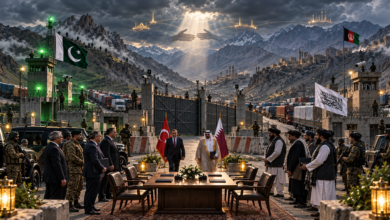
Gwadar: Shadows of Rivalry
Gwadar’s Hidden Front

The UAE–Balochistan Connection: Gwadar, Regional Rivalry and Pakistan’s Strategic Predicament
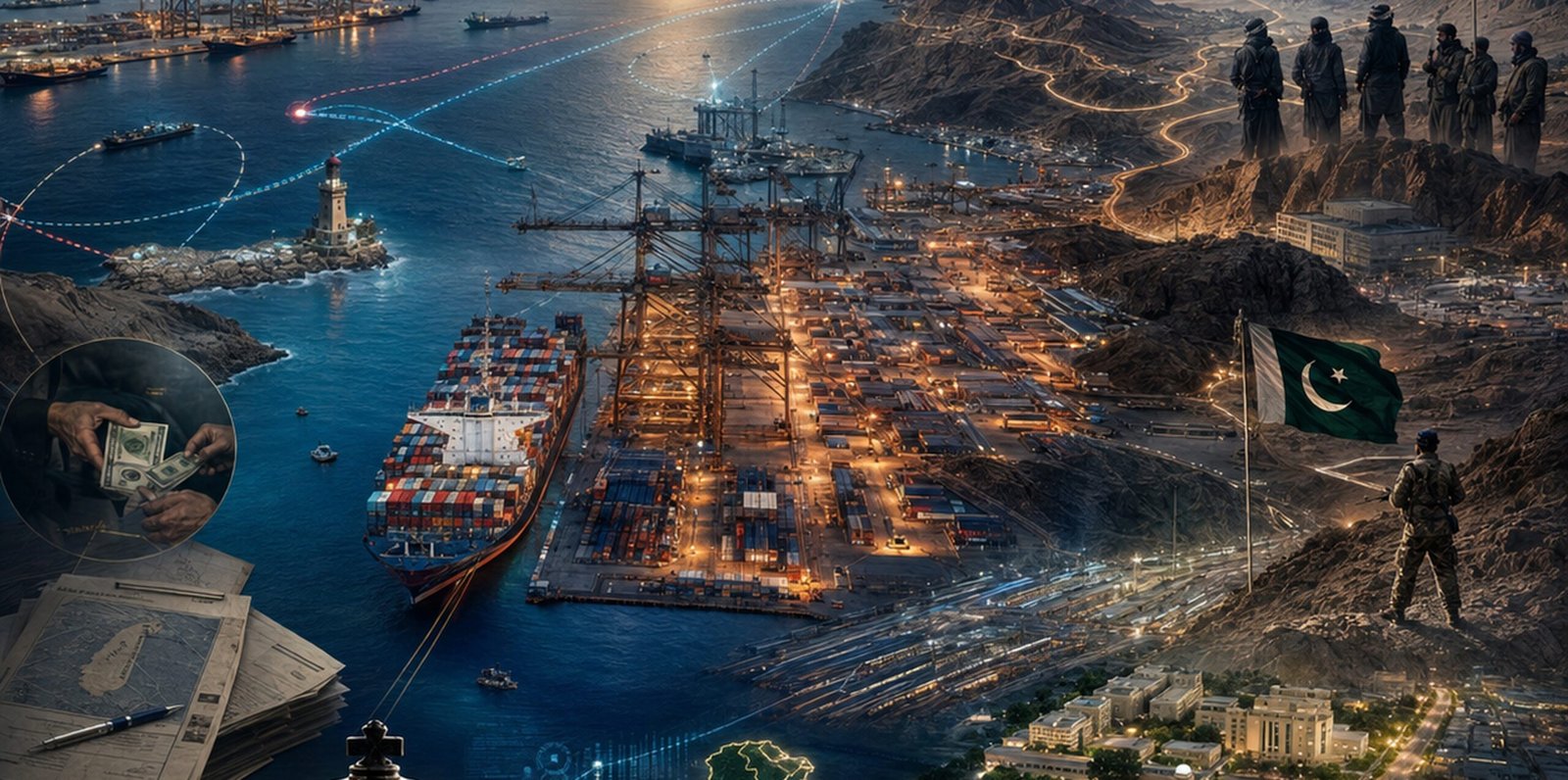
There are moments when the destinies of nations are written not amid the thunder of guns, but upon the silent waters of their harbours. The sea may appear tranquil, yet beneath its surface move the powerful currents of commerce, ambition, geography and statecraft—currents capable, in time, of altering the direction of an entire region. Gwadar belongs to this class of places: on the map, a port; upon the strategic chessboard, a square whose significance far exceeds its modest dimensions.
When Balochistan’s internal disquiet, regional commercial rivalry, foreign financial influence and Pakistan’s economic frailties rise upon the same horizon, the question can no longer be reduced simply to who stands behind the curtain. One must ask how opaque that curtain truly is—and how substantial the shadows discernible behind it may be. In matters touching national security, therefore, the task is not to brandish the sword of accusation, but to hold aloft the lamp of evidence. For in the graver affairs of states, the quiet traces left across time often matter more than the clamour of the moment.
History has a curious habit: the great contests of nations are not always fought upon battlefields. At times a harbour proves more decisive than a battery of artillery; a clause in a loan agreement may exert greater pressure than a battalion; and a handful of trade routes may reorient the political compass of an entire region. Gwadar, standing upon the Arabian Sea, is therefore no mere port. It is a point at which geography, commerce, energy, China’s expanding influence, the Gulf economies and Pakistan’s national integrity converge.
Is the unrest in Balochistan born solely of domestic deprivation, or has Gwadar—rising upon the shores of the Arabian Sea—become the centre of a quieter regional contest whose consequences extend far beyond the visible courtesies of diplomacy? Do Gulf commercial rivalries, international trading interests, Baloch separatist networks and Pakistan’s own political and financial vulnerabilities intersect at certain points? And if they do, the proper question is no longer whom one should accuse, but how far the available evidence is capable of bearing the weight placed upon it.
The allegations, indications, economic interests and national-security questions set out in the material under consideration must therefore be examined historically and analytically. Not every claim belongs upon the same evidential scale. Some matters appear in documentary records and historical references; others remain allegations, financial or strategic indications, or suspicious associations. The purpose of inquiry is not to affix the seal of judgement before the evidence has been heard, but to locate that narrow frontier at which economic competition may conceivably pass into covert interference—and at which Pakistan’s external vulnerabilities may begin to impair its freedom of internal decision.
The dignity of serious inquiry lies precisely here: an indication must not be promoted into proof; suspicion must not be mistaken for verdict; accusation must not be allowed to masquerade as fact. Yet when events, interests and relationships repeatedly point in the same direction, to ignore them altogether ceases to be scepticism and begins to resemble negligence. What follows is an attempt to lift, layer by layer, that veil of ambiguity.
1. The Principal Intelligence Allegation: The 2008 Briefing and the Beginning of a Difficult Question
The first significant knot in this affair appears, according to the document, in a confidential parliamentary briefing of 2008. In that briefing, Lieutenant-General Ahmed Shuja Pasha, then Director-General of Pakistan’s Inter-Services Intelligence, is said to have advanced the view that India, Russia and the United Arab Emirates were playing supportive roles in the insurgency in Balochistan. More specifically, the document records an allegation that the UAE had provided arms and financial assistance to the Baloch Liberation Army, with opposition to the development of Gwadar Port cited as the principal motive.
This was not an allegation to be dismissed lightly. It was attributed not to an obscure commentator or to the speculative columns of a newspaper, but to the occupant of Pakistan’s highest intelligence office. Yet the discipline of historical inquiry teaches an equally important lesson: an allegation emanating from high office may command seriousness, but eminence of source does not, by itself, transform assertion into judicial or incontrovertible proof.
Two distinct questions therefore arise. The first is whether elements within Pakistan’s state machinery possessed intelligence sufficient to arouse suspicion regarding an Emirati role. The document answers that question in the affirmative. The second—and sterner—question is whether any such assistance formed part of an organised, sustained and officially sanctioned state policy. On that point, the material itself offers no conclusive answer.
The 2008 briefing may therefore properly be regarded as the beginning of the argument, not its conclusion. It is the first curl of smoke upon the historical horizon; the full shape of the fire, however, remains unseen.
2. The Strategic Logic: Does Gwadar Challenge Dubai’s Maritime Primacy?
In international politics, friendship and rivalry frequently dine at the same table. States may invest with one hand while, with the other, defending commercial interests accumulated over decades. It is through this lens that the document considers the possibility of strategic competition between the United Arab Emirates and Gwadar.
Dubai is described as one of the Middle East’s foremost centres of logistics and re-export trade. Should Gwadar achieve its full potential—and should reliable overland corridors connect it with Central Asia and western China—it could introduce a significant new competitor into a commercial landscape long dominated by established Gulf ports. From this premise the document advances a strategic proposition: that keeping Gwadar unstable might serve the interests of those seeking to limit an emerging rival.
The China–Pakistan Economic Corridor gives the matter an additional dimension. Gwadar ceases to be merely an undertaking of Pakistani commerce and becomes part of China’s larger conception of access to the Arabian Sea. Around a single harbour, therefore, three concentric interests begin to form: Pakistan’s economic sovereignty, China’s strategic access, and the established commercial ascendancy of the Gulf ports.
Yet competition is not, in itself, evidence of sabotage. Singapore, Dubai, Jebel Ali, Chabahar, Doha and numerous other ports compete fiercely for trade; it does not follow that every commercial rival secretly conspires against another. A Gwadar–Dubai rivalry may furnish a conceivable motive, but there remains a considerable distance between motive and culpability—a distance which cannot be crossed by political rhetoric, but only by evidence capable of independent verification.
The sounder conclusion is consequently more restrained. A successful Gwadar could alter the
existing balance of maritime commerce in the Gulf, and such a change might encourage some states to act more vigorously in defence of their established interests. That proposition, however, does not in itself prove the sponsorship of an armed or separatist organisation.
3. Financial Channels, Facilitators and Separatist Networks: How Far Does the Trail Lead?
The third question is at once the most sensitive and the most demanding of investigation. The material refers to alleged financial and logistical connections said to extend through London, Qatar, the United Arab Emirates and circles associated with Baloch militancy. It records claims that substantial sums reached certain BLA-linked accounts in Dubai, and that some reports connected the operational financing of female militants with individuals resident in the emirate.
A further episode of significance is the arrest of Rashid Baloch in Sharjah in 2019. The document describes him as an important facilitator in relation to the 2018 attack upon the Chinese Consulate in Karachi. At the very least, this episode gives substance to one question: the presence or movement within the Emirates of individuals allegedly connected with Baloch militant or separatist circles cannot be treated as an entirely theoretical proposition.
Yet here, too, the distinction required by logic is indispensable. The presence of a suspect within a country and sponsorship by that country’s state are two very different propositions. Indeed, an arrest may, under some circumstances, point in precisely the opposite direction—to official cooperation rather than official complicity.
The document also invokes the UAE’s support for the Southern Transitional Council in Yemen as an illustration of a broader regional method: the pursuit of strategic objectives through local or separatist forces. But to transplant automatically a policy observed in one theatre into another would be not investigation but conjecture.
Indications may illuminate the road like lanterns; they do not invariably tell us where that road ends.
4. The Paradox of Visible Cooperation: Investment Amid Suspicion
International politics seldom wears a single colour. Two countries may be defence partners and economic competitors at the same time; they may cooperate in commerce while finding their interests opposed in some third arena.
The document identifies precisely such a tension in relations between Pakistan and the United Arab Emirates. On the one hand stand serious allegations concerning an Emirati role in Balochistan; on the other, the UAE has continued an open policy of official cooperation and investment in Pakistan generally, and in Balochistan in particular.
According to the material, support was pledged in 2018 for a major desalination plant at Gwadar, while discussions with the Government of Balochistan in 2025 concerned solar energy and other energy projects. Pakistani officials have, on certain occasions, also characterised allegations of Emirati interference as “false propaganda”.
This apparent contradiction recalls an elementary principle of statecraft: relations between states are compartmentalised. Trade is one sphere, security another; energy a third, regional competition a fourth. Cooperation in one field does not render disagreement in another impossible.
But the principle cannot fairly be employed only in one direction. If investment does not automatically disprove an allegation, neither does an allegation automatically convert investment into the camouflage of conspiracy.
The UAE’s visible investment therefore introduces an important counterweight into the case. Were a state pursuing a direct and continuous policy designed to ensure Gwadar’s failure, participation in development projects at the very place it sought to frustrate would, at the very least, appear contradictory. That contradiction remains one of the most formidable obstacles to any categorical judgement.
5. Pakistan’s Elite, Dubai Property and Economic Dependence: Have Private Interests Constrained the State?
The fifth chapter of this discussion is perhaps the most uncomfortable, for here the accusing finger turns from the foreign horizon towards Pakistan itself.
According to the document, the 2024 Dubai Property Leaks linked more than 23,000 properties in Dubai to Pakistani nationals. Those reportedly associated with such holdings included political families, former government figures, members of parliament and cabinet, retired military officers, senior public officials, or members of their families. The document interprets this pattern as raising the possibility that private economic interests may complicate the relationship between Pakistan’s governing elite and the Emirates.
The essential national question is not why a Pakistani citizen should lawfully possess property in Dubai. Legitimate investment abroad is neither a crime nor an act of treason. The real questions concern transparency, the lawful provenance of wealth, and whether private economic interests possess the capacity to influence decisions touching national security.
Here lies the delicate frontier at which private interest may collide with public duty. Where the assets, businesses or financial security of national decision-makers become unusually intertwined with the financial system of another country, the difficulty is not confined to demonstrable corruption. Even the appearance of a conflict of interest may diminish confidence in the independence of the state.
The document further presents the UAE’s reported demand in April 2026 for the early repayment of a US$5.3 billion loan in the context of economic pressure. It also refers to the large-scale deportation of Pakistani Shia workers from the Emirates. These factors are connected in the report with what it describes as Pakistan’s alleged strategic paralysis.
The lesson for the state is stark. A country that is economically needy, financially dependent and whose elite interests are anchored in external centres of wealth may discover invisible chains fastened to the wings of its diplomacy. Sovereignty is not merely the defence of frontiers; it includes the liberty to make national decisions without extraneous constraint.
6. The Evidential Balance: What Is Established, What Is Alleged, and What Remains a Hypothesis?
Perhaps the most valuable feature of the entire discussion lies in this distinction, for here the document itself attempts to classify the evidential standing of its principal claims.
It treats as matters capable of documentation the 2008 allegation attributed to the ISI, the potential commercial rivalry between Dubai and Gwadar, the 2019 arrest in Sharjah of an alleged BLA facilitator, and the extensive Emirati assets associated with members of Pakistan’s elite. By contrast, it acknowledges that sustained, direct sponsorship of the BLA by the UAE at the highest level of state authority between 2004 and 2026 remains unproven in the public record.
That distinction is the heart of the matter.
It is one proposition to say that financial, political or individual actors within the Emirates may have facilitated Baloch separatists. It is another—and vastly more consequential—to assert that all such activity proceeded as the official policy of the UAE’s central state or upon the direct instructions of its senior leadership.
The document ultimately advances a hypothesis that UAE-linked financial or political actors might, in an atmosphere of possible official tolerance or inattention, have assisted Baloch separatist elements, while the financial dependencies of sections of Pakistan’s elite might have impeded an effective response. Yet the intellectual propriety of a hypothesis rests upon refusing to disguise it as a verdict.
In national-security affairs, two extremes are equally dangerous: to dismiss every suspicion as fantasy, or to transform every indication into conclusive guilt and pronounce a diplomatic sentence upon it. Wisdom lies upon the bridge between the two—a bridge founded upon investigation, financial tracing, intelligence cooperation and verifiable evidence.
7. The Central Question: Where Does Commercial Rivalry End and Covert Interference Begin?
In the final reckoning, the entire controversy may be reduced to a single question.
Did the United Arab Emirates merely regard Gwadar as an economic and strategic competitor, or did Emirati state institutions—or non-state actors associated with the Emirates—cross the frontier separating legitimate competition from practical assistance to Baloch separatist activity?
The document itself makes this the ultimate test.
The available material suggests, at the very least, that the matter cannot prudently be buried beneath the convenient label of rumour. An allegation attributed to a former senior intelligence chief; a plausible collision between Gwadar and established Gulf commercial interests; connections involving individuals associated with Baloch militancy in the Emirates; reports concerning financial assistance; and the extensive financial ties of sections of Pakistan’s political and administrative elite—taken together, these do not constitute a verdict, but they unquestionably constitute a body of questions deserving serious investigation at the level of the state.
The material regards these factors as raising an important national-security concern. At the same time, it explicitly recognises the limit imposed by the absence of conclusive evidence establishing a continuous Emirati state policy of sponsorship.
For Pakistan, however, the deeper lesson may concern Pakistan more than the Emirates.
If Gwadar is a gateway to the country’s future, it cannot be secured by armed detachments alone. Its defence requires transparent government, the political and economic inclusion of the people of Balochistan, strong local institutions, credible intelligence, scrutiny of foreign financial connections, and a foreign policy in which the private wealth of individuals is never permitted to cast a shadow over the interests of the state.
To explain Balochistan entirely through the language of the “foreign hand” would itself be an evasion of reality. External influence finds purchase where internal deprivation, political uncertainty, economic injustice or institutional weakness have already prepared the ground. The strongest wall of national security is not always the frontier post manned by soldiers; it is the citizen who can see dignity, participation, justice and a future within his own state.
The ships that will one day enter the blue waters of Gwadar will carry more than merchandise. They will also carry a test of Pakistan’s capacity for statecraft. If the country leaves its economy upon the crutch of debt, its politics at the mercy of private interest, and its national assets as ornaments for public speeches, then lamenting the manoeuvres of others will offer no remedy for weaknesses of its own making.
But if Pakistan can free its national judgement from excessive financial dependence; make Balochistan a genuine partner in the federation’s strength; subject foreign financial and militant connections to impartial investigation; and test every allegation upon the anvil of evidence, Gwadar may cease to be merely an arena of rivalry and become instead an emblem of national confidence.
History does not invariably ask who the enemy was. At times it asks a more searching question: when the first intimations of danger were heard, how vigilant was the state, how independent was its judgement, and how honest was it when confronted by the private interests of its own powerful men?
Within that question lies the true significance of the UAE–Balochistan controversy—and perhaps the larger lesson for Pakistan’s strategic journey in the years ahead.
In the last analysis, therefore, the argument turns away from foreign actors and towards Pakistan’s own reflection in the mirror. If Gwadar is indeed a doorway to the future, neither guns, fences nor port infrastructure alone can secure it. It also requires the firm lock of political trust, economic sovereignty, transparent governance and the genuine participation of the people of Balochistan.
External influence acquires its greatest force where domestic deprivation, institutional weakness and economic dependence have already opened cracks in the foundations. States are often tempted to search for the storm beyond their borders, when the smaller breach within the hull may prove the greater danger.
Pakistan’s true test, then, is not to convert every suspicion into enmity. It is to submit every allegation to evidence, every financial relationship to transparency, and every strategic decision to the sovereign test of the national interest.
History may never ask which power feared Gwadar most. It may well ask something sterner: when the clouds of competing interests gathered over the Arabian Sea, how brightly did Pakistan keep its own lamps burning?