The Makkah Pact, Delhi’s Unease
Makkah’s Pact, Delhi’s Dilemma

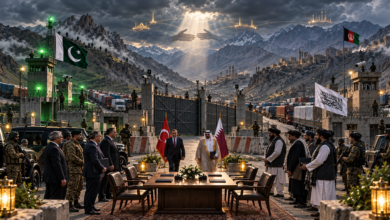
Certain decisions in history are not forged amid the clamour of swords but conceived in the quietude of diplomatic tables. They bear neither banners nor the thunder of artillery, nor the spectacle of marching armies; yet, with the passage of time, it becomes evident that a single, silent signature has redrawn the very contours of power. The recently concluded defence accord in Mecca between Pakistan, Saudi Arabia, and Turkey may well be counted among such moments.
The significance of this agreement lies not merely in the fact that three states have chosen to bind their security to one another. The more compelling question is the historical moment in which this decision has emerged. The Middle East has, for decades, been a theatre of war, intervention, proxy conflicts, and externally managed security architectures. Meanwhile, in South Asia, the enduring tension between Pakistan and India—tempered yet made more perilous by their nuclear capabilities—has long imposed a cautious vigilance upon the international order.
In such a context, the Mecca accord cannot be dismissed as yet another defence arrangement. Rather, it gestures towards a deeper inquiry: are key states within the Muslim world now seeking to construct an indigenous framework of security—one that relies less upon external umbrellas and more upon regional partnerships? And if so, why should New Delhi regard this development as a distant Middle Eastern affair rather than a matter of immediate strategic consequence?
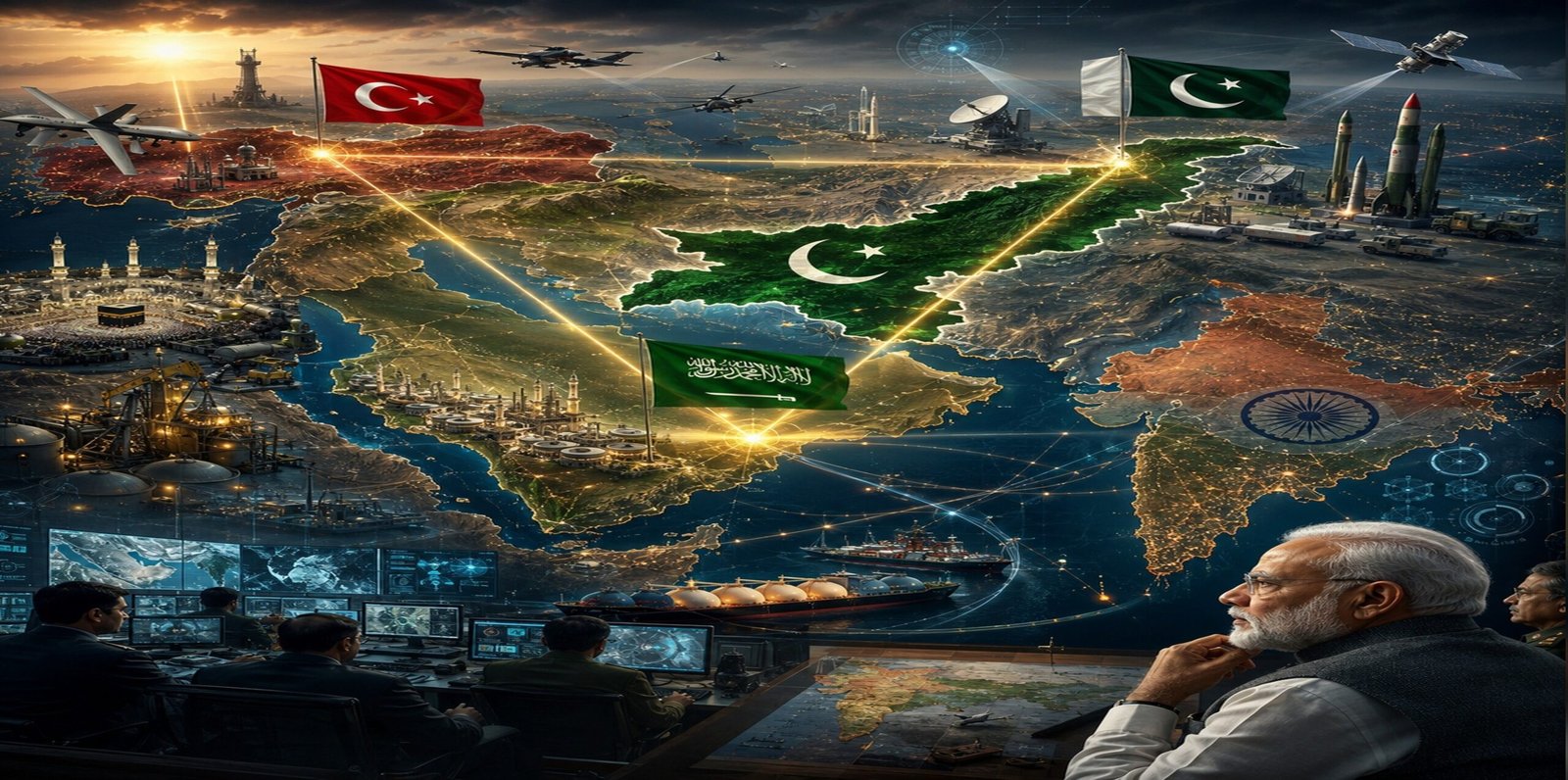
To appreciate India’s unease, one must resist the temptation to view the agreement as a mere trilateral arrangement. When the geographical positioning, military capacity, economic weight, and diplomatic reach of these three states are considered in concert, what emerges is not a simple alliance, but a strategic triangle of considerable consequence—each vertex distinct in its strengths, yet collectively formidable.
Pakistan stands as a significant military power in South Asia and a declared nuclear state. Turkey, as a member of NATO, combines a robust defence industry with a seasoned military and an expansive diplomatic footprint. Saudi Arabia commands vast economic resources, immense energy leverage, and occupies a central religious and political position within the Muslim world, alongside a notable presence in global diplomacy.
Thus, from Delhi’s vantage point, the concern extends beyond Pakistan acquiring two additional partners. The deeper unease lies in the fact that Pakistan’s security calculus now appears increasingly intertwined with capitals that carry substantial weight in their respective domains.
A subtle yet consequential distinction must also be noted. Traditional military alliances were often forged under the aegis of a dominant external power. In contrast, this emerging arrangement appears—at least ostensibly—to reflect a regional initiative, wherein states themselves are defining their security priorities and frameworks. It is precisely this autonomy that renders the development particularly sensitive for India.
Perhaps the most consequential feature of the accord is its spirit of collective defence: an armed attack upon one shall be regarded as an attack upon all. In the lexicon of international politics, certain phrases possess the capacity to alter entire strategic landscapes. “Collective defence” is one
such term. The symbolic resonance of Mecca, too, cannot be overlooked. A city that stands as the spiritual epicentre for Muslims worldwide lends to the agreement not merely political significance, but a civilisational and psychological dimension as well.
Yet, the calculus of statecraft is governed less by sentiment than by interest. Hence, the true measure of this agreement lies not in its setting, but in its practical implications. Should the principle of collective defence remain confined to declaratory rhetoric, its impact will be largely symbolic. However, if it evolves into coordinated planning, intelligence-sharing, defence-industrial collaboration, joint training, and sustained strategic consultation, it may well become a durable factor in the regional balance of power.
It is this very clause that has prompted unease in India. When questions were put to the Indian Ministry of External Affairs spokesperson, Randhir Jaiswal, the issue at hand was never merely the agreement itself. Rather, it was an inquiry into how New Delhi interprets this emergent security framework.
Military alliances are not unfamiliar in Pakistan’s foreign and defence policy history. During the Cold War, Pakistan aligned itself with U.S.-backed arrangements such as SEATO and CENTO. At that time, the world stood divided into two ideological camps. For Washington, the primary objective was to contain Soviet influence and the spread of communism; for Pakistan, the imperative was to secure its own defence, obtain economic assistance, and find a reliable partner against regional threats.
History, however, soon demonstrated that the true value of any alliance is determined not by the elegance of its documents, but by the conduct of its members in moments of crisis. While SEATO embodied principles of mutual defence, it was encumbered by conditions and political constraints that left Pakistan perpetually uncertain of where its allies would stand in the event of a direct conflict with India.
It is against this historical backdrop that the present Mecca accord assumes a different significance. The question is no longer what Washington, or any external power might do; rather, it is whether regional states themselves are prepared to stand by one another in times of peril.
Here, history steps out of the past and knocks upon the door of the present—bringing with it a difficult question: should conflict erupt between Pakistan and India in the future, would Turkey and Saudi Arabia indeed translate the principle of collective defence into tangible action? It is in such a moment that the agreement will find its true test.
Yair Netanyahu, in raising questions about the accord, inadvertently touched upon a fundamental issue. If Saudi Arabia were to face threats from Iran, Yemen, or Iraq, would Pakistan and Turkey engage militarily on those fronts? Conversely, in the event of war between Pakistan and India, would Saudi Arabia and Turkey undertake military action against India? Though framed with a note of scepticism, these questions underscore a deeper legal and political dilemma: what constitutes an “attack”?
Every collective defence arrangement must grapple with this ambiguity. Does a missile strike qualify? A drone incursion? A limited cross-border operation? Counter-terror military action? A cyber offensive? Or the activities of proxy groups operating from a third country? These questions acquire urgency because modern warfare has blurred the once-clear boundary between war and peace. Consequently, the strength of this agreement will reside not merely in its language, but in the mechanisms devised for its interpretation.
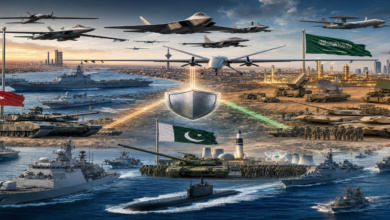
Pakistan’s employment of its defence capabilities during Operation Sundur once again illustrated that modern warfare is no longer defined by numerical strength alone. Aerial surveillance, missile technology, command-and-control systems, electronic warfare, drone capabilities, intelligence integration, and precision targeting collectively constitute contemporary military power. In this light, the most consequential benefit of the agreement with Saudi Arabia and Turkey may lie less in direct battlefield participation and more in the integration and enhancement of defence capabilities.
Turkey’s defence industry has, in recent years, secured a position of notable consequence—particularly in drone technology, aviation, electronic systems, and a range of adjacent fields. Saudi Arabia, by contrast, commands a different order of power, grounded in vast financial resources, sustained defence investment, and formidable energy leverage. Pakistan, for its part, brings to the table the hard-earned experience of conflict, the formidable assurance of nuclear deterrence, and the foundations of an indigenous defence industry. Should these three strands be woven into a coherent system, the result would not be a mere aggregation of three armies; it would be a synthesis of distinct forms of power, fused into a more consequential whole.
The most fundamental strategic reality between Pakistan and India remains the equilibrium of nuclear deterrence. Pakistan’s nuclear doctrine has been, in essence, shaped in response to India, its central purpose being to transform conventional military asymmetry into a strategic balance wherein the prospect of full-scale war carries consequences too grave for any rational actor to ignore. The Mecca accord neither nullifies nor supplants this nuclear reality. Rather, its likely effect is to operate at a secondary tier—an additional layer of conventional and diplomatic deterrence beneath the nuclear threshold.
In practical terms, should Pakistan acquire a credible assurance that, in times of crisis, it will receive political, diplomatic, economic, and defence support from regional partners, the calculus for any adversary contemplating limited military action becomes markedly more complex. This, indeed, is the essence of deterrence: not the waging of war, but the rendering of war so costly, so fraught with uncertainty, that its very initiation demands repeated reconsideration.
A further significance of this agreement lies in its potential to confer a more durable, institutional character upon the political support that has, until now, often manifested in episodic form during crises. In the conduct of state relations, support tends to operate at three distinct levels: declaratory, diplomatic, and operational.
Declarations are fleeting. Diplomacy can exert pressure in moments of crisis. Yet defence cooperation advances a step further, for it binds states into shared planning and mutual obligation. It is for this reason that the Mecca accord does more than merely identify alignments; it raises the more consequential question of response—who will act, and at what level, when crisis descends. Should the agreement give rise to sustained defence consultations, joint exercises, intelligence-sharing, and closer diplomatic coordination, its significance will extend far beyond the written clauses that define it.
For New Delhi, perhaps the most intricate dimension of this development lies not in Saudi Arabia’s defence alignment with Pakistan, but in its deep and expanding economic relationship with India. Bilateral trade runs into billions, and Saudi Arabia has signalled its intent to invest heavily in India’s energy, refining, petrochemical, and infrastructure sectors. Saudi Aramco has, on several occasions, expressed interest in major industrial ventures within India. Moreover, millions of Indian nationals reside and work in the Kingdom, forming a dense web of human and economic interconnection. In the realm of energy, too, Saudi Arabia remains a critical partner for India.
Against this backdrop, Riyadh’s decision to link its security interests with Pakistan introduces a difficult diplomatic equation for Delhi. Can economic partnership and defence alignment proceed simultaneously along divergent tracks? For Saudi Arabia, the answer appears to be in the affirmative, for foreign policy seldom conforms to a zero-sum logic. A state may trade with one partner while entering into defence cooperation with another. Yet it is in moments of crisis that such balances are most severely tested.
One of the most striking political dimensions of this accord is that it marks, within a relatively short span, a second instance in which Saudi Arabia has chosen to align its security interests with those of Pakistan. This points to an underlying transformation: relations between Riyadh and Islamabad are no longer confined to the familiar domains of historical affinity, religious connection, or traditional friendship; they are increasingly acquiring the character of strategic interdependence.
For Saudi Arabia, Pakistan is not merely a fellow Muslim state, but a country endowed with an experienced military, nuclear capability, and a strategically significant geographic position. For Pakistan, Saudi Arabia represents more than an economic partner; it serves as a vital diplomatic gateway to the Arab world, the Gulf, and the broader Muslim community. Thus, their interests converge at a juncture where faith, geography, economy, and security may be interwoven into a single strategic fabric.
To hastily label this arrangement as a “Muslim NATO” or any such formulation would be to sacrifice analytical caution for rhetorical flourish. Yet the terminology is less important than the underlying idea it gestures towards. If states with Muslim majorities are indeed seeking to construct a collective framework for their own security, then this marks a departure from a long-standing pattern in which the Muslim world has often looked outward for protective guarantees.
Here, one discerns the early outlines of a new concept—regional ownership of security. That is to say, states within a region endeavour to understand their own challenges, define their own priorities, integrate their own capabilities, and resist the impulse to treat external powers as the sole arbiters of their safety. Yet the internal divisions of the Muslim world—political divergences, the complexities of relations between Iran and Arab states, Turkey’s varied regional interests, and other structural tensions—pose formidable questions to this vision. It would therefore be premature to declare this a destination; it may, however, be regarded as a discernible direction.
In the context of South Asia, the most consequential implication of this agreement for any future crisis may well be the introduction of new variables into the strategic equation. Where once the framework of conflict between Pakistan and India was primarily bilateral—albeit influenced diplomatically by external actors such as China, the United States, Saudi Arabia, and Turkey—there now arises the possibility that defence alignments may assume a more tangible role. In any major crisis, the question will no longer be confined to Islamabad and New Delhi; it will extend to the positions adopted by regional partners.
Such a development may enhance deterrence for Pakistan, yet it may also render crisis management more intricate. For it is often the case that additional allies do not merely augment strength; they complicate decision-making. It follows, therefore, that genuine stability demands not only defence arrangements, but also robust mechanisms for the management of crises.
A pressing question thus presents itself: what if an operation akin to “Operation Sundur” were to recur? It is here that the most sensitive provisions of the agreement come into sharper relief. Should India, in some future contingency, characterise a limited strike within Pakistan as an operation directed against militant infrastructure or military installations, Islamabad may well construe it as an armed action against a sovereign state. In such circumstances, calls for the activation of collective defence provisions could arise. Yet it is essential to recognise that the agreement does not, in itself, constitute an automatic declaration of war.
The practical application of collective defence will depend upon how the three states interpret the nature, scale, and legal character of any given incident. For this reason, the true strength of the agreement will reside less in its textual formulation than in the institutional mechanisms that underpin it. Should there exist, in moments of crisis, an effective system of immediate consultation among the three capitals, it may prove possible to prevent a limited confrontation from escalating into a wider war. In this sense, a well-constructed defence accord may serve a dual purpose: to deter aggression, and, no less importantly, to contain conflict within manageable bounds.
At this juncture, India’s apprehensions point towards those dimensions of the accord that New Delhi cannot readily afford to disregard. If the language of the agreement indeed approximates a conception of collective defence akin to Article Five, then its political significance cannot remain confined to the Middle East alone. The history of relations between Pakistan and India is already marked by border skirmishes, wars, acts of terrorism, diplomatic crises, and the lingering shadow of nuclear brinkmanship. Should a new regional defence arrangement now be superimposed upon this landscape, Delhi will be compelled to incorporate additional variables into its strategic calculus.
It is for this reason that certain former Indian diplomats and defence analysts have characterised the development in unfavourable terms. Yet there exists another, more nuanced perspective. If the purpose of collective defence is to deter aggression, its ultimate effect may not be the proliferation of conflict, but rather the diminution of its likelihood. History reminds us that swords often remain sheathed not by accident, but by the full and sober recognition, on both sides, of the cost of unsheathing them.
President Recep Tayyip Erdoğan, in the aftermath of the accord, was at pains to emphasise that its purpose was not directed against any particular state. This clarification is of considerable importance. In international law, the distinction between defensive agreements and offensive alliances rests fundamentally upon intent and legal justification. By situating the accord within the framework of the inherent right of self-defence, as recognised under Article 51 of the United Nations Charter, Ankara has ensured that, at least in its official narrative, the arrangement is not cast as a vehicle of confrontation against any specific country.
Turkey’s diplomatic posture in this regard is equally noteworthy. While deepening defence cooperation with Pakistan and Saudi Arabia, Ankara has simultaneously signalled that the door remains open to other friendly states that seek peace, prosperity, and stability within the region. The language employed is not that of alignment against an adversary, but of convergence around a shared conception of security. Such phrasing gestures towards a broader regional vision. Should this vision endure in the practice of politics, the agreement may serve not as an instrument of confrontation, but as a foundation for regional stability.
The reaction among Indian commentators on social media is itself indicative of the seriousness with which the Mecca accord is being regarded within Delhi’s intellectual and strategic circles. The question—whether Prime Minister Modi would risk a strike against Pakistan before forthcoming elections—is not merely rhetorical flourish; it reflects an underlying perception in certain Indian quarters that the agreement may raise the prospective cost of any future military action against Pakistan. The remarks attributed to former Foreign Secretary Kanwal Sibal, suggesting exploration of strategic possibilities with the United Arab Emirates, Israel, Greece, and Cyprus, alongside consultations with Afghanistan and Iran, point towards the outlines of a potential counter-alignment.
From here, the matter assumes a broader dimension. Should defence cooperation among Pakistan, Saudi Arabia, and Turkey consolidate further, and should India respond by extending its own diplomatic and defence partnerships across Israel, the Gulf states, Greece, Cyprus, and beyond, the politics of the Middle East and South Asia may become more deeply intertwined than at any point in recent memory.
Indian observers who situate this agreement within the wider context of the future of American military presence in West Asia, and the emergence of new regional security architectures, are thus pointing towards a transformation that may extend well beyond the immediate parties to the accord.
Yet one question stands above all others: will Iran perceive this emerging equilibrium as a threat, or interpret it instead as a regional arrangement capable of balancing the presence of external powers? And beyond this lies another: will India respond to this evolving environment solely through the construction of new alliances, or will it also undertake a reassessment of its policy towards Pakistan?
The history of the world offers a constant lesson: the great centres of power are never fixed. At times, the Mediterranean has been the axis; at others, Europe; at others still, Washington or Moscow; and now, increasingly, new forces rise upon the horizons of Asia. Yet one of the defining realities of the twenty-first century is that power no longer resides solely in military bases or nuclear arsenals. It is forged through the interplay of economy, technology, diplomacy, energy, geography, and the elusive yet indispensable element of mutual trust. The Mecca defence accord may thus be read as a symbol of this changing world.
It is neither, as yet, a “Muslim NATO,” nor can it be conclusively defined as a new military bloc. Its true significance lies in the possibility it represents that three major Muslim states are moving towards interlinking their security interests. For Pakistan, it is a question not merely of defence cooperation, but of strategic depth. For Saudi Arabia, it may form part of a reimagined regional conception of security. For Turkey, it offers an avenue through which to channel its expanding regional role. And for India, it signals the emergence of an environment in which the calculus of any future confrontation with Pakistan may become more intricate than ever before.
Yet history teaches that alliances are not ultimately judged by their performance in war, but by their capacity to prevent it. Should the Mecca accord reach a point where its very existence compels all parties to pause, to calculate, and to reconsider before embarking upon conflict, then that alone may constitute its greatest success. For true power is not that which reveals itself after victory in war; it is that which renders war itself unnecessary before it begins. And it is perhaps here that the deepest meaning of this unfolding diplomatic narrative resides.
This is not a proclamation of drawing the sword against an adversary; it may well be an attempt to still the hand before the sword is ever drawn.
History, however, remains silent. The pages of the future are yet unwritten. Whether this agreement inscribes upon them a testament to peace or inaugurates a new chapter in the politics of power, is a question that time alone will answer. One truth, however, is already evident: this development in Mecca has brought South Asia, the Gulf, and the Middle East into a single strategic frame. And when geography, history, and power converge at a single point, an agreement ceases to be merely an agreement—it becomes the prologue to an age yet to unfold.