
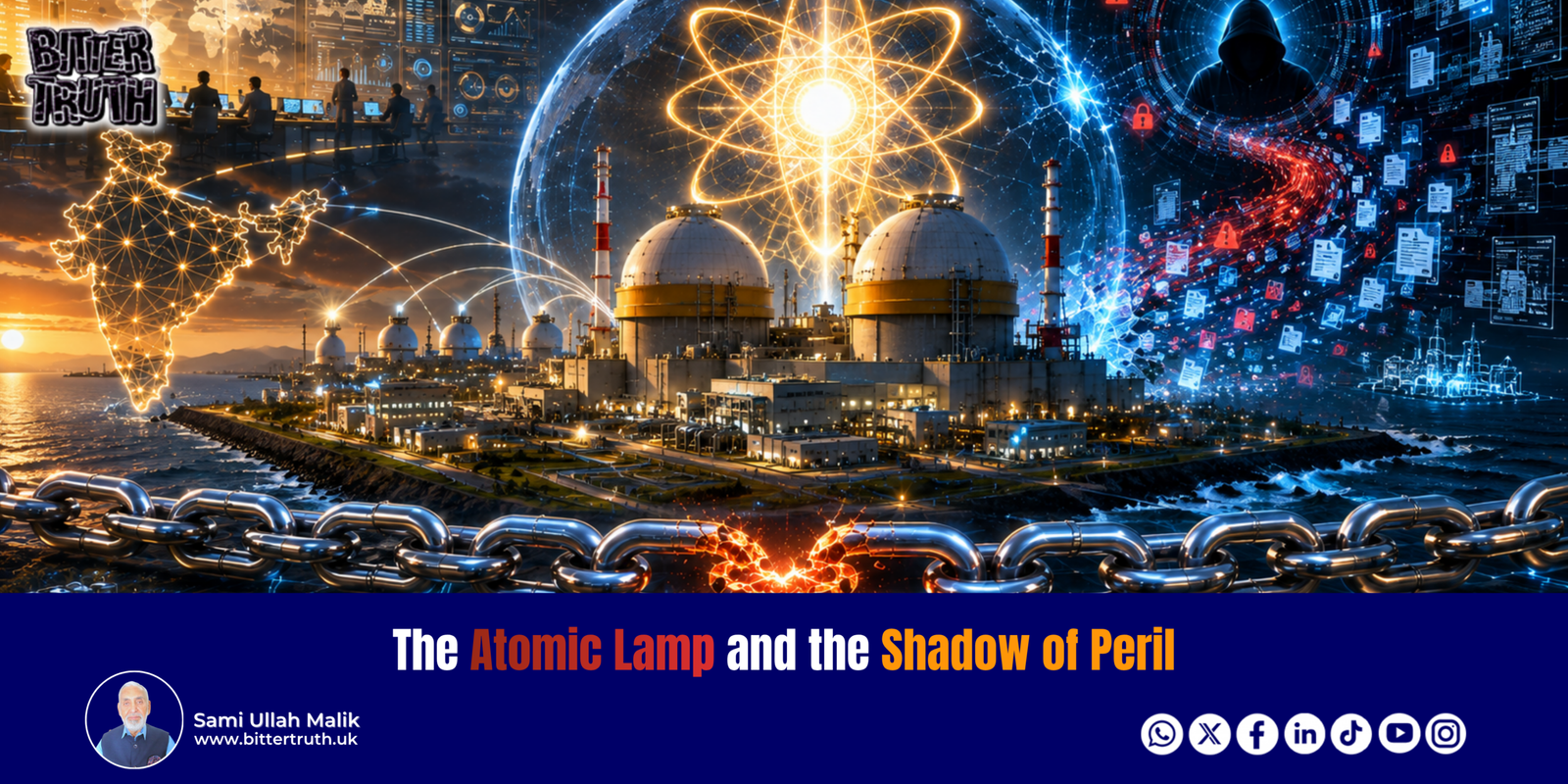
The Atomic Lamp and the Shadow of Peril
The Silent War Beneath the Surface

The Age of Atomic Power: Progress, Peril and the Moral Burden of Civilisation
The age upon whose threshold humanity now stands, having raised the banners of its intellectual triumphs, is not merely an era of celebration and accomplishment; it is equally the prelude to a complex and profound examination of our collective wisdom. It is an age in which the human intellect has dared to lift the veils from the concealed mysteries of the universe, an age in which man has penetrated the innermost chambers of the atom and, by mastering its hidden forces, has compelled the silent scriptures of nature itself to reveal their secrets.
Yet, as Maulana Abul Kalam Azad once cautioned while contemplating the vast horizons of human knowledge, every discovery arrives not only with the promise of power but also with the burden of responsibility. Knowledge, when separated from wisdom, does not necessarily become a blessing; it may itself become a test of civilisation. For every new frontier conquered by the human mind also presents a new moral frontier upon which humanity must prove the maturity of its judgment.
Nuclear energy, which appears at first glance as a brilliant flame illuminating the lamp of civilisation, carries within its depths a profound and unsettling silence. It resembles, in the words of many of the great thinkers of our age, a vast furnace of fire from which warmth and light may be drawn, yet which, if approached without caution and humility, may consume the very hands that seek to command it. Humanity, having torn open the hidden chambers of the atom and discovered within them a treasury of unimaginable energy, has also arrived at a perilous threshold where the distance between enlightenment and catastrophe may be measured not in centuries, nor even in years, but in the briefest moments of human error.
Herein lies the central drama of the modern age: the enduring and exhausting contest between the swift momentum of technological advancement and the slower, more hesitant pace of human prudence. We have kindled innumerable lamps of industry, science and progress; yet behind the radiance of these lamps, a shadow has quietly expanded — a shadow deepened by human negligence, institutional weakness and the careless handling of knowledge that possesses consequences far beyond its immediate appearance.
The fear that confronts us is not merely the fear of an external adversary. It is, in many respects, a fear born from within ourselves — from the very hands that have built the magnificent structures of modern civilisation, but which also possess the capacity to bring them into ruin. The hand that constructs the cathedral of progress is, tragically, the same hand that can set fire to its foundations.
The recent episode concerning the reported data leak associated with India’s Kudankulam Nuclear Power Plant stands as a striking metaphor for this very contradiction of modern civilisation. It is not merely a question of a technical lapse or a momentary failure of security procedure; rather, it is a mirror reflecting some of the deepest intellectual, political and ethical tensions of our time.
The true question extends far beyond the disclosure of information itself. It concerns the wider architecture of our contemporary thinking — a system in which progress advances with remarkable speed, while the foundations of protection, caution and institutional resilience often struggle to keep pace with the very forces they are meant to govern.
Viewed through the discerning lens of Maulana Azad’s intellectual legacy, this incident reminds us of the persistent imbalance that has repeatedly accompanied modern civilisation: the expansion of knowledge without an equal expansion of wisdom; the multiplication of human capabilities without a corresponding deepening of moral responsibility.
And it is precisely within this dangerous gap — this distance between what humanity can achieve and what humanity has learned to govern responsibly — that the seeds of future crises are often planted. A minor negligence, an overlooked vulnerability, or an apparently insignificant oversight may become the opening chapter of a far greater tragedy.
Ladies and gentlemen of thought and reflection, this episode is not merely a news item to be consumed and forgotten; it is an intellectual summons. It is a question that echoes not only through the chambers of reason but also through the quieter corridors of conscience. It calls upon us to look beyond appearances, beyond statistics and official statements, and to examine the deeper meanings and implications concealed beneath them.
The matter before us is not simply whether a particular piece of information was sensitive or insignificant. The deeper question is whether, in our relentless pursuit of advancement, we have allowed caution to fall dangerously behind. Have we preserved the delicate equilibrium between ambition and responsibility, or have we embarked upon a path where, in our pursuit of greater brilliance, the shadow behind that brilliance increasingly becomes our companion?
This is the moment when history, philosophy and foresight collectively demand a renewed act of self-examination. Humanity must restrain its intellectual pride with the discipline of wisdom and illuminate the path of progress with the steady flame of responsibility. For the atom, which we have transformed into a symbol of human ingenuity and hope, may one day stand before us not as a triumph of civilisation, but as an unanswered question directed at our own conscience.
The Kudankulam episode, therefore, should be regarded not merely as an isolated occurrence but as a warning of wider significance — a reminder that civilisations do not endure through knowledge alone. They survive through restraint, foresight, ethical judgment and balance.
Should we disregard this lesson, the journey of progress which we presently regard as the ultimate expression of human achievement may, at some unforeseen turning point, reveal itself not as our greatest triumph but as the most demanding test of our collective wisdom.
The Leaked Information: The Nature of Risk and the Civilisational Examination of Security Awareness
When reports of information being exposed from a nuclear installation emerge upon the horizon of public awareness, they cannot be regarded as mere technical notifications confined to the narrow boundaries of administrative concern. Such incidents possess a far deeper resonance; they send a tremor through the collective consciousness of society, unsettling not only experts and institutions but also the ordinary citizen who instinctively recognises that certain domains of knowledge carry consequences far beyond their immediate context.
The reported data leak associated with the Kudankulam Nuclear Power Plant generated precisely such a moment of reflection. It provoked a wider intellectual unease — a disturbance not limited to questions of technology, but extending towards the fundamental relationship between knowledge, security and responsibility in an age where information itself has become a strategic force. It compelled both specialists and the wider public to confront an uncomfortable question: was this merely an isolated episode whose significance had been magnified by circumstance, or was it a warning sign pointing towards vulnerabilities yet insufficiently understood?
At the official level, the Nuclear Power Corporation of India Limited sought to clarify that the information reportedly exposed was not of a sensitive nature and was confined primarily to administrative and construction-related aspects. Such an assurance may, at first sight, offer a measure of reassurance — a necessary response intended to calm public apprehension and restore confidence.
Yet history teaches us that reassurance, while valuable, is not always the same as security. The surface appearance of an event does not invariably reveal its deeper implications. The wisdom of history reminds us that threats rarely announce themselves in their complete and final form. More often, they emerge through seemingly insignificant weaknesses, scattered fragments of information, minor oversights and overlooked details which, when assembled by a capable and determined mind, may form a picture far more consequential than their individual elements would suggest.
It is within this space — between official confidence and intellectual caution — that a quiet but significant debate begins. It is not necessarily a conflict between those who seek to reassure and those who express concern; rather, it is a necessary dialogue between institutional responsibility and strategic foresight.
For the central question remains: does danger always arrive carrying its own name? Does every threat present itself openly, announcing its intentions before it strikes? History, security studies and human experience alike demonstrate otherwise. The true nature of risk often remains concealed beneath ordinary appearances, and its recognition requires not merely observation but imagination, discernment and the ability to perceive consequences before they fully unfold.
The Kudankulam episode therefore confronts us with a fundamental question of the modern age: do we evaluate danger solely according to its present form, or do we possess the intellectual discipline to understand its possible evolution, its wider implications and the pathways through which a seemingly minor weakness may develop into a serious vulnerability?
To state that the disclosed information was not directly connected with the core mechanisms of nuclear safety may, within a limited technical interpretation, be a valid observation. Yet the eye of wisdom must look beyond immediate categories and examine the broader landscape. Security in the contemporary world is no longer defined solely by physical barriers, sophisticated defence mechanisms or advanced technological systems. It is equally defined by the protection of every fragment of information, every digital trace and every seemingly insignificant detail that forms part of a larger strategic environment.
The modern age has transformed information into a force of extraordinary consequence. It may become the foundation upon which security is strengthened, or it may become the very opening through which vulnerability enters. The distinction between these two possibilities rests upon the quality of governance, institutional discipline and collective awareness.
This is why the significance of such an incident cannot be measured merely by asking what was disclosed; it must also be assessed by asking what such disclosure reveals about our assumptions, our preparedness and our understanding of risk itself.
The greatest danger in matters of security is often not the existence of vulnerability, for every human institution carries imperfections. The greater danger lies in the illusion that vulnerability does not exist. Civilisations decline not because they encounter challenges, but because they fail to recognise those challenges in time.
Thus, the Kudankulam data leak should be regarded as more than a single episode in the chronology of technological events. It is a philosophical mirror held before our civilisation — a mirror reflecting the state of our collective judgement, the priorities of our institutions and the maturity of our security consciousness.
The lesson it offers is both simple and profound: in an age defined by extraordinary scientific power, wisdom must advance with equal determination. The future will not belong merely to those who discover new sources of energy or unlock new realms of knowledge; it will belong to those who possess the prudence to govern such discoveries responsibly.
For ultimately, the survival and dignity of civilisation depend not only upon what humanity is capable of achieving, but upon whether humanity has acquired the wisdom to bear the immense responsibilities that accompany its achievements.
“Common Service Facilities”: From the Margins to the Main Text — A Philosophical Examination of the Significance of the Ordinary
When, in the aftermath of the Kudankulam episode, the official explanation emerged that the disclosed information related merely to “Common Service Facilities” — those basic industrial provisions which constitute an indispensable part of any power plant or complex technological infrastructure — it appeared, at first glance, to be a statement capable of diminishing the intensity of public concern.
The clarification seemed, in a certain measure, to offer reassurance: as though the matter belonged solely to the realm of constructional arrangements and administrative details, carrying no dimension that could directly influence the domain of nuclear safety or strategic security. The impression conveyed was that what had come to light was peripheral rather than fundamental — a matter situated on the outer edges of the system rather than at its vital core.
Yet, when this narrative is examined through the more searching lenses of intellectual inquiry and strategic analysis, a deeper question inevitably arises: can any component of a complex and interconnected system truly be dismissed as entirely insignificant? Can those facilities which appear merely supportive or secondary in nature genuinely possess such simplicity, or do they contain within them hidden relationships and structural connections that may provide the key to understanding the architecture of the entire system?
History and experience stand as enduring witnesses to a fundamental truth: great structures are always sustained by the interaction of smaller elements. Whether industrial, military, political or technological, every vast enterprise rests upon countless individual components which, taken separately, may appear ordinary and unremarkable, yet collectively determine the strength, continuity and resilience of the whole.
If the character, location or interrelationship of even one such component becomes known, the possibility of gaining insight into the wider structure, operational patterns and potential vulnerabilities of the system inevitably increases. The matter, therefore, ceases to be merely a question of technical specifications or constructional details; it assumes the character of a map — a map which, in the hands of a discerning observer, may reveal the hidden contours of an entire landscape.
In the language of civilisation and metaphor, the situation may be compared to a great fortress whose outer gate is dismissed as a minor feature, despite the fact that history repeatedly demonstrates how the fate of mighty citadels has often been determined through precisely such points of entry. The greatest gates of history have not always been opened by overwhelming force; at times they have yielded to a small key.
And that key is often knowledge — the very information which, because of its apparent simplicity, we are tempted to disregard.
Ladies and gentlemen of foresight and judgement, this is precisely where the seemingly ordinary acquires an extraordinary significance. Common Service Facilities are not merely marginal notes written upon the edge of a larger document; they are, in reality, part of the very text upon which the entire system is constructed.
They are the elements that sustain industrial operations, enable continuity of function and preserve the rhythm of a technological ecosystem. Should their details, configurations and structural relationships fall into the hands of an irrelevant, careless or hostile actor, such knowledge may offer not merely a glimpse into the internal pathways of the system, but also an understanding of where its weaknesses might lie.
The question, therefore, is not a mere exercise in semantics. It points towards a deeper intellectual reality: are we truly capable of seeing the “ordinary” within its complete context, or do we dismiss it simply because it does not present itself as an immediate and visible sign of danger?
The reality of the modern world is that every fragment of information possesses potential significance, and every detail may represent a piece of a much larger picture. Meaning does not always reside in the dramatic or the obvious; sometimes it is concealed within the quiet details that appear least remarkable.
The lesson of the Kudankulam episode, therefore, is that security cannot be defined merely through the superficial division between “sensitive” and “non-sensitive” information. Such a distinction, while useful in administrative classification, is insufficient as a complete philosophy of protection.
In the modern security environment, the margin may become the centre; the footnote may become the main text; and information that appears insignificant may, under particular circumstances, produce consequences far beyond its original appearance.
This understanding forms the foundation upon which a mature, responsible and forward-looking security consciousness must be built.
The Dark Web: The Invisible Marketplace and the New Frontier of Information Warfare
When reports emerged that approximately nineteen thousand digital files associated with the Kudankulam facility were circulating on the Dark Web — allegedly including ventilation designs, control-room layouts and other technical materials — the matter could no longer be regarded as a simple numerical disclosure.
It became instead a revealing moment in the modern history of security: an incident that compelled the world to reconsider the very foundations upon which contemporary concepts of protection and resilience are built.
For the deeper message was unmistakable: in the twenty-first century, the exposure of information is no longer merely an accident or an administrative failure. It has become an event capable of generating consequences that extend across borders and influence the strategic calculations of nations.
The Dark Web is not merely a technical expression. It represents one of the shadowed corners of modern civilisation — a realm where anonymity, concealment and invisible networks combine to create a marketplace unlike any known in previous centuries.
It is not a bazaar situated within the streets of a physical city, but one established in the hidden recesses of digital space; a marketplace where information, rather than traditional commodities, becomes the object of exchange.
Here, geographical boundaries lose much of their traditional meaning, and conventional systems of law struggle to exercise their full authority. A single file transferred across this invisible landscape may become the beginning of consequences far greater than its creator ever intended.
The Architecture of Vulnerability: Auxiliary Systems, Interdependence and the Expanding Boundaries of Security
This reality points towards a defining characteristic of contemporary industrial civilisation: the intricate architecture through which modern enterprises are constructed. The great projects of our age are no longer the products of a single institution acting within an isolated sphere; rather, they emerge through the collaboration of numerous auxiliary organisations, technical partners and interconnected systems operating in mutual dependence.
This interdependence is, without question, one of the foundations of modern progress. It represents cooperation, efficiency and the collective application of specialised knowledge. Yet concealed within this very strength lies a potential weakness. For within any vast and complex system, the vulnerability of a single component may, under certain circumstances, affect the stability and resilience of the entire structure.
Ladies and gentlemen of intellectual foresight, this is precisely the point at which we must move beyond traditional conceptions of security. Even the strongest fortresses become vulnerable when weaknesses appear within their outer defences. History bears witness to the fact that many seemingly invincible citadels have fallen not because their principal walls were inadequate, but because overlooked passages, neglected gateways and underestimated vulnerabilities provided the means of their defeat.
The same principle applies to modern industrial and nuclear systems. Their security cannot be guaranteed merely through the strength of their central core; rather, they depend upon the integrity of every surrounding circle, every supporting institution and every connected pathway through which their operations and information networks extend.
The lesson of this episode is therefore fundamental: security resembles a chain, and the strength of a chain is ultimately determined by its weakest link. A central nuclear facility may possess sophisticated safeguards and formidable protective mechanisms; yet if the institutions connected to it operate with inadequate security standards, the possibility of vulnerability remains.
This is precisely the insight that has transformed modern security thinking. Protection can no longer be understood merely as an internal defensive arrangement confined within the boundaries of a single facility. It must instead be conceived as a comprehensive ecosystem — one in which every relationship, every dependency and every channel of information exchange forms part of the wider security landscape.
The central question, therefore, is not simply where the information originated. The deeper question is how effectively the entire ecosystem surrounding a sensitive undertaking is protected. For in the modern world, danger does not reside only at the location where the principal asset is housed; it may also exist along every pathway that, directly or indirectly, provides access to that asset.
Thus, the question of data origin carries with it a profound warning: the boundaries of security have expanded beyond institutions and buildings. They now encompass entire networks, all supporting entities and every point through which information may travel.
The lesson of the modern age is clear: fortresses are not preserved merely by the strength of their walls; they survive through vigilant control of the roads that lead towards them.
The Contracting System: A Test of Trust and Security Along the Road of Progress
One of the defining characteristics of modern industrial civilisation is that great undertakings are no longer completed within the confines of a single organisation or limited administrative sphere. Instead, they are brought into existence through the combined efforts of multiple institutions, technical specialists, supporting enterprises and private-sector partners.
The involvement of private entities in the construction of the third and fourth units of the Kudankulam Nuclear Power Plant reflects this broader transformation in contemporary industrial practice. Yet, while such arrangements undoubtedly accelerate development and enhance technical capability, they also raise a question of profound importance:
When a sensitive national undertaking becomes distributed across numerous hands, how can the highest standards of responsibility, confidentiality and security be maintained?
There can be little doubt that private institutions have become indispensable actors in the modern economy. Their technical expertise, managerial competence and operational efficiency often serve as essential instruments in bringing complex projects to completion.
However, when such participation extends into fields where national security, sensitive information and long-term strategic interests are involved; the matter transcends the simple questions of efficiency and delivery. It becomes a question of trust, integrity and the depth of security consciousness embedded within every participant.
Ladies and gentlemen of discernment, the machinery of progress undoubtedly moves through partnership; yet every partnership carries within it an accompanying obligation. Sensitive projects are not constructed merely from steel, concrete, machinery and engineering designs. They are also built upon the invisible foundations of confidence and trust.
Should those foundations weaken, even the most advanced technological systems may find themselves exposed to unforeseen risks.
The fundamental reality of a contracting system is this: while the participation of multiple organisations makes complex projects faster, more efficient and more specialised, it also expands the number of points through which information may travel.
Every new partner brings not only expertise and capability, but also a new responsibility for safeguarding the integrity of the entire undertaking. Consequently, the security of a major project cannot remain solely the responsibility of the central institution; it becomes a collective obligation shared by every individual, every company and every system connected to it.
The essential question, therefore, is not whether private organisations should participate in sensitive national projects. In the modern world, complete avoidance of such participation is neither realistic nor desirable.
The true question is whether these organisations possess the security standards, specialised training and institutional awareness demanded by the nature of such responsibilities.
Have mechanisms of oversight evolved alongside mechanisms of cooperation? Has trust been accompanied by accountability? Or has the speed of development, in certain circumstances, advanced more rapidly than the requirements of caution and protection?
These questions extend far beyond the immediate context of Kudankulam. They represent a fundamental challenge for the industrial and national strategies of the future. For the great enterprises of tomorrow will inevitably be built through collaboration, and the ultimate measure of success will not be merely the speed of construction, but the strength of protection surrounding it.
The contracting system is therefore an undeniable necessity of modern industrial civilisation; yet this necessity must always be balanced by a corresponding culture of responsibility.
As we move forward along the highway of progress, we must remember that great caravans are always dependent upon the vigilance of their most vulnerable guardians. Trust is the capital upon which industrial greatness is built — and the protection of that capital is, ultimately, the protection of the future itself.
The Confirmation of Hacking: The Open Acknowledgement of an Invisible Threat
When speculation surrounds an incident, a veil remains suspended between assumption and reality. But when the concerned institution itself confirms that unauthorised access was obtained to its systems, that veil is lifted, and uncertainty gives way to fact.
In the Kudankulam-related episode, the confirmation by Reliance Group that its server had been compromised transformed the matter from the realm of rumour and apprehension into the domain of established reality.
This acknowledgement was not merely a recognition of a technical occurrence; it became a profound reflection upon the condition of modern digital systems — revealing institutional vulnerabilities, emerging security challenges and the constantly evolving nature of contemporary threats.
It reminded us of a fundamental truth: even the most sophisticated institutions of the modern world are not beyond the reach of vulnerability. Threats do not always arrive as visible assaults from outside. At times, they emerge quietly through internal gaps, overlooked weaknesses or failures of vigilance.
Ladies and gentlemen of reflection, such an acknowledgement resembles a silent bell — one that produces no thunderous sound, yet conveys a message of considerable importance.
It announces that the danger is not merely theoretical but real; that in the digital age, security is not a permanent fortress built once and completed forever, but a continuous process of monitoring, renewal, adaptation and disciplined caution.
The confirmation of hacking directs our attention towards a central reality of our time: information systems have become comparable to the great structures built by human civilisation. The more extensive and complex they become, the greater the number of potential pathways through which risk may emerge.
Therefore, advanced technology alone is insufficient. What is required is an equally advanced culture of security — one founded upon constant vigilance, timely oversight and a profound sense of institutional responsibility.
For in the silent battles of the digital age, the greatest defence is not merely the strength of the walls we build, but the wisdom with which we guard them.
The Continuing Vigilance of the Digital Age: Cyber Security as an Endless Journey
This episode further illuminates a fundamental truth of our time: cyber security is not a destination that can be reached once and permanently secured; it is a continuous journey, demanding perpetual attention, adaptation and renewal.
With every new technological advancement, new forms of vulnerability emerge. Every innovation that expands human capability also creates new avenues through which risk may travel. And for every new manifestation of threat, there must arise a corresponding response — a new strategy, a deeper understanding and a more refined state of preparedness.
The confirmation of hacking, therefore, serves both as a warning and as a lesson. It is a warning because even the most sophisticated systems, despite their outward appearance of strength and sophistication, may remain susceptible to hidden internal weaknesses. And it is a lesson because the true meaning of security does not lie merely in constructing higher walls of defence, but also in possessing the wisdom to recognise, examine and repair every possible fracture that may appear within those walls.
For in the digital civilisation of today, silent threats often possess consequences far more extensive than visible assaults. Those institutions capable of understanding the language of such silence are the ones best equipped to confront the challenges of tomorrow.
The Official Position: An Examination of Assurance, Trust and Transparency
Whenever a sensitive incident occurs, institutional and governmental explanations become an unavoidable necessity. This is why, in relation to the Kudankulam data leak, the Nuclear Power Corporation stated that the disclosed information was not directly connected with nuclear safety or matters of sensitive security significance.
Such a position may be understood as an attempt to reduce public anxiety and demonstrate institutional responsibility. For every state authority carries an essential obligation: it must prevent its citizens from being trapped within a prolonged atmosphere of uncertainty and fear.
Yet, ladies and gentlemen of reflection, the architecture of trust is not built upon the pillars of official statements alone. It rests upon a far stronger foundation — the foundation of transparency, intellectual honesty and accountability.
A governmental explanation achieves genuine authority not merely when its words appear reassuring, but when those words are illuminated by facts and accompanied by visible measures capable of strengthening public confidence.
Statements issued by state institutions are not simply instruments for transmitting information; they possess a profound psychological dimension. They influence public perception, shape collective confidence and determine whether uncertainty is transformed into reassurance or deepened into suspicion.
Yet the true strength of such statements does not lie in the elegance of their language, but in the credibility of their substance — in their truthfulness, transparency and practical commitment.
Here a fundamental question emerges:
Is the mere assurance that the leaked information was not of a sensitive nature sufficient to resolve public concern? Or does the modern age demand something more — a process in which institutions provide not only explanations, but also transparent investigations, comprehensive security assessments and concrete reforms designed to prevent recurrence?
Those entrusted with authority must recognise a lesson repeatedly demonstrated by history: trust is never created through command; it is earned through conduct.
A statement that stands clearly before the mirror of truth becomes a source of confidence. But where ambiguity, concealment or insufficient disclosure appears, reassurance gives way to further questions.
Public trust is a lamp that cannot be sustained by the oil of words alone; it requires the enduring flame of transparency, accountability and responsible action.
Therefore, the significance of the official response in the Kudankulam episode lies not merely in what was said, but also in what followed those words. For in modern democratic societies, security is not strengthened solely by technology, physical barriers or administrative procedures. It is equally sustained by the invisible bond of confidence between citizens and institutions.
Assurance is necessary. Yet assurance reveals its true strength only when accompanied by openness, accountability and a continuing commitment towards improvement.
This is the path that not only mitigates the consequences of a single incident but also lays the foundation for a stronger, more resilient and trustworthy security framework capable of confronting future challenges.
The Kudankulam Plant: Where Energy, Politics and National Strategy Converge
Situated along the coastal landscape of Tamil Nadu, the Kudankulam Nuclear Power Plant is far more than an industrial facility or a centre of electricity generation. It represents a significant chapter in India’s wider narrative of energy policy, national development and international cooperation.
It is a place where science, economics, politics and diplomacy converge to create a reality whose significance extends far beyond the production of power alone.
The plant is regarded as India’s largest nuclear power project, developed with substantial Russian cooperation. Its various units have become important contributors towards meeting the country’s growing energy requirements.
Yet its importance cannot be measured merely through its capacity to generate electricity. It stands also as a central pillar of India’s long-term energy strategy and its aspirations for a more secure and diversified energy future.
Ladies and gentlemen of vision, certain structures are not built merely from concrete, steel and machinery. Within them are embedded the hopes, priorities and ambitions of an entire era. Kudankulam is such a symbol.
Every system, every installation and every technical component within it forms part of a much larger national narrative — a narrative in which the pursuit of development, the necessity of energy security, international partnerships and political considerations exist together in a complex but interconnected design.
The significance of this undertaking is further demonstrated by its geographical importance, international partnerships and considerable economic scale.
It is not simply a domestic energy project; it is also an expression of global cooperation, where technological expertise and diplomatic relationships between nations have been brought together in pursuit of a common objective.
These dimensions elevate Kudankulam beyond the category of an ordinary industrial undertaking, transforming it into an asset of national and international consequence.
It must also be recognised that any project which becomes a central pillar of national policy demands a security strategy equal to its importance.
For the greater the role played by a system, the greater becomes the responsibility attached to its protection.
The security of such a facility cannot be confined merely to machinery, physical barriers or operational safeguards. It must encompass every technical, administrative, digital and informational dimension upon which the integrity of the system depends.
The story of Kudankulam ultimately reflects a wider truth about modern states: energy is no longer merely a matter of consumption and supply. It has become an instrument of national strength, strategic autonomy and the shaping of future possibilities.
In such circumstances, safeguarding projects of this magnitude is not merely an institutional obligation; it becomes a matter of national priority.
To view Kudankulam solely as a nuclear power plant would therefore be to underestimate its true significance.
It is a place where the lamp of energy illuminates not only homes and industries, but also the broader pathways of national strategy, international cooperation and future ambition. And that is precisely why its protection cannot be regarded merely as a technical necessity. It is, in the fullest sense, a responsibility owed to the future.
The Future of Nuclear Energy: The Light of Possibility and the Shadow of Responsibility
Throughout the long journey of human civilisation, energy has remained one of the fundamental pillars upon which progress has been built. In the contemporary age, nuclear energy represents a defining moment in this journey — a moment in which the brilliance of possibility and the weight of responsibility exist together, inseparable and equally profound.
India’s ambitious programme to significantly expand its nuclear power capacity reflects a forward-looking national strategy, one that envisions the generation of 100 gigawatts of nuclear electricity by 2047. It presents a vision of industrial advancement, economic resilience and greater energy self-reliance.
Yet, alongside this vision of illumination, there remain profound questions of security, governance and responsibility.
Ladies and gentlemen of foresight, every great achievement arrives carrying within it an equally great obligation. These new sources of energy may indeed brighten the horizon of human development, but they require safeguards of equal strength and sophistication to preserve their promise.
History offers a timeless lesson: powerful capabilities become a blessing to humanity only when governed by wisdom and restraint. When prudence is abandoned, the very force that serves as an instrument of construction may, under different circumstances, become a source of danger.
The expansion of nuclear energy is therefore not merely a matter of increasing the number of reactors or expanding electricity generation. It represents a comprehensive responsibility — a responsibility that accompanies every new facility, every technological system and every ambitious undertaking.
Each new installation brings with it a fundamental question:
Are we prepared to manage this expansion with an equal commitment to security, transparency and institutional wisdom?
This is the point at which the dream of progress and the possibility of risk stand face to face. On one side lie the growing demands of energy consumption, the momentum of industrial development and the aspirations of national independence. On the other stand the imperatives of security, information protection, technological oversight and institutional accountability.
The true measure of achievement does not lie merely in discovering new sources of power; it lies equally in ensuring that such power remains safe, dependable and sustainable.
The future of nuclear energy is, in essence, a journey towards greater illumination. Yet, throughout that journey, humanity must remain conscious of the shadows that accompany every great source of light.
For the value of a flame is preserved only when there exists the wisdom to protect it. The brighter the lamp, the greater becomes the responsibility of guarding its flame.
India’s expanding nuclear ambitions must therefore be understood not merely as an industrial objective, but as a national covenant.
It is a commitment not only to generate more energy, but also to cultivate greater responsibility, deeper transparency and a more mature culture of security.
For the ultimate question before humanity is not simply how far it can harness the power of the atom; the greater question is whether it possesses the wisdom, restraint and responsibility necessary to govern that power.
That will be the true measure by which nuclear energy is transformed from merely a source of strength into a lasting instrument of sustainable progress.
Conclusion: The Lamp of Awareness and the Final Call for Balance
Builders of this age, travellers upon the pathways of knowledge and wisdom — the Kudankulam episode is not merely the story of a data leak, a technical lapse or a weakness in security arrangements.
It is a mirror placed before our civilisation.
A mirror in which we may observe not only our achievements but also our vulnerabilities; not only our triumphs but also the responsibilities that accompany them; not only the shining surface of progress, but also the deeper questions that continue to stir beneath it.
This episode reminds us of a profound truth: civilisations do not become great through speed alone.
They endure through the correctness of their direction.
If progress is the speed of the journey, security is the path upon which that journey must travel. If knowledge is the lamp, wisdom is the hand that protects its flame.
And if power is a magnificent treasure, responsibility is the guardian entrusted with preserving it. For speed without direction does not guarantee arrival; at times, it carries humanity towards destinations from which return becomes painfully difficult.
The Kudankulam episode is therefore not merely a matter of technology or security. It is a deeper civilisational question: Are we as serious about protecting our achievements as we are about pursuing them?
Have we succeeded in lighting the lamps of progress, yet neglected to shield those lamps from the merciless winds that surround them?
Have we opened the doors to immense power, yet appointed the guardians of wisdom required to protect those doors?
Ladies and gentlemen of reflection, the pages of history bear witness to the fact that great civilisations do not collapse solely because of external enemies. At times, they are weakened beneath the burden of their own negligence.
A small crack, unnoticed at the right moment, may weaken even the strongest wall. A detail considered insignificant, when misunderstood or ignored, may become the pathway through which a greater danger enters.
This is why the Kudankulam episode does not call upon us to surrender to fear; it calls upon us to awaken to responsibility.
It invites us to pause, to examine our systems, to reconsider our priorities and to ask a fundamental question:
Is our progress truly secure, balanced and sustainable?
Wise guardians of knowledge, there are two ways to look into this mirror.
One is to dismiss the matter as a passing incident, allowing its message to disappear beneath the noise of time, until another crisis forces itself upon our attention.
The other is to recognise it as a call to awareness — a call reminding us that the future belongs to those nations which possess not only the confidence to celebrate their strengths, but also the courage to acknowledge their vulnerabilities.
For true greatness does not consist merely in mastering the atom, conquering the digital realm or discovering new frontiers of energy.
True greatness lies in the ability to govern the forces we create with wisdom, foresight and responsibility.
This moment therefore calls upon us.
It is time to make caution a companion of progress; to unite knowledge with wisdom, power with responsibility, and speed with direction.
For the future will belong to those hands that do not merely know how to build, but also possess the discipline to protect what they have built.
Remember:
The brighter the lamp, the greater the need to guard its flame.
The wider the ocean, the greater the necessity of a reliable course.
And the higher a civilisation rises, the deeper must become its wisdom.
Therefore, people of thought and vision, recognise the demands of this age.
This is not merely an era of knowledge; it is an era of wisdom.
Not merely an age of discoveries; but an age of responsibilities.
Wisdom is the lamp that reveals the path through darkness.
It is the balance that grants power its restraint.
It is the vision that prevents humanity from stepping beyond the edge of progress into the abyss of destruction.
The Kudankulam episode may eventually become only a brief entry in the chronicles of current affairs, but its lesson will endure:
The true victory of progress does not lie merely in moving forward.
It lies in moving forward in the right direction.