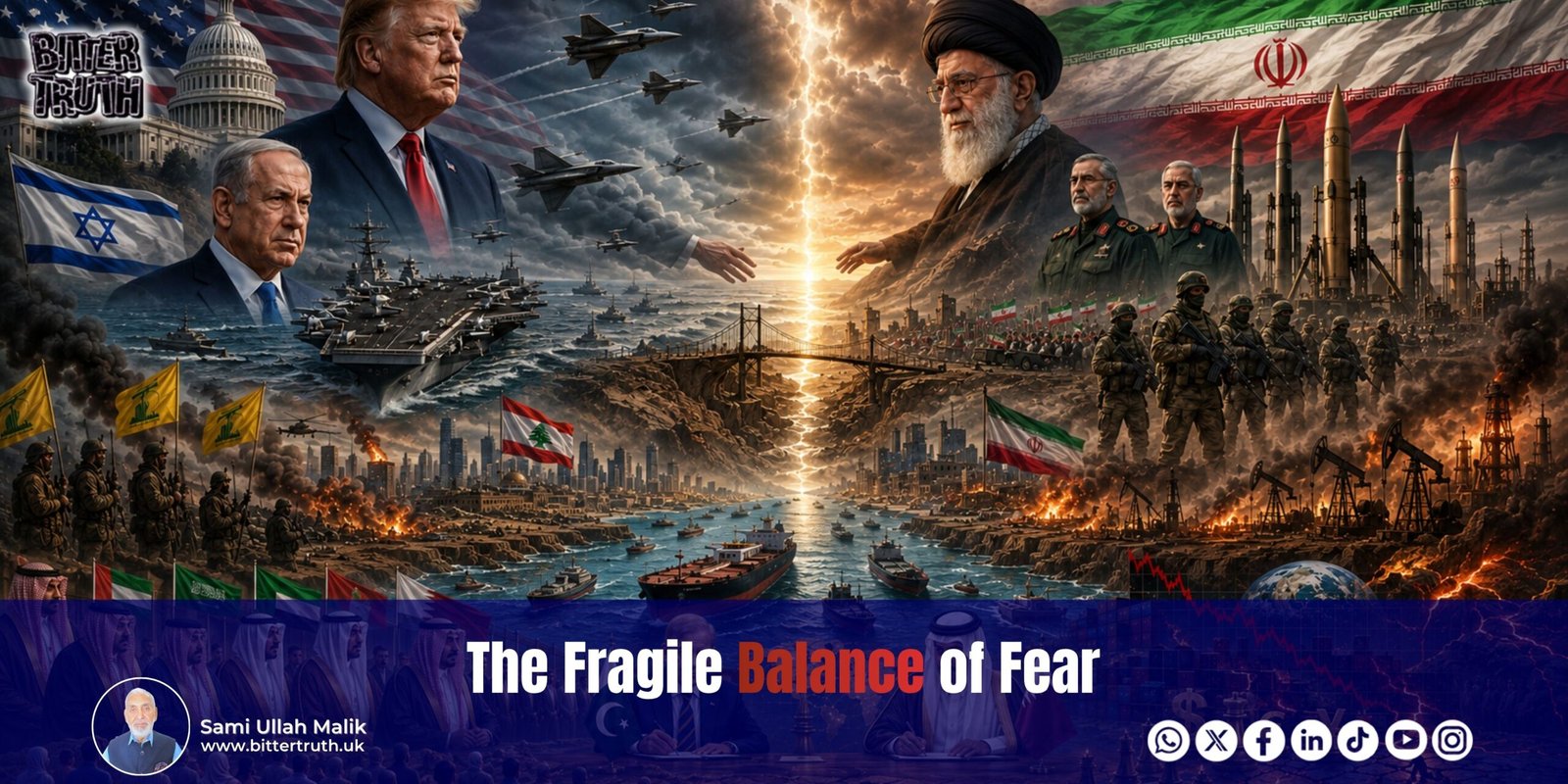
The Fragile Balance of Fear
Between War and Wisdom

When the annals of world history are inscribed in lines steeped in blood, they do not merely chronicle events; they enshrine the destinies of civilisations and the ambitions of nations. There arise, at intervals, epochs so burdened with consequence that time itself appears to groan beneath their weight. In such moments, events cease to be mere occurrences; they assume the character of verdicts upon the fate of entire cultures. When history sits heavy with unspent storms, even the slightest incident may turn upon its hinge and become an inflection point for an age.
The Middle East, that ancient crucible of power and belief, has for centuries smouldered upon the embers of history. It is a region where the contests of might, the friction of ideologies, and the calculus of interests have long been arrayed in restless tension. The present crisis is but another chapter in that enduring chronicle—one in which the politics of power, the resilience of doctrine, the imperatives of commerce, and the anxieties of identity stand in stark contention. Decisions may be struck in the marbled halls of authority, yet their reverberations are heard across deserts, harbours, and the arteries of global trade. One must concede that the current turmoil is no isolated disturbance, but rather a comprehensive tableau in which a single bullet, discharged from the barrel of a gun, wounds not merely a soldier but the very architecture of the global order.
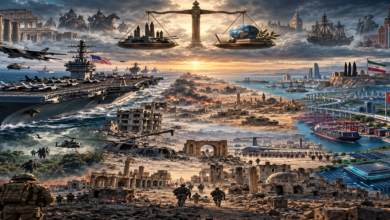
This is no simple quarrel between the United States and Iran. It is, in truth, the outward manifestation of a far broader geopolitical, political, and civilisational confrontation. Beneath its surface lie the accumulated sediments of centuries: political inheritances, religious narratives, economic imperatives, and deep-rooted civilisational tensions. It is a region where even the grains of sand seem to whisper history; where every decision carries not only the weight of the present, but the echo of the past and the prelude to the future. What unfolds here is not merely war—it is an inquiry into the shape of the world yet to come, and the principles by which it shall be governed.
The Qur’anic injunction offers a sobering reminder of the cyclical nature of power: “These are the days which We cause to alternate among the people.” Power, it suggests, is never static; it is subject to the slow but inexorable turning of time. It is precisely such a transformation that we now witness in the Middle East. The present crisis is a continuation of that enduring rhythm, wherein the roles of the United States, Iran, Israel, and the Arab world converge to compose a dense and intricate political narrative.
Donald Trump’s politics, in many ways, reflect the instincts of the merchant’s mind — transactional, immediate, and mathematically profitable. His approach to Iran bore the unmistakable imprint of this approach: a belief that a show of force would be enough to compel submission. As in Venezuela, he initially seemed to view the contest as a game of chess, in which a handful of decisive moves would win, and his name would be etched on the political landscape. Yet Tehran’s resilience, coupled with Benjamin Netanyahu’s unyielding strategic positioning, stood in his way like an immovable wall.
What may have been conceived as a calculated political wager—perhaps even a swift triumph—collided instead with the deeper currents of history, which do not yield readily to force alone. For this was no mere chessboard; it was, rather, a Karbala of history, where each piece contends for its very existence. Iran is no ordinary state, nor a mere geographical entity; it is an ideological cosmos, founded upon revolution, sovereignty, and resistance. Encircled within the fortifications of its autonomy, Tehran stands as a citadel whose ramparts are forged not of steel but of conviction, whose walls are cemented not by brick but by a resolve tempered in sacrifice. Its present defiance testifies to a perennial truth: that nations endure not by the sword alone, but by the fervour of their belief. It is this very conviction that has stood as an iron barrier before the designs of Washington.
On one side stands Iran, unwilling to yield even an inch of its sovereignty; on the other, Israel, which perceives in any concession to Tehran a threat to its own security. Benjamin Netanyahu, in this unfolding drama, appears as a blade drawn against compromise itself—regarding any gesture towards accommodation as a peril to be resisted. Thus, President Trump finds himself advancing along a path where each turn reveals yet another impediment.
The ceasefire of the eighth of April, when examined with due sobriety, resembles a fragile bridge cast across a tempestuous river—a temporary expedient rather than a durable settlement. It is, in essence, an interlude of unease rather than of repose. The guns may have fallen silent, yet it is the silence of a sea whose surface belies the storms gathering beneath. In the rhetoric of both parties, one discerns a latent severity, suggesting that this calm is but a pause, not a resolution.
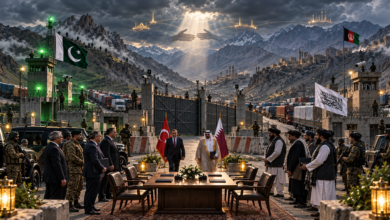
Both the United States and Iran have intimated a reluctance to descend once more into the quagmire of war. Yet the caution, ambiguity, and diplomatic intricacy that permeate their statements betray the provisional nature of this peace. Beneath the veil of diplomacy, preparations persist—an unmistakable sign that this is the quiet that precedes the storm. The mediation of Pakistan, Qatar, and others serves as a slender thread upon which this precarious calm is suspended—a thread that may fray or snap at any moment.
The Qur’an counsels: “And if they incline to peace, then incline to it also.” It is a principle at once simple and profound; yet in the harsh theatre of power politics, its realisation demands not only prudence, but a rare and resolute statesmanship.
Yet herein lies the central dilemma: the inclination towards peace is neither complete nor sincere on either side; it is, rather, a transient expedient—an interval of calculation rather than conviction.
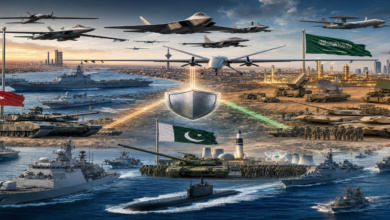
The American naval presence in the region, reinforced by formidable air power, resembles a vigilant bird of prey circling its quarry with measured patience. Its posture is not merely one of military preparedness but of psychological pressure—an unspoken warning cast across the strategic horizon. Iran, for its part, has placed its forces on heightened alert, as though engaged in the quiet labour of reorganisation before an impending trial. Its military doctrine has long rested upon a dual foundation: defensive resilience coupled with the capacity for unexpected reprisal. Aware that the balance of power in a conventional confrontation may tilt against it, Tehran has cultivated alternative instruments—networks of influence, missile capabilities, and the strategic leverage of maritime routes. Thus emerges a silent contest in which no shot has yet been fired, yet the finger rests ever upon the trigger.
This condition embodies, in its starkest form, a balance sustained by fear. The United States exerts pressure through the weight of its superior force, while Iran preserves equilibrium through the unpredictability of its unconventional means. It is a reminder that when force and conviction stand opposed, the decisive struggle is not always resolved upon the battlefield, but within the realm of resolve.
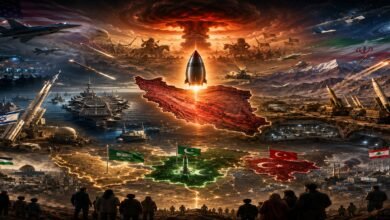
The region now stands poised upon a powder keg. A single misjudgment, a miscalculation, or an incautious utterance may suffice to ignite a conflagration whose consequences would extend far beyond its immediate theatre. The United States appears to pursue a policy of intensifying pressure in the expectation of extracting concessions, while Iran advances a countervailing doctrine of resistance designed to preserve strategic balance. In so doing, Tehran signals that any imposed conflict would not remain confined within territorial bounds but would instead reverberate through the economic arteries of the Gulf, unsettling the foundations of global commerce. These opposing philosophies, irreconcilable in their essence, render the crisis all the more perilous. At any moment, tension may harden into open confrontation.
History offers a sobering lesson: great wars are often born of small errors. The First World War was kindled by a single act of violence; the present crisis, too, may yet be inflamed by one ill-judged decision.
At such a juncture, the Qur’anic admonition acquires renewed significance: that discord weakens those who indulge in it. The path to a comprehensive settlement resembles a desert mirage—visible from afar, yet elusive upon approach. The immediate imperative is the preservation of the ceasefire, yet even this modest aim is fraught with difficulty. A deficit of trust, the burdens of past experience, and mutual suspicion stand as formidable barriers. For an agreement is not merely a document; it is the embodiment of confidence. Where confidence is absent, agreements dissolve into parchment without substance. It is for this reason that Iran regards any prospective accord with scepticism, mindful of precedents in which commitments proved fleeting. The United States, in turn, harbours its own doubts regarding Iran’s intentions. Thus, the situation assumes the character of a chessboard upon which each player hesitates, wary of the other’s next move.
Lebanon has, in this unfolding crisis, assumed the role of an indirect theatre in which greater powers confront one another by proxy. It is here that the modern character of conflict is most clearly revealed: states refraining from direct engagement yet prosecuting their aims through aligned forces. The reverberations of strikes upon Beirut have introduced a new dimension to the crisis. Although Israel has, at moments, signalled restraint, its continued operations in southern Lebanon betray a strategy marked by contradiction—extending the hand of conciliation while sustaining the instruments of pressure. It is, in effect, a dual policy: peace offered in gesture, force applied in practice.
Benjamin Netanyahu’s position is unambiguous: Iran must be weakened, irrespective of the cost to diplomatic process. In this view, diplomacy is not an instrument of strength but a concession to vulnerability, while power alone constitutes the language of statecraft. Any agreement between Washington and Tehran is thus perceived as inimical to Israeli interests—peace itself appearing as a shadow in which danger lurks.
Iran’s association with Hezbollah is not merely political; it is rooted in a deeper ideological affinity, grounded in the conviction that resistance to oppression constitutes a moral obligation. Tehran has repeatedly asserted that so long as Israeli operations persist, the prospect of a comprehensive settlement remains remote. This condition renders the diplomatic pathway increasingly narrow, if not altogether impassable.
The Strait of Hormuz, that vital artery of global energy supply, stands as a reminder that geography itself may be wielded as an instrument of power. Its potential closure would amount to a shock capable of unsettling the global economy, gripping the pulse of nations with sudden force. Iran has demonstrated an acute awareness of this reality, employing it as a strategic lever to signal that its capacity for response extends beyond the military sphere into the economic domain.
Thus the crisis endures—poised between fragile restraint and latent upheaval—its resolution uncertain, its consequences profound.
A contraction of nearly twenty per cent in the supply of oil and gas has sent tremors through global markets, unsettling economies across continents. The surge of inflation, the slowing of industry, and the pervasive climate of economic uncertainty have brought the world to the brink of yet another crisis. Should this condition persist, the spectre of a severe global recession looms ever larger—one whose repercussions may endure for decades. This crisis has long since outgrown its regional confines; it now exerts its influence upon the entire world. Rising energy prices, disrupted supply chains, and waning investor confidence together strain the very fabric of the global economic order. If prolonged, its consequences may well cast a long shadow over the future.
What President Trump once envisioned as a swift and decisive victory — an opportunity for political gain — has instead become a burden. His decisions have not only jeopardized the region but also his own political standing. Now he finds himself entangled in the complex consequences of his own design, as if caught in a trap of his own making. He stands at a crossroads where every path is fraught with difficulties: retreating would invite accusations of weakness yet risking escalating war. It is a calamity of his own making, and one that is not easy to avoid.
Within the United States, opposition to the conflict has begun to gather momentum. Voices raised against recent aggression have grown more insistent, while public opinion, media scrutiny, political pressure, and divisions within his own ranks have combined to complicate the situation further. It is a reminder that in a democracy, the exercise of power seldom proceeds without question or consequence.
President Trump has sought to distinguish his approach from that of President Obama, resisting any comparison with the agreement of 2015, which acknowledged the limits of coercion in restraining Iran. Yet, for all its differences in tone and method, his policy appears to revolve within the same strategic orbit; the manner may differ, but the ultimate outcome remains constrained by the same realities.
For Iran, this confrontation transcends geography; it is a matter of principle. Decades of sanctions and conflict have forged a nation of considerable resilience—one not easily bent to external pressure. Its history is steeped in resistance, and it is from this wellspring that it derives its enduring strength. In its present posture, Iran stands as an exemplar of patience and steadfastness.
The sacred text reminds us that those who endure with patience are not without support. It is a sentiment that resonates deeply in moments such as these, when resolve becomes the measure of survival.
The Arab states, too, have been profoundly affected by this crisis. Their economies, in need of stability and reliant upon peace, can ill afford further disruption. Their ambitions for development are inextricably bound to conditions of calm. They now strive to maintain a delicate equilibrium—unable
to align themselves wholly with one side yet unwilling to confront the other outright.
The efforts of Qatar and Pakistan stand out as notable and commendable, offering a glimmer of hope for peace. They serve as a testament to the enduring presence of those who would choose dialogue over conflict. Yet the path they tread is fraught with difficulty. Competing regional interests render the process intricate and uncertain, even as their mediation marks a constructive step forward.
Saudi Arabia’s role in this crisis has introduced a new and potentially destabilising dimension. Its recent actions have further complicated an already intricate conflict. Though presented as a response, their implications are far-reaching, with the potential to reshape the political landscape of the region in the years to come.
President Trump and Prime Minister Netanyahu appear, at least initially, to have underestimated the resilience of Iran. History, however, offers a consistent lesson: nations tempered by trial are seldom easily subdued. Such societies, hardened by adversity, do not yield readily to pressure—and Iran stands firmly among them.
This crisis is not merely a regional dispute; it constitutes a significant chapter in the broader narrative of global politics. Here, power, interest, and ideology are tightly interwoven, each contending with the other. The situation now stands at a decisive juncture—one from which the path may lead either towards reconciliation or towards ruin. Should wisdom, prudence, and dialogue prevail, the flames may yet be extinguished; if not, they may spread beyond all control.
History bears witness to a profound truth: wars are not won or lost solely upon the battlefield, but within the minds of those who wage them. The ultimate resolution of this conflict may thus depend less upon the thunder of artillery than upon the deliberations of negotiation.
For it is not the roar of guns that renders the final judgment of history, but the awakening of human consciousness. Should that awakening occur, even this tempestuous crisis may yet herald the dawn of a new and more hopeful age.