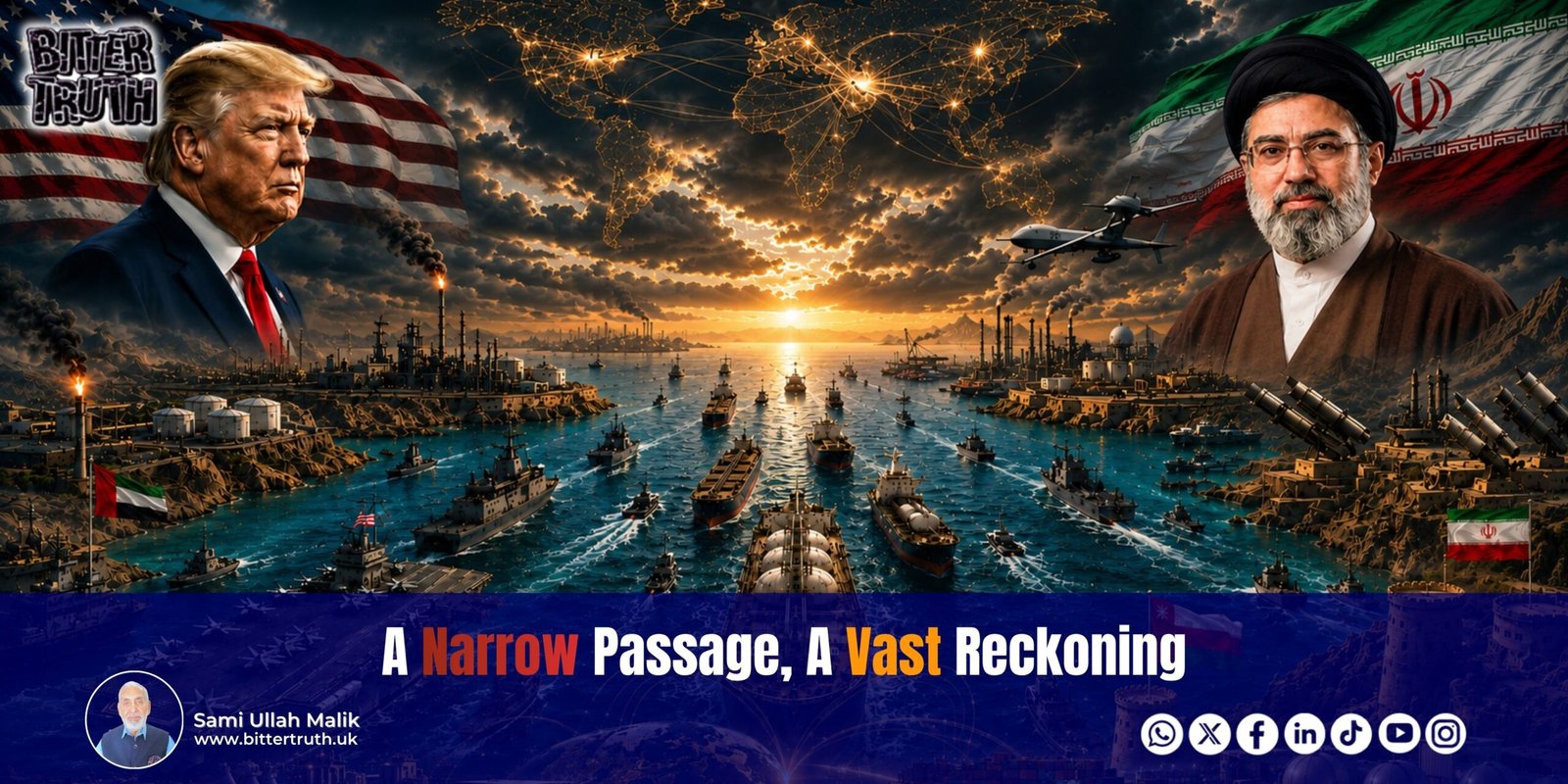
A Narrow Passage, A Vast Reckoning
Where Geography Becomes Power

The Strait of Hormuz — A Narrow Yet Decisive Current in the River of History
There are, in the long and restless march of human history, certain places which—though modest in their physical extent—exert an influence commensurate with the sweep of continents. The Strait of Hormuz stands among these rare geographical paradoxes: a slender incision upon the map, yet one that has, time and again, altered the very course of history. It is here, at this delicate hinge of geography and destiny, that the tremors of power, the evolution of empires, and the turbulence of time converge into a moment of profound consequence.
Between the vast expanse of the Indian Ocean and the deceptively tranquil waters of the Persian Gulf lies this narrow passage—a fissure, almost imperceptible to the casual eye, yet decisive in its implications. The Strait is no mere demarcation; it is a force, a fulcrum upon which the weight of global affairs is balanced. A thin ribbon of water, and yet it gathers within itself the breadth of epochs. In its presence, scale loses meaning: the small becomes immense, the narrow expansive. It is, in truth, a confined maritime corridor, yet in significance it resembles an ocean unto itself.
Here, the contours of the earth, the mysteries of nature, and the enduring narratives of human ambition and dominion intertwine so intricately that the boundary between the real and the symbolic begins to dissolve. This is no ordinary waterway; it is the breath of civilisations, the pulse of economies, and the very throat of global politics—so placed that to grasp it is, metaphorically, to take hold of the world’s heartbeat.
The waves that pass-through Hormuz do not merely brush against its shores; they resonate with the intentions of states, the equilibrium of markets, and the continuity of cultures. Together, they compose a silent yet far-reaching symphony—one whose reverberations travel across distant continents, shaping destinies far removed from its immediate shores.
History bears solemn witness to an enduring truth: wherever the arteries of resources flow, the grasp of power is never far behind. The Strait of Hormuz is the living embodiment of this principle. It is a place where geography, economics, military strategy, and international politics are so intimately interwoven that they resemble the inseparable union of word and meaning. It functions, in effect, as a gateway through which the machinery of the global economy must pass. No vessel traversing these waters carries cargo alone; it bears with it the aspirations, necessities, and latent anxieties of nations.
If one were to conceive of the world as a living organism, then Hormuz would be its vital artery—sustaining the flow of energy upon which modern civilisation depends. So long as that flow remains uninterrupted, the system endures; should it falter, the tremors are felt across the entire body. It is for this reason that whenever tensions mount among global powers, attention invariably turns to this singular passage. And when unrest arises here, its echoes are neither local nor contained—they ripple outward, unsettling the broader architecture of the international order.
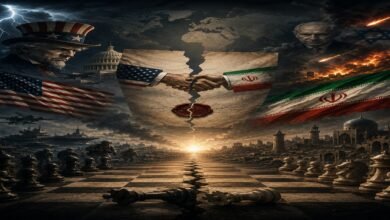
The contest between the United States and Iran, as it now unfolds around this strategic corridor, is no fleeting quarrel. It is the culmination of a layered and protracted history—one shaped by revolution, ideology, power, and an enduring undercurrent of mistrust. The present tensions cannot be understood in isolation; they are but the latest chapter in a narrative that stretches from the upheavals of Iran’s revolutionary past to the shifting political landscape of the Middle East.
Yet what distinguishes the current moment is the transformation of theatre. No longer confined to land, the arena of contest has extended into the maritime domain. The sea, once a conduit of commerce, has become a stage upon which strategic rivalry is enacted with renewed intensity.
For Washington, the issue transcends immediate confrontation; it is framed as a matter of safeguarding the integrity of the global order. Iranian naval capabilities, in this view, are not merely defensive instruments but potential levers through which international trade could be constrained or coerced. Thus, American attention has been deliberately directed toward Iran’s coastal sphere—the very region where geography and strategy intersect, and where the balance of power is most defined.
Recent developments underscore this shift with unmistakable clarity. The coastal zones of Iran—sensitive not only in geographical terms but also as gateways to global commerce—have become the focal point of American action. Here, the language of conflict is no longer articulated through the thunder of artillery, but through the measured movement of vessels, the silent vigilance of drones, and the strategic significance of maritime infrastructure.
For the United States, this engagement is presented as an effort to preserve systemic stability; for Iran, it is perceived as a challenge to sovereignty and regional identity. Thus, both states find themselves at a juncture where each step carries consequences extending beyond the immediate present, shaping not only the trajectory of current tensions but also the contours of future order.
The strategic calculation guiding Washington appears to be aimed at limiting Iran’s ability to influence maritime trade – particularly its ability to block the flow of oil on which global markets depend. Yet these actions are part of a broader and more complex design than mere displays of force.
The strikes carried out under the auspices of the United States Central Command on 13 July must be read in this light. They were not simply military manoeuvres, but symbolic acts—quiet proclamations whose political resonance exceeded their immediate tactical objectives. Among them, the roar of the explosion was less important than the message it conveyed: this conflict has transcended the traditional battlefield and has extended its reach into the arteries through which the blood of global civilization flows.
By targeting coastal installations, missile systems, drone facilities, and defensive infrastructures, these actions sought not merely to degrade capability but to redefine the parameters of engagement. From Bushehr to Bandar Abbas, from Chabahar to Jask, the series of attacks traced a deliberate arc along Iran’s maritime border, clearly indicating that the sea itself has become a sphere of contested authority.
These were not isolated coordinates upon a map; they were pillars of Iran’s maritime sovereignty. Bushehr, a locus of energy; Chabahar, Iran’s window onto the Arabian Sea; Bandar Abbas, the beating heart of its naval presence—each carried significance beyond its immediate function. To strike them was to communicate an intention that extends beyond the present moment, touching upon the prospective balance of power in the region.
In this evolving landscape, a further dimension has emerged—one that binds security with economics in a novel and disquieting synthesis. When protection is rendered as a service, and that service is assigned a price, a new doctrine begins to take shape. The proposition that passage through Hormuz might be subject to a fee under the aegis of protection reflects precisely such a convergence of force and finance.
At first glance, this framework presents itself as an instrument of order—a mechanism through which stability might be ensured. Yet beneath its surface lies a more profound implication: the gradual transformation of global commons into arenas of managed authority. It raises an enduring question—one that remains unresolved—whether such measures constitute genuine guardianship, or whether they herald the آغاز of a more subtle, yet no less consequential, form of economic dominion.
Guardianship, Power, and the Contest of Sovereignties
When the President of the United States proclaimed himself the “guardian” of the Strait of Hormuz, the word was not a mere flourish of rhetoric; it was, rather, the articulation of a doctrine. It spoke of a vision in which the great arteries of the world are not simply traversed but administered—regulated, if necessary, by the application of power. Yet beneath the language of guardianship there lingered a more disquieting suggestion: that protection might serve as the pretext for dominion, and order as the instrument of control.
The declaration that vessels passing through the Strait would be subject to a levy of twenty per cent introduces into the theatre of international politics a question both novel in form and ancient in substance. Is this the conduct of a custodian, or the foundation of a new economic dispensation? It is presented, outwardly, as a measure of security; yet within it resides an unmistakable echo of authority seeking to transform common passage into managed privilege. To describe protection as a service, and to attach to it a price so considerable, is to blur the line between stewardship and exaction.
This proposed tariff, therefore, is more than a fiscal device; it is a glimpse of an emergent model—one that binds force and finance into a single design. Whether this represents a reconfiguration of the global order or merely the latest guise of an older contest for predominance remains an open question, though history inclines one to caution.
In contrast, the response of Iran’s Foreign Minister carried a weight that extended beyond the confines of diplomacy. It was not simply a rebuttal, but a declaration steeped in historical consciousness and civilisational memory. While conceding, in part, the language of guardianship, he advanced a counter-claim: that the true custodian of the Strait is Iran itself. This assertion rests not upon transient power alone, but upon the deeper foundations of geography, continuity, and identity. Iran, in this telling, is not an incidental presence but an inheritor—bound to these waters by centuries of maritime tradition and historical experience.
Such a position reflects a conception of the state not merely as a political entity, but as a civilisational trust. It affirms the belief that sovereignty entails not only authority, but stewardship—an obligation to oversee and preserve that which history has entrusted. Hence Iran presents itself not as a participant among equals, but as a vigilant overseer, whose role is shaped as much by inheritance as by interest.
Memoranda of understanding often appear as harbingers of concord, casting a brief illumination across troubled waters. Yet when the ideas that underpin them lack harmony, that light soon falters. The agreement reached on the seventeenth of June seemed, at first glance, a fragile beacon—lit in the hope of dispelling uncertainty. But its glow was unsteady, for within it lay the latent embers of divergence. It was, in essence, a compact between competing visions: on one side, the principle of open and unimpeded trade; on the other, the assertion of regional sovereignty and regulated passage.
Its clauses spoke the language of cooperation, yet between their lines ran a discernible current of discord. Thus, it became a structure sound in phrasing but divided in purpose—a bridge that aspired to unite opposing shores yet remained suspended between them. Like a vessel whose apparent strength conceals a hidden weakness, it only lasted until the pressure of events revealed its fragility.
The relationship between authority and responsibility has long occupied the attention of philosophers and statesmen alike. Where responsibility is assigned, authority is inevitably sought; and it is at this juncture that contention arises. Iran, invoking this principle, anchored its argument in the fifth clause of the agreement, which conferred upon it an administrative role. From this premise it advanced a broader claim: that responsibility without authority is not governance, but burden—and a burden that invites dispute.
This contention transforms a contractual provision into a constitutional question of enduring significance. Can responsibility be meaningfully exercised in the absence of corresponding authority? It is here that the tension between international frameworks and regional power becomes most apparent, revealing the fault lines that underlie the present crisis.
The incidents of the twenty-fifth and twenty-seventh of June were not isolated occurrences, but the culmination of a tension that had been steadily gathering. The attacks upon vessels in Omani waters during the closing days of the month marked a decisive escalation—a moment at which latent conflict assumed visible form. These events were neither abrupt nor inexplicable; they were the logical consequence of a sequence in which each step prepared the ground for the next.
The United States denounced these actions as violations; Iran, in turn, defended them as responses compelled by circumstance. Thus began a familiar cycle of accusation and justification, in which clarity recedes and the demonstration of power takes precedence over the search for truth. In their wake, the limitations of the prior agreement stood revealed, for the realities of the sea proved more forceful than the assurances of parchment.
Such episodes remind us that in the realm of international politics, no event stands alone. Each is a fragment of a larger narrative, shaped by forces that extend beyond the immediate moment. The global economy, intricate and interdependent, may be likened to a vast and delicate web—and within that web, the Strait of Hormuz forms a central knot. If the world is conceived as a living system, then this passage is the channel through which its vital energies flow. Every barrel of oil, every current of gas that traverses these waters is more than a commodity; it is a sustaining force, maintaining the rhythm of life across distant regions.
It is estimated that a fifth of the world’s oil passes through this narrow corridor. This is not merely a statistic; it is the measure of a dependency upon which modern civilisation rests. Its very narrowness is the source of its significance, for where passage is constrained, the impulse to command it grows ever stronger. Hence even the slightest disruption within these confines can reverberate across global markets with the force of a seismic shock—altering not only prices and supply, but the broader contours of geography, risk, and destiny.
In this sense, the Strait of Hormuz is not merely a place upon the map; it is a test of the principles by which the modern world is governed. Whether it becomes a shared artery of cooperation or a contested instrument of power will determine not only the fate of a region, but the character of the international order itself.
The Strait as Theatre, Artery, and Trial
The Strait of Hormuz lies poised between Iran, Oman, and the United Arab Emirates—a place where land and sea draw close in quiet complicity, granting passage to the commerce of the world. In its narrowness there resides a curious vastness, and it is precisely this constriction that conceals its latent power. Its depth, its carefully defined channels, and its confined breadth render it a classic point of passage where even the slightest obstruction may swell into a crisis of global proportion. Each vessel must adhere to prescribed routes, and it is this very limitation that magnifies the significance of control.
The surrounding states confer upon this geography a political character so pronounced that the land itself appears to speak in the language of power. Here, geography is not a passive backdrop but an active and silent participant, shaping the course of events without uttering a word. Every ship that passes through these waters does not merely traverse a maritime corridor; it enters, however unwittingly, into the theatre of international politics.
The energy that flows through this passage constitutes, in truth, the pulse of the global economy. Continuity ensures stability; interruption invites crisis. This simple yet profound reality endows the Strait with its enduring significance. Each day, millions of barrels of oil and vast volumes of gas pass through its confines, attesting to the fact that it is not merely a route, but a central hub of energy upon which modern civilisation depends. Nowhere is this dependence more evident than in Asia, and particularly in China, whose economic vitality is closely bound to the uninterrupted flow of these resources. In this sense, the Strait serves as a lifeline to the eastern economies.
Yet it is not energy alone that courses through these waters. Essential commodities—food, fertiliser, medicines, and industrial goods—also traverse this passage, binding it to every facet of human existence. Its closure would not merely disturb markets; it would touch upon the very conditions of life itself.
With rising tension comes the multiplication of risk—risk not confined to the military sphere, but extending into the economic and psychological domains. Each vessel navigating these waters must contend with an atmosphere of uncertainty, and it is this uncertainty that exerts a corrosive effect upon the broader system. Drones, missiles, naval mines, and warships transform this narrow channel into a potential arena of conflict, where the meaning of war extends beyond direct engagement to encompass the destabilisation of the global order itself. A single strike may imperil not only a ship, but the intricate web of the world’s economy.
As danger intensifies, confidence diminishes. Insurance premiums rise, the cost of passage increases, and the tempo of trade begins to falter. The hesitation of insurers, though less visible than the movement of fleets, constitutes a quiet yet formidable threat. Rising rates are not merely economic indicators; they are reflections of fear—not of the depths of the sea, but of the uncertainties that reside within the human mind. It is at this juncture that the effects of conflict transcend the battlefield and make themselves felt in the marketplace.
The consequences are neither distant nor abstract. Shortages of fuel in Asia, rationing in parts of Europe, and constraints upon electricity in regions of Africa all testify to the global reach of any disturbance in this passage. The crisis of Hormuz is not confined to its immediate surroundings; it radiates outward, enveloping economies and societies irrespective of their proximity. It is, in the truest sense, a challenge that defies borders.
Alternatives exist—pipelines, auxiliary ports, and secondary routes—but their capacity remains limited. They offer, at best, temporary relief, unable to compensate fully for any sustained disruption. The Strait remains, therefore, indispensable: a passage whose absence would create a void no substitute can entirely fill.
Yet beyond its material significance, the Strait of Hormuz stands as a symbol of humanity’s collective condition. It is a place where power and necessity, politics and economics, fear and hope converge. Here, a decision taken within a narrow compass may reverberate across the globe with the force of an upheaval. When calm prevails, the world’s economy breathes with ease; when tension rises, its echoes are heard across continents.
In this sense, the Strait becomes a mirror of the modern world—a place where strength and vulnerability, ambition and restraint, are reflected together. It poses, in essence, a question and a test: can power and cooperation coexist, or must one inevitably displace the other? Can a balance be struck between global interests and regional sovereignty?
At present, the Strait stands as a proving ground—a trial between humanity and the forces it has unleashed. Each decision taken here writes a new line in history; each misstep carries within it the seed of crisis.
If the world can grasp the delicacy of this place, it may yet transform it into a conduit of peace, cooperation, and shared prosperity. If not, the same waters may herald storms yet to come. And should wisdom fail, the Strait of Hormuz may, in the years ahead, become the subject of a history written not in triumph, but in regret—a chronicle recounted with a sense of loss for what might have been preserved, yet was allowed to slip away.