Apocalypse or Awakening?
The Politics of Apocalypse

Global Peace and the Islamic Moral Imagination
This essay takes as its point of departure Naomi Klein and Astra Taylor’s investigation, “The Rise of End Times Fascism”, and offers a critical account of the powers, doctrines and interests that are fanning fear, war and disorder in our age. It asks why justice, moral consciousness and international solidarity have become indispensable if humanity—across the divisions of faith, race and region—is to confront the dangers it shares.
The extended conversation under consideration gathers several of the deepest anxieties of our time into a single, disquieting mirror: the conversion of religious prophecy into a political programme; the raising of walls between human beings in the name of race and nation; the emancipation of artificial intelligence from meaningful human command; the concentration of wealth and resources in ever fewer hands; and, instead of arresting ecological catastrophe, the construction of private sanctuaries for the privileged. Its governing metaphor is “end-times fascism”: a politics that, having despaired of building a future, declares collapse inevitable and then seeks in that collapse a path to power, profit or personal deliverance. The idea possesses considerable force as a warning. Yet every claim made in its name must still answer to research, context and evidence. In political argument, apprehension that hardens into certainty without proof may itself become part of the very industry of fear it seeks to arraign.
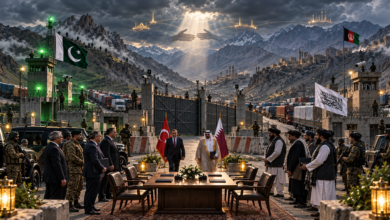
The Islamic perspective introduces into this discussion a principle of remarkable clarity: belief in the life to come is not an alibi for abandoning this world; it is a covenant of stewardship, justice and accountability within it. Knowledge of the Last Hour belongs to God, but until that hour the human duty is to mend the earth, preserve life, restrain oppression and enlarge the realm of good. Whoever sanctifies war in the name of religion, licenses hatred in the name of race, or renders human beings expendable in the name of progress may clothe his speech in celestial language; his work upon the earth remains corruption. What the present hour requires is not the supremacy of one religion, nation or civilisation, but a global compact in which Muslims, Christians, Jews, Hindus, Buddhists, those of no religious profession, and people of every region become one another’s allies in the defence of a common life.
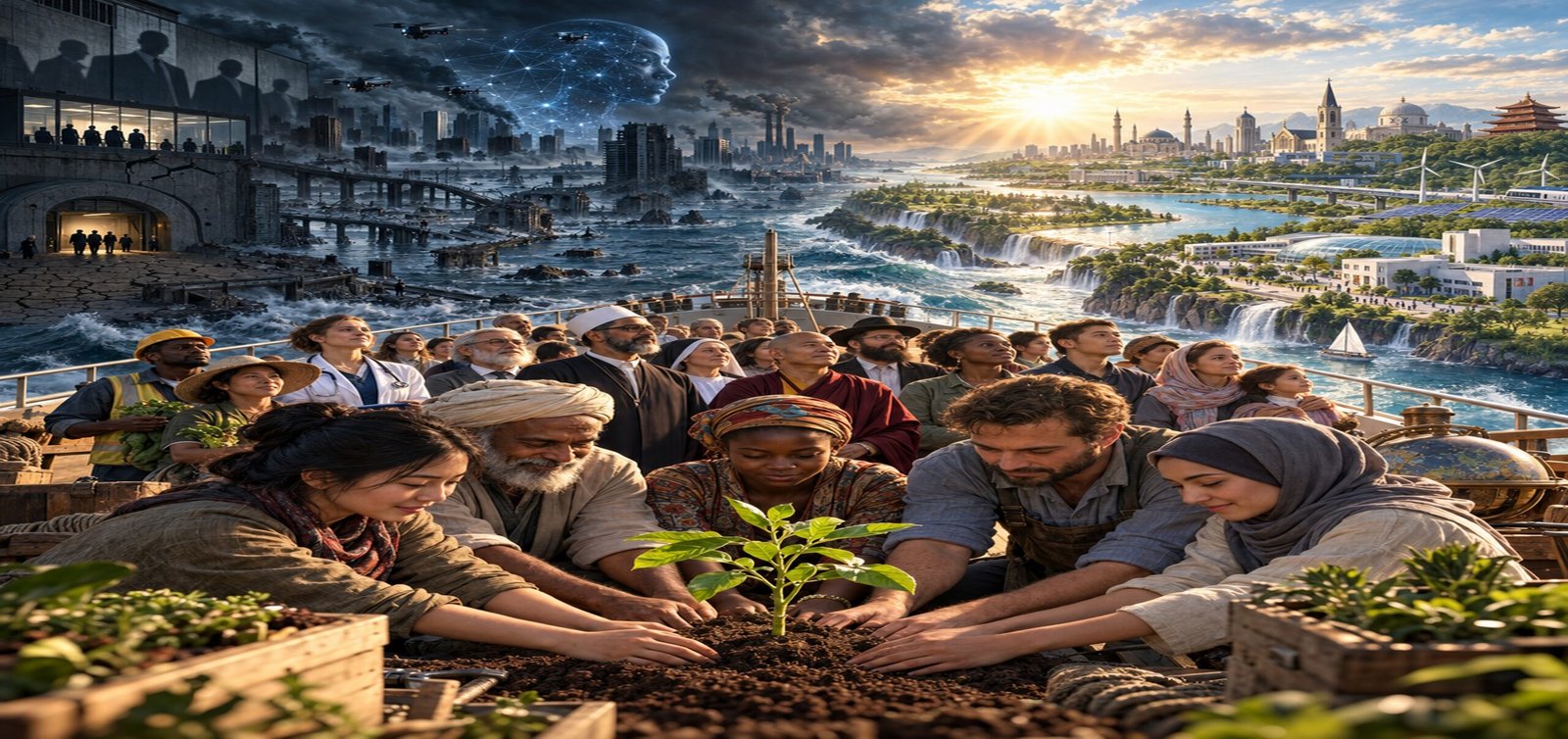
The Qur’an certainly reminds humankind of mortality, but it does not appoint us spectators of ruin. It describes the human being as God’s vicegerent upon the earth and the bearer of a trust: endowed with agency, yet answerable for its use. The injunctions that “God does not love corruption” and that humankind must not spread corruption upon the earth after it has been set in order bind religious conscience to public responsibility. Hence, in the Islamic tradition, planting a crop, giving water to the thirsty, removing an obstruction from the road, defending the oppressed and reconciling adversaries all fall within the province of worship. A celebrated Prophetic teaching holds that, even if the Last Hour is at hand and a sapling rests in one’s palm, one should plant it. Few images express Islamic hope more luminously: knowledge of the end does not annul the obligation to act.
Here lies the fundamental distinction between a politicised cult of apocalypse and the Islamic doctrine of the Hereafter. The former becomes malignant when a faction seizes heavenly promises as warrants for an earthly project, treats slaughter as the fulfilment of prophecy, and, declaring itself elect, becomes indifferent to the destruction of everyone beyond its ranks. The Qur’an repudiates such conceit. Salvation is not the prize of lineage, nation, colour or self-proclaimed election; it entails the responsibilities of faith, justice and righteous conduct. For a Muslim, the signs of the Last Day are not a campaign map for commencing war, but a summons to self-reckoning. The lamp of religion was given to illuminate the road, not to set a powder magazine alight.
The Qur’anic voice is not confined within an ethnic citadel. It addresses the whole human family: you were created from a man and a woman and made into nations and tribes so that you might know one another; distinction rests not upon colour, blood, passport or capital, but upon moral consciousness and character. This is more than spiritual counsel. It is an ethical constitution for international affairs. Difference ought not to be kindling for war, but the ground of acquaintance, co-operation and civilisational exchange. In the same spirit, the Qur’an likens the killing of one innocent person to the killing of all humanity, and the saving of one life to the saving of humanity entire. Here, the very word humanity rises above the frontiers drawn by states.
By this measure, the migrant, the refugee, the minority, the adherent of another faith and the inhabitant of a distant country do not fall beyond the circumference of moral concern. A government’s need for security is real; but collective punishment, racial degradation, forced displacement and extrajudicial killing cannot be made lawful merely by invoking it. Borders are administrative realities, not the outermost boundary of human sanctity. When the world is partitioned by merchants of fear, the Qur’anic answer is that a person is first a human being and only thereafter a member of a nation or party. Upon that foundation, an alliance transcending religion and race may be built.
Twentieth-century fascism did not spring from a vacuum. The wreckage of the First World War, economic misery, national humiliation, unemployment, class anxiety and political disorder prepared the soil in which authoritarian seeds grew with alarming speed. Fascist leaders recognised genuine affliction, but fashioned scapegoats rather than remedies. Jews in one place, migrants in another, communists elsewhere, and racial or religious minorities in many lands were charged with the nation’s decline. Instead of binding the people’s wounds, such leaders poured into them the poison of revenge; anger that might have been directed towards the true centres of power was turned upon the weak next door.
That lesson has lost none of its urgency. When an elite presents itself as “besieged”, “victimised”, or the dispossessed heir to a stolen greatness—even while wealth, media and the instruments of the state remain firmly in its hands—we must look through the veil of language to the realities of power. Wounded authority often assumes the costume of victimhood in order to conceal its strength. Islamic justice neither mistakes the wrath of a majority for truth nor treats minority identity as an offence. The Qur’an commands that hatred of a people must not cause us to depart from justice. Nothing could stand more squarely against the fascist temper: fascism lives by manufacturing an enemy; justice means upholding the right even in one’s dealings with an enemy.
One of the most instructive chapters of Islamic history is the Covenant of Madinah. Madinah was no monochrome settlement. It contained distinct tribes, Muslim communities and Jewish clans, each with its own interests, traditions and religious identity. Rather than erase this plurality, the Prophet’s leadership ordered it within a political covenant founded upon mutual defence, justice, responsibility and co-operation against oppression. The episode demonstrates that uniformity of belief is not a condition of solidarity within a shared homeland or in the face of a shared danger. Civic peace emerges when diverse identities retain their dignity while entering a just framework of law and reciprocal obligation.
The Treaty of Hudaybiyyah offers another expression of the same spirit. Though its terms appeared severe, the immediate passion for conflict was mastered and the possibility of peace preferred. Political courage is not displayed only by drawing the sword. At times, greater courage is required to keep it in its scabbard, to restrain the tide of feeling and to discern the longer horizon. At the conquest of Makkah, a general amnesty broke what might otherwise have become a long inheritance of vengeance. These luminous episodes are not tales of flawless human societies, but they remain lamps of principle: fidelity to covenants, impartial justice, an open door to peace even for an adversary, and mercy at the moment of triumph. These are precisely the virtues of which the contemporary international order stands in need.
When Religion Becomes a Ladder to Power
Naomi Klein has raised grave concerns about the relationship between religious prophecy, messianic politics and the wars of the Middle East. Her particular claims require their own scrutiny; the danger in principle, however, is beyond dispute. Once sacred text is severed from context, ethics and the inviolability of life, and converted into a political chart, holy words become the seal of temporal power. From the Crusades to sectarian massacres, adherents of many religions have at one time, or another presented their own interests as the will of God. This is not an original sin peculiar to one faith. It is a malady of human power, capable of dyeing every sacred tradition in its own colours.
Islam issues a double warning here. First, there is no compulsion in religion: faith is the assent of the heart, not the decree of a cannon. Secondly, the signs of God must not be sold for a paltry price; religion must not be bartered for advantage, office or sectarian dominion. The sanctity of mosque, church, synagogue, temple and every place of worship can endure only when the same principle is applied to ourselves and to others. The task of religious leadership is not to pour the oil of sanctity upon the fires of war, but to put to power those questions the powerless cannot: whose life is being taken, whose home laid waste, and whose coffers are being filled?
Artificial intelligence is, in itself, neither angel nor demon. It is a power fashioned from human knowledge, capital, data, energy and political choice. It promises immense benefits in medicine, education, research, disaster forecasting and public administration. Yet the same power may become an instrument of surveillance, autonomous weaponry, systematic deception, discriminatory judgement, the degradation of labour and unprecedented corporate monopoly. The essential question is not whether a machine can think. It is who commands its decisions, who bears the burden when it harms, and into whose treasury the profits flow.
In Islamic ethics, knowledge is a trust, and an instrument acquires moral worth from the ends it serves. Technology that saves life, makes justice more accessible and cultivates human capacity may become an agency of good. Technology that reduces a person to exploitable data, a target, or surplus labour is a modern idol. The Qur’an confers an intrinsic dignity upon the human being; it cannot be weighed upon an algorithmic scale of utility. Artificial intelligence therefore requires enforceable international rules: human supervision, transparency, accountability, civil privacy, protection against discrimination, stringent restraints upon lethal autonomous weapons, and the participation of affected communities in decisions. Invention may outrun legislation; it cannot outrank morality.
Klein employs the powerful metaphor of the “bunker”: a cast of mind that, rather than repairing the common vessel, prepares a separate lifeboat for a favoured few. There are two broad responses to the threats of ecological breakdown, war, pandemic and economic collapse. The first is to fortify systems of water, food, health, knowledge and security for all. The second is for the wealthy to purchase guarded islands, private armies and avenues of escape. The latter may look like safety, but it makes fear permanent; no bunker can afford lasting peace in a world beyond its walls convulsed by hunger, anger and ruin.
Islam does not condemn wealth but regards it as a social trust that must circulate, lest riches pass only among the rich. Zakat, voluntary charity, inheritance law, the condemnation of hoarding and the rights of the vulnerable are all parts of this economic ethic. In the modern world, its spirit demands fair taxation, resistance to monopoly, the rights of labour, universal foundations of health and education, reform of predatory debt, and public investment in resilience against disaster. When a state pleads an empty treasury for books, hospitals and clean water, yet throws open doors of gold for war, surveillance and corporate privilege, the true scarcity is not of resources but of moral priority.
The environmental crisis has confronted humanity with an elemental truth: the atmosphere inspects no passport, the sea asks no sect, and drought halts at no ideological frontier. Smoke from one region may alter the rainfall of another; uncontrolled emissions in one country may swallow the existence of a distant island. Climate cannot therefore be rescued within the narrow arithmetic of national advantage. Certain centres of power seek not to prevent the crisis, but to insulate themselves from its consequences. Yet the earth’s balance cannot be restored from inside a private refuge.
The Qur’an speaks of the cosmos as mizan—a balance—and forbids humankind to transgress it. The censure of extravagance is not confined to the dining table; it applies equally to the reckless consumption of energy, water, minerals and land. In an Islamic environmental ethic, humanity is not absolute proprietor but trustee. Trees, animals, rivers and generations yet unborn are the silent beneficiaries of that trust. A just environmental settlement must therefore form one pillar of global solidarity: economies responsible for the greatest pollution should shoulder the greater burden; poorer countries must receive the means for clean energy and adaptation; and the lands of local peoples must not be sacrificed to a new colonialism of extraction.
A Practical Charter for Global Solidarity
Good intentions alone do not alter the course of history; principle requires institutions, and resolve must ripen into action. The first step towards world peace is to place the unconditional sanctity of human life at the centre of international politics. There must not be one law for a powerful ally and another for a weak adversary. War crimes, ethnic cleansing, terrorism, collective punishment and extrajudicial killing must be investigated by the same standard. The second step is a body of binding international law governing lethal artificial intelligence, nuclear weapons and mass surveillance. Voluntary assurances are inadequate where a single error may change the fate of a generation.
The third step is economic justice: concerted action against exploitative debt, tax evasion, monopoly and the hoarding of food and medicine, coupled with investment in basic education, health, clean water and climate security. The fourth is a permanent forum among religions and civilisations—one that moves beyond ceremonial photographs, supplies learned answers to doctrines of hatred, and undertakes joint missions for peace in moments of crisis. The fifth is to educate the young in critical thought, ethical science and service, rather than in the romance of war, racial vanity or the worship of technology. The sixth is to bring cities and local communities into the making of decisions, because peace is not created by a communiqué in a capital; it is built from trust in the neighbourhood.
Such an alliance should signify neither the defeat of a religion nor the triumph of a civilisation. In the Qur’anic spirit of ta‘awun ‘ala al-birr wa al-taqwa—co-operation in goodness and moral responsibility—it should be a covenant: Muslims bringing their faith, Christians their spiritual tradition, Jews their ethical inheritance, and all others their conscience and human dignity to a common table. Differences would remain but cease to be warrants for killing; competition would endure, but no longer become a war for survival.
The most valuable intimation in the discussion before us is that the project of destruction, for all its apparent might, is not invincible. Religious extremists, racial nationalists and the unaccountable monopolists of technology may find common ground in certain interests, but their promises cannot give ordinary people bread, repose, dignity or a secure future. There lies their weakness. When farmers, labourers, teachers, scientists, religious leaders, environmental advocates and responsible businesspeople recognise their common interest, the artificial frontiers erected by fear may begin to fall. Clean water is neither a question of the Right nor of the Left; a child’s safe future is the patrimony of no single creed.
Hope is not the credulity of the simple-minded. It is the decision to act while knowing that darkness is deep and yet the lamp is not futile. The Islamic idea of raja—hope anchored in God’s mercy—guards the human being against despair and binds hope to endeavour. Systems of oppression invariably contrive to appear eternal. History records otherwise: the citadels of slavery fell; colonial empires broke apart; racial laws were overturned; the idols of dictatorship were shattered. None of these victories arrived of their own accord. People of different faiths and nations paid a price to make them possible. The struggle before us demands an ethical fellowship no less capacious.
Humanity now sails in a single vessel. Many languages are spoken upon its decks; prayers are offered in different directions; distinct anthems of history are sung. But if the hull is breached, no passenger’s cabin remains secure. Against the forces that wound this vessel through war, hatred, ecological plunder, nuclear threat, ungoverned artificial intelligence and economic exploitation, solidarity is not merely a moral grace; it is a condition of survival. It must be an alliance not against a nation, but against oppression; not against religion, but against the exploitation of religion; not against technology, but against its inhuman and unanswerable exercise.
In this age, Islam summons Muslims to be not merchants of fear but witnesses to peace. Faith gives us no warrant to write the date of the world’s ending; it lays upon us the duty, while time remains, to kindle one more light of justice upon the earth. Let us fashion a global covenant in which the sanctity of the murderer is recognised before anyone asks his religion, bread is placed before the hungry before anyone demands her nationality, and the cry of the oppressed is heard before anyone examines a passport. This is the honour of civilisation, the moral foundation of politics and the mercy at the heart of religion.
When the Last Hour will come is a mystery belonging to God. When our civilisation will awaken is a question addressed to us. If justice becomes our standard, compassion our language, inquiry our lamp and human unity our destination, perhaps posterity will remember our age not as the era of ending, but as the turning of the tide—the hour in which humanity at last acknowledged, in full earnest, that peace is not the prize of the victor, but the common trust of all.