The Ramparts of Power and the Balance of History
A Historical and Analytical Study of America’s Wars, Interventions and Political Defeats

The names of empires are not always inscribed upon the pages of history in letters of gold. At times, the smoke of artillery, the dust of ruined cities, and the lamentations of broken nations draw around them a darker margin—one that no later ink can wholly efface. Power is, without question, among the greatest instruments placed in the hands of states. Yet power and wisdom are not one and the same; nor are military victory and political success merely two names for the same destination. Again and again, history has delivered the same austere lesson: a sword may batter down a gate, but it cannot command the allegiance of the heart. An army may occupy a capital, but it cannot indefinitely subdue a people’s collective memory, civilisational resistance, or political will.
From the latter half of the twentieth century into the twenty-first, the United States has stood among the foremost military, economic and technological powers the world has known. It possesses floating airfields upon the oceans, an air force capable of spanning continents, a network of military bases stretching across regions, and a defence budget beyond the imagining of many states. And yet the question remains: why, from Korea to Vietnam, from Beirut to Mogadishu, from Kabul to Baghdad, and from Libya to Syria, has extraordinary military superiority so often failed to mature into durable political and strategic victory? This is not, at its heart, a question of being for or against America. It is a question of history, power and political judgement.
The real difficulty is not that America has “lost” every war. Historical truth is far more complicated than so convenient a verdict. The more serious question is how often the United States has won upon the battlefield only to lose in the political arena; how many governments it has overthrown only to unleash crises for which Washington itself possessed no satisfactory remedy; and how frequently a limited military purpose has, by degrees, sunk into a political morass in which even the meaning of victory became obscure.
When the Korean Peninsula was engulfed in war in 1950, the conflict was initially regarded as the first great armed test of the ideological struggle between Communism and the Western world. North Korean forces advanced southwards; the United States entered the field in support of South Korea under the banner of the United Nations. In the early months the fortunes of war shifted repeatedly. At one point northern forces pressed towards the southern coast; at another, the allied armies under General Douglas MacArthur drove northwards with such speed that they approached the Yalu River. Then China entered the war, and the balance of power shifted once more.
After three years of bloodshed, an armistice was concluded in 1953. There was neither complete victory nor complete defeat. The frontier remained broadly where the conflict had begun. Millions had been killed or displaced, settlements devastated, families divided for generations, and Korea remained politically partitioned—as it does to this day. Korea was, in that sense, a war that ended without being resolved. It offered one of the first great lessons of modern American military history: forcing an opposing army into retreat may be comparatively straightforward; bringing permanent resolution to a political conflict sustained by great-power interests and local nationalisms is infinitely harder.
If Korea was an unfinished verdict, Vietnam became the mirror in which the limitations of American military power were displayed before the world with unprecedented clarity. America’s growing involvement in Vietnam was closely bound to the Cold War doctrine known as the “domino theory”: the fear that, if South Vietnam fell to Communist forces, other states in South-East Asia might follow in succession.
By the 1960s, the American military presence had risen to hundreds of thousands of soldiers. The most advanced air power of its age carried out immense bombardments; chemical agents were dispersed across forests; villages were emptied; and operations were conducted whose consequences endured across generations. Yet a truth of the battlefield became increasingly apparent to military planners in Washington: for the Viet Cong and North Vietnamese forces, this was not merely an ideological struggle. It was also, in their own understanding, a continuation of a long war for national sovereignty, historical resistance and freedom from foreign domination.
That distinction could not be grasped through statistics alone. How many enemy soldiers America could kill was a military question. How many Vietnamese remained prepared to return to the struggle was a political and civilisational one.
The Tet Offensive of 1968 inflicted heavy military losses upon North Vietnamese and Viet Cong forces, yet politically it shook American public opinion to its foundations. Confidence began to erode in Washington’s repeated assurances that victory was near. By 1973 the greater part of American forces had withdrawn, and in 1975 Saigon fell to North Vietnam.
The images of the American departure from Saigon were not merely pictures marking the close of a war; they became emblems of a larger truth: even the most advanced weaponry may prove powerless when political purpose, local reality and popular will are out of alignment. Vietnam had taught America this lesson. The tragedy is that the voice of history’s tutor is so often drowned beneath the thunder of guns.
To understand relations between Iran and the United States merely through recent confrontation or sanctions would be rather like judging the roots of a tree by looking only at its leaves. The year 1953 remains a defining turn in that history. Iran’s Prime Minister, Mohammad Mosaddegh, sought to nationalise the oil industry. A profound confrontation with Britain followed, and American and British intelligence services supported a covert operation against his government. Mosaddegh was removed from power, and the position of Shah Mohammad Reza Pahlavi was strengthened.
The episode left a wound in Iran’s collective memory and nourished a deep distrust of the United States. The Islamic Revolution of 1979 overthrew the monarchy; the American embassy crisis followed; and relations between the two countries moved towards something resembling permanent hostility.
During the Iran–Iraq War of the 1980s, the American military presence in the Gulf increased. In 1988, during Operation Praying Mantis, American and Iranian forces engaged in direct naval combat. That same year, the American warship USS Vincennes shot down Iran Air Flight 655, killing 290 people. The tragedy remains a powerful historical reference in Iranian memory.
In the decades that followed, sanctions, the nuclear programme, Gulf politics, Israeli security, Iraq, Syria and Lebanon repeatedly placed the two countries at odds. In January 2020, the killing of Iranian General Qasem Soleimani in an American drone strike in Baghdad carried tensions to a new level.
Here too the fundamental question is familiar: can a state be permanently compelled, through economic sanctions, military pressure or limited attacks, to adopt a particular political course?
History gives no simple answer. Its judgement is markedly more cautious.
Pressure may weaken governments. Yet the same pressure may also intensify nationalist sentiment, strengthen the domestic legitimacy of an opposing government, and encourage the greater use of non-state allies across a region. Contemporary American policy is also being discussed in connection with China’s energy requirements, the oil of Iran and Venezuela, and the wider economic rivalry of great powers. Energy, trade routes and economic competition among major states have always been central elements in the politics of war and peace.
Following the attacks of 11 September 2001, the United States entered Afghanistan. The initial objective was comparatively clear: destroy the structure of al-Qaeda and remove the Taliban government that had harboured Osama bin Laden. Within weeks, Taliban rule had been driven from the principal cities. That was a military victory.
But thereafter the nature of the war changed. A limited campaign against terrorism gradually expanded into a vast enterprise of state-building: constructing democratic institutions, creating an Afghan army, undertaking development projects, conducting counter-insurgency operations, and attempting to reconstruct an entire political order. It was here that the distance between military achievement and political reality began steadily to widen.
Afghanistan was never simply a territory enclosed by lines upon a map. Tribal relations, ethnic divisions, the interests of neighbouring countries including Pakistan and Iran, corruption, local centres of power, rural social structures, religious tradition and decades of warfare had produced a social landscape of immense complexity. To imagine that it could be reordered from outside within a few years was close to impossible.
The Taliban did not disappear. They regrouped in rural areas, found sanctuary in border regions and turned time itself into an ally. America had the watches; the Taliban had the time. In the end, that difference proved decisive.
The Taliban’s return to Kabul in August 2021 produced some of the most painful political images in modern American history. Scenes from Kabul airport revived memories of Vietnam. It would be historically more accurate to say that America did not lose every military engagement in Afghanistan; rather, it failed to preserve on a permanent basis the political system for which twenty years, immense resources and thousands of lives had been expended.
This was more than a military failure. It was the collapse of a political project. Afghanistan thus entered history as a dark and unfinished dream: twenty years of war, expenditure exceeding hundreds of billions of dollars, and one of the most grievous reverses in the American experience.
In 2003, the United States and its allies invaded Iraq. The central justification advanced for the war was that Saddam Hussein possessed weapons of mass destruction. Baghdad fell within weeks. Saddam’s regime was overthrown. Yet the weapons that had constituted the principal case for war were not discovered in the form in which their existence had been asserted. From that point arose a profound political and moral crisis.
The dissolution of the Iraqi army and much of the Ba’athist state apparatus abruptly deprived hundreds of thousands of men of employment, status and a place within the political order. Sectarian tensions intensified. Insurgency followed. Al-Qaeda in Iraq emerged, and from the ashes of these subsequent crises there arose, in later years, the organisation that became known as Islamic State.
The images from Abu Ghraib prison inflicted severe damage upon America’s moral standing. The Iraq War became perhaps the clearest example of the paradox whereby a superpower could defeat an enemy’s conventional army within weeks yet remain incapable for years of filling the political vacuum produced by that very victory.
The palace had been taken; the map of power had been redrawn; yet peace did not descend upon the street or the marketplace.
History does not pronounce its judgement at the final roar of artillery. Its verdict comes later, when the question is asked whether human life after the war became safer than it had been before. Baghdad had been conquered—but where was the peace?
The Gulf War of 1991 offers an important exception within this wider history. Saddam Hussein had invaded Kuwait. A broad international coalition was assembled under American leadership. The objective was comparatively clear and limited: to expel Iraqi forces from Kuwait.
Operation Desert Storm achieved that purpose in a short period. American leadership did not seek a permanent occupation of Baghdad, nor did it attempt to reconstruct Iraq’s entire political system. That difference deserves attention.
When the purpose of a war is clear, limited and measurable; when international support is broad; and when military success is not followed by the indefinite expansion of political ambition, power may be employed with considerably greater effect. The Gulf War of 1991 thus stands as a case of a limited purpose and an unmistakable military achievement, even though debate about its wider meaning has endured.
The Iraq War of 2003 produced an entirely different result in the same country, because the objective was no longer merely the liberation of Kuwait. It was the transformation of an entire political order.
In 1999, NATO conducted an air campaign against Yugoslavia lasting approximately eleven weeks. Its stated purpose was to halt Serbian military operations in Kosovo. Serbian forces eventually withdrew from Kosovo, and an international administration was established.
NATO regards the intervention as a success, and from that perspective its central military and political objectives were largely secured. Yet arguments concerning the legal basis of the war, the absence of explicit authorisation by the United Nations Security Council, the human consequences of the bombing and the political settlement that followed continue to this day.
History therefore requires a balance rather than a slogan. To confine every complicated war within the single word “victory” or “defeat” is, at times, to do violence to history itself. Hence Kosovo remains suspended between competing judgements: was it victory, or a complicated settlement?
Grenada and Panama provide easier tests of American power. In 1983 the United States intervened
militarily in the small Caribbean island of Grenada. The American government cited the protection of its citizens and the political crisis on the island among its reasons. Resistance was overcome within days.
In 1989, Operation Just Cause in Panama removed the government of General Manuel Noriega. Both operations were militarily straightforward for the United States because its opponents possessed neither Vietnam’s manpower, Afghanistan’s geography, Iraq’s extensive state apparatus nor the direct support of rival great powers.
Yet here too a principle reveals itself: power appears most effective where the imbalance of power is greatest. The true test begins when an adversary is not merely an army, but an amalgam of ideology, geography, nationalism, religion, history and popular resistance.
After 1982, American forces became part of a multinational peacekeeping mission in Lebanon. Yet the Lebanese civil war, the Israeli invasion, the Palestinian question and rivalry among regional powers had made the situation extraordinarily complicated.
In October 1983, a suicide bombing against the United States Marine barracks in Beirut killed 241 American servicemen. Within months American forces withdrew from Lebanon.
Beirut became a bitter historical reference point. In later decades, non-state armed organisations could draw from it a brutal psychological conclusion: compel a superpower to bear a political cost it finds intolerable, and even overwhelming military strength may eventually choose to leave the field. Variations of that logic would later be witnessed in Somalia, Iraq and Afghanistan.
American forces entered Somalia in 1992 as part of a broad international effort to facilitate humanitarian relief and restore order amid famine. Yet the mission soon expanded into operations against armed factions.
In October 1993 an American special-forces operation in Mogadishu descended into fierce urban combat. American helicopters were shot down; eighteen American soldiers were killed; and images of their bodies were broadcast around the world. The political atmosphere in Washington altered sharply, and American forces withdrew the following year.
Once again, the difficulty was not that the United States lacked the military capacity to continue fighting. The difficulty was that the political price of the war had become greater than the political value of its objective.
Here lies both a strength and a vulnerability of modern democratic powers: soldiers fight upon the battlefield, but the authority to continue the war ultimately comes from public opinion and the political system. The streets of Mogadishu offered a new definition of the limits of power.
In 2011, amid the Arab Spring, rebellion broke out against Muammar Gaddafi. NATO conducted air operations in which the United States played an important role. Gaddafi’s government collapsed. Yet Libya did not thereafter emerge as a stable democratic state.
Competing armed groups, parallel governments, tribal conflict, foreign intervention and prolonged civil war divided the country. It was another echo of Iraq: removing a government is far easier than constructing a state.
Bombs may destroy a military installation. They cannot manufacture courts, police forces, constitutions, political confidence or social reconciliation. Such institutions are not born from the smell of gunpowder. They are built through time, consent and social trust.
Libya therefore supplied another sombre verdict: the government could be brought down, while the state itself continued to fall apart.
In the Syrian civil war, the United States did not seek to occupy the entire country directly. Yet air operations against Islamic State, support for the Kurdish-led Syrian Democratic Forces, a limited military presence and certain missile strike against the Syrian government constituted important elements of American involvement.
The territorial rule of Islamic State’s so-called caliphate was largely dismantled, but Syria’s political crisis did not end. Russia, Iran, Türkiye, Israel, the Gulf states, Kurdish forces, the Syrian government and multiple armed groups all remained present with their own interests and calculations.
Syria demonstrated once more that, amid limitless complexity, defeating one enemy in a limited war and solving the political problem of an entire country are two very different undertakings.
The history of American intervention is not confined to declared wars. In Latin America, covert hands were often at work before guns were heard.
In 1954, a CIA-supported operation helped overthrow the government of Guatemalan President Jacobo Árbenz. In 1961, the Bay of Pigs invasion of Cuba ended in the failure of American-backed Cuban exiles to overthrow Fidel Castro’s government.
In 1965, American troops entered the Dominican Republic. During the 1980s, American support for the Contra rebels in Nicaragua contributed to a prolonged political and military crisis in Central America.
These episodes matter because modern power does not extend its influence by tanks alone. Intelligence services, economic sanctions, assistance to opposition groups, diplomatic coercion, trade embargoes and information warfare are likewise instruments of state power.
Some wars are therefore fought without declaration. Their cannon-fire may be quieter, but the wounds they leave upon history can be just as deep.
Why, then, does America so repeatedly descend into political quagmires? Across this long record, several enduring principles emerge.
First, Washington has repeatedly risked mistaking military superiority for political authority. Defeating an enemy in battle is no guarantee that a society can thereafter be remade according to the victor’s design.
Second, neglect of local history has repeatedly proved dangerous. Nationalism in Vietnam, tribal and religious structures in Afghanistan, sectarian balances in Iraq, and the fragility of the Libyan state were realities that American planning did not always fully comprehend.
Third, “mission creep”—the continuous enlargement of an original objective—has appeared again and again. In Afghanistan, an operation against terrorism evolved into state-building. In Iraq, regime change became an attempt to reconstruct an entire political order.
Fourth, modern wars are won not merely by weapons, but by legitimacy.
The day the moral or legal justification of a war comes under serious doubt, an adversary acquires a weapon more powerful than many missiles: a persuasive counter-narrative.
Fifth, great powers measure time in years; local resistance movements may measure it in generations. An American president occupies office for four or eight years. An Afghan fighter may regard his land as part of a continuous history stretching from his grandfather to his grandson.
Their clocks are not the same. America may possess the watches, but time has so often been the companion of the other side.
Repeated events have also strengthened a harsh but persistent accusation: that when its interests ultimately demand it, the United States will sacrifice its friends. It would be difficult to elevate this claim into an absolute law of history, for several American alliances have endured for decades—NATO, Japan, South Korea and others among them.
Yet circumstances are changing. Relations within NATO have been unsettled by President Trump’s repeated grievances; in Japan, voices have likewise emerged questioning relationships perceived as being sustained by the weight of American power; while South Korea, confronted by the hard-line policies of North Korea, remains for the present closely attached to the American strategic order.
To understand friends, allies and the cold logic of interest, one must begin with a fundamental principle of international politics: states are usually bound more firmly to interests than to friendships.
Today’s ally may become tomorrow’s adversary. The Shah of Iran was once a close partner of Washington. Saddam Hussein’s Iraq was viewed during the 1980s through a particular strategic lens as a counterweight to Iran; after 1990, he became America’s foremost regional enemy.
Afghan Mujahideen received support against the Soviet Union; later, the United States fought a twenty-year war in the same region.
Such examples remind us that international relations have seldom been governed by permanent affection or permanent hatred. The idea of permanent interests has usually been more powerful.
Yet this very reality also constitutes an ethical test for great powers. A state that weighs every relationship solely upon the scales of immediate advantage and loss may readily acquire temporary allies, but it is far less likely to build enduring trust.
In the twenty-first century, the rise of China constitutes America’s greatest long-term strategic question.
This rivalry is not confined to warships and missiles. Semiconductors, artificial intelligence, ports, commercial routes, energy, minerals, currencies, the global financial system and infrastructure have all become theatres of a new competition.
Within this setting, the geographical importance of Iran, the Gulf, the Arabian Sea, the Indian Ocean and countries such as Pakistan correspondingly increases.
In contemporary global politics, Iranian and Venezuelan oil is increasingly discussed in relation to China’s energy requirements, while the China–Pakistan Economic Corridor is frequently viewed as part of the wider contest among great powers.
Whatever may be said of particular interpretations, one fundamental reality is difficult to deny: China’s Belt and Road Initiative, maritime routes, Gulf energy supplies and access to the Indian Ocean will remain among the defining questions of international politics in the decades ahead.
America therefore encounters an old question wearing new clothes. Must every geographical challenge be answered by military pressure? Or will the ascendant power of the coming age be the one capable of establishing influence through markets, ports, knowledge, technology, diplomacy and trust?
Empires, at the height of their power, are often tempted into believing that power itself constitutes proof of righteousness.
History keeps another balance.
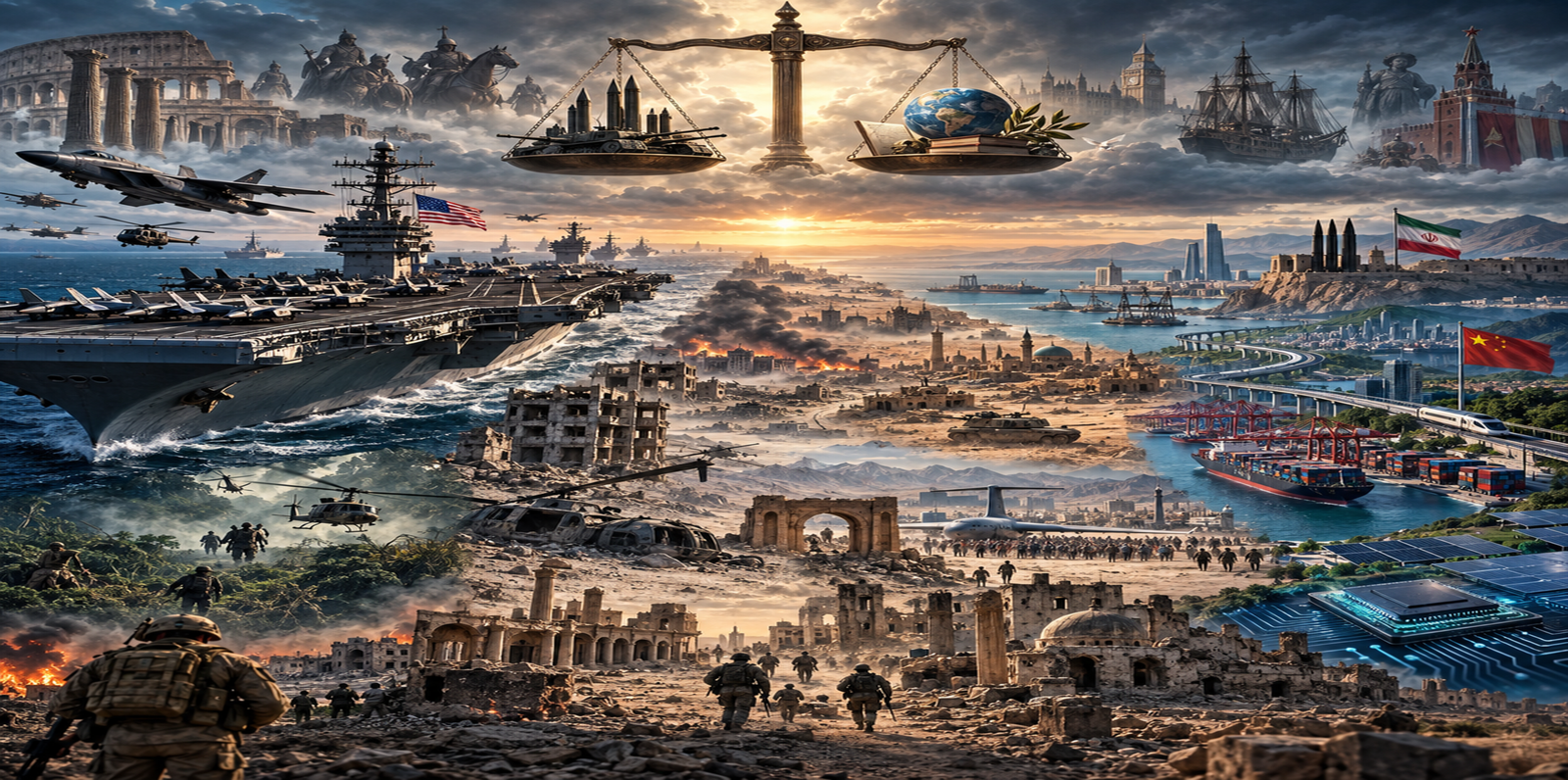
Rome possessed its legions; Rome did not endure in its imperial form. The Mongols possessed the fury of conquest; their empire fragmented. British ships once ruled the seas; in time the colonial order contracted. The Soviet Union possessed nuclear weapons and armies counted in millions; yet the dust of Kabul, alongside domestic economic and political crisis, shook the foundations of its power.
The United States is no more exempt from the laws of history than those who came before it.
Its universities, scientific achievement, technological ingenuity, economic strength, constitutional institutions and creative society are among the deepest sources of its real power.
But if its global identity becomes ever more inseparable from war, sanctions, regime change and military intervention, it may steadily dissipate a treasure of soft power that no aircraft carrier can recover.
The highest accomplishment of power is not the destruction of an enemy, but the diminution of the causes of enmity.
The wise state is not the one that wins every battle. It is the one that avoids entering a war for whose ending it possesses no map.
The swamps of Vietnam, the rubble of Beirut, the streets of Mogadishu, the flames of Baghdad and the dust rising from Kabul airport appear, in retrospect, as different chapters of a single story.
Each chapter bears a different title, yet the same sentence seems written in the margin:
Military power is no substitute for political wisdom.
That may be the greatest lesson—and perhaps the final judgement—of America’s modern history of war.
The moment a great power persuades itself that, because it possesses the ability to begin a war, it must also possess the ability to dictate its conclusion, history quietly takes up its pen.
History does not ask permission of kings.
It does not listen merely to the speeches of the victors.
It examines the consequences.
It asks not how many cities were conquered, but how many societies were restored; not how many enemies were killed, but how many enmities were brought to an end; not how many flags were raised above fortresses, but how many human beings were able to return to their homes in peace.
Power deprived of justice eventually begins to bend beneath the weight of its own intimidation; and victory without foresight may, in time, prove merely the preface to defeat.
In the long chronicle of the rise and fall of nations, this is the balance from which no superpower, no empire and no military alliance has ever secured exemption.
In the end, the guns fall silent.
The ships return to harbour.
Generals retire.
Presidents are replaced.
But the earth remembers its dead; mothers remember their sons; nations remember their humiliation; and history remembers its testimony.
And the testimony of history is this:
The highest purpose of power is not domination, but justice; and the greatest victory of statesmanship is the peace after which another war is no longer required.