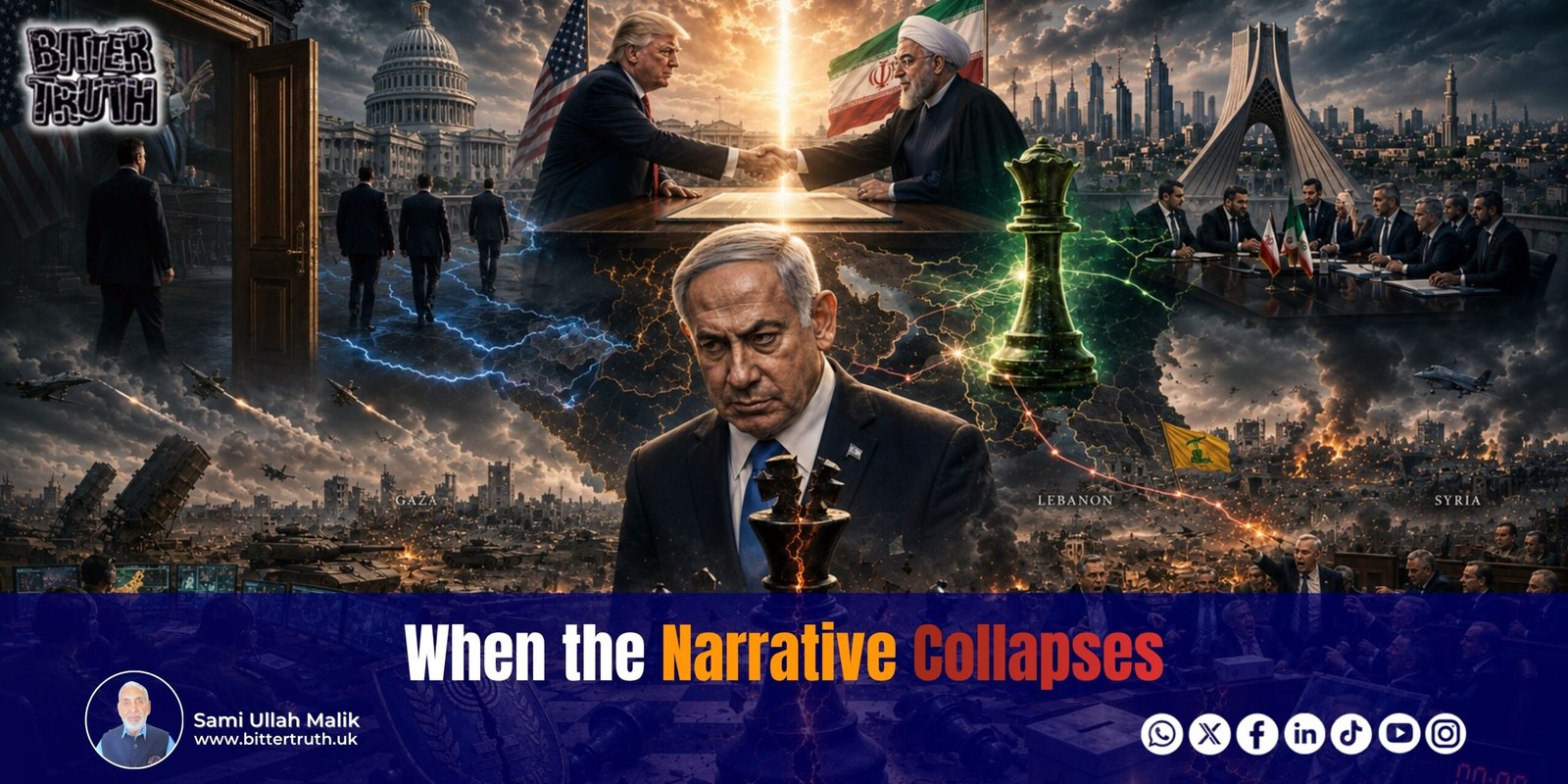
When the Narrative Collapses
A Pact That Shook the Board

At times, upon the grand chessboard of international politics, there occur movements so unexpected, so profoundly disruptive, that years of carefully contrived strategy are undone in a single, irrevocable instant. There are moments upon the horizon of global affairs which are not mere occurrences to be reported in passing, but rather the prologue to epoch-defining transformations. In the long chronicle of history, certain decisions transcend the realm of diplomacy; they become inflection points—turns in the current of time itself.
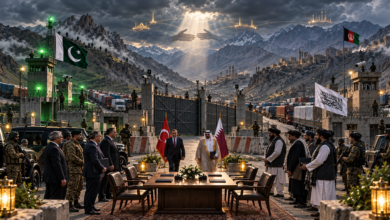
The recent accord between the United States and Iran belongs unmistakably to this rare and consequential category. It stands as a decisive juncture, a milestone of no small magnitude, and for Israel’s Prime Minister, Benjamin Netanyahu, it must appear nothing short of a disquieting dream. This agreement does more than signal the thawing of diplomatic frost; it marks the tentative emergence of a new geopolitical equilibrium—one that seeks to supplant decades of entrenched suspicion, hostility, and mutual antagonism. On the surface, it proclaims the easing of tensions; in substance, it has already begun to rearrange the strategic architecture of the Middle East. In doing so, it unsettles not only the balance of power in the region but also the very narrative upon which Netanyahu has so long constructed his political edifice.
For Netanyahu, this development assumes the character of a political nightmare because his career has, in no small measure, been anchored in the cultivation of a singular and persistent fear—what he has consistently portrayed as the “Iranian threat.” By framing Iran as an existential and perpetual danger, he endowed his political posture with both urgency and legitimacy. Yet now, as that same Iran emerges upon the stage of global diplomacy as a recognised negotiating partner, the central pillar of his narrative appears to tremble. It is as though an architect, having raised a formidable structure upon the foundations of conflict and coercion, now finds the very ground beneath it shifting.
A survey of Netanyahu’s long political career reveals a consistent pattern: the deliberate embedding of a security-conscious anxiety within the public imagination. The spectre of Iran was cast not merely as a rival, but as an ever-present shadow looming over Israel’s very existence. Without this spectre, his political discourse would seem incomplete. Indeed, the portrayal of Iran as a permanent and existential threat formed the cornerstone of his political philosophy.
Yet when the United States itself raises the banner of engagement with Iran—opting for conciliation over confrontation—a profound intellectual contradiction arises. This dissonance does not merely erode public confidence; it challenges the very political doctrine that had long been presented as an unquestionable truth. It hollows out the roots of his narrative. One is reminded of a tree, long nourished and carefully tended, now lamenting the very soil that once sustained it. What we witness, therefore, is not a routine diplomatic adjustment, but the gradual unravelling of an entire ideological framework—like a lamp extinguished, whose light had for years guided the public gaze.
A central feature of Netanyahu’s political strategy has been his cultivation of close ties with the United States, which he presented as a source of strength and influence. There was a time when he projected himself as a formidable voice within the corridors of Washington. His addresses to Congress, his adeptness in lobbying, and his intricate web of relationships all contributed to his stature as a statesman of consequence. Yet the present moment appears to negate that claim. The scene has changed.
It is a sobering reality that the leader who once considered himself an intimate of Washington’s inner sanctums now finds those very doors only partially open to him. His counsel is not merely overlooked; at times, it is met with open criticism. The shifting priorities of American leadership have made one truth unmistakably clear: in international politics, relationships are not permanent—they are subordinate to interests, and it is the shifting axis of those interests that ultimately determines relevance. Those who stand at the centre today may find themselves at the margins tomorrow. This moment reflects that enduring truth with stark clarity. Indeed, public rebuke from the American presidency has come to symbolise, for Netanyahu, a perceptible decline in political stature—like a cavalryman whose steed falters at the very height of battle.
Netanyahu’s approach towards Iran has been marked by an unyielding severity. Pre-emptive strikes sustained diplomatic pressure, and the mobilisation of global opinion against Tehran formed the core of his strategic arsenal. In his view, any form of accommodation with Iran was tantamount to weakness. His hardline policy was presented as the guarantor of Israel’s security. Yet now, as major powers incline towards negotiation rather than confrontation, an unavoidable question emerges: was this doctrine rooted in pragmatic realism, or was it shaped by political necessity?
If Iran was indeed an irredeemable adversary, how has it now become a legitimate interlocutor? What narrative, then, does this apparent contradiction foreshadow? Has the strategy proved illusory—no more than a mirage upon the desert of power politics? It is at this juncture that the tension between political construction and objective reality becomes unmistakably visible.
Within Israeli political discourse, “security” occupies a near-sacred status, and Netanyahu has long sought to embody its foremost guardian. His identity has been that of a leader who claims to shield Israel from all peril. Yet in the present climate—where pressure mounts from the United States and other global actors urging restraint, particularly in relation to military operations in Lebanon—this claim appears increasingly fragile. His credibility stands shaken, his authority under scrutiny. The image is that of a general whose soldiers begin to question his command.
The narrative of security, once defined by the projection of force, now demands a more nuanced equilibrium—one that incorporates diplomacy alongside strength. It is precisely at this point that Netanyahu’s strategy encounters its most formidable challenge. Standing as he does on the threshold of electoral contest, the moment presents itself not merely as a political trial, but as a defining test of his entire legacy.
At present, Netanyahu stands at a crossroads of the most unforgiving kind—where every path is strewn with thorns, and each direction leads, in varying measure, towards loss. It is precisely such a juncture that constitutes the severest trial in the craft of politics: a moment in which the act of choosing becomes, in itself, the gravest ordeal. The options before him offer no easy refuge. To confront the United States risks diplomatic isolation of a kind that borders upon political self-immolation; to retreat, by contrast, invites the charge of weakness upon the domestic stage. This is the condition which the lexicon of statecraft might well describe as a choice among lesser evils—where decision is not liberation, but burden.The observation offered by the Israeli opposition leader, Yair Lapid, is in truth but a reflection of this very dilemma.
Criticism directed at Netanyahu by the President of the United States—particularly in relation to military decisions, and most notably in the context of the Beirut strike—constitutes no ordinary divergence of opinion. It carries the weight of a diplomatic admonition of unusual clarity. This is not mere disagreement; it is, rather, a form of political censure—a signal that priorities have shifted, and that former certainties no longer command unquestioned allegiance. The reverberations of such criticism are not confined to the realm of diplomacy; they penetrate deeply into the domestic political sphere, unsettling its delicate equilibrium.
At a moment when elections loom near, such reproach assumes the force of an earthquake, shaking the very foundations upon which political authority rests. It leaves its mark upon public opinion, shaping perception in ways both immediate and enduring. The media amplifies it, the opposition seizes upon it, and the public reads it, almost instinctively, as a sign of frailty.
Netanyahu now finds himself beset not only by external pressures, but by mounting internal disquiet. Indeed, the more formidable challenge may lie within. Unease is spreading through his own party and among his allies; the increasingly strident statements issuing from coalition partners are but the outward expression of an anxiety that has begun to permeate the corridors of Israeli power. Leaders of the far right have denounced the agreement as contrary to Israel’s interests. Such internal divergences signal a weakening of the once-solid ramparts of political unity. When fissures appear within, and dissenting voices gather strength, external pressures are not merely felt—they are magnified.
Political alliances, by their nature, are sustained by a delicate balance of interests. In Israeli politics, disagreement among partners is hardly novel; yet when that balance falters, discord no longer remains veiled—it emerges into the open with unmistakable force. What we now witness is no longer muted dissent, but overt division. The present fractures suggest a loss of coherence in policy-making, a fragmentation that may prove perilous for any government. Statements from members of parliament point to a stark reality: that “unity” has become little more than a word, its spirit having quietly departed. These cracks are not confined to matters of policy; they betray a deeper erosion of trust. And in politics, the collapse of trust is akin to the fall of pillars upon which the entire edifice depends.
Security experts and former intelligence officials have voiced grave reservations regarding this agreement. In their estimation, it may confer upon Iran a renewed diplomatic leverage—one whose implications will extend across the region. There is growing concern that Iran’s influence may expand upon sensitive fronts, particularly in Lebanon and beyond. Former intelligence figures and seasoned analysts regard the accord with suspicion, fearing that it may ultimately strengthen Iran’s regional hand, thereby intensifying the strategic anxieties of Israel. Such assessments underscore a crucial point: that the issue at hand is not merely political, but fraught with intricate strategic complexities.
Should Iran acquire a greater role in regional decision-making, the consequences would be profound. It would not only consolidate its own standing but also embolden its allied groups. On a sensitive front such as Lebanon, such a development would inevitably reinforce the position of Hezbollah, thereby entrenching a persistent challenge for Israel. This scenario is akin to fanning a flame already alight—a transformation capable of altering the balance of power in enduring ways. It is, in effect, the elevation of a dangerous piece upon the chessboard to one of decisive power.
Yet Netanyahu, in his public pronouncements, continues to project the familiar note of resolve: that Israel will brook no compromise upon its security. The cadence of determination remains unchanged, but the shifting realities of circumstance now place that resolve under severe strain. The question, therefore, presses with renewed urgency—can such a stance be sustained in practice? For between declaration and possibility there lies often a wide and revealing gulf, and it is within that gulf that political reality is most starkly exposed.
The ongoing operations in Gaza, Lebanon, and Syria bear witness to Israel’s assertive strategic posture; yet, despite their intensity, groups such as Hamas and others have not been wholly extinguished. The inability to secure complete success, despite sustained efforts, serves as a sober reminder of the limits inherent in military power. It reveals the constraints of a policy that leans too heavily upon force alone. Military strength, formidable though it may be, cannot furnish a solution to every dilemma. The conflict itself has assumed the character of a cycle—each success transient, each failure deepening in consequence—an unending circle whose conclusion remains elusive.
Meanwhile, the proposed peace framework for Gaza remains unrealised, suspended in a state of inertia. It stands as testament to a truth long recognised yet seldom mastered: that the making of peace is far more arduous than the waging of war. The initiation of conflict may be swift, but its resolution is invariably intricate. What confronts us here is a knot that tightens rather than loosens—a problem that grows more entangled with each passing turn.
Despite the persistence of conflict, Iran and its allies have not been diminished; rather, they appear to have gathered renewed strength. This is a reality that challenges the orthodox assumptions of military doctrine and points to an inconvenient truth: that the application of force does not invariably yield the outcomes it intends. It is a sobering conclusion—one that now stands as a direct challenge to Israeli strategy, casting upon it a question that cannot easily be dismissed. One is reminded of the old maxim that war, at times, does not weaken the adversary, but steels him.
There is a growing consensus among analysts that Israel must undertake a sober reassessment of its policies. Realism, diplomacy, and equilibrium—these are no longer optional virtues, but urgent necessities. The hour demands not the sway of impulse, but the discipline of reason; for without such recalibration, the consequences may become ever more intricate and severe. This is the moment when judgement must prevail over sentiment.
Netanyahu’s long-standing narrative is, by degrees, losing its hold. His enduring claim to be the foremost guardian of Israel’s security now appears increasingly attenuated. Circumstances have brought him to a point where he finds himself contending not only with adversaries, but with allies, and subjected to criticism of the most searching kind. It is a political drama in which the protagonist begins to bend beneath the weight of his own decisions—a chapter in which the hero grows wary even of his own shadow. Had circumstances within Iran evolved differently, his narrative might have found renewed vindication; yet events have taken an altogether contrary course.
This is the juncture at which history itself poses its quiet but inexorable question: which leaders adapt to the current of their time, and which are reshaped—if not swept aside—by it?
The broader tableau reveals a deeper truth: that in the theatre of international politics, no narrative is immutable. Neither enmity nor alliance, neither power nor strategy, retains a permanent form. All are subject to the ceaseless motion of change, and from their interplay new realities are forged. The accord between the United States and Iran is not merely a diplomatic development; it is the harbinger of a new era—an upheaval whose reverberations will travel far beyond its immediate setting.
For Netanyahu, it represents a moment of profound reckoning: whether to move with the current of history, or to stand against it—risking, in so doing, the isolation that may imperil his political survival.
Yet this is not merely the story of a single leader. It is the story of an age in which power, prudence, and politics contend in restless tension. Even as events unfold, history turns its pages in silence, inscribing its verdict with an unseen hand. The years to come will determine whether this chapter is remembered as a tragedy—or as the prologue to a new beginning.