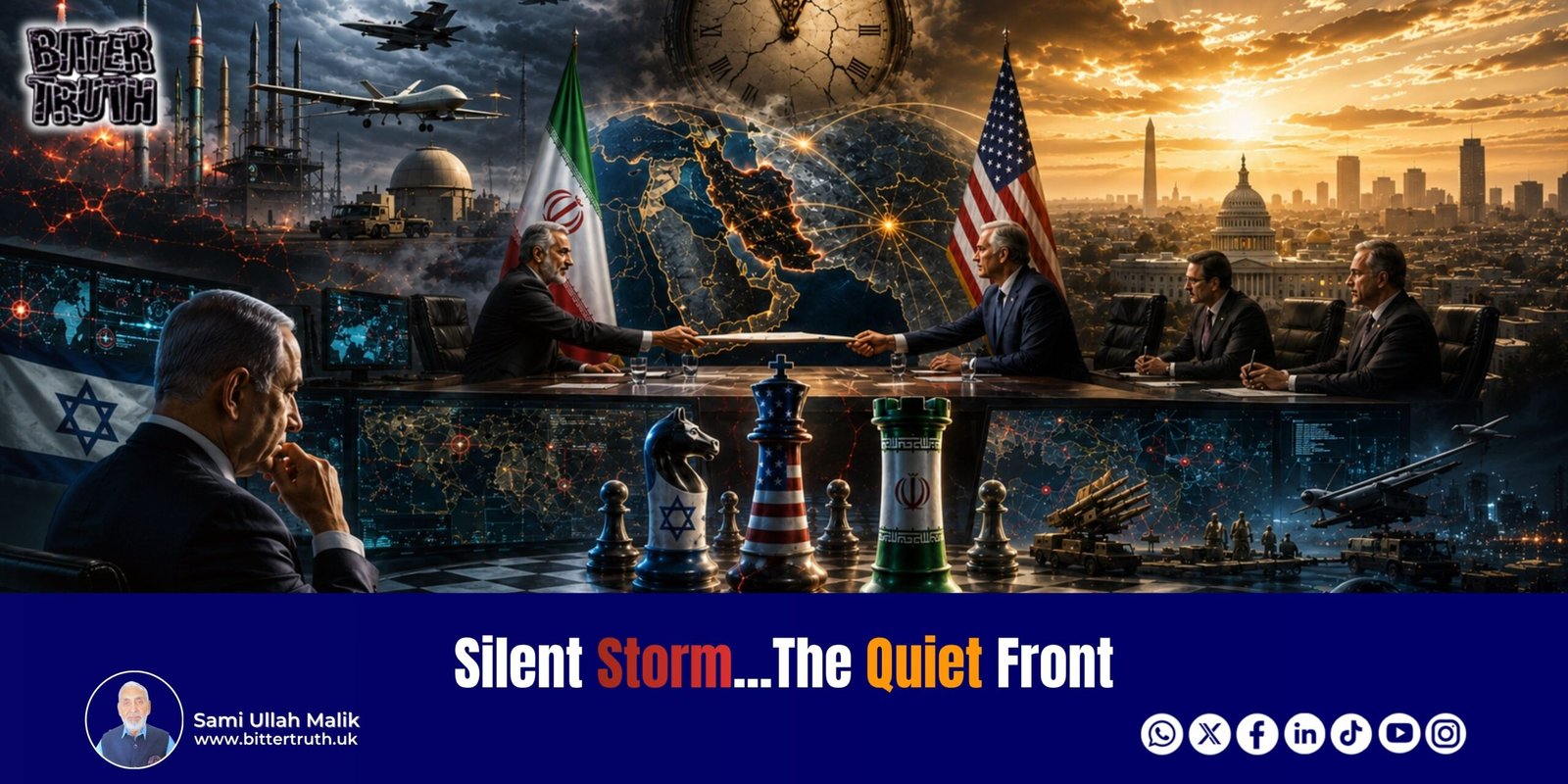
Silent Storm
The Quiet Front

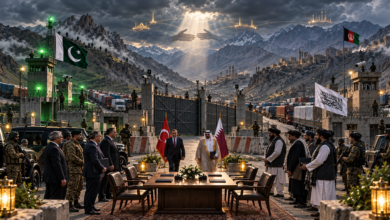
Time, it is often said, buries within its breast a multitude of unspoken truths. Yet there are moments when the sealed doors of history swing open with such force that every whisper within is loosed upon the world as a storm. The politics of the Middle East have long been forged in that volatile alloy of powder and narrative; but the present juncture is of a complexity that surpasses even this familiar tradition. Today, the region stands at a precipice where the courteous smile of diplomacy scarcely conceals the murmuring imminence of war. What confronts us is not merely a contest of states, but a collision of ideas, of interests, and of rival philosophies of survival.
The tentative overtures of accommodation between the United States and Iran may, at first glance, appear as a diplomatic advance; yet beneath their surface lies a tremor capable of recasting the entire equilibrium of power in the region. The reverberations of a possible rapprochement between Washington and Tehran signify far more than the conclusion of an agreement—they herald the opening of a new chapter in the enduring dialectic of power, fear, and survival. And inscribed upon the margins of that chapter, with unmistakable clarity, is the unease of Israel.
The question, therefore, is no longer confined to whether such an agreement will materialise. The more pressing inquiry is this: should Washington and Tehran indeed clasp hands, in what direction will Tel Aviv’s finger be raised? For Israel, the moment resembles that of a traveller who, having nearly reached his destination, suddenly finds himself bereft of the path. It is not merely an external challenge that now confronts the Israeli state, but an internal disquiet of no lesser magnitude. Its policymakers are being compelled, perhaps reluctantly, to acknowledge that the world is passing from the certainties of a unipolar order into the ambiguities of a more plural and negotiated reality—one in which decisions are no longer the product of untrammelled authority, but of uneasy accommodation.
Within Israeli political and military circles, the axis of debate has perceptibly shifted. Where once the effort was directed towards forestalling any such accord, the discussion has now turned to the management of its consequences. Should Washington and Tehran arrive at a shared framework, it would constitute not merely an agreement, but a declaration of altered priorities within the hierarchy of global power. In such an eventuality, Israel may, for the first time with acute clarity, apprehend that its traditional strategic buttress—namely, the unqualified support of the United States—is undergoing a subtle but decisive transformation into a more conditional reality. It would be as though the stratagems devised to shield the vessel from the storm had failed, and the mariner must now contemplate the art of navigating with the waves rather than against them.
Indeed, within Zionist strategic circles and military institutions, the discourse has already migrated from the language of “containment” to that of “adaptation”. Though this shift may present itself as prudence, it also constitutes, in its quieter register, an admission that history cannot always be arrested; at times, it must be endured, and its currents mastered rather than resisted.
The prospective agreement—regarded in some quarters as a revised echo of the 2015 nuclear accord—presents Israel with a puzzle of formidable intricacy. It may impose constraints upon Iran’s nuclear programme, yet leave intact its missile capabilities, its drone technologies, and its extensive network of regional allies. In this sense, it resembles a tree whose branches are lopped off while its roots remain firmly embedded in the soil—and it is, after all, the roots that nourish the enduring threat.
Although the precise architecture of such an agreement remains indistinct, its emerging contours suggest that Iran is not to be wholly curtailed but rather accommodated as a tolerable actor within the regional order. It is precisely this implication that gives Israel the greatest cause for concern, for its entire security narrative has been predicated upon casting Iran as an unacceptable and existential menace.
To Israeli analysts, such an accord would represent a departure from the initial objectives of confrontation: the curtailment of Iran’s regional influence, the weakening of its military infrastructure, and the fragmentation of its allied networks. Yet the mirror of reality now reflects a different image. Israel may find itself relinquishing the aspiration of “total victory” and reconciling itself instead to the more modest and sobering threshold of “acceptable loss”.
This evolving reality is engendering within Israel a climate of intellectual dissonance and psychological strain. On one side stand those who, recognising the inevitability of the agreement, seek to carve out within it a space for national advantage; on the other, a current of ideological rigidity that regards any form of compromise as weakness, indeed as a perilous retreat. This contradiction not only frays Israel’s strategic nerves but also envelops its policymaking in a dense fog of uncertainty.
A further dimension must also be considered. Should negotiations protract and American interest wane, Israel may find itself suspended in a void—deprived alike of the recourse to war and the assurance of diplomacy. In such circumstances, Iran’s nuclear programme could advance with diminished restraint, while its regional influence deepens still further. For Israel, this is a vision whose realisation would border upon the nightmarish.
It is noteworthy, moreover, that some analysts deem even an “imperfect agreement” preferable to the absence of any agreement at all. In their estimation, partial control is superior to complete disorder. Yet an opposing and formidable camp contends that a flawed accord merely defers the danger rather than extinguishing it.
It is at this juncture that Israel’s first strategic pathway comes into view: the endeavour to shape the agreement to its own advantage. Under this approach, it would seek to exert pressure upon the United States to harden the terms of any accord—demanding, among other provisions, the total prohibition of uranium enrichment, strict limitations upon missile development, and the establishment of a rigorous regime of oversight.
Yet here, too, a void persists. The distance between what Israel seeks and what the United States appears willing to concede is widening with a quiet but unmistakable momentum. This is no mere diplomatic divergence; it is strategic in nature—and it is precisely such distances that, in the long ledger of history, have so often given rise to confrontation.
Thus, the Middle East now finds itself drawn into a game of chess of uncommon subtlety, where every move conceals within it the shadow of several others yet to be played. Iran, the United States, and Israel each sit before their respective boards, their pieces carefully arranged; yet the crown of ascendancy rests upon no single head. It is, perhaps, this very condition of suspended certainty that renders the entire tableau so perilous.
Against this backdrop, the question acquires a sharper urgency: should an agreement indeed be concluded, what then will constitute Israel’s priorities? Will it accept the arrangement as a temporary expedient, dictated by necessity, or regard it as a long-term peril, to be resisted in quieter, more oblique forms? It is at this juncture that diplomacy ceases to be merely an art and becomes instead a trial of endurance—where every answer begets a fresh and more difficult question.
History, for its part, is never silent. It turns its pages with a deliberate insistence, holding before the present a mirror polished by experience. For Israel, the events of the past decade amount to a curriculum of considerable instruction. The first lesson is a stark one: that international agreements are not forged solely at the negotiating table, but across a multitude of arenas—media, politics, and the shadowed corridors of discreet diplomacy.
The nuclear accord of 2015 remains, for Israel, not merely an episode but a wound whose ache continues to inform its policies. At that time, Benjamin Netanyahu chose open confrontation with President Obama, carrying his case into the very chamber of the United States Congress. His address there rose to the level of a political tempest, in which he cast the agreement as a direct threat to Israel’s survival. It was, by any measure, an extraordinary act—tantamount to challenging the policy of an ally upon its own soil.
In parallel, pro-Israel lobbying groups exerted themselves with formidable energy. Across media, political institutions, and diplomatic channels alike, pressure was applied with unrelenting force; yet the agreement was concluded, nonetheless. From this episode Israel drew a sobering lesson: opposition, however vigorous, is insufficient in the absence of strategy.
Today, a similar scene re-emerges, albeit in altered form. Israel’s second recourse lies in the renewed deployment of diplomatic and political pressure. The interval between an initial understanding and a final agreement offers, in this regard, its most fertile ground for manoeuvre. It is within this interstice that Israel may seek to shape the contours of any prospective accord.
To this end, it is likely to engage not only the various factions within the American political system but also to cultivate international opinion in its favour. In such a contest, the crafting of narrative becomes a weapon—and perhaps the most potent of all. Congress may be mobilised; Iran’s missile programme may be elevated into a matter of global concern; and even discreet operations may be undertaken in an effort to influence the course of negotiations. In this sense, the theatre of conflict has shifted—from the domain of powder to that of persuasion.
Yet this strategy is not without its limitations. The temper of global politics has evolved; unilateral pressure no longer commands the same efficacy it once did. Iran, for its part, has refined its diplomatic craft over time. It no longer occupies the position of a mere respondent but has emerged as an active author of its own narrative.
The question, therefore, presents itself with renewed force: will such a strategy succeed on this occasion? Some analysts are inclined towards scepticism. In their estimation, Iran now approaches the table from a position of greater strength. It has endured sustained pressure, while maintaining internal cohesion, and thus sits not as a weakened party but as one possessed of a certain confidence. It is for this reason that some within Israeli circles regard the prospective agreement as even more fraught than that of 2015. In their view, Iran now stands in a position to extract concessions rather than to grant them.
In these circumstances, a third pathway emerges before Israel: the preservation of military autonomy. Within this framework, the notion of independent action assumes central importance. Israel seeks to affirm that, regardless of any diplomatic arrangement, its defence policy shall not be circumscribed by external agreements. This principle—often described within its security establishment as “freedom of action”—implies the retention of the right to act unilaterally in matters of national defence.
Yet the practical force of such a declaration is inevitably tempered by the realities of Israel’s profound military and financial ties with the United States. The assertion of independence and the fact of dependence exist here in a state of intricate tension—a contradiction not easily resolved.
It is for this reason that some propose a middle course: limited military measures, calibrated with care, capable of conveying resolve without opening the gates to full-scale war. Such a strategy represents an attempt to strike a delicate balance between the demonstration of strength and the exercise of restraint.
And yet, a sobering truth remains. However formidable Israel’s military capabilities may be, it cannot sustain a protracted conflict without the support of the United States. Should Washington incline towards diplomacy, Israel’s options may find themselves constrained.
Here, then, lies the crux of the matter: the paradox of power and dependence. Israel is strong, yet not wholly sovereign in its freedom of action. It is perhaps for this reason that some observers anticipate a preference for limited and selective operations—actions sufficient to signal intent yet restrained enough to avoid the descent into open war.
Thus, while several paths lie before Israel, each is strewn with thorns. Neither total war appears feasible, nor complete peace entirely acceptable.
And yet, within this entire unfolding drama, the most decisive element is time itself. Should negotiations be prolonged, Israel will find in that delay further opportunities to exert its influence and shape the eventual outcome. But if an agreement is concluded with dispatch, it may be confronted with a reality it can neither reshape nor resist. Thus, Israel finds itself engaged upon a board where every move must be calculated with the utmost care; for a single misstep may imperil not only its present position, but the full range of its future possibilities.
When direct confrontation ceases to be practicable, power does not vanish—it merely alters its form. History bears ample witness to this transformation: war retreats into the shadows. For Israel, this third—and perhaps most pragmatic—option lies precisely there, in the domain of covert conflict. It is a theatre in which it may preserve its advantages without incurring the visible perils of open war.
This strategy is, by its nature, subdued in appearance yet profound in effect. It is a method in which bullets yield to whispers, and silence conceals design. Cyber operations, clandestine interventions, the disruption of scientific facilities and critical infrastructure, and the targeted removal of key individuals—these constitute the instruments of a “silent war” that, in the modern age, increasingly supplants traditional forms of conflict.
Israel is no novice in this arena. It has, in the past, undertaken such operations against Iran. Yet the essential question remains: can this approach furnish a comprehensive resolution? Most experts incline towards the negative. Such measures may impose temporary pressure, but they do not dismantle the foundational structures of a state. Their efficacy is inherently limited. They may disrupt, delay, and disorient, but they cannot wholly unmake.
Iran itself stands as a testament to this reality. Despite sustained internal pressures, its state apparatus has endured. It has demonstrated a capacity for resilience that outlasts moments of internal strain. This persistence leads some observers to a more sober conclusion: that, in the long term, Israel may be compelled to adopt a different strategy—one less concerned with direct confrontation, and more attuned to the maintenance of a stable balance of power.
It is from this reasoning that a number of Israeli analysts arrive at a striking proposition: that an agreement, however imperfect, may in fact be inevitable. Within this perspective, Israel would ultimately reconcile itself to such an outcome and recalibrate its strategy towards long-term deterrence. This approach would emphasise regional partnerships, defensive preparedness, and vigilant oversight. It would privilege enduring stability over immediate and dramatic gains. Attention would be directed towards containing allied forces in the region, reinforcing strategic alignments, and sustaining continuous pressure where required.
Yet even with all these considerations, one fundamental question persists—rising, time and again, with a quiet but inescapable insistence. It is the question that follows every war, every agreement, and every grand design; and perhaps it is the most disquieting of all: what, in the end, has been gained?
This inquiry extends beyond outcomes to encompass purpose itself. If the balance of power remains essentially unchanged, if the threats endure in altered but recognisable forms, and if, ultimately, the same diplomatic path must be embraced that was once rejected—then what meaning can be ascribed to the initial decisions?
Iran’s system has endured; its influence, in certain respects, has not diminished but become more pronounced; and its capacity to exert pressure upon the global economy has revealed itself with increasing clarity. Thus, critics contend that the conflict has not only failed to achieve its stated objectives but has, in some respects, served to illuminate and even amplify elements of Iran’s strength.
Should Israel, in the final reckoning, find itself compelled to accept an agreement—of whatever character—then history will record a question that cannot easily be set aside: what, indeed, was gained by withdrawing from the accord of 2015? This, in truth, is the essence of the entire narrative—a question whose answer may elude the present, but which the judgement of time will inevitably supply.
For this entire situation transcends the mere mechanics of diplomacy or military strategy. It is, at its core, a contest of power, fear, interest, and the enduring philosophy of survival. The Middle East once again stands at a turning point in history where each decision carries within it the weight of generations yet to come. And herein lies, perhaps, the deepest tragedy of history itself: that its decisions are made in the present, while their consequences reverberate across centuries.
It is at such moments that history delivers its verdict—though never with haste. Its judgement emerges gradually, reflected in the mirror of time, until at last it reveals not only events, but their causes, their contexts, and their consequences in their full and unvarnished form. The Middle East stands today in anticipation of such a verdict—awaiting a decision not yet fully written, yet whose traces are already scattered across the landscape.
And so this entire tableau instructs us in a final and enduring lesson: that in the realm of international politics, no conclusion is ever truly final. Every ending serves as the prelude to another beginning. The story of power is perpetual—only its actors, its methods, and its titles are ever changed.