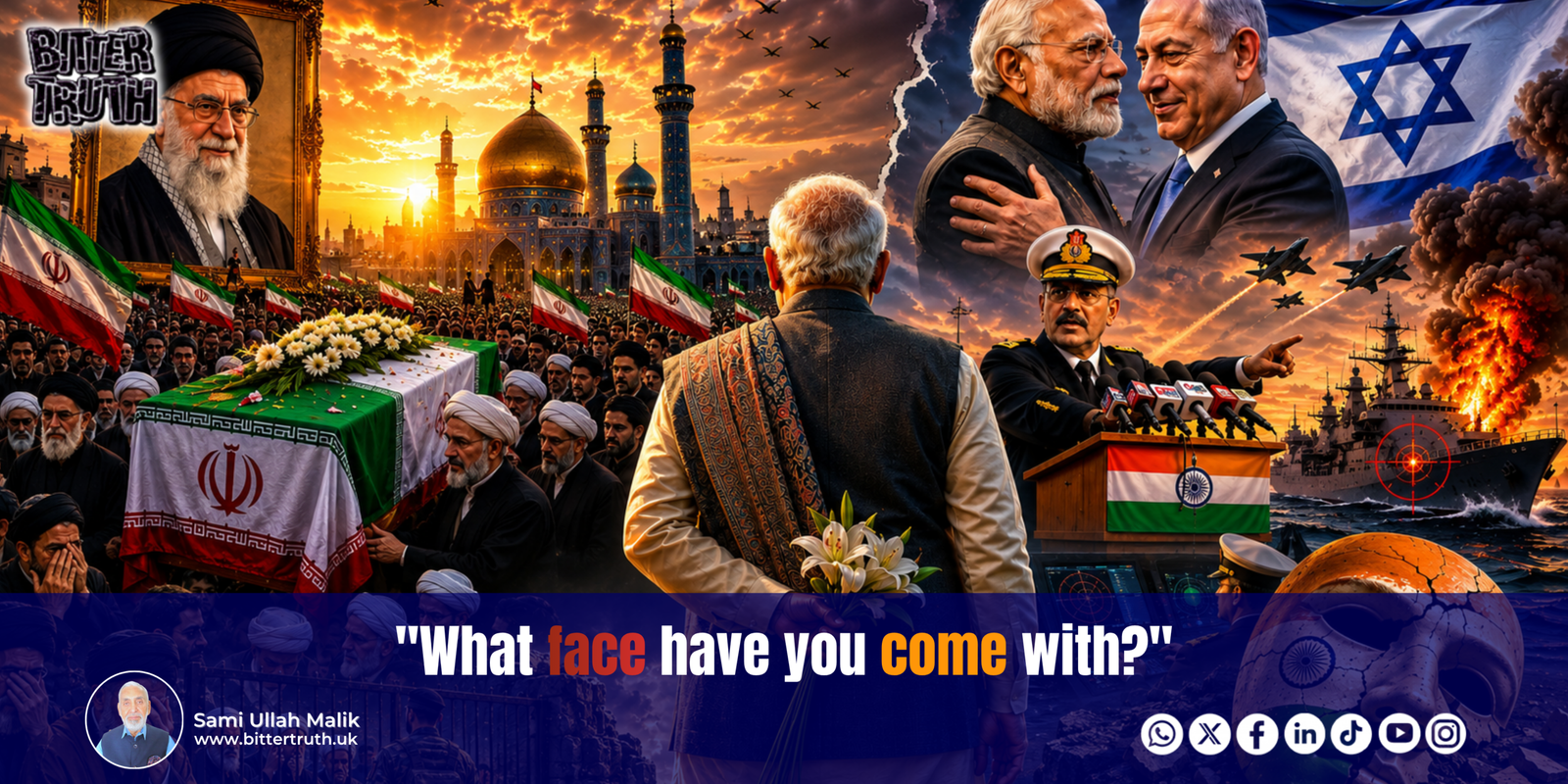
“What face have you come with?”
A broken trust

The Final Rites of Iran’s Supreme Leader in Tehran: What Does India’s Low-Level Delegation Signify?
Tehran, in these days, seems suspended in a peculiar stillness—as though time itself has slackened its pace to mourn the passing of an age. The city breathes beneath a sombre canopy where grief is neither loud nor theatrical, but heavy, restrained, and profound. This is no ordinary lamentation. The sorrow that hangs over Tehran is not merely for a departed leader; it is an unfolding tableau in which the conscience of the world stands quietly on trial.
The funeral rites of Iran’s former Supreme Leader, Ayatollah Sayyid Ali Khamenei, signify far more than a national bereavement. They mark, in symbolic terms, the burial of an entire civilisational and political epoch. In such a moment, India’s decision to dispatch a low-level delegation cannot be dismissed as routine diplomacy; it is, rather, a gesture laden with implication—one whose echoes are already reverberating through the corridors of international power.
Pause, if you will, and attend to the air of Tehran, where history itself seems steeped in tears, and where the pulse of a global community throbs in the absence of a towering figure. These are the moments in which nations reveal their character—when the veils of friendship and duplicity alike are torn asunder. And what are we to make of India’s modest delegation? This is no mere condolence; it bears the chill of studied detachment. It is in such silences that the loudest declarations are made—and today, that silence proclaims, with unmistakable force, that allegiances have shifted.
The passing of Ayatollah Khamenei is not simply the departure of a man, but the fading of an intellectual era, the dimming of an ideological citadel, and the quieting of a spiritual centre. A state’s response, in such an hour, is never merely ceremonial; it reveals, beneath the surface, its diplomatic priorities, moral compass, and ideological affinities. India’s choice to send a low-level delegation, therefore, appears less an exercise in diplomatic nuance and more a conscious expression of reserve—a sentence unspoken, yet rich in meaning. It is a gesture that outwardly conveys condolence yet inwardly signals दूरी—a carefully measured distance. Beneath the veneer of sympathy lies a troubling indifference, as though a momentous tragedy had been reduced to the brevity of a bureaucratic notation. The question, then, is not who attended—but who did not, and why.
These seven days, one might say, are not merely days of mourning; they are a crucible for the moral awareness of the global community. Leaders from across the world stand with bowed heads, their presence itself an acknowledgment that the Supreme Leader was a figure of profound spiritual and political consequence. And yet, there are those who avert their gaze. Iran’s week-long observances will present a tableau of global leadership assembled in solemn tribute, even as India’s Ministry of External Affairs announces the attendance of Bihar’s Governor, Syed Ata Hasnain, and Minister of State for External Affairs, Pabitra Margherita—a choice that reflects a carefully calibrated, and arguably partisan, diplomatic balance.
On the surface, this may be construed as a gesture of respect for civilisational ties. Yet beneath it one senses a more intricate web of political calculation. India has indeed sent a delegation—but its stature is modest, its message subdued. Is this the same nation once hailed as a custodian of civilisations, or has it now become captive to expediency? As leaders from across the globe converge upon Tehran, India’s limited representation emerges as a conspicuous contrast. The invocation of “civilisational ties” by the Foreign Office appears, in this light, less a declaration of principle than a diplomatic veil—behind which the politics of interest stands starkly exposed.
Even if one were to interpret India’s presence as a continuation of cultural engagement, there remains an unmistakable note of caution—as though the relationship must be maintained, yet at arm’s length. In the Islamic moral framework, condolence is not mere formality; it is an expression of fraternal solidarity, measured on the scale of sincerity and moral commitment. Within much of the Islamic world, this gesture is being read not simply as participation, but as a grading of relationships—and one that does little credit to India, whose current posture is widely attributed to the policies of Prime Minister Modi.
If there was an invitation and it was declined, then it amounts to refusal. If there was none, then it bespeaks isolation. Power, after all, does not absolve one from the judgment of history. It will be asked: where were you when a great soul was laid to rest? Was it the weight of office that restrained you, or the hierarchy of your priorities that rendered you unmoved? In either case, the conclusion is unfavourable. The absence of the Prime Minister, coupled with the dispatch of a representative delegation, amounts in diplomatic parlance to a courteous refusal—a gesture that signals restraint, if not दूरी. It conveys, unmistakably, that New Delhi chose not to expend its full diplomatic capital at this juncture.
The non-attendance of Prime Minister Modi is, in essence, a political decision—one that projects, upon the global stage, a message of distancing from Tehran. The prospective participation of opposition figures does little to mitigate this absence; indeed, it accentuates it. The possible presence of Congress leaders, including Mallikarjun Kharge and Salman Khurshid, introduces a further dimension, wherein domestic political currents intersect with foreign policy. It is a moment in which the national narrative fractures into multiple voices, revealing the lack of a unified stance.
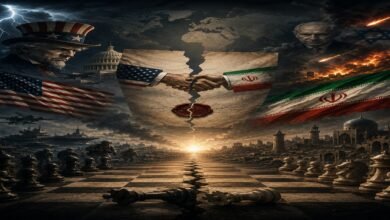
Here, the picture comes fully into focus. India appears to have aligned itself within a geopolitical axis where power increasingly eclipses principle. Its silence during attacks upon Iran cannot be dismissed as mere caution; it carries the troubling odour of moral abdication. For silence, in the face of ظلم, becomes complicit in that very ظلم. In the prevailing global climate—particularly amid the aggressive posture of the United States and Israel towards Iran—India’s inclination towards the Western bloc has grown increasingly evident, to the detriment of its ties with Tehran. Across the Islamic world, a perception is taking root: that in the presence of power, principle has been quietly set aside.
In the moral grammar of civilisations, silence is never a neutral act. The teachings of the Qur’anic tradition, as often invoked in public discourse, are unequivocal in their insistence upon standing against oppression. Yet here, in this moment of global scrutiny, silence has prevailed—and it is precisely this silence which has assumed the weight of a louder, more enduring proclamation. A voice unspoken has become the most resonant testimony of all.
It is at this juncture that the long, silken thread of India–Iran relations—spun across centuries of cultural familiarity and historical engagement—appears strained, if not altogether fraying. This is the point at which veils fall away, and the perennial tension between principle and expediency stands exposed in stark relief. When the fires were raging over Iran, where did you stand? In your reticence, you have already been revealed. For history renders its judgement without appeal: he who remains silent before injustice does not merely observe it—he is, in effect, drawn into its shadow. And today, that silence stands as testimony; a record already inscribed upon the ledger of time.
Within India’s domestic political sphere, criticism has not been slow to emerge. The Congress party’s response—particularly that of Pawan Khera—has characterised this silence as “criminal”, a term which, in the lexicon of politics, carries the sharpest possible moral indictment. When political disagreement mutates into an ethical question, its significance is inevitably magnified. Khera’s formulation is not merely an act of opposition rhetoric; it reads instead as an attempted moral prosecution, in which silence itself is placed in the dock. It is a charge that transcends partisanship, claiming the authority of conscience.
These are not merely political jibes. They are, in essence, questions hurled at the moral equilibrium of the state itself: has India lost its ethical compass? The phrase “criminal silence” is not simply an accusation—it is a verdict being pronounced in the tribunal of public conscience. These voices do not merely contest policy; they interrogate the very soul of governance. And when such a charge is uttered, it is not merely the administration that is addressed, but the conscience of the nation itself. Are these questions being heard, or have the corridors of power grown impervious to their echo?
In the Islamic conception of political responsibility, the ruler is not merely the guardian of interest but the custodian of justice itself. Power, in this moral architecture, is inseparable from accountability before the demands of equity and righteousness.
Against this backdrop, the participation of Salman Khurshid assumes a subtler and more nuanced significance. His presence, while rooted in personal and party representation, carries with it an unmistakable tone of restraint and cultivated civility. It is, perhaps, an attempt to loosen a thread that risks snapping altogether—a gesture designed to soften the hardening edges of a strained diplomatic posture. There is in his manner a certain recognition that politics, even at its most fractured, still permits space for dignity and measured expression. In that sense, he appears almost as a faint but discernible voice of conscience within a more dissonant national chorus.
Yet the uncomfortable truth remains: no delegation, however sincere, can substitute for the absence of leadership. Representation is not synonymous with direction. A nation is not steered by envoys alone, but by the clarity of its highest political will. To place a single representative in the stead of decisive engagement is to apply a delicate dressing to a wound that demands far deeper attention—an effort that may conceal but cannot heal.
Further complicating this tableau is the deeply troubling episode involving Kashmiri Shia scholars, notably Agha Syed Hassan Al-Moosavi Al-Safavi and Masroor Abbas Ansari, whose inability to travel has cast a long and painful shadow. Their restriction is not merely an administrative detail; it is a subdued tragedy, recorded perhaps in official files as a procedural note, but etched into personal and communal memory as a profound grievance. In a country that prides itself upon pluralism, the barring of religious scholars from attending a moment of such spiritual gravity raises searching questions about the balance between security considerations and religious sensibility.
What manner of diplomacy is this, one is compelled to ask, that denies a devotee the final rites of his spiritual guide? What conception of justice permits such exclusions under the weight of administrative discretion? This is not merely a matter of policy; it is a rupture in the moral texture of engagement. Within the framework of Islamic fraternity, such acts inevitably widen emotional and spiritual distances, leaving behind not reconciliation but resentment. History, too, remembers such moments not as procedural footnotes, but as moral imbalances.
The possible participation of Mehbooba Mufti adds yet another dimension to this evolving narrative—one that binds Kashmir’s political sensitivities to broader regional sentiments. Her inclination to attend reflects an enduring emotional and cultural resonance between sections of Kashmiri society and Iran. It suggests that beneath the architecture of formal diplomacy, there persists a living current of affinity that no administrative boundary can entirely extinguish. It is a reminder that while states may calculate, peoples often remember.
And yet, the central question persists with increasing urgency: does this same resonance still exist within the corridors of New Delhi, or has it been dimmed by the long shadow of strategic calculation?
Voices emerging on social media further complicate this picture. They are not merely expressions of dissent; they represent an awakening of public consciousness, a collective demand for coherence between principle and practice. When citizens question, they are not rebelling against the state—they are holding up a mirror to it. Every question becomes an arrow; every utterance, a challenge. Where, they ask, has the tradition gone? Where has the dignity of conduct disappeared? Or has it all been surrendered at the altar of expediency?
The suggestion that India has departed from its established diplomatic traditions cannot be dismissed lightly. Historically, the passing of prominent global figures has often been marked by high-level representation; deviation from such conventions is itself a statement, whether intended or not. Observations by figures such as Shashi Tharoor, alongside commentators like Samita Sharma, point towards a perceptible void in India’s diplomatic posture—a widening gap between ceremonial condolence and substantive engagement.
To speak of civilisational ties has increasingly become a formulaic refrain. Civilisational geography, unlike political cartography, does not easily succumb to the winds of immediate interest; yet contemporary geopolitics appears governed almost entirely by the language of utility. India, like many others, has begun to speak in this idiom. The difficulty, however, lies in the incomplete nature of this transition. Neither fully integrated into the Western strategic orbit, nor able to preserve unblemished trust in the East, it finds itself occupying an uneasy diplomatic in-between—a space defined less by alignment than by ambiguity, and more by calculation than conviction.
There is a harsh, historical truth which civilisation has long learned to recognise, even if it has not always had the courage to heed it: civilisations do not perish, yet consciences do. Relations may endure across centuries, but trust—once fractured—is far harder to restore. In the present moment, India finds itself poised upon a threshold from which no clear direction emerges neither fully a friend, nor entirely a stranger. This condition of strategic ambiguity is not a virtue; it is a vulnerability. For nations, like individuals, are hollowed out not by their enemies alone, but by a loss of coherence within their own sense of purpose.
The India–Iran relationship, historically layered and culturally rich, now appears increasingly subject to the harsh alchemy of contemporary geopolitics, where ideals are too often dissolved in the furnace of interest. It is an uncomfortable but unavoidable truth that no state, however venerable its civilisational claims, is immune to the gravitational pull of national advantage. In such a world, civilisational affinity is frequently acknowledged in rhetoric, while quietly subordinated in practice.
Indeed, scholars of international affairs have long observed that while cultural bonds may be celebrated in discourse, they are routinely sacrificed upon the chessboard of strategic necessity. A senior fellow at an Indian think tank specialising in Central Asian affairs has remarked that although India and Iran continue to be described in civilisational and historical terms, the last four decades—shaped by shifting global power alignments—have rendered such categories increasingly symbolic rather than substantive. In his assessment, India has pursued its national interest with growing determination, yet the more troubling consequence of this trajectory has been a perceptible erosion of trust in certain quarters.
Among the most sensitive and consequential episodes cited in this context is the wartime incident involving an Indian naval officer’s public admission regarding intelligence-sharing related to an Iranian vessel, which was subsequently targeted and destroyed in circumstances that resulted in significant Iranian casualties. Whether interpreted through the lens of military strategy or geopolitical alignment, the episode has left an indelible mark upon perceptions of reliability and intent. For Iran, it represents not merely a tactical loss but a profound breach of confidence; for India, it constitutes a lingering stain upon its diplomatic reputation. Such incidents, whether viewed as isolated or systemic, possess the capacity to corrode relations that have taken generations to construct.
At its core, this is not simply a matter of diplomatic miscalculation; it is, more gravely, a question of moral consequence. Acts perceived as betrayals of trust between partners—even under the shadow of conflict—strike at the very foundations upon which international relations are built. In the ethical vocabulary of many traditions, including Islamic teaching, the sanctity of trust occupies a position of paramount importance. Its violation is not easily categorised as mere policy error; it is experienced as rupture.
The subsequent official response—characterised by restraint, silence, and later formalised condolence—has only intensified the perception of a state prioritising calculation over conviction. The contradiction is now increasingly difficult to obscure. Alignment with one regional power, coupled with carefully measured expressions of sympathy toward another, has generated questions regarding consistency of principle. India’s foreign policy, in the eyes of some observers, appears less guided by enduring norms than by situational advantage. In parts of the Islamic world, this posture is no longer interpreted as balance, but as ambiguity verging on duplicity. Other regional actors, notably Pakistan, have adopted a markedly more explicit tone of condemnation, thereby sharpening the contrast in diplomatic styles.
Within this charged atmosphere, the remarks of Asaduddin Owaisi capture a wider current of public sentiment. His intervention is not merely partisan commentary; it articulates a question that resonates beyond political affiliation. Can India, he implicitly asks, maintain credibility while appearing selectively engaged in its diplomatic relationships? If engagement is genuine, why is it unevenly expressed? If friendship is sincere, why does it appear conditional upon circumstance? These are not questions easily answered within the conventional vocabulary of diplomacy, for they arise from perception rather than protocol.
And it is precisely here that history begins to inscribe its judgment. Diplomacy does not ultimately remember carefully constructed statements; it remembers character. When foreign policy becomes indistinguishable from transactional convenience, credibility itself begins to erode. The paradox surrounding Iran is therefore emblematic of a broader tension: the declared language of partnership contrasted with the visible practice of restraint. Where relations are governed predominantly by utility, durability is rarely guaranteed. Tehran’s present silence may well, in time, evolve into a retrospective commentary of its own—on sincerity, distance, and intent.
History is unkind to ambiguity. It preserves such moments not for immediate verdict, but for deferred understanding, allowing future generations to decide where truth lay and where performance began. The question that therefore remains—uncomfortably persistent—is not merely what was done, but how it will be remembered.
And so the final inquiry returns, stripped of ornament and rhetoric, to the realm of political morality itself: does diplomacy still allow space for principle, or has every relationship, every gesture of friendship, every expression of condolence been reduced to the arithmetic of interest?
If the latter is true, then the silence surrounding Tehran is no longer passive. It becomes interrogative. It asks, without words, a question that echoes beyond governments and generations alike: by what moral authority do you arrive?