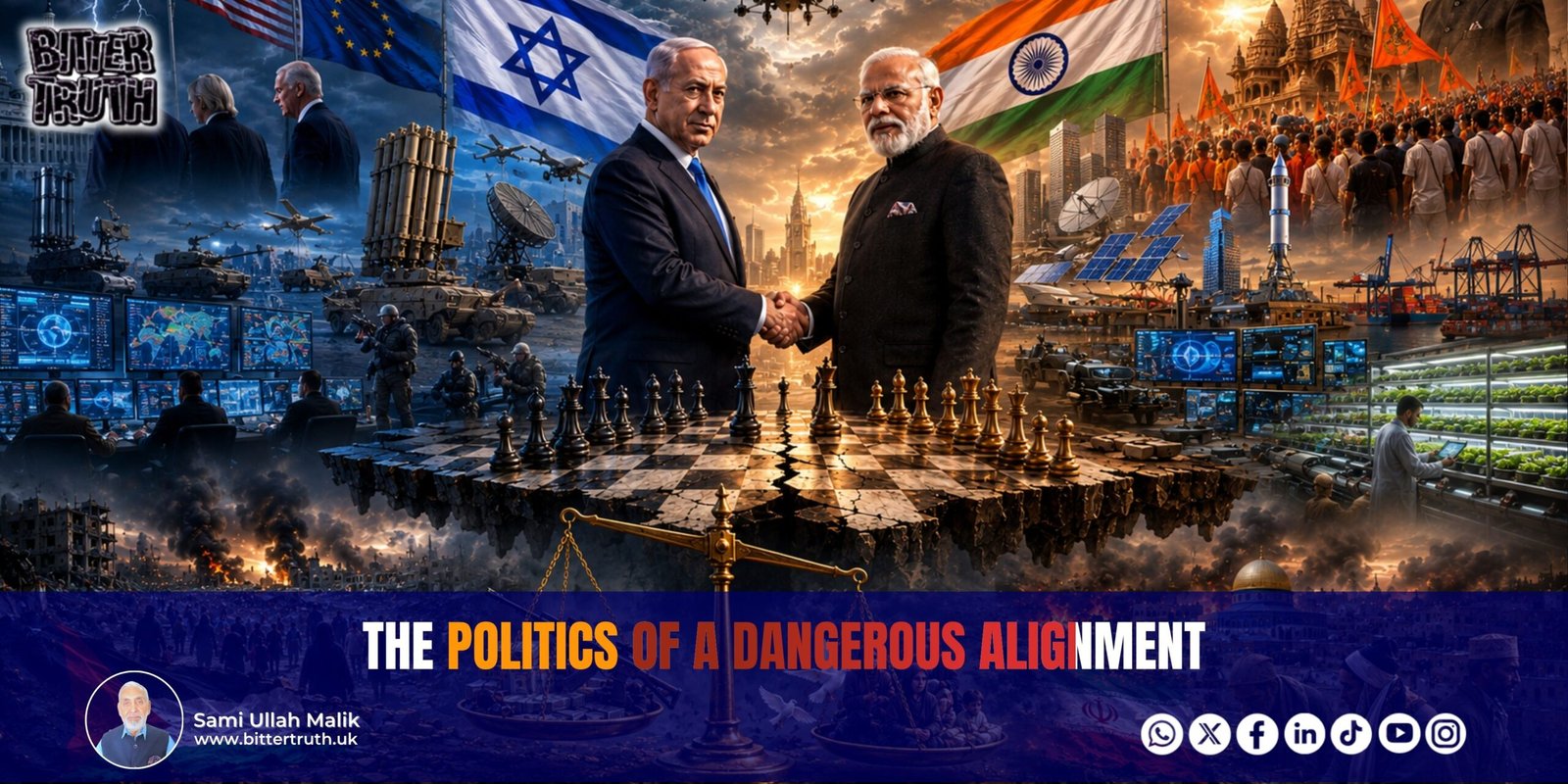
The Politics of a Dangerous Alignment
An Unsettling Alliance

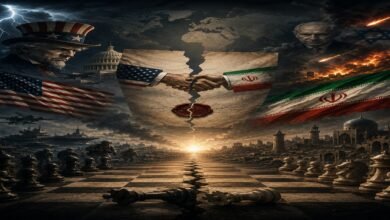
Upon the grand chessboard of international politics, the pattern now emerging resembles a silent tempest—outwardly composed, yet inwardly trembling with unrest. History bears witness to those rare interludes when the balance of power shifts not with clamour but with quiet decisiveness. Our present age appears to belong to such a moment: an era in which the foundations of old alliances seem to quiver, while new partnerships arise from unexpected quarters. The world is turning upon its axis, and the horizon of global politics is tinged with a new and restless unease.
Israel, long ensconced within the fortified embrace of Western patronage for over half a century, now senses fissures within that very bulwark. The state that once flourished under Europe’s protective gaze finds itself increasingly estranged in the eyes of its erstwhile benefactors. Once the fulcrum of Western support, Israel now stands at a crossroads where even its most steadfast allies appear disenchanted with its policies. The warmth that once animated European chambers has noticeably cooled, and within American political circles there emerges a discernible caution—at times bordering on detachment. The policies of Benjamin Netanyahu have stirred such a fierce gale that even long-standing allies seem inclined to withdraw their cloaks. Even the United States, for years its most resolute patron, appears compelled to erect subtle barriers of distance.
This growing disquiet is not merely a matter of diplomatic froideur; it is the echo of a deeper moral unease. What we witness is not simply a recalibration of protocol, but the consequence of policies that have profoundly unsettled the human conscience. The bloodshed upon the soil of Gaza, the intensifying aggression in the West Bank, and now the devastation and loss of life upon Iranian territory have together shaken the moral sensibilities of the international community, compelling a palpable shift in global opinion. European unity on this question has visibly frayed, while in Washington a new, more cautious line of thinking appears to be taking hold.
Yet, at this delicate juncture—when old companions retreat and diplomatic isolation looms—there arises a solitary voice that continues to strike a chord of solidarity amidst the gathering silence. That voice belongs to India’s Prime Minister, Narendra Modi, who has not only nurtured this relationship but has staked considerable diplomatic capital upon its preservation. It is a relationship in which principle appears subordinate, and interest ascendant.
This alignment seems not merely the product of transient expediency but rather the reflection of a deeper ideological consonance. Narendra Modi and Benjamin Netanyahu have, within their respective polities, come to embody centres of authority wherein decision-making gravitates less towards collective deliberation and more towards personal will. Two leaders, distinct in name yet strikingly similar in intellectual architecture. Both are heralded as champions of democracy, yet the contours of their governance reveal a pronounced inclination towards centralisation and rigidity. It is as though beneath the mantle of democracy there flourishes a politics of firm control—one in which dissent finds little room to breathe, and obedience is tacitly prized.
There is, in their political method, a centralising impulse that appears not merely at odds with the spirit of democracy but intent upon subsuming it. Against this backdrop, an extraordinary development emerges: the role of India. At a time when much of the world appears to be recalibrating its distance, India stands conspicuously aligned with Israel, not merely in quiet support but with visible advocacy. This posture transcends the merely diplomatic; it signals a deeper intellectual affinity.
Within the ideological frameworks of both leaders, religion occupies a position of unmistakable centrality. The notion of “national identity” is elevated to an almost sacrosanct plane. In Israel, this identity is anchored in Jewish nationalism; in India, the concept of Hindutva has assumed a comparable centrality. In both contexts, a form of unity is cultivated that often renders minorities peripheral, unfamiliar, and, at times, alien. The narratives of both states, particularly in relation to Muslims, resonate with an uncanny harmony—as though two distinct instruments were rendering the same melody. Within this intellectual architecture, minorities are reduced to marginal annotations: visible, perhaps, yet seldom truly read.
Under the stewardship of Modi and Netanyahu, relations between their respective nations have acquired a new and pronounced dimension. A shared trait dominates their political ethos: the concentration of power and a firm command over the state narrative. Democracy, within such a framework, risks appearing as a formal structure, while substantive authority resides within a narrower circle.
October 2023 has already inscribed itself upon the annals of history as a moment of symbolic clarity. In the immediate aftermath of the Hamas attacks, the first voice of unequivocal solidarity did not arise from Washington or London, but from New Delhi. In a region once again engulfed in flames, where much of the global response was marked by caution and hesitation, India’s reaction was swift and unambiguous. Prime Minister Modi’s telephone call to Netanyahu was not merely a diplomatic gesture; it was the articulation of a deeper ideological kinship.
It was a moment that revealed to the world the depth of mutual trust between the two. In both states, national identity is built on religious foundations. In Israel, through Jewish nationalism, and in India, through Hindutva, each fosters an environment in which space for minorities is permanently contracted. This trend not only shapes domestic dynamics but also has a clear impact on foreign policy.
The events of October 2023 endowed this relationship with renewed significance. As conflict once more consumed the region, the cautious tenor of global reactions stood in stark contrast to India’s immediate and forthright support—underscoring that this bond is neither superficial nor transient, but deep-rooted and enduring. Its foundations are not merely rhetorical or ideological; they are firmly embedded in practical cooperation.
This partnership extends well beyond declaratory statements. Defence collaboration, intelligence sharing, the exchange of sensitive information, the transfer of advanced technologies, and arms trade worth billions of dollars have together forged a robust economic and military alliance—binding the two states in a chain not easily sundered by mere diplomatic rhetoric. Each sees its own strength reflected in the other. They are not just “partners,” but increasingly, indispensable to each other—especially in strategic and defense spheres.
Seen through the lens of history, this transformation takes on even deeper resonance. The India that once stood as a vocal advocate for Palestine, championing its cause in international forums, now maintains a conspicuous silence—indeed, seems to align itself with Israel in the same court of opinion. The nation that opposed the partition of Palestine in 1947 is now embracing Israel in close embrace, even as the Palestinians face profound suffering. This is not simply a change in policy. It is the announcement of a transformation in thinking—a gradual evolution that has, over time, given rise to an entirely new narrative.This silence cannot be dismissed as mere diplomatic prudence. It reflects a deeper convergence of priorities, where former commitments have yielded to new calculations. One might even discern within it a shared thread of expediency—an alignment in which principles have been quietly rearranged, and the moral vocabulary of the past has given way to the strategic lexicon of the present.
The Kargil conflict stands as a turning point in the history of this relationship, lending both to its connection and its stability. Israel’s aid to India during this period placed it at the forefront of those lining up against Pakistan. It was during this delicate period of conflict that a bond of trust was forged – one that, as the circumstances would have it, would grow stronger with the passage of time. At a moment when India found itself in the shadow of international sanctions, with little hope of help from the wider world, Israel’s silent but determined support took on profound significance. By means of arms when few others would have wanted it, it extended not merely material aid but a strategic assurance – a responsibility whose echoes, it can be argued, still resonate. History is never a blank page. Even its modest notes have a way of shaping the grandeur of nations.
With Narendra Modi coming to power, the relationship emerged from the shadows in a clean and unapologetic perspective, taking on a new and stronger dimension. A visit to Israel in 2017, which included high-level engagements, did more than strengthen the partnership—it brought it into the public consciousness.This was not diplomacy in its routine form; it bore the character of a symbolic advance. One could almost assume that each leader reflects his own political image in the other—an image marked by power, nationalism, and centralism. In fact, the visit was a defining moment: a signal that India had redrawn the contours of its foreign policy. Here diplomacy transcended its procedural boundaries and took on a distinctly symbolic significance. The exchanges at the highest level only deepened and popularized this alignment, until, under Modi’s auspices, it reached what might be described as a new zenith.
The scope of this partnership has not remained confined to the realm of defence; it has broadened to encompass the economy, agriculture, science, and culture. The conjunction of Israeli expertise and Indian resources has given rise to a cooperation that yields tangible dividends for both parties. It is, in essence, evolving into a wide-ranging economic compact. Yet, alongside this expansion, a pressing question asserts itself: can such progress be sustained in the absence of moral equilibrium? Can advancement endure if principles are quietly set aside?
For there exists another face to this narrative—one marked by criticism, concern, and persistent questioning within India itself. Voices, both domestic and international, have begun to interrogate the implications of this proximity. A segment of intellectuals and former diplomats expresses unease that such closeness risks compromising India’s long-cherished posture of non-alignment. Does this intimacy not signify a departure from the Palestinian cause? Is this friendship being cultivated at the expense of moral principle? In their estimation, distancing from that cause may incur not only ethical cost but diplomatic loss as well, creating a void that renders India, like Israel, an object of suspicion in parts of the Middle East. Its reputation, they warn, risks appearing as one marked by duplicity—professing virtue while pursuing a harsher calculus.
Opposition voices have not remained silent. They have characterised the government’s policy as an outgrowth of personal affinity, raising the question of whether national interest is being subordinated to individual rapport. These questions linger in the air, unresolved, awaiting the verdict of time. On the global stage, too, this relationship is viewed through divergent lenses. Some discern in it the outlines of a new geopolitical alignment; others regard it as a troubling tendency, one that may unsettle the delicate balance of the international order—at a potential cost borne by India’s own populace. With millions of Indian nationals residing across Middle Eastern countries for their livelihoods, apprehensions persist that the repercussions of such policies may, in due course, be felt most acutely by them.
Internationally, the relationship continues to invite varied interpretations. For some analysts, it signals an emergent strategic configuration; for others, it portends a deepening fragmentation of the global landscape. For Israel, India’s support has arrived at a time of mounting isolation, offering it a measure of political respite.
The cultural sphere, too, reflects signs of this growing consonance. Films and dramas increasingly project a shared narrative, often framing a joint struggle against terrorism through a particular lens. This public narrative, imbued with a distinct ideological hue, plays a significant role in shaping collective perception. It is through such means that public opinion is moulded, often subtly yet powerfully.
Economic cooperation has further deepened and diversified this bond. Collaboration in ports, energy ventures, and trade agreements has drawn the two nations closer, transforming the relationship into not merely a political alignment but an economic necessity. Yet, notwithstanding this closeness, a crucial question remains—and a palpable void endures: the absence of moral balance and responsibility. Silence in the face of human rights concerns at the global level continues to provoke unease, returning again and again as a question that cannot be indefinitely ignored. Such silence, in itself, constitutes a message. Must principle invariably yield to interest?
India’s cautious posture during periods of tension between Iran and the United States must also be read within this broader context. A nation once maintaining cordial relations with both sides appeared reluctant to assume an active role in the crisis, its restraint becoming, in effect, a statement in its own right. The episode reflects a larger truth: that contemporary international politics is no longer governed solely by principle, but by an intricate web of interests. Within this complex tapestry, the relationship between India and Israel emerges as a particularly telling example.
Looking to the future, a question of enduring significance presents itself: will this partnership withstand the test of time, or will shifting circumstances redirect its course? History instructs us that no alliance is eternal; each is subject to the contingencies of its age. The great game of international politics continues, its outcome yet unwritten. The friendship between Modi and Netanyahu may yield immediate advantage, yet history’s judgement, though often delayed, is seldom ambiguous. In the court of time, not only policies but intentions themselves are weighed.
In conclusion, it may be said without exaggeration that this relationship represents not merely the convergence of two states, but the conjunction of two ideational forces—an alignment that brings the world to the threshold of new questions and fresh anxieties. It is, in truth, not simply the story of two nations, but of an age defined by the tension between principal and interest. It is this very tension that will shape the politics of the future—and perhaps stand as the defining lesson of our time.
This story is not yet complete. The pen of history has not been set aside; it yet requires more ink to render its final judgement.