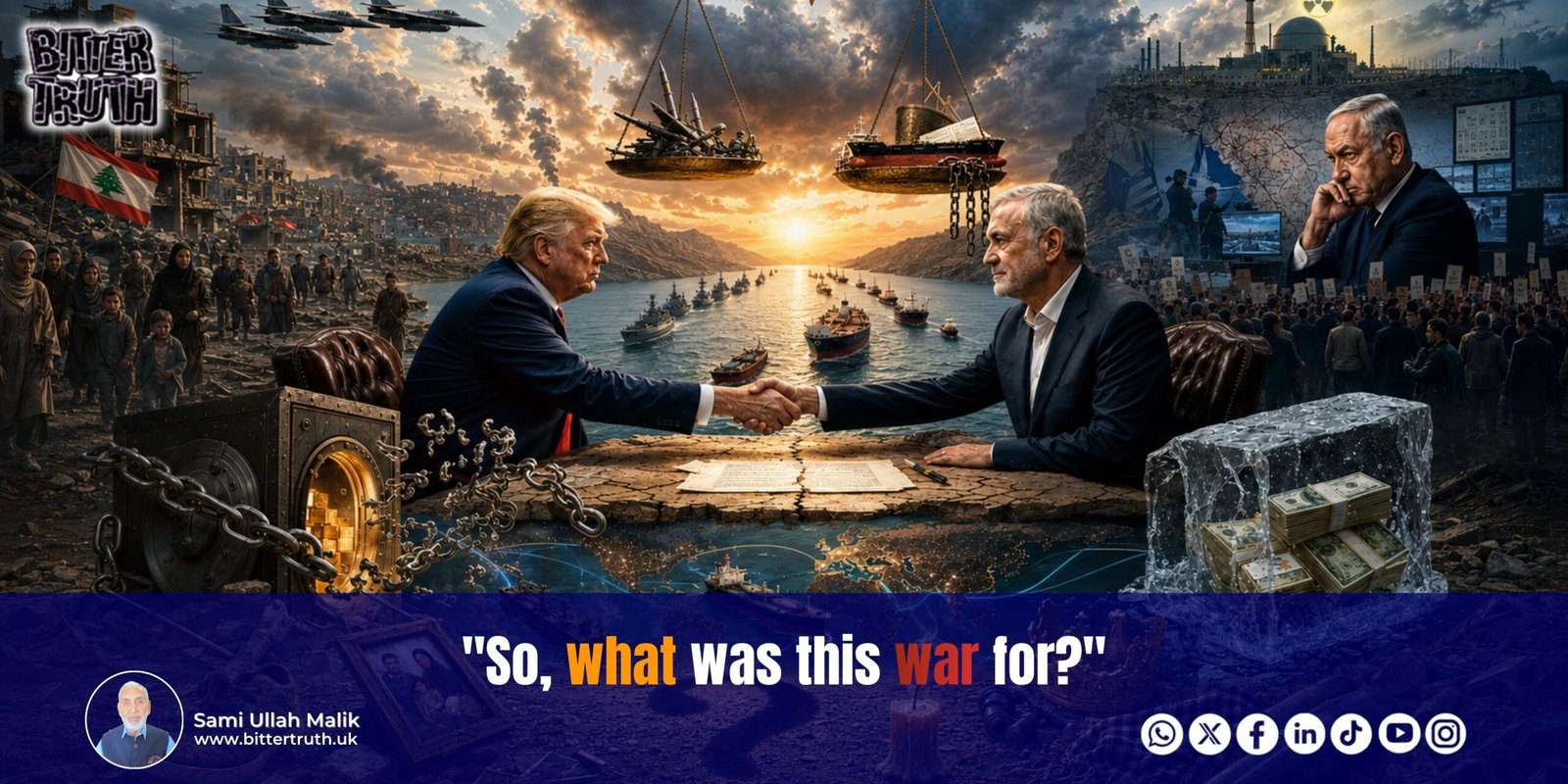
“So, what was this war for?”
“From Fury to Fragile Accord”

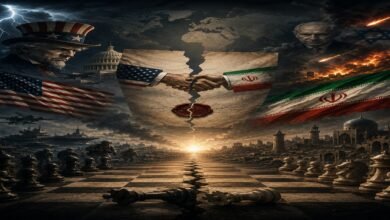
There are moments in history when time itself appears to pause, as though compelled to confront its own conscience. This is one such juncture—where the dust of conflict settles, and the question emerges with quiet insistence: to what end was this war waged? When thousands of lives have been reduced to ash in the furnace of violence, what remains of victory? At times, the chronicles of mankind record agreements that do not commemorate triumph but rather stand as solemn testaments to human limitation. The memorandum of understanding reached on 28 February between the President of the United States, Donald Trump, and the President of Iran, Masoud Pezeshkian, bears precisely this character. It is the stillness that follows a storm—yet a stillness heavy with unspoken cries.
The loss of human life, the blood that coursed through the streets of Iran and Lebanon, and the eventual resort to strategic retreat—all these converge within this document of conciliation agreed between Washington and Tehran. Together, they rise as a question mark etched upon the brow of history.
To regard the accord of 28 February merely as a diplomatic instrument would be to misread its significance. It is, rather, the culmination of a complex and multi-layered geopolitical process. While it gathers the immediate consequences of military confrontation, it also unsettles long-standing assumptions about power, resistance, and the architecture of global order. Its language speaks of reconciliation; yet between its lines echo the faint tremors of shaken confidence. As the flames of war subside, one is struck by a troubling realisation: that a conflict which stained the earth with blood has yielded little more than a fragile equilibrium inscribed upon paper.
The human cost of war—particularly the toll exacted upon civilian populations—raises profound questions within the framework of international humanitarian law. Has the application of force achieved its intended ends, or has it instead deepened the very instability it sought to resolve? This question lingers, unanswered yet unavoidable.
The resilience of Iran’s state structure offers a stark reminder that ideological states are not so easily destroyed by military pressure alone. For Iran, this conflict was never simply about territorial defense. It was about identity itself. When world powers demonstrated their overwhelming military might, Tehran was perceived not simply as a challenge but as an existential negation. Although the joint US-Israeli actions were ostensibly aimed at regime change, Iran’s political and institutional framework absorbed and sustained the shock. Indeed, what appeared outwardly as tension had inwardly transformed into a strong resolve—as the threat intensified, so too did the organization of the resistance.
When Tehran saw its gravest fears materialise—that the world’s foremost power and the Middle East’s most formidable military force had aligned with the intent of erasure—history once again demonstrated a timeless truth: nations endure not by arms alone, but by the resilience of their spirit. The state not only survived but emerged from the crucible of trial with renewed hardness. In this, one may discern a striking example of state resilience.
In the theatre of global politics, certain decisions are compelled not by the gun, but by geography. The Strait of Hormuz emerged as the very embodiment of this geographic determinism. Its closure laid bare the vulnerability of global energy supply chains. Iran transformed this narrow maritime corridor into an instrument of immense strategic leverage—grasping, as it were, the pulse of global commerce. In that moment, economics triumphed over militarism, and the very definition of power was subtly but decisively altered.
The constriction of the Strait choked the lifeblood of the global economy. Oil flows faltered, markets trembled, and Washington found itself compelled to concede what once lay beyond the bounds of imagination. Iran’s manoeuvre resembled the calculated stroke of a master strategist upon the chessboard—affirming that economic instruments, too, may serve as potent expressions of power.
The provisions relating to Lebanon reveal, in turn, the intricate web of proxy conflict. Israel’s insistence upon unfettered military freedom, juxtaposed with Iran’s indirect yet undeniable influence, has produced a precarious equilibrium in which regional stability remains perpetually at risk. This dilemma exposes not merely a bilateral tension, but a deeper fragility within the collective security architecture of the region.
Within the framework of the accord, Lebanon is no peripheral concern; it is, rather, the sensitive nerve centre of the entire conflict. The memorandum calls for a ceasefire in Lebanon, yet Israel has viewed such constraints as an infringement upon its sovereignty. For Israel, this theatre constitutes an essential pillar of its defence doctrine; for Iran, it is a symbol of strategic reach. Any compromise here, therefore, signifies not merely the cessation of hostilities, but a redefinition of spheres of influence. Israel’s desire for operational autonomy risks introducing fissures in its relationship with Washington—fissures through which more hardline narratives may well gain strength. It is here, perhaps, that the seeds of future discord are sown.
Economic sanctions, in the modern world, are chains that bind without the sound of iron. Their gradual loosening represents, in effect, a tacit admission that the limits of economic coercion had been reached. For Iran, such relief is not merely financial respite, but an opportunity to breathe once more within the international system. The easing of sanctions signals a shift—from coercive diplomacy to negotiation grounded in inducement—where the balance of interests, rather than the blunt force of power, assumes central importance.
The Reopening of the Strait: A Return, or a Reckoning Deferred?
In exchange for the reopening of the Strait of Hormuz, the United States undertook to lift its naval encirclement of Iranian ports, to ease the grip of sanctions, and to restore frozen assets long held in abeyance. Thus, after passing through the furnace of war, the protagonists appear to have circled back to the very point from which their fraught journey began—only this time, the toll has been exacted in blood.
One is reminded of that morning of 27 February, when vessels moved unimpeded through the Strait, and diplomats bent with quiet determination over negotiating tables. War shattered that continuity; conciliation now strives, with delicate hands, to mend it. The pre-war landscape—marked by dialogue rather than destruction—serves as a sober reminder that conflict is seldom inevitable. More often than not, it is the offspring of human misjudgement, of faltering judgement under the weight of pressure and misperception. This war, too, must be counted among those grievous miscalculations that rupture the steady thread of diplomacy. It underscores a central tenet of international relations: that misunderstanding and political compulsion often intrude decisively upon the calculus of statesmanship.
These signatures, then, do not merely conclude a chapter—they inaugurate another. Negotiators will return to their labours, and the tides shall once more carry the commerce of nations across open waters. The resumption of dialogue may be viewed as an instrument for the mitigation of conflict; yet an unavoidable question lingers—does this herald a durable peace, or merely a transient pause? As pathways reopen, one must ask whether this is a true beginning or simply a return in disguise. History has often shown that within such returns lie the dormant seeds of future strife.
The conflict, now assuming the form of an intellectual puzzle, compels us towards a more fundamental inquiry: does military power still reign supreme in the ordering of global affairs, or have economic leverage and geographic realities begun to usurp its primacy? This is no question to be resolved by political calculation alone; it demands moral discernment. It revives, in essence, the enduring contest between competing schools of thought in international theory—between those who place faith in power, and those who seek order through interdependence. Does the application of force resolve disputes, or merely alter their outward form? And so, the question persists, suspended in the air with quiet insistence: what, in truth, was this war for? It was not merely a political misstep, but a failure of foreign policy of such magnitude that it has altered the very current of history.
Within Israel, the reverberations of this conflict have been nothing short of seismic. The widening gulf between the assurances of leadership and the realities on the ground has unsettled public confidence. What now stands at stake is not merely electoral fortune, but the very survival of a political narrative.
The turbulence within Israel’s domestic sphere bears witness to a broader truth: that failures in foreign policy often return home as agents of internal instability. The bond between leadership credibility and public trust stands here exposed in stark clarity.
The consequences of war have reached deep into Israel’s political fabric. Benjamin Netanyahu—long styled as the embodiment of security—now finds himself subject to the scrutiny of public judgement. His inability to thwart the accord between Washington and Tehran has shaken the foundations upon which his authority rested.
When the rhetoric of power exceeds its rightful bounds, it collapses beneath its own weight. Israel’s uncompromising posture was, in part, an attempt to restore its standing; yet history has shown, time and again, that the conceit of strength cannot indefinitely conceal the absence of prudence. So it has proved in this instance, where military superiority was privileged over diplomatic foresight—yielding not resolution, but a crisis of greater complexity. Even now, an excessive reliance upon militarism risks constraining diplomatic possibilities. This predicament bears the hallmarks of a classic security dilemma, wherein the defensive measures of one state are perceived as threats by another, thus perpetuating a cycle of tension.
Iranian leadership, for its part, had long exercised restraint rooted in strategic foresight. The significance of the Strait of Hormuz was never lost upon Tehran; yet caution prevailed under earlier stewardship. That prudence preserved a latent instrument of power—one did not deploy until circumstances rendered its use unavoidable. When the moment came, that concealed capacity was brought forth with decisive effect, demonstrating that states may, when pressed, turn to unconventional means in the assertion of power.
Changes in leadership, however, brought corresponding shifts in policy temperament. Domestic political dynamics exerted their influence upon foreign policy with unmistakable force. When the old guard passed from the scene, their successors—keenly attuned to the gravity of the moment—did not hesitate to close the Strait. For them, it was not a gesture of defiance, but a necessity of survival. Thus did a change in leadership alter the direction of policy, transforming peril into opportunity, and marking the decisive turning point of the war.
Control over energy corridors has now emerged as a factor capable of reshaping the very character of future conflicts. Economic and geographic considerations are poised to assume a central role in the conduct of war. Iran’s experience has revealed that to grasp the pulse of the global economy may prove more potent than the forging of military alliances—a weapon at once economical and devastating in its effect. The battlefields of tomorrow may not be confined to borders; they will extend to the arteries of trade and energy. In this regard, Iran employed its strategic advantages with notable effect—an approach that ultimately contributed to its success.
Though Iran’s regional allies have been weakened, their continued existence remains a fact that cannot be dismissed. It attests to the enduring nature of ideological alignments, which cannot be extinguished by force alone. The fall of the Assad government in Syria may have altered the landscape, yet the axis of resistance endures—wounded, perhaps, but not extinguished. Its true strength, however, now stands open to question.
The Unsettled Question: Power, Principle, and the Burden of Consequence
At the very heart of this conflict lies the most delicate and perilous of questions: the nuclear programme—an issue poised uneasily between the imperatives of strategic balance and the principles of global non-proliferation. It has elevated Iran to the rank of a consequential actor upon the world stage, even as it has drawn the nation to the very brink of confrontation. Though long declared to be peaceful in intent, the programme has nonetheless cast a shadow of apprehension so deep that it helped summon the spectre of war itself. It remains, still, an unresolved chapter in this unfolding narrative.
Military successes are, by their nature, often fleeting; strategic consequences, by contrast, endure. The actions undertaken by the United States and Israel stand as a stark illustration of this paradox—tactical gains upon the field, yet an absence of fulfilment in ultimate purpose. Air superiority delivered momentary advantage, but it could not avert a broader strategic failure. The aspiration of regime transformation, conceived in simplicity, dissolved under the weight of reality.
The Iranian state, for all its flaws, is founded on a foundation of ideology, faith, and a sense of national survival rooted in past struggles. Such a foundation demonstrates that ideological and spiritual foundations—however contested—can provide the state with a certain stability, especially when woven into the fibers of national identity. It is this resilience that makes it strong against external oppression, enabling it to endure where others might fail.
The divergence between political pronouncement and practical outcome reveals a familiar truth:
that the declarations of leadership are often shaped more by passion than by the constraints of reality. History, however, is an exacting judge; it measures not the grandeur of words, but the substance of results. So, it has been in this instance. Lofty proclamations—predictions of collapse, demands for unconditional surrender—have faded into the obscurity of time, leaving behind a far more complex and ambiguous reality.
The invocation of religious and historical imagery in this conflict underscores that it is not merely political in character, but also civilisational and intellectual in dimension. Yet when the hour of action arrived, such imagery proved unequal to the weight of reality. It could adorn rhetoric, but not secure results. Thus it was that the language of scripture and history, employed to frame the struggle, could neither fulfil its promises nor sustain the ambitions it inspired.
The memorandum of understanding is no final settlement; it is a threshold—a passage towards the greater question embodied in Iran’s nuclear ambitions. It is, in essence, a provisional bridge: one that for the moment connects two opposing narratives, yet whose strength will be tested in the negotiations that lie ahead. It must therefore be regarded not as a resolution, but as an initial step towards addressing the underlying issue from which the conflict arose.
A deficit of trust stands as the most formidable obstacle in this entire enterprise. It is the unseen fracture that threatens the durability of any accord. So long as this chasm endures, every agreement will exist beneath a shadow of uncertainty. The coming weeks of negotiation will prove decisive; yet in an atmosphere so burdened by suspicion, each step forward carries with it the risk of reversal.
Hardline elements, determined to frustrate reconciliation, remain poised to exploit every weakness.
For Iran, the central challenge lies in the preservation of balance: between the aspiration for economic recovery and the imperative of ideological constancy. It is this equilibrium that will shape the course of its future policy and determine its national trajectory. Should it adopt an inflexible posture, it risks forfeiting the economic relief upon which its strained economy depends. Yet, even so, this accord—imperfect though it may be—stands as a preferable alternative to a war that had brought the global economy to the edge of crisis.
Should the negotiations succeed, the consequences may extend far beyond the immediate parties. The destiny of the Middle East itself could be altered; the balance of power recalibrated; the region ushered, perhaps, into a new epoch—one in which cooperation displaces confrontation. Yet such an outcome demands not only sustained diplomatic labour, but also the painstaking restoration of trust. In the light of history, this hope flickers like a fragile flame—one that even the faintest wind may extinguish. For history teaches us that the passage of “if” is among the most treacherous of all.
This conflict, in its totality, reveals a deeper transformation in the nature of power within modern international politics. Military force remains significant, yet it no longer reigns alone. Economic leverage, geographic realities, and ideological currents now converge to form a far more intricate equilibrium. No conflict, therefore, may be understood through a single lens; it demands a perspective as complex as the forces that shape it.
And from this long and troubled tale, one lesson emerges with sombre clarity: wars are not always lost upon the battlefield; they are often lost earlier—in the anxieties of minds, in the missteps of judgement, and in the frailties of decision. Thereafter, every word inscribed upon the parchment of peace becomes, in its own quiet way, an admission of what could not be achieved.
This war is not merely a chronicle of fire and steel, but a meditation upon human choice, political error, and the inexorable pressures of history. And at its core remains the most haunting of questions:
If the end was destined to be thus, why was the beginning ever undertaken?