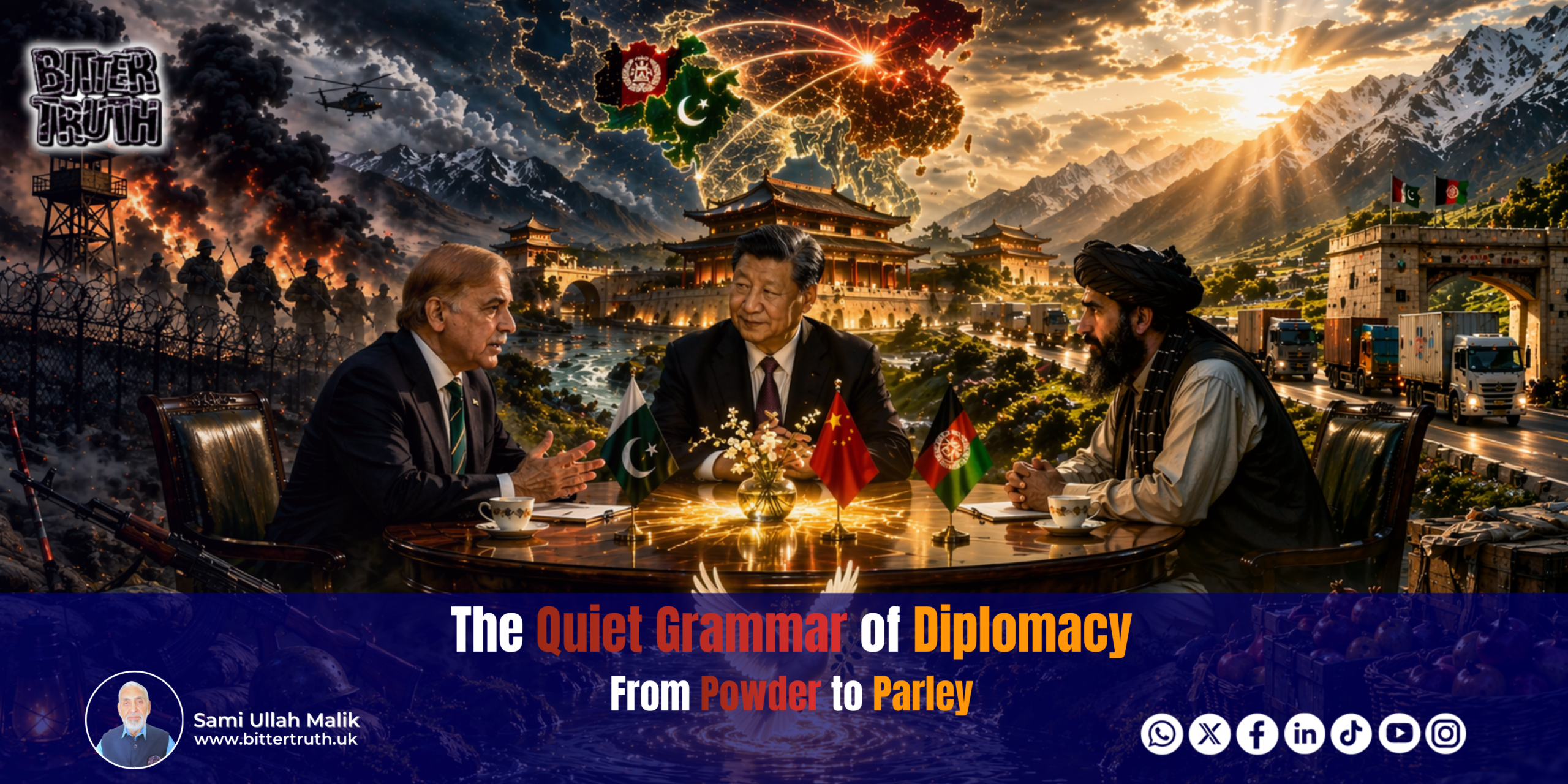
The Quiet Grammar of Diplomacy
From Powder to Parley

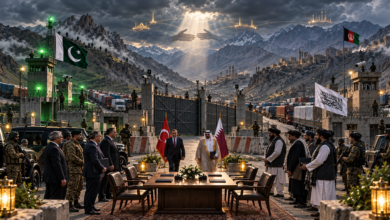
When the storm-clouds of global politics begin, however tentatively, to disperse, the lamps of diplomacy are apt to kindle of their own accord. In the intricate and often turbulent theatre of international affairs, there arise, from time to time, moments when the air clears just enough for a faint glimmer of concord to appear upon the horizon. Such a moment has, in recent days, presented itself upon Chinese soil, where Pakistan and Afghanistan convened for a seven-day dialogue—an encounter that was less a routine exercise in protocol than a carefully wrought overture to history itself. It was not merely an exchange of words, but a convergence of intentions; a deliberate attempt to supplant the bitterness of a protracted past with the tempered sweetness of dialogue, and to lay, upon the wounds of yesterday, the balm of possibility for tomorrow.
This tableau was most vividly realised in the region of Ürümqi, where the proceedings unfolded not as a perfunctory diplomatic ritual, but as a quiet illumination within the half-light of history—an illumination that dared to cast its glow upon the uncertain pathways of the future. One might say, borrowing the cadence if not the exact phrasing of Winston Churchill, that this was not the end of discord, nor even its beginning end, but perhaps the end of its beginning. For what transpired was not a mere sitting and rising, but the tentative preface to an era in which the acrid scent of gunpowder yields, however reluctantly, to the subtler fragrance of discourse. It was, in essence, a test not only of language but of resolve—a mirror held up to the intentions of those assembled.
The broader international climate lends this episode an added layer of significance. The ceasefire between the United States and Iran, though momentarily soothing to the global atmosphere, has in truth set in motion a recalibration of power whose consequences are yet unfolding. It was in this shifting context that China, with a deliberation reminiscent of the prudential wisdom so admired by Edmund Burke, seized the moment to exercise its diplomatic acumen. By bringing Pakistan and Afghanistan to a common table, Beijing signalled—firmly yet without ostentation—that the East is no longer content to remain a spectator, but has assumed the mantle of an active architect in the ordering of world affairs.
The pronouncement of a “comprehensive solution” by the Chinese Foreign Ministry is, in this regard, no mere communiqué. It bears the character of a considered doctrine—indeed, a manifesto of sorts—eschewing piecemeal remedies in favour of a holistic strategy. It is a cartography not of fragments, but of totalities; a recognition that the maladies afflicting the region cannot be cured by superficial expedients, but demand an engagement with their deeper causes. In this, one detects an insistence that durable peace is not the offspring of transient measures, but of sustained and principled thought.
Pakistan’s role within this unfolding narrative has been neither negligible nor merely ornamental. Its quiet diplomacy during the tensions between Washington and Tehran functioned, in effect, as a bridge—unseen perhaps, yet indispensable—bringing two adversarial forces into a posture, however fleeting, of restraint. If Pakistan’s contribution has been one of subtle facilitation on the global stage, China’s has been that of an assured mediator at the regional level, discharging its office with a composure that calls to mind the measured prose of Thomas Babington Macaulay. The result has been not only a willingness to converse, but the emergence of a cautiously constructive atmosphere.
In contrast to earlier episodes in the fraught history of Pak-Afghan engagement, the present round of talks has been marked by a discernible sobriety—a steadiness that has, for once, displaced rancour, and a prudence that has tempered uncertainty. It is as though diplomacy, long overshadowed by impulse, has at last asserted its primacy. Yet the essential question persists, and must persist: are these proceedings to be remembered as an exercise in rhetorical dexterity, or as the prologue to genuine normalisation? History, stern and unsentimental, reminds us that agreements derive their longevity not from the elegance of their phrasing, but from the sincerity of the intentions that animate them. Where resolve is steadfast, compacts transcend paper; where it is wanting, even the most artful language dissolves into irrelevance.
Thus, the fate of these negotiations hinges upon that delicate yet decisive axis—between appearance and authenticity, between declaration and deed. Should earnestness and gravity indeed undergird this endeavour, it is not beyond conjecture that the region may yet pass into a new dispensation: one in which differences are not extinguished by force, but reconciled through reasoned discourse.
The negotiations in Ürümqi may be likened to a silent river—outwardly placid, yet bearing within it currents of considerable depth. Their quietude belies a resonance that travels far beyond the confines of the negotiating chamber, echoing across the breadth of the region. According to the Chinese Foreign Ministry, both parties have concurred in seeking a comprehensive resolution to the tensions that have persisted since October of the previous year. This declaration signals a transition—from the expedient to the enduring, from the immediate to the lasting—in the pursuit of peace: a peace not confined to borders, but extending into the very sentiments of the peoples concerned.
There is, moreover, a certain equilibrium and dignity in the language employed by the Chinese spokesperson—qualities that reflect the higher canons of diplomacy. The mutual pledge to refrain from any action that might aggravate the situation constitutes, in effect, a moral covenant: unwritten, perhaps, yet potent in its ethical force. It is less an announcement than a compact of restraint, animated by the дух of patience, prudence, and balance. China’s provision of a structured negotiating framework further attests to its intention that this process should not be episodic, but continuous and coherent—an unfolding sequence rather than an isolated event.
It was, moreover, candidly acknowledged in the meeting that the peace of South Asia is inextricably bound to the tenor of relations between Pakistan and Afghanistan. To designate terrorism as the principal impediment to this relationship is not merely to assign blame; it is, in effect, to diagnose a long-festering malady—an affliction that has for years been embedded deep within the body politic of the region. Until this canker is confronted and treated at its roots, all endeavours toward tranquillity must remain necessarily incomplete. China’s persistent emphasis upon dialogue is thus neither ornamental nor incidental; it is a deliberate affirmation that the instruments of war—however forceful—are ultimately inferior to the patient craft of conversation. The crack of the rifle may impose a momentary hush, yet it is only the cadence of reasoned discourse that can secure a lasting peace. In this insistence lies a quiet but resolute declaration: that the primacy of argument shall, henceforth, supersede that of arms.
Pakistan’s apparent silence in this unfolding drama is, upon closer inspection, neither evasive nor accidental, but rather a considered and purposeful restraint—an eloquent quietude in which deliberation finds its truest voice. In the subtle art of diplomacy, silence is often the most articulate of statements, speaking in tones that words themselves cannot sustain. Such silence is rarely empty; it is, more often than not, clothed in the garments of prudence. It suggests that, behind the visible stillness, a process of careful reflection is underway, wherein each facet of the matter is weighed with meticulous care before any definitive position is pronounced.
Though the negotiations did not, in their present form, command the presence of the highest echelons of leadership, the engagements between ambassadors and the tenor of their measured statements furnish ample evidence that a serious diplomatic process is not only underway but quietly advancing. This is diplomacy in its more discreet incarnation—a continuity of engagement that seldom announces itself with fanfare, yet frequently lays the groundwork for decisions of far-reaching consequence. The meetings of envoys and the temperate optimism of their pronouncements are but outward manifestations of this quieter enterprise, whose effects, though not immediately conspicuous, tend to unfold with gradual but enduring impact. It is not unreasonable, therefore, to anticipate that subsequent stages may witness the elevation of these talks to a more senior and decisive plane.
On another front, Pakistan’s security narrative remains unambiguous and firm. Its ongoing operations against terrorism testify to the fact that it regards this challenge not as a transient political inconvenience, but as a question intimately tied to its very survival. The issue of Afghan soil being utilised against Pakistan is not a passing grievance; it is a long-standing apprehension that has cast a persistent shadow over bilateral relations, and which has now crystallised into a clear and unequivocal demand. As many observers have noted, Pakistan’s central contention is both simple and profound: that Afghan territory must not serve as a platform for hostile designs against it. This demand, in essence, is but another expression of its imperative for national security.
Encouragingly, the statements emanating from the Afghan side suggest a parallel recognition of the gravity of the situation. In the measured words of Amir Khan Muttaqi, one discerns not only a note of moderation but a glimmer of hope—that minor differences shall not be permitted to harden into insurmountable barriers. Such sentiments reflect an emerging inclination, on both sides, to privilege cooperation over confrontation. They amount, in effect, to an acknowledgment that while disagreement is natural, wisdom lies in its resolution. Should this spirit of cautious optimism translate into tangible action, it may yet herald the dawn of a more stable and harmonious regional order.
Similarly, the carefully calibrated remarks of Suhail Shaheen, delivered from Qatar, bear the hallmarks of diplomatic finesse. Analysts have observed that the tone of the negotiations, on this occasion, has been notably more tempered and courteous—an evolution that augurs well for the future. It suggests that both nations, while not oblivious to the burdens of their shared past, are nevertheless prepared to turn their gaze toward the possibilities that lie ahead. Even amidst the residue of bitter memory, there is discernible the first tentative step toward a more constructive future.
The tensions of the previous October stand as a sombre reminder of how precarious this relationship has, at times, been. Those were moments of profound regret, when hostile forces found opportunity in discord, and when escalation—manifested in aerial strikes and retaliatory measures—inscribed upon the pages of history chapters written, as it were, in lines of blood. Such episodes serve as a stark admonition: that the path of conflict leads inexorably toward devastation. It is, perhaps, the hard-earned memory of these experiences that now inclines both nations toward the negotiating table, imbuing the present talks with a significance that extends beyond the immediate to encompass the healing of past wounds.
The closure of borders and the suspension of trade have likewise exerted a heavy toll, both economically and socially. When commerce falters, it is not merely goods that cease to move, but the very flow of daily life that is disrupted—often with severe consequences for ordinary people. It is this shared realisation that has, in no small measure, impelled both parties back toward dialogue. There is, increasingly, an acknowledgment that economic relations must be insulated, as far as possible, from the vicissitudes of political disagreement, and that mutual prosperity cannot be held hostage to perpetual discord.
Although no formal communiqué has yet emerged, the very duration and continuity of the seven-day negotiations testify to the seriousness with which they were conducted. This was no series of perfunctory encounters, but a sustained and substantive exchange in which both sides articulated their positions with candour. The persistence of dialogue over such a period is itself indicative of a genuine search for resolution—an effort that aspires to move beyond the superficial toward something more durable and consequential.
Pakistan’s position, in this regard, remains both clear and consistent: it seeks concrete and verifiable action against militant groups operating from Afghan territory—groups that, for a considerable period, have functioned as instruments of proxy conflict, engaging in acts of violence within Pakistan while openly claiming responsibility for them. This demand is neither rhetorical nor transient; it is rooted in accumulated experience and bound up with the imperatives of internal security and stability. Without meaningful progress on this front, it is difficult to envisage any substantive advancement in the broader relationship.
Pakistan’s position with regard to the Tehrik-i-Taliban Pakistan is, by every measure, unequivocal. To designate it as a terrorist organisation, and to insist upon the dismantling of its operational networks, is not merely a matter of policy preference but a prerequisite for the restoration of trust. In pressing this demand, Pakistan articulates not an abstract doctrine, but an imperative rooted in the exigencies of its internal security. A cessation of hostilities, coupled with the effective prevention of cross-border incursions, constitutes the very foundation upon which any durable peace must be constructed. Yet the decisive test lies not in articulation but in execution. Should these negotiations ascend, in their subsequent stages, to a higher level, it would signify that the initial seed has indeed taken root—an achievement of no small consequence. Failing this, they risk joining the long and sobering catalogue of unrealised efforts that history records with a certain quiet severity.
The challenge, however, does not end with a single organisation. Other militant groups form links in the same troubling chain; and so long as their activities persist, the atmosphere of trust cannot fully take hold. A tangible diminution in their operations would serve as the clearest indication that the negotiations are yielding substantive results, rather than merely rhetorical assurances.
Entities such as ISIS and Al-Qaeda represent a shared threat to the stability of the region. While the operational footprint of the latter may have diminished, the former continues to present an evolving and increasingly complex challenge—one that neither state can effectively confront in isolation. Only through a joint strategy, conceived with clarity and pursued with constancy, can the prospect of lasting peace be meaningfully secured.
Encouragingly, the recent decline in attacks offers a cautiously optimistic signal—an indication that beneath the visible surface, some measure of progress may indeed be unfolding. It is akin to that brief, almost imperceptible calm that follows a storm: a stillness that may yet presage a more profound transformation. Reports of militant elements shifting their positions further reinforce the impression that practical measures, however discreet, are being undertaken, even if their full contours have yet to be publicly delineated.
Afghanistan’s proposition that trade be insulated from the vicissitudes of politics is, in its essence, both pragmatic and farsighted. The restoration of border routes would not merely revive commerce but reopen the arteries of everyday life, yielding tangible benefits for the peoples of both nations and creating new avenues of shared prosperity.
In the final analysis, one truth stands beyond dispute: neither Pakistan nor Afghanistan possesses the luxury of a protracted conflict. The burdens—economic, social, and human—are simply too great to be borne indefinitely. Peace, therefore, is not an idealistic aspiration but a strategic necessity—the only viable path toward sustained stability.
Yet history, ever the stern instructor, reminds us that negotiations alone do not suffice. They must be accompanied by sincerity of purpose, the gradual accumulation of trust, and—above all—the discipline of implementation. The recurring dispute over written guarantees has, in earlier efforts, proved a decisive stumbling block, laying bare the underlying deficit of trust between the parties.
Pakistan’s demand, and the position of the Afghan Taliban, reflect, in essence, two distinct perspectives: the one shaped by the imperatives of security, the other informed by considerations of sovereignty and ideological affinity. It is within this delicate and often contested space that the success or failure of the entire enterprise shall ultimately be determined.
The Ürümqi negotiations thus constitute but the latest chapter in a long and complex story—yet one to which China’s mediation has imparted a new dimension and a renewed sense of possibility. Should this process continue with the seriousness thus far exhibited, it is not beyond the bounds of reason to imagine that a region long beset by turmoil and uncertainty may, in time, be transformed into a bastion of peace and stability. For these negotiations are more than a diplomatic exercise; they are, in their quiet way, an embodiment of hope—and hope, when allied with resolve and realised through action, possesses the rare capacity to alter the very course of history.