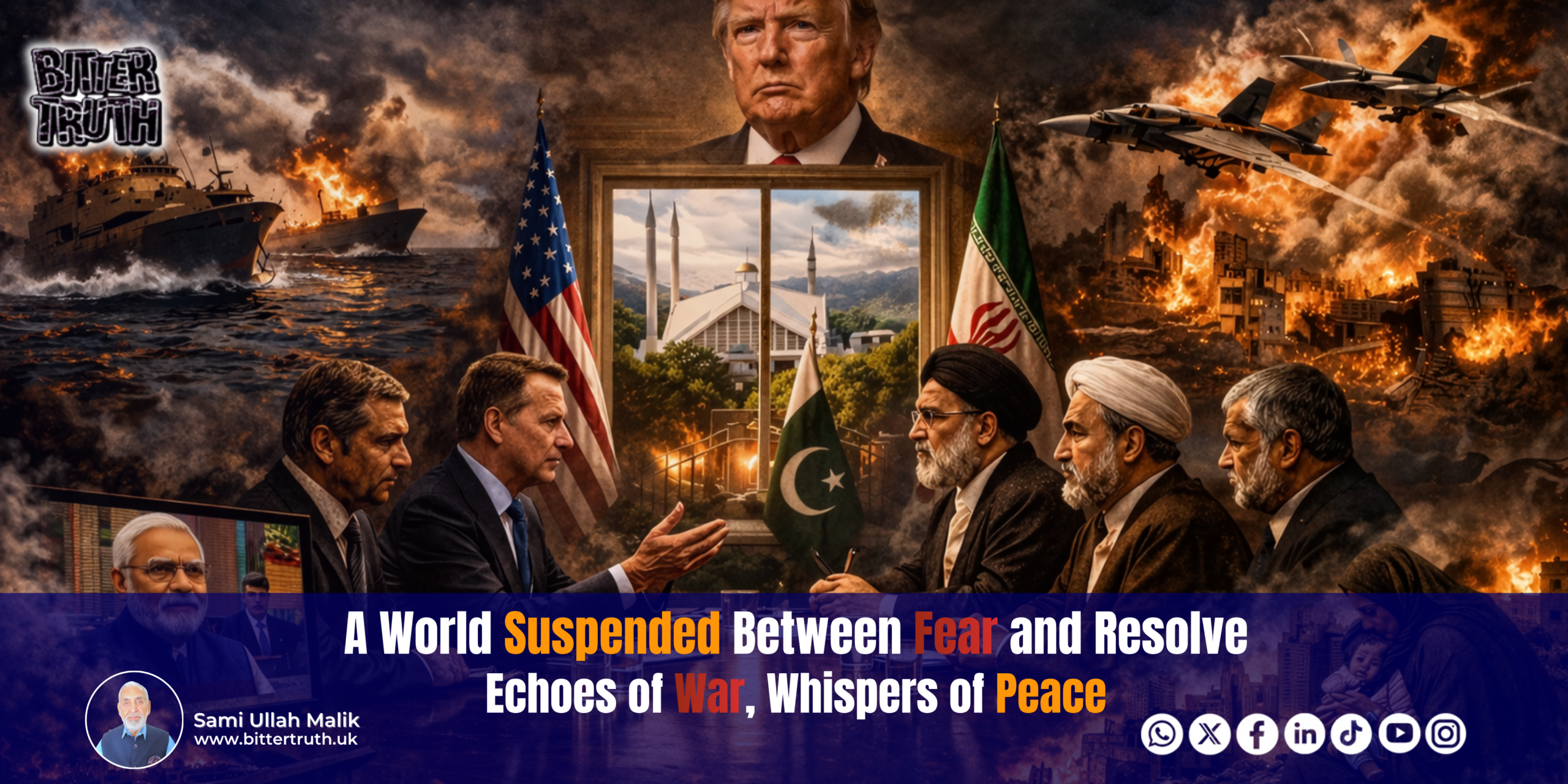
A World Suspended Between Fear and Resolve
Echoes of War, Whispers of Peace

This is no mere chapter in the dry and lifeless annals of politics; rather, it is a tragic inscription etched upon the very breast of humanity itself—an inscription from whose every word one detects the acrid scent of gunpowder, and from whose every line there echoes the muffled lament of suffering souls. What confronts us here is not simply a contest between two states, but a searching trial of the global conscience—one that, despite centuries of civilisation, religion, moral philosophy, and humanist aspiration, still appears prostrate before the idol of power.
The modern world, for all its outward splendour—its triumphs in science, learning, and technological mastery—remains, in its inner constitution, curiously unchanged. Beneath its polished exterior linger the same ancient impulses: the same predatory instincts, the same insatiable thirst for dominion, the same ruthless calculus of interest. Those who preside over the great chambers of power, and who would not hesitate to plunge the world into darkness merely to keep alight the flickering candle of their own advantage, are in truth the principal architects of this unfolding tragedy. These are the forces that wage war in the name of peace, and that fortify their dominions with the very lifeblood of humanity, even while invoking its name.
It is within this sombre and unsettling context that the present conflict transcends the boundaries of a routine diplomatic dispute and assumes the proportions of a global calamity. Here, decisions are not merely political calculations; they are determinations that shape the destinies of peoples and nations. On one side stands the arrogance of power; on the other, the desperate struggle for survival. On one side, the blind game of strategic interest; on the other, the faint yet persistent cry of humanity itself.
Readers would do well, therefore, not to approach this account as a mere report, but rather as a mirror—one in which the deeper truths of our age stand revealed in stark and often uncomfortable clarity. This is a moment of reckoning: a juncture at which we must ask ourselves whether we shall remain complicit in the gathering storm of war, or instead choose to tend that fragile yet enduring flame of peace which alone has the power to pierce the darkness and illuminate a path forward. For history bears solemn witness to this enduring truth: whenever mankind has chosen the sword over reason, it has secured not victory, but a more profound and lasting defeat—its own.
Thus, this matter cannot be reduced to the language of diplomatic subtlety. It is, in its essence, a reflection of the intricate and often perilous chessboard of contemporary international politics, wherein each piece signifies far more than its immediate motion—carrying within it the accumulated weight of history, ideology, fear, and ambition.
Nor, indeed, is this simply a disagreement between two nations. It is emblematic of a wider and more intricate condition—a defining chapter in the political narrative of our time, in which power, doctrine, interest, and apprehension are so deeply interwoven that they defy easy separation. It is against this broader canvas that the following analysis is presented, in the hope that readers may discern for themselves how a world once poised on the brink of catastrophic destruction—mere hours away, it seemed—has yet to fully emerge from the shadow of that peril.
The relationship between the United States and Iran may aptly be likened to a mirror perpetually clouded by the vapours of mistrust. At present, five principal points of contention stand between them—formidable barriers that continue to challenge not only the prospect of agreement, but the very possibility of peace itself.
First, there is the question of Iran’s nuclear programme—a matter that has, for decades, resisted resolution. It remains the central axis of dispute, drawing both nations into a prolonged and increasingly fraught confrontation. To the United States, it represents a latent and potentially grave threat; to Iran, it is a sovereign right, an emblem of national dignity and scientific progress. What one perceives as danger, the other proclaims as legitimacy and honour.
Second is the issue of regional influence. Iran’s so-called “axis of resistance” is viewed in Washington and Tel Aviv as a persistent and destabilising force. Through its alliances and affiliated groups across the Middle East, Iran has constructed a sphere of influence that it regards as both defensive and necessary. Yet to its adversaries, this network appears less as a shield and more as a source of enduring instability. Here, the disagreement transcends geography and enters the realm of competing worldviews.
Thirdly, there is the enduring burden of economic sanctions. The United States has long wielded these measures as instruments of strategic pressure, while Iran regards them as a form of economic warfare. Their cumulative impact has placed immense strain upon Iran’s economy, deepening grievances and reinforcing mutual hostility.
Fourth is the dispute over the Strait of Hormuz—a narrow yet immensely significant maritime passage, through which flows a substantial portion of the world’s energy supply. It is not merely a corridor of navigation, but a vital artery of the global economy. Iran asserts a degree of sovereign authority over these waters, while the United States maintains that they must remain international. Thus, a geographical feature becomes the focal point of a far broader contest of power and principle.
Finally, and perhaps most decisively, there exists a profound and deeply entrenched deficit of trust. This absence of confidence transforms every negotiation into an exercise in suspicion. The walls of mistrust between the two sides have risen so high that even dialogue itself appears to collide against them. Every agreement is viewed through a lens of doubt; every assurance is shadowed by questions of intent.
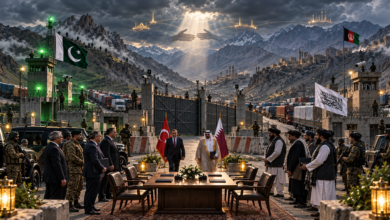
It was against this backdrop that negotiations in Islamabad were convened—heralded, at least outwardly, as a tentative step towards a new dawn. They resembled, one might say, the lighting of a solitary lamp amid a gathering storm. Yet in reality, they marked the beginning of a journey whose destination lay obscured in dense uncertainty. From the very outset, it was evident that immense obstacles stood in the way—obstacles not susceptible to resolution through mere diplomatic pleasantries, nor bridgeable by the fragile architecture of words alone.
Indeed, these negotiations were akin to an attempt to construct a bridge across a turbulent river—its opposing banks distant, and its waters roiled by fierce and unrelenting currents. Beneath the surface lay forces not easily subdued: historical grievances, ideological divergence, and the accumulated weight of years of distrust.
The statement issued by the Iranian Foreign Ministry’s spokesman, Esmaeil Baqaei, serves as a candid reflection of this reality. The talks did not end in absolute failure; yet neither did they approach genuine success. While some areas of understanding were achieved, there remained two or three critical issues—knots, as it were, that resisted all efforts at unravelling. The inclusion of additional matters, such as the Strait of Hormuz, only served to deepen the complexity, introducing new layers of difficulty. Each issue seemed to give rise to another, as though the very act of seeking resolution generated fresh complications.
Thus, the negotiations, though not devoid of effort or intent, ultimately faltered before reaching their intended destination—exhausted, as it were, by the very weight of the challenges they sought to overcome.
At the very heart of this protracted dispute lies Iran’s nuclear programme—a central pillar upon which the entire edifice of contention appears to rest. It is, in many respects, an old and wearied narrative, its pages frayed by time and repetition; yet its force has in no way diminished. The United States maintains that, beneath the outward guise of civilian endeavour, Iran seeks to acquire the capacity to produce nuclear weapons—a prospect regarded in Washington as nothing less than a grave and gathering danger. Iran, for its part, rejects this charge with steadfast insistence, portraying its programme as exclusively peaceful and emblematic of its sovereign right to scientific advancement. Thus, what emerges is not merely a policy disagreement, but a deeper struggle between power and apprehension—between America’s fear and Iran’s aspiration to strength.
The remarks of the American Vice-President, J. D. Vance, conveyed with notable clarity the underlying thrust of Washington’s position: assurances must transcend rhetoric and assume tangible, verifiable form. It is not words that are sought, but certainty. In this light, the essence of the negotiations was defined by a singular demand—that Iran must not only refrain from the pursuit of nuclear weapons, but also relinquish the means, infrastructure, and pathways by which such a capability might ever be attained. Written guarantees, enforceable and unequivocal, were deemed indispensable.
This insistence is, at its core, a reflection of profound mistrust. The United States does not repose confidence in declaratory commitments alone; it seeks demonstrable restraint. Yet, by its own admission, such willingness has not thus far manifested itself on the Iranian side, leaving the process suspended in a state of unresolved tension.
Iran, however, remains immovable in its position—firm as a mountain against the shifting winds of external pressure. It contends that, as a signatory to the international framework governing the non-proliferation of nuclear weapons, it is fully entitled to pursue the enrichment of uranium for peaceful purposes. This claim is not advanced merely as a technical argument, but as a matter of national sovereignty and dignity. Indeed, its ten-point proposal, presented as a basis for negotiation, seeks formal international recognition of this right—an effort, in essence, to secure not only acceptance, but legitimacy. In this regard, the issue transcends technicalities; it becomes a question of principle, bound up with the very idea of statehood and self-determination.
Set against this position stands the American framework, markedly more exacting in its demands. Within its multi-point proposal lies the insistence that Iran must bring to an end all forms of uranium enrichment upon its own soil. For Tehran, such a condition is wholly untenable, for it would amount to a surrender of both scientific autonomy and national prerogative. It is precisely at this juncture that the path to compromise narrows almost to vanishing point. The disagreement hardens into a line so starkly drawn that neither side finds it possible to cross without forfeiting what it regards as essential.
In earlier years, there had been a moment—fleeting, yet significant—when such differences appeared capable of resolution. The agreement reached in 2015, formally known as the Joint Comprehensive Plan of Action, represented the culmination of prolonged and painstaking diplomacy. It offered a framework whereby limitations upon Iran’s nuclear activities were to be exchanged for the easing of economic sanctions. For a time, it stood as a testament to what sustained negotiation might achieve—a glimmer of hope amid a landscape otherwise marked by discord.
Yet that hope has since faded. The agreement now appears less as a durable settlement than as an unfinished chapter—its promise dimmed by the passage of time and the shifting currents of international politics. What once seemed a carefully constructed bridge now resembles an incomplete structure, abandoned before its purpose could be fully realised.
Compounding these difficulties has been the broader regional climate, in which military developments have cast a long and dark shadow over diplomatic efforts. The ongoing operations by Israel against forces aligned with Iran in Lebanon have exerted a palpable influence upon the atmosphere of negotiation. These actions, like gathering clouds obscuring the sun, have diminished the already fragile prospects of progress. Iran’s leadership has made clear that the reverberations of the battlefield cannot be divorced from the deliberations at the negotiating table; should such hostilities persist, dialogue itself risks becoming a hollow exercise.
Even the announcement of a ceasefire—seemingly a step towards de-escalation—has proved uncertain in its durability. Continued military activity in Lebanon has undermined its credibility, illustrating once again the disjunction between diplomatic declarations and realities on the ground. Indeed, the reports of renewed strikes emerging almost immediately after the departure of the American delegation from Islamabad served as a stark reminder that agreements, however carefully phrased, may prove no more resilient than paper before the force of armed conflict. Words, it would seem, are all too easily undone by the thunder of artillery.
Meanwhile, the Strait of Hormuz remains a focal point of strategic tension—a narrow passage, yet one of immense global consequence. Through its waters passes a substantial share of the world’s energy supply, rendering it not merely a geographical feature, but a vital artery of the international economy. Iran’s efforts to assert greater control over this passage, including the imposition of charges upon shipping, have provoked sharp objection from the United States, which maintains that such waters must remain open to all. Here, geography and economics converge, and the contest for authority reaches a particularly acute intensity.
Iran, for its part, appears determined not merely to maintain its position, but to formalise it. By advancing new regulatory frameworks and reinforcing its presence, it seeks to translate de facto influence into recognised authority. This initiative forms part of a broader regional strategy—one aimed at consolidating its standing and extending its reach within an already volatile environment.
Central to this strategy is Iran’s network of allied groups across the region. These associations serve as the foundation of what might be described as a forward defensive posture, enabling Iran to project influence while avoiding direct confrontation. Through this network, it engages its adversaries at a distance, shaping the strategic landscape to its advantage. Yet this same system is perceived by the United States and Israel as a persistent and unacceptable threat—one that must ultimately be dismantled. It is in this context that continued military actions, particularly in Lebanon, must be understood.
At the same time, Iran confronts mounting pressures within its own borders. Years of economic sanctions have imposed a heavy burden upon its economy, and signs of public discontent have grown increasingly evident. There is, among many of its citizens, a desire that national resources be directed less towards external engagements and more towards domestic welfare. Yet the imperatives of security and the realities of prolonged confrontation have thus far constrained any significant shift in policy. In the face of what it perceives as sustained external hostility, Iran finds itself compelled to allocate considerable resources to defence, even at the cost of internal strain.
Thus, the internal and external dimensions of this crisis remain inextricably linked—each reinforcing the other, and together sustaining a cycle of tension from which escape appears, for the present, uncertain.
Among Iran’s foremost demands is the restoration of its frozen assets and the lifting of international sanctions that have, for years, constrained its economic vitality. Yet, from the vantage point of Washington, such magnanimity appears increasingly improbable. With each passing day, the prospect of accommodating this demand seems to recede further into the realm of conjecture. It is precisely at this juncture that the gulf between hope and reality widens most starkly, becoming perhaps the single greatest impediment upon the path of negotiation.
Taken together, these complexities reflect a deeper and more disquieting truth: that the dispute between the United States and Iran cannot be reduced to a mere catalogue of disagreements. It is, rather, an intricate amalgam of ideology, interest, power, and history—so densely interwoven that its tensions reverberate far beyond the immediate parties involved. Nowhere is this more acutely felt than in the Middle East, a region brought perilously close to the brink of upheaval, though the tremors of this confrontation are by no means confined to its borders. Increasingly, voices within the region speak with candour, alleging that their resources and destinies are being subordinated to the preservation of external dominance.
This is a narrative whose chapters give rise to ever more searching questions, yet whose conclusion remains unwritten. It is a knot not easily untangled—a problem that demands not only the instruments of diplomacy, but also the rarer virtues of trust, foresight, and patience.
The broader tableau reveals an uncomfortable reality: that the world continues to operate, in large measure, upon the calculus of power. The ideals of justice and humanity, though often invoked, have yet to secure their full and consistent expression in the conduct of international affairs. These conflicts, these wars, these relentless diplomatic contests—together they stand as stark reminders that mankind has not wholly transcended the more primal elements of its nature.
And so the question arises, with renewed urgency: how long is this to endure? How long shall the blood of innocents be expended in the name of causes that seldom bear their burden? How long shall human lives be offered up at the altars of power? And how long shall the voice of peace be drowned beneath the thunder of arms?
For those forces in the world that profess a commitment to peace, this is a moment of trial. Silence, at such an hour, would not merely be a failure of resolve; it would be an abdication of responsibility for which history is seldom forgiving. The demands of the present moment call for action—measured, principled, and resolute. It is incumbent upon these actors to stand, with unity of purpose, as a bulwark against those aggressive impulses that threaten to draw the world ever closer to the precipice.
Peace is not a sign of frailty; it is, rather, the most enduring expression of strength. It is the force that binds nations, nurtures civilisations, and sustains the very fabric of human existence. War, by contrast, is a consuming fire—one that spares neither adversary nor instigator, but ultimately devours both alike. It follows, therefore, that the international community must move beyond the realm of declarations and resolutions, and instead pursue tangible measures capable of restraining those forces that imperil global stability.
It is, moreover, a bitter truth that so long as the politics of interest continues to eclipse the politics of principle, peace will remain elusive—more aspiration than reality. To transform this aspiration into substance requires the reconstruction of the international order upon firmer foundations: justice, equity, and mutual respect.
Humanity now finds itself at a crossroads. One path leads towards conflict, destruction, and decline; the other towards peace, stability, and survival. The choice, stark though it may be, rests with us. Should we persist in inaction, history may yet record that, at the very moment when the world stood ablaze, we chose the role of spectators.
Thus, the call of the hour is unmistakable: that those who would claim to speak for humanity must rise, lend their voices against injustice, and assume their share of responsibility in restoring the world to a condition of peace. For if we fail to safeguard humanity today, we may find, tomorrow, that there remains little of it left to save.
For the present, the vessel of this crisis drifts amid the turbulent seas of politics—tossed by uncertain currents, its destination obscured beyond the horizon. And yet, even in this gathering gloom, there are faint indications that efforts, seen and unseen, continue to strive for the preservation of peace. The attention of the international community now turns, with cautious expectation, towards those arenas where the unfinished work of ceasefire and reconciliation might yet be brought to completion—transforming what remains an incomplete tale into a testament of peace for the world at large.