Diplomacy in the Shadows: The Unwritten Negotiation
Behind the Curtain of Global Statecraft

There are, in the long chronicle of history, certain moments that—though fleeting in appearance—carry within them the sediment of centuries: the accumulated tensions of rival civilisations, the slow grinding of ambition against restraint, and the delicate recalibration of power itself. These are the intervals when time, as if in contemplation, seems briefly to suspend its march; when decisions of vast consequence are not proclaimed from podiums but conceived in hushed exchanges behind closed doors. Such murmured negotiations, scarcely audible at their inception, often return in due course as the resounding verdicts that shape the destinies of nations.
Our own age of international politics now finds itself poised upon such a hinge of history. It is a moment at which power, interest, pride, and necessity have become so intricately interwoven that their boundaries defy easy distinction. This is no longer merely an era of military pre-eminence; it is, more profoundly, an age governed by the authority of narrative—where words may travel further than artillery, and where silence itself can assume the character of a most emphatic declaration. The great powers, accordingly, no longer contend solely upon the battlefield; they advance their claims across negotiating tables, through the calibrated imposition of economic sanctions, and by the subtle orchestration of strategic communication.
Within this shifting theatre, the Middle East has once again assumed a central role upon the stage of history—a region where the shadows of the past and the outlines of the future appear locked in a continuous and uneasy embrace. Each development there reverberates far beyond its immediate geography, shaping the currents of the global economy, the flow of energy, and the reconfiguration of political alliances. It is for this reason that the tensions of the region cannot be reduced to the narrow confines of a singular conflict; rather, they form part of a broader and more intricate global narrative, in which each actor strives—by turns—for survival, supremacy, and the preservation of identity. Within that narrative one discerns, in varying measure, the hues of resistance, the gestures of conciliation, and the unmistakable echoes of power.
For countries such as Pakistan, this evolving landscape presents at once a trial and an opportunity. It is a trial inasmuch as the preservation of sovereignty and dignity within so complex a web of global intrigue is no easy undertaking; yet it is also an opportunity, for those who can act with clarity and purpose may yet secure for themselves a more assured diplomatic standing. It is here that the true test emerges: the test of national strategy, of leadership endowed with foresight, and of a historical consciousness sufficiently refined to distinguish the transient from the enduring.
Pakistan’s recent diplomatic exertions suggest an acute awareness of this moment. Rather than confining negotiations to the visible geometry of formal trilateral engagement, efforts have been vigorously pursued through the more discreet avenues of back-channel diplomacy. Yet, even as these quiet endeavours unfold, a parallel theatre has emerged in the form of public pronouncements—most notably those of President Trump—which, with their dramatic inflections and shifting tones, have themselves become a focal point of global attention. The present essay, therefore, is not a mere recital of events, but an attempt to interrogate the deeper forces, motivations, and possibilities that lie beneath their surface. It seeks to illuminate not only what is occurring upon the visible board of world affairs, but also the stakes of the game itself—and the principles by which it is being played.
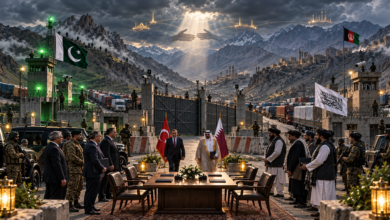
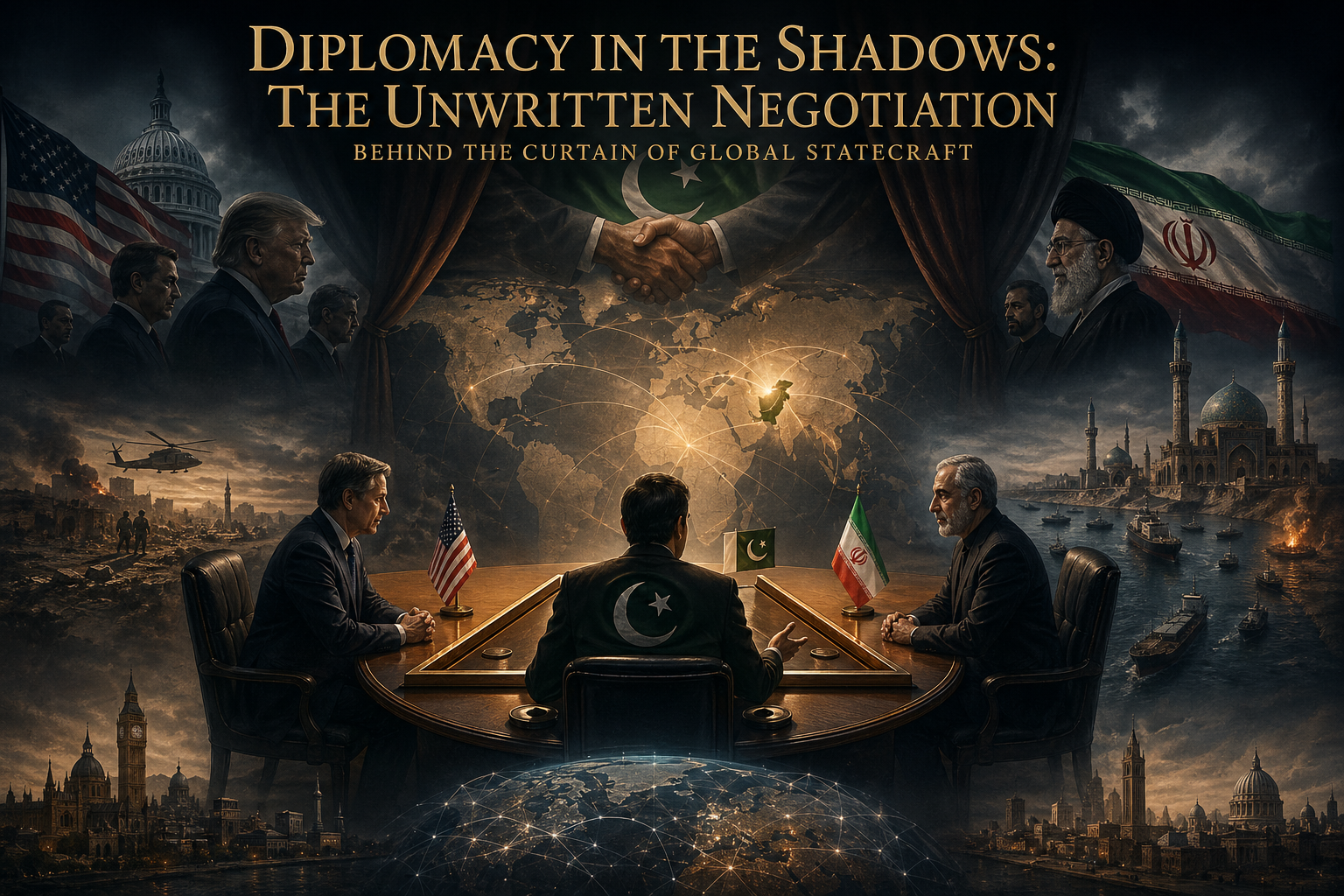
On that particular day, a curious gravity seemed to settle over the air of Islamabad. Within a quiet chamber of the Serena Hotel stood a triangular table—no mere assemblage of wood and craftsmanship, but a potential milestone in the unfolding current of history, and a living metaphor of contemporary diplomacy. Were history capable of assuming a physical form, it might well have chosen such a shape: poised upon three angles yet bound to a single centre; representative of three distinct forces yet compelled towards a precarious equilibrium. This was no ordinary object fashioned by the hand of an artisan; it appeared, rather, as though cast in the crucible of time itself—each of its edges bearing the imprint of a civilisation, a political vision, and a deferred aspiration.
Three sides, three chairs, three flags—an image as though the geometry of the world had momentarily converged upon a single point. There was, in that tableau, an almost symbolic magnetism, as if destiny itself had paused in anticipation of its own signature. The United States, Iran, and Pakistan were present not merely as states, but as embodiments of three competing narratives: power, resistance, and reconciliation. The very structure of the table seemed to disclose a deeper philosophy. The circle, one might say, signifies unity; the square, stability; but the triangle—by contrast—speaks of tension held in balance. It was as though the table itself proclaimed that any dialogue conducted upon it would not proceed along simple lines but would instead unfold as a complex interplay of angles, contradictions, and negotiated accommodations.
The inspection of this table by Field Marshal Asim Munir was not, therefore, a routine gesture of military formality. It carried with it the unmistakable suggestion that Pakistan no longer stands as a mere spectator—or worse, a pawn—within the great game of nations, but has emerged as a participant of consequence, a co-author in the writing of history itself. His gaze appeared directed not at the material surface before him, but at the potential outcomes it portended—outcomes capable not only of reshaping the region, but of redrawing the political contours of the wider world. For beyond the immediate choreography of diplomacy there lingered the more ominous reverberations of threat—echoes that spoke, in stark and unsettling terms, of reducing a civilisation as ancient as Iran to ruin and thereby casting a long and disquieting shadow over the prospects of global peace.
In certain respects, the scene called to mind those earlier moments when history turned upon decisions made within confined spaces—whether at Camp David, Oslo, or Dayton. Yet the table in Islamabad possessed an additional dimension. It was not merely a reflection of shifting balances of power; it was also an assertion of civilisational confidence. It signalled that the making of decisions would no longer remain the exclusive preserve of Western capitals; that the East, too, would speak in its own voice, claim its own space, and negotiate upon its own terms.
And yet, history—like a restless poet—rarely consents to dwell upon a single line. The moment that appears most certain is often the one most vulnerable to dissolution. The table that seemed destined to bear witness to agreement was, in the end, quietly removed. It was as though the final couplet of a carefully composed poem had been abruptly erased. But does that erasure signify an ending? Or merely an interlude—a pause before the narrative resumes, perhaps in a different key, yet with undiminished consequence?
A few days later, when an American journalist crossed the threshold of that same room, he encountered an atmosphere steeped in a peculiar stillness—an air heavy with absence, as though a gathering had been prepared in full splendour, the lamps lit and awaiting, yet no guests had come to partake. The edges of the table had already been dismantled; the flags were being folded away with ceremonial restraint; and in the surrounding silence there lingered the quiet melancholy of an unfinished narrative. An unspoken question seemed suspended in the air: was this a failure—or merely the overture to a greater success yet to unfold?
The absence of the American delegation transformed the entire tableau into something resembling a half-shattered dream. The expected arrivals—Steve Witkoff and Jared Kushner—never materialised; their flights halted before they could complete their journey. Meanwhile, Donald Trump’s oft-repeated assertion—“we have all the cards”—echoed with a curious duality. It bore the cadence of a player who pauses the game, not in surrender, but in the calculated hope of reshaping its terms; a declaration that, on the surface, projected confidence, yet beneath it concealed the careful recalibration of strategy. This was not a simple refusal, but a theatrical interlude—a deliberate pause in which the true narrative was being composed behind the curtain. Indeed, Trump’s statements—outwardly forceful yet inwardly measured—served as a reminder that in politics, words are seldom mirrors of reality; more often, they are its veil.
From the Pakistani airbase, the departing C-17 Globemaster aircraft seemed to bear silent witness to this ostensibly faltering scene. American matériel was being withdrawn, yet the broader chessboard of diplomacy remained very much in play. The movements of the Iranian delegation—from Islamabad to Muscat, then onward again, and eventually to Saint Petersburg—evoked the rhythm of a chess match in which each apparent retreat conceals the preparation of a more decisive advance. The presence of Vladimir Putin within the halls of the Boris Yeltsin Presidential Library suggested that the contest had now outgrown its original confines: no longer a duel between two adversaries, but a far more intricate engagement involving multiple actors. The game, in other words, had not ended; it had merely expanded its field. Diplomacy was no longer contained within a single chamber—it had dispersed across continents.
The global media, true to form, responded with characteristic haste. “Islamabad Process Fails,” “Trump Refuses,” “Iran Tilts Towards Russia”—such headlines betrayed a tendency to apprehend only the surface of events, neglecting the deeper currents beneath. The language of “failure” was readily invoked, yet in truth this moment represented not an end, but a stage—one that pointed towards a more consequential outcome. The projections of Goldman Sachs, the fluctuations in oil prices, and the thinning traffic through the Strait of Hormuz all served as indicators of a crisis that, while outwardly unsettled, was in fact moving—however unevenly—towards a new equilibrium.
The formula advanced by Iran marks a significant inflection in the practice of diplomacy. Viewed with due intellectual care, the situation reveals itself in three discernible layers. The first lies in Iran’s proposal itself—an initiative that signals an unusual and noteworthy departure from established patterns. “Peace first, then nuclear”—the phrase establishes the foundation of a new strategic sequence. The willingness to reopen the Strait of Hormuz and to relinquish certain forms of maritime control constitutes both an admission and an affirmation: that Tehran has introduced a measure of flexibility into its posture, coupled with a recognition that complex disputes may best be resolved in stages rather than as a single indivisible whole.
At first glance, such flexibility might be mistaken for retreat; in reality, it reflects a deliberate and time-honoured strategy. Even in warfare, a step backward may serve as the prelude to a more decisive advance. This evolution is far from trivial. Iran, which once bound its concerns into a single, unyielding chain, now appears willing to disentangle them—to address each issue within its own distinct frame. It is, in essence, a form of intellectual maturation, a hard-won composure forged in the crucible of experience.
The second layer resides in the thinking of American strategic circles. It is for this reason that formulations such as “open for open” are being accorded serious consideration—a reflection not of idealism, but of pragmatic realism. For the United States, energy prices are never merely economic; they are deeply political. As elections approach, the cost of fuel becomes, in effect, a matter inscribed upon the ballot itself. Iran seeks to sell its oil; the United States seeks to stabilise prices. Their needs, though shaped by different impulses, converge upon a common ground. It is here that interest begins to outweigh ideology.
Analyses emanating from institutions such as the Center for Strategic and International Studies, particularly the notion of a “paradoxical equilibrium,” illuminate the deeper essence of this contest. Power, in this conception, is not defined solely by military superiority; it is equally a function of endurance, patience, and strategic restraint. Iran, in this instance, appears to be exercising a distinct form of power—one grounded less in immediacy than in persistence. Pressure is applied; pressure is answered; yet both sides are acutely aware that such a contest cannot extend indefinitely. In this arena, patience itself becomes a weapon—and it is one that Iran seems particularly adept at wielding.
Herein lies the central paradox of the crisis. Iran possesses fewer resources, yet greater patience. The United States commands vast resources yet is constrained by time. It is at precisely this juncture that Trump’s oft-invoked “trump card” appears less decisive than it might once have seemed. Power, after all, is not merely the accumulation of means; it is also the capacity to endure. The American public cannot indefinitely absorb the pressures of inflation, whereas Iran’s historical experience has cultivated a certain resilience—a long familiarity with hardship borne in the name of continuity. This divergence—between abundance and endurance—may yet prove the decisive factor in this intricate game of statecraft.
The third layer, perhaps the most revealing of all, lies in the language of official statements. When Marco Rubio observed that “the offer is better than expected,” he was doing more than offering a casual assessment. Such phrasing belongs to the subtle lexicon of diplomacy, in which rejection and invitation often coexist within the same utterance. It was, in effect, an acknowledgment that the door remains ajar—a gesture not of outright acceptance, but of conditional openness. In that carefully measured sentence lay the quiet assurance that the conversation, far from concluded, was still very much alive.
Reports emanating from global media outlets, when read with a measure of discernment, serve not to negate but rather to reinforce the impression that the real negotiations have never ceased. The distances between the parties, though outwardly apparent, are in truth narrowing; and a phased agreement—incremental in form yet substantial in implication—appears to be taking shape. It is, in essence, the very conception advanced by Iran, now finding a cautious echo among American analysts. This is the world as it truly operates: not in the glare of cameras, but in the quiet discretion of closed rooms, where the architecture of decision is patiently assembled.
Why, then, was that triangular table removed? The answer lies in a principle as old as politics itself: perception often outweighs reality. In Donald Trump’s political method, drama is not an accessory but an instrument. He denies before he affirms; he rejects before he reclaims the same proposition as his own triumph. It is a familiar stratagem—first the refusal, then the acceptance, recast as victory. The performance is as deliberate as it is calculated, designed to persuade a domestic audience that concession has not been made, even when agreement lies just beyond the horizon.
Within this unfolding drama, Pakistan’s role emerges with increasing clarity and consequence. Iran’s confidence in Islamabad, coupled with continued US engagement—and reinforced by Trump’s repeated praise of Pakistan’s leadership, including its prime minister and Field Marshal Asim Munir—confirms a subtle but significant transformation. Pakistan is no longer defined by geography alone. It is taking shape as a diplomatic identity, one that commands widespread international recognition.
Whether the negotiations are conducted in Islamabad or Muscat is, in the final analysis, of secondary importance. The venue may change; the necessity does not. The process itself has not concluded—it has merely entered a new phase. Its methods may evolve, its locations may shift, yet its purpose remains constant. Russia, Oman, and other actors are increasingly drawn into the orbit of this engagement, enlarging both its scope and its complexity.
This conflict, if such it may be called, is singular in its nature. Its conclusion, in broad outline, appears already discernible; yet its stages are marked by a complexity that both obscures and enriches the path towards that end. For all the theatre, the volatility, and the apparent uncertainty, the underlying necessities are too compelling to sustain indefinite confrontation. History, in its long memory, offers a consistent verdict: necessity, in the end, prevails over spectacle.
Iran’s endurance and calculated resistance have already begun to alter the prevailing global narrative, unsettling established balances and compelling a reassessment of power itself. The question is no longer simply who is stronger, but who can persist longer. Meanwhile, within the Middle East, a more searching inquiry has begun to take shape among its peoples: whether the United States stands as a guarantor of their security, or as an instrument of other priorities. This question transcends the merely political; it reaches into the realms of civilisation and collective consciousness.
At the heart of the matter lies a deeper and more consequential inquiry: does this crisis herald the emergence of a new global order, one in which regional powers assume a more decisive role? The prospect appears increasingly plausible. China, Russia, and a constellation of regional alignments may yet lay the foundations of a reconfigured equilibrium. Within this evolving landscape, Pakistan, particularly in the Middle East, seems poised to assume a role of growing significance—its strategic commitments and regional engagements suggesting a trajectory that extends well beyond its traditional confines.
When history approaches one of its defining moments, it ceases to be a mere sequence of events and becomes, instead, a lesson in profound lessons. It forces us to reconsider the nature of power, the limits of interest, and the moment in which collective reason turns away from the path of negotiation and toward the path of accommodation. The current situation offers a living example of this process: beneath the surface of tension, danger, and uncertainty, a quiet movement persists—one that steadily, if imperceptibly, tends toward stability.
It is a truth increasingly evident that in the modern world no conflict can endure indefinitely. The interlocking chains of economic dependence, the imperatives of energy, and the dense fabric of global interconnection render prolonged confrontation not merely costly, but ultimately untenable. Under the weight of its own contradictions, conflict gives way to conciliation. It is this principle that, sooner or later, compels even the most reluctant adversaries to face one another across a table—however empty that table may momentarily appear.
Another dimension of this unfolding reality lies in the construction of narrative itself. Nations and leaders who succeed in articulating a coherent, persuasive, and resonant narrative are those who shape the currents of global opinion. War, in our time, is waged not only along borders but within minds—across perceptions, ideas, and interpretations. Victory, therefore, belongs not merely to those who command resources, but to those who can sustain a delicate balance between reality and perception.
For Pakistan, this is not a moment for passive observation, but for considered action. As a responsible and increasingly engaged state, its success will depend upon its capacity not only to comprehend the shifting contours of global politics, but to act upon them with foresight and deliberation. Diplomacy must not remain confined to reaction; it must be elevated into a proactive and shaping force.
In the final reckoning, the world seems to be passing through a phase in which every conflict carries within it the seeds of its own solution. The volatility of circumstances, the intensity of rhetoric, and the uncertainty of the moment are undeniable. Yet the deep current of history tends toward balance. It is this balance that maintains the continuity of civilization, and it is from this balance that a new order, a new structure, and a new hope inevitably emerge after every major crisis.
Thus, one may say, without undue exaggeration, that the world now stands at a juncture where every actor seeks not only to make a move, but to enhance his own value within the game. The marketplace is animated; the bargaining continues; yet the conclusion is inescapable—agreement must, in time, be reached. And when that agreement is finally struck, history will once again bear witness to a familiar truth: it is not power that prevails, but necessity. And it may well record, alongside the cities where peace has altered the course of events, the name of Islamabad—inscribed among those places where the direction of history itself has been quietly, yet decisively, transformed.