New World Order
History Turns

Time never stands still. The wheel of history is in perpetual motion. Yet there are moments in which its momentum gathers such momentum that events, with startling intensity, cover the distance of centuries in a moment-by-moment span. This is why the theater of world politics has sometimes resembled a restless river – sometimes appearing calm on the surface, but at others swelling into a mighty and uncontrollable torrent. Our age is not simply an age of events. It is an ocean of meaning, the depths of which must be given voice if the tumult of its waves is to be understood.
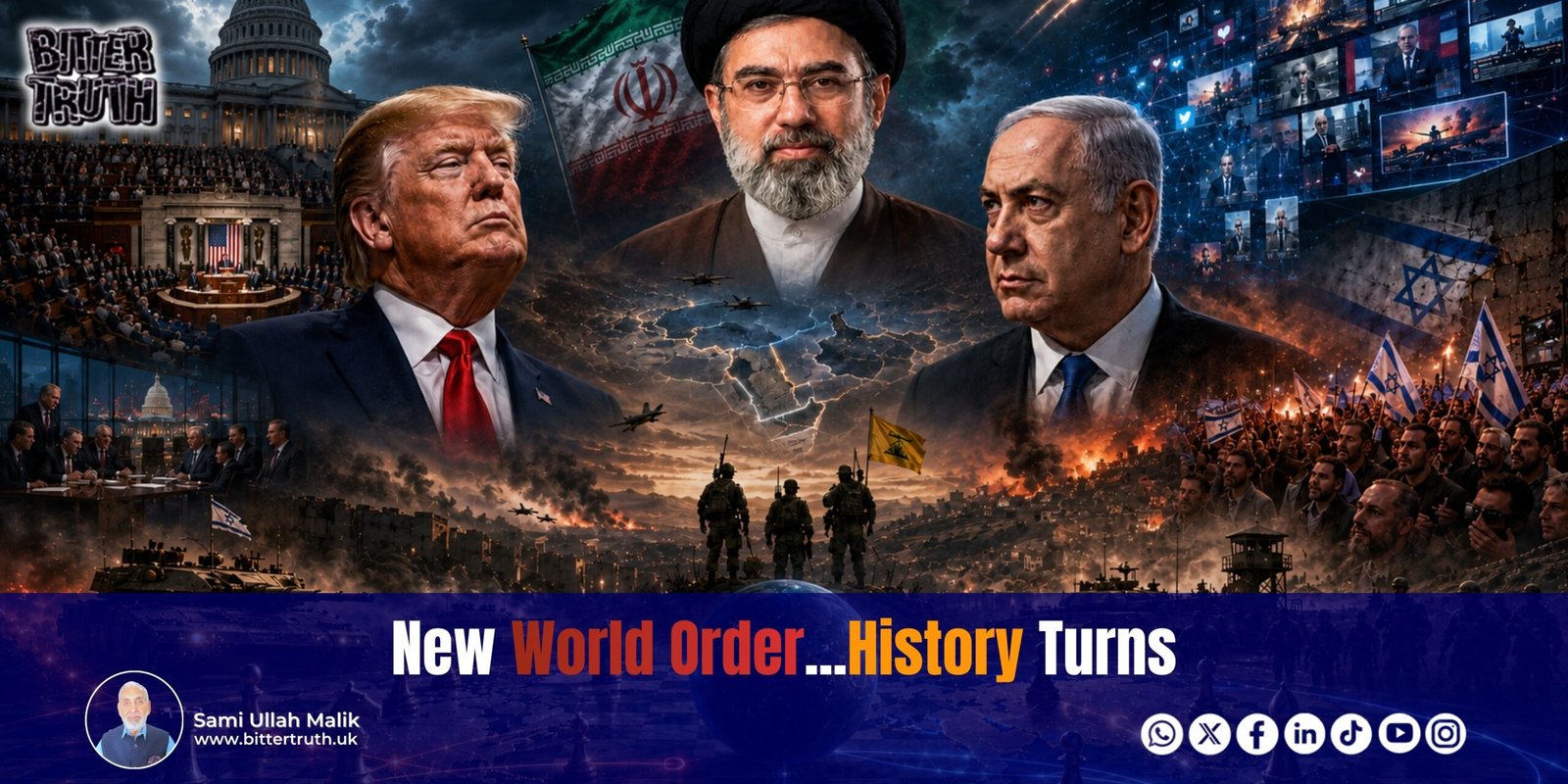
In the third decade of the twenty-first century, the loci of power are undergoing a profound reconfiguration. The grammar of power politics, long cast in familiar moulds, is being recast into new and uncertain forms. The contemporary global landscape offers a striking illustration: the tensions between the United States, Iran, and Israel transcend the bounds of routine diplomacy and instead suggest the early tremors of a reconstituted international order. What unfolds among these three states is no ordinary contest; it is a layered and intricate narrative in which not only military strength, but also narrative construction, diplomatic manoeuvre, and domestic political calculus play decisive roles. This is not merely a triangular dispute—it is a moment in the making of a new world order, wherein old axioms falter and new principles remain yet indistinct.
Within the architecture of the state, the concentration of power has long been regarded as a portent of danger. Recent developments in the United States Senate reflect the enduring vitality of self-corrective mechanisms within modern democracies. The American constitutional design rests upon the deliberate diffusion of authority, ensuring that no single institution might assume unbridled dominion. The recent resolution appears, in this light, as a renewal of that founding philosophy—an instance in which the legislature has sought to interrogate the ambit of executive power. By conditioning military action against Iran upon legislative approval, it affirms the principle that the decision for war must not rest upon the will of an individual, but rather upon the sanction of a collective political conscience.
To interpret this senatorial action as a mere procedural gesture would be to diminish its true significance. Presidential war powers have long stood at the centre of American political debate, yet in the context of a potential confrontation with Iran, the question has resurfaced with renewed urgency. At its core lies an ancient constitutional dilemma: should the authority to wage war reside in the hands of a single executive, or within the deliberative councils of representative institutions? The issue, therefore, extends beyond Iran itself; it touches the very spirit of American democracy. It invites reflection upon whether the restraint of power constitutes the strength of the state—or its vulnerability.
The resolution passed by the Senate stands, in effect, as a reaffirmation that in a democratic polity, sovereignty is not embodied in an individual but in its institutions. Its passage—secured by the narrow margin of 50 votes to 48—is no mere arithmetic; it is the visible expression of a deeper intellectual contest, wherein power and accountability stand in uneasy opposition. In this sense, it serves as a reminder that the decision for war is not solely an impulse of authority, but a solemn act requiring the endorsement of a nation’s collective will.
Politics has often shown that decisions appearing inconsequential on the surface may, in truth, carry profound implications. History bears witness to resolutions whose importance derives less from their legal force than from their moral weight. This measure, too, may be understood as a kind of parliamentary whisper—subtle in tone, yet resonant in implication. It is a lamp that may not banish the darkness entirely but nonetheless challenges its dominion.
Though lacking binding legal force and outwardly limited in effect, the resolution emerges as a form of silent dissent. In politics, symbols frequently possess a potency that surpasses material realities, and their presence alone may constitute a decisive signal. Like the unseen current beneath a placid river, this act reveals the latent tensions within American political life. It communicates a message less through words than through its very existence.
Its endorsement in the House of Representatives further signals a discernible division within the American political elite. The resolution thus assumes the character of a quiet protest—one articulated not in the formal language of law, but through the subtleties of political gesture. It conveys the enduring truth that dissent is not a flaw within democracy, but its very ornament; it is the force that prevents power from slipping into excess.
President Donald Trump’s response to the resolution reflects the posture of a leader who conceives himself as an architect of history—one who presents his strategy as poised upon the threshold of triumph. His statements carry both the cadence of victory and the undertone of political grievance: the confidence of a victor interwoven with the irritation of a statesman constrained. The intensity and assurance of his rhetoric exemplify a broader tendency in contemporary politics, wherein narrative often assumes precedence over empirical reality. He casts himself as a figure capable of redirecting the course of history, suggesting that absent obstruction, the outcome would have been markedly different.
Such a mode of expression belongs as much to political psychology as to political argument, wherein the assertion of success becomes its own justification. Yet while the imagination of victory may sustain itself rhetorically, it does not always withstand the test of material reality. His words evoke a tableau in which success lay within reach, thwarted only by political impediments. He speaks of bringing Iran to the brink of defeat, as though the contest were not merely strategic but also a matter of personal stature. And yet, in politics, the conditional—those persistent “ifs” and “buts”—never wholly disappear; history retains its prerogative to adjudicate such claims.
The question of war powers has long occupied a sensitive place in American history, rooted in a constitutional ethos that privileges the division of authority. Since 1973, a renewed debate has emerged, underscoring the persistence of foundational questions despite the passage of time. Indeed, this marks the first occasion since the War Powers Resolution of that year that Congress has raised such a collective voice. It is a reminder that democracy is not a settled verdict, but an ongoing conversation—one that evolves through contestation rather than closure.
The present developments stand firmly within this enduring tradition, reinforcing the truth that democracy is not confined to the ritual of elections, but is instead defined by the delicate equilibrium of institutions. The limitations placed upon war powers in American law are not mere clauses inscribed in statute; they are the distilled outcome of historical experience. These constraints were conceived to ensure that force is exercised not in the heat of impulse, but under the discipline of reason. History, it seems, is repeating itself—albeit with new actors and in a changed idiom. The statutory framework, with its sixty-day limit and provision for a thirty-day extension, serves as a sober reminder that wars are waged not only upon battlefields, but also within the architecture of constitutional order. Yet the enduring question remains: does practical politics ever remain wholly obedient to such restraints?
The relationship between the United States and Israel has long been regarded as both steadfast and exemplary. Yet the recent criticisms voiced by J. D. Vance, coupled with visible unease within the Israeli leadership, reveal an abiding truth: alliances in global politics are governed by interests rather than sentiment. Where foundations are laid upon interest, even the slightest divergence may widen into a fracture. Recent tensions have made plain that no alliance is immutable; every relationship rests upon shifting priorities, and as interests evolve, so too do allegiances. Even the most enduring partnerships are subject to strain when subtle differences emerge, for within every alliance lies a fragile balance. Once that balance is disturbed, even the strongest ties begin to weaken.
There exists, moreover, a curious paradox: the more powerful a state becomes, the more it finds itself reliant upon its allies. The American role in sustaining Israel’s military strength illustrates this contradiction with striking clarity—that dependence and autonomy may coexist, yet rarely in perfect harmony. The remarks of the American Vice President gesture toward this complex reality: even powerful allies remain interdependent, and yet the question of self-respect persists undiminished.
Thus, the Vice President’s observations bring into sharper relief a central truth of international relations—that autonomy and dependence move in tandem, often generating tension within the very fabric of alliances. His statement reflects, with a certain candour, the reality that a significant portion of Israel’s military capacity is intertwined with American resources. This is not merely a matter of defence assistance; it is a relationship structured by asymmetry, in which the balance of power is neither fixed nor equal. It reminds us that the architecture of power is frequently sustained through networks of cooperation, even as it engenders latent unease.
Vance’s admonition to Israeli ministers to exercise restraint—couched in language of measured counsel—constitutes, in truth, a message of considerable firmness. In the realm of international politics, words are never mere vehicles of expression; they are instruments of strategy. The gentleness of his phrasing conceals the sharpness of its intent, rendering the message both palatable and unmistakable. This is the hallmark of modern diplomacy: the capacity to convey severity through civility, to deliver hard truths in softened tones. Here, language appears tempered, yet its meaning carries a keen and deliberate edge.
In the Middle East, the balance of power remains in constant flux, and each new pronouncement becomes another thread in an unfolding tapestry of change. President Trump’s reference to Syria in the context of Israeli operations in Lebanon constitutes a signal of unusual significance. Does it point towards an emerging recalibration of regional power, or is it merely an ephemeral utterance? In politics, questions often possess greater weight than their answers. Nevertheless, the statements emerging in relation to Lebanon and Syria suggest that a new strategic design may be taking shape. Each move appears as part of a larger design, each step laying another piece upon a board whose full pattern remains obscured.
When one state extends sustained support to another, expectations inevitably arise in return. These expectations, however, may themselves become the seeds of discord, particularly when they collide with the instinct for sovereignty. It is in this tension that disagreement often finds its origin, as recent statements have made abundantly clear. President Trump’s exhortation that Israel ought to express gratitude forms part of a broader diplomatic narrative, signalling a widening divergence that observers are now increasingly willing to acknowledge.
The persistence of skirmishes despite formal ceasefire arrangements underscores a fundamental reality: agreements are often subordinate to conditions on the ground. So long as underlying disputes remain unresolved, peace is but a temporary interlude. The casualties in southern Lebanon stand as a stark testament to this truth—that agreements may be written upon paper, yet wars are decided upon the earth itself. Such clashes reveal that formal accords cannot, in themselves, transform entrenched realities. Power ultimately manifests where action unfolds. The continuing confrontation between Hezbollah and Israeli forces deepens the region’s complexity, reminding us that a ceasefire does not necessarily herald peace; more often, it marks a pause in which both sides gather strength. The situation in Lebanon is but a reflection of this enduring pattern.
The statements issued by Hezbollah and Israel alike depict a confrontation in which both parties remain resolute in their respective positions. Israel’s decision not to withdraw its forces lays the groundwork for a conflict whose outcome remains veiled in uncertainty. Conversely, Hezbollah’s stance signals that resistance is not merely a military posture, but an ideological commitment—one born not solely of circumstance, but of conviction. It is this very conviction that sustains its continuity, and it is this steadfastness that serves to prolong the conflict.
The mounting domestic pressure upon Benjamin Netanyahu serves as a pointed reminder that behind every external conflict there lies an internal political theatre. Public opinion and the force of political opposition frequently exert a decisive influence upon the direction of policy. Netanyahu’s predicament illustrates with clarity that decisions taken upon the world stage are seldom insulated from domestic constraint. A statesman must contend not only with threats beyond his borders, but with dissent within them. In this interplay, public sentiment and political survival are inextricably entwined—and it is often this nexus that proves most determinative.
The pronouncements of Itamar Ben-Gvir embody a strain of extremity—a disposition that seeks resolution through the unrestrained application of force. Such a temper of mind does not merely intensify conflict; it forecloses the avenues of diplomacy altogether. His rhetoric carries a severity that closes doors which, once shut, are not easily reopened. In this manner, such an outlook renders disputes more intricate, more intractable, and more perilous.
Yet within any democratic society, dissenting voices serve as instruments of correction rather than disruption. The critical currents emerging from within Israel itself stand as testament to the proposition that dissent is the lifeblood of reform. That voices have arisen calling even for a change of leadership suggests that unease has begun to permeate the very chambers of power. It is in such moments that the vitality of democracy reveals itself—not in unanimity, but in principled disagreement.
Yair Lapid’s warning, in this context, assumes the character of a political alarm—an admonition that imbalance in policy may invite international isolation. Should the present course remain unaltered, such isolation may come to constitute the gravest threat to Israel’s long-term security. Implicit within this caution is the suggestion that the removal of Netanyahu from the political stage may, in the eyes of some, appear not merely desirable, but necessary.
Avigdor Lieberman’s position, meanwhile, reflects a calculated effort within Israeli politics to distinguish between the theatres of Iran and Lebanon, thereby preserving strategic flexibility. His stance also underscores a fundamental truth: that every state, irrespective of external pressure, places its national interest above all else. Even the weight of international opinion must, at times, yield before the imperatives of domestic policy.
Where parties decline to recognise the binding force of an agreement, it is reduced to little more than a written artefact. Such appears to be the case here. Ben-Gvir’s assertion that the agreement holds no authority lays bare a central weakness of international accords: their efficacy depends ultimately upon the willingness of parties to abide by them. Absent that commitment, they remain but words upon paper.
President Trump’s direct criticism of Netanyahu, coupled with the shifting posture of European leaders, has elicited from the Israeli Prime Minister a response marked by studied caution. It is the reply of a seasoned, if calculating, political figure—one acutely aware that in diplomacy every word carries weight, and every utterance may find its place in the ledger of history. His language reflects a careful calibration, intended to preserve equilibrium amid gathering uncertainty.
In the digital age, the discourse that has spread across social media platforms provides compelling evidence that diplomacy is no longer confined to the seclusion of closed chambers. Instead, it has moved into the public sphere, where statements are subject to immediate scrutiny and reaction. In this environment, narratives are not simply crafted – they are contested, reshaped, and disseminated with unprecedented speed, shaping public opinion in almost real time. Thus, diplomacy itself has taken on a more participatory, and at times more volatile, role.
Expert assessments suggest that, notwithstanding the severity of public statements, immediate shifts in policy remain unlikely. What we may be witnessing is, in part, a contest of psychological endurance—a struggle in which the object is not solely material advantage, but the erosion of the adversary’s resolve. It is, in essence, a war of words. Yet history cautions that words are seldom innocuous; at times, they become weapons in their own right, capable of reshaping reality itself.
Dominic Michael’s analysis offers a glimpse into a possible future in which the United States may seek to exert increased pressure upon Israel. Prospective sanctions or delays in the provision of arms represent instruments of influence that may yield tangible effects without recourse to open conflict. Such measures have become among the most effective tools of modern diplomacy—means by which the consequences of war may be approximated without its overt prosecution.
Taken together, these strands form a picture at once intricate and coherent, revealing the dynamics of global politics in their full intensity. It is a tableau in which power, principle, and interest are engaged in a delicate and perpetual contest, bound together in a complex and shifting equilibrium. The international arena begins to resemble a chessboard: each piece possesses its significance, yet the essence of the game lies in strategy rather than mere position.
The ongoing tensions between the United States, Iran, and Israel thus emerge as part of a broader transformation—one in which conflicts are waged not only upon physical battlegrounds, but within minds, narratives, and institutions. This is no mere contest of strength; it is an encounter shaped by civilisational, intellectual, and political forces alike. One is left with the sense that history stands upon the threshold of a new chapter—one in which victory will not belong solely to the most powerful, but to those who possess the wisdom, balance, and discernment to navigate this intricate and evolving contest.
In such an age, wars will be fought not only with arms, but with words, agreements, and narratives—and triumph will belong to those who command mastery across all these domains. The tensions among the United States, Iran, and Israel are but a manifestation of this wider transformation, one that will shape the trajectory of global politics in the years to come. It would not be an exaggeration to suggest that we have entered an era in which conflicts unfold as much within the realm of ideas and institutions as upon the field of battle. It is here, perhaps, that history is even now preparing the contours of its next chapter.
If the entire panorama were to be distilled into a single proposition, it might be said thus: this is an age in which wars are waged less by the gun than by the narrative—and victory belongs to those who can command not only the field, but the mind.