Behind the Fear
History’s Other Face

Between Veils and Fears
On Europe’s Muslims, the witness of history and the politics of fear
An article published in The Economist on 12 September 2026, “Between Veils and Fears”, describes the concerns of some European officials about political Islam and extremist organisations. It also quotes politicians who present the very presence of Muslims as a threat to European society. Yet the article acknowledges that very few of Europe’s Muslims seek to undermine democracy from within. Fairness therefore forbids us to dismiss the whole piece as a single indictment of Muslims. A question nevertheless remains: what happens to millions of people when scrutiny of particular organisations is accompanied by a language of suspicion directed at their identity, worship and ordinary lives?
This is more than a question about journalism. It concerns the moral terms of citizenship. The law may investigate a person’s conduct, and politicians may criticise doctrines that would deny others their rights. But a Muslim woman’s headscarf, a family’s celebration of Eid, a neighbourhood mosque or a young person’s religious commitment is not, in itself, evidence against democracy. When suspicion spreads so far that harmless religious practice appears to require a defence, the scales of justice have tilted before the evidence has been weighed.
European debate often places “Islam”, “Muslims”, “Islamism” and “violent extremism” in close company, although they carry different meanings and different consequences in law. A religion concerns belief and worship. A political ideology may express a view about the ordering of state and society. Violence is an act for which a person can be held accountable. Giving all three the same name does not make an inquiry easier; it makes its conclusions less trustworthy.
The article itself supplies grounds for making these distinctions. It reports official concerns about certain individuals and organisations, while also citing observers who question the scale of the danger. It shows, too, that some voices in Europe’s populist movements have travelled far beyond the surveillance of particular groups to attack mosques, the call to prayer and the right to be Muslim. It is at this point that legitimate disagreement may curdle into collective suspicion.
If an organisation is genuinely attempting to weaken democratic institutions through deception or coercion, evidence should be gathered, action taken under the law and the possibility of judicial review kept open. But to transfer an allegation against an organisation to the neighbour, shopkeeper, teacher, student or doctor is neither sound reasoning nor justice. People must be judged by their own actions. To keep an entire religious community perpetually on its defence wounds the principle of equal citizenship.
British figures offer some measure of the human cost of that climate. In the 2021 census of England and Wales, approximately 3.9 million people identified as Muslim, representing 6.5 per cent of the population. Official figures recorded 4,478 religious hate crimes targeting Muslims in the year ending March 2025. Statistics cannot tell us what every individual has endured. They do establish that hostility to Muslims is more than a term of debate: it has real victims.
Hatred does not always arrive with a stone in its hand. Sometimes it comes as a persistent
insinuation: these people are unlike us; there must be some design behind their worship; their silence is suspect, and so is their protest. In such a climate, a citizen is expected to work, obey the law and be a good neighbour, yet still furnish fresh proof of innocence each morning. No free society should make that demand.
Who helped rebuild Britain?
After the Second World War, Britain needed workers, services and industrial production. People already living in the country took part in its reconstruction, as did arrivals from across the Commonwealth. Significant numbers of Pakistani migrants found work in the textile industries of West Yorkshire and Lancashire, particularly in towns such as Bradford. Members of other communities worked in transport, factories and healthcare. Historic England has documented this labour and its place in Britain’s past.
Here, too, history ought not to be simplified for the sake of a slogan. Britain’s industries were not rebuilt by Muslim migrants and workers from abroad alone, nor did all those workers share one faith. Reconstruction was a long, complicated and collective undertaking. The sounder—and stronger—point is that many migrants from Muslim backgrounds had a part in it. To consign their earnings, their night shifts and the generations their children raised to the margins of the national story would be an injustice.
The history of the National Health Service tells a similar story of shared service. In its early years, workers from overseas played an important part, notably the Windrush generation from the Caribbean. Muslim migrants, too, belong in the account; the larger lesson is that people of many backgrounds helped sustain Britain’s public institutions. Anyone inclined to file the whole history of migration under the heading of “threat” should also read the history of the institutions on which they rely each day.
The roots of this shared history reach back into wartime. During the Second World War, the army of undivided India grew to approximately 2.5 million. Its soldiers came from different religions and peoples, and their experiences cannot be pressed into one simple, uniform story. Still, we should remember that the history of Europe’s freedom and of the war effort was not written on European soil alone. People from the subcontinent have their place in its pages.
History may rightly prompt gratitude. Citizenship, however, cannot rest on ancestral service. A Muslim’s rights to worship, expression, education and safety do not depend on whether a grandfather worked in a mill. Those rights belong to that person as an equal human being and citizen. Past contributions illuminate the claim; they do not create it.
What does the history of war tell us?
It is equally false to suggest that Islam, or Muslims as a whole, are the source of war and disorder. History writes neither a perpetual acquittal for one civilisation nor a perpetual charge sheet against one religion. The appetite for power, the seizure of territory, racism, state violence and religious prejudice have appeared in different ages and under different authorities.
The history of more than a century makes plain that the world’s deadliest wars cannot be attributed to the nature of a single faith or people. Rival empires plunged the world into bloodshed in the First World War. Nazi Germany’s aggression and imperial Japan’s expansionism subsequently made the Second World War a catastrophe in which, by one estimate, around 60 million people died. The Nazi regime and its collaborators systematically murdered approximately six million Jews. Islam and Muslims had no part in perpetrating the Holocaust. China and other parts of Asia and the Pacific, meanwhile, paid a terrible price for Japan’s campaigns.
In later decades, the wars in Vietnam, Afghanistan and Iraq uprooted countless families. During the Soviet and American wars in Afghanistan, the article’s account puts Afghan deaths at more than six million and Pakistani deaths at over 100,000. These events should be remembered to understand how war must be judged: by the decisions of rulers, the conduct of armed forces and the consequences of their actions, not by pronouncing every member of a nation guilty. Nor is it accurate to describe the total number who died in a war as the number directly killed by one country. An honest reading of history defeats the claim that Islam or Muslims collectively bear responsibility for the world’s wars and ruin. Wherever an atrocity occurs, responsibility must be assigned, on evidence, to the people and centres of power concerned—not to an entire religious population.
In Rwanda in 1994, more than 800,000 people were killed in the genocide against the Tutsi; the dead also included moderate Hutu who opposed the violence. To understand such destruction, we must examine propaganda, power and organised brutality. History repeatedly warns that depicting a population as an imagined danger can prepare the ground for real cruelty. These events should not be treated as interchangeable. We should nevertheless recognise the habit of thought that turns human beings, with names and faces, into emblems of fear.
The genocide of Muslims at Srebrenica in Bosnia, and the international judicial record concerning it, offer another reminder: in Europe’s modern history, Muslims have been more than the subject of argument; they have also been victims of grave injustice. To recall that tragedy is not to diminish another. It is to affirm a principle: every life has equal sanctity, whatever name a person gives to their place of worship.
In verse 32 of Surah al-Ma’idah, the Qur’an likens the killing of one innocent person to the killing of all humanity, and the saving of one life to the saving of all humanity. It is an exacting moral standard. Those who invoke it should be candid enough to measure the conduct of Muslim societies against it as well. The moral force of a religious teaching becomes credible in public life when it takes the form of mercy, trustworthiness and justice towards others.
A person who disagrees with Islam has every right to ask questions. Religious injunctions, interpretations of history, organisational demands and political doctrines may all be openly debated. But a question differs from an accusation. A question seeks an answer; an accusation arrives with its verdict already written. Serious criticism tests the evidence for a claim. Prejudice looks at the claimant’s name before hearing the claim.
Dialogue is necessary within Muslim societies, too. Defending religious freedom cannot excuse disregard for women’s voices, young people’s questions, the rights of other faiths or the standing of those who dissent from religion. Islamic teaching contains provisions concerning the rights of minorities. If a Muslim citizen claims freedom of conscience, that citizen must accept the same principle of equality for others. Equality is a lamp whose light cannot be confined to one’s own doorstep without eventually going out.
The best answer to the concerns raised in the article is not to dismiss every concern as bad faith.
Where there is verifiable evidence of violence, intimidation, deceit or the misuse of institutions, there should be independent investigation. Where the matter is merely religious conservatism or an unpopular opinion, a democratic society must show that it can tolerate disagreement. An uncertain boundary in the law tends to fall first upon the least powerful. The law must therefore be clear, proportionate and applied equally.
Fear is a commodity that pays quickly in politics. It takes work to explain the tangled causes of economic hardship, housing shortages or pressure on public services. It is easier to give all these troubles the face of a recognisable minority. A slogan takes the place of figures; a provocative image eclipses the life of an entire neighbourhood; and the voter is presented with an invented culprit in place of the problem itself.
None of this settles every political disagreement. The pace of migration, housing, employment, education and social cohesion all deserve serious discussion. Nor should the difficulties faced by local communities be waved away as mere prejudice. But discussion can be useful only when a problem is called by its proper name. A person at prayer cannot be made to answer for a failure of housing policy; the offence of one individual cannot be charged to an entire people or religion.
The responsibility of the media is correspondingly greater. Journalism has no duty to conceal a danger. It has a duty to establish its extent, its evidence and its context. If a report describes organisational activity attributed to a few dozen people alongside the lives of millions of ordinary Muslims, readers should be able to see the distance between the two. Otherwise, every figure may be accurate while the overall impression misleads. The choice of words is more than a matter of style: it may shape how a pupil regards a classmate, or the feeling with which one neighbour knocks on another’s door.
Official British guidance also distinguishes hostility towards Muslims from legitimate criticism of religious beliefs. Protecting that distinction serves everyone. It allows Muslim citizens to seek protection against hatred and harassment, while leaving others free to express their views on religion and politics. A free society needs more discernment than a slogan can provide if it is to uphold both rights.
Europe’s Muslim population has no single face. Its members speak different languages, inherit different histories and understand their religion in different ways. Some have only recently arrived; others were born in the same city in which their parents and grandparents lived. To erase that variety and fashion an imaginary figure called “the Muslim” is first an offence against knowledge, and then an injustice to people.
Muslims, for their part, need not build walls around themselves. Neighbourhood associations, schools, hospitals, local government and the ordinary intercourse of daily life are places where the haze of unfamiliarity can lift. Dialogue has meaning when difficult questions are allowed, but no participant is presumed guilty before speaking. The defence of rights and the discharge of civic responsibilities grow from the same tree.
Perhaps this is the central test of our time: can we investigate danger without surrendering justice? Can we protect religious liberty while opposing violence and coercion without qualification? Can we remember the labour we have shared in the past while speaking plainly about the real problems of the present? No newspaper, party or community possesses the whole answer. Society must write it together in the way it behaves.
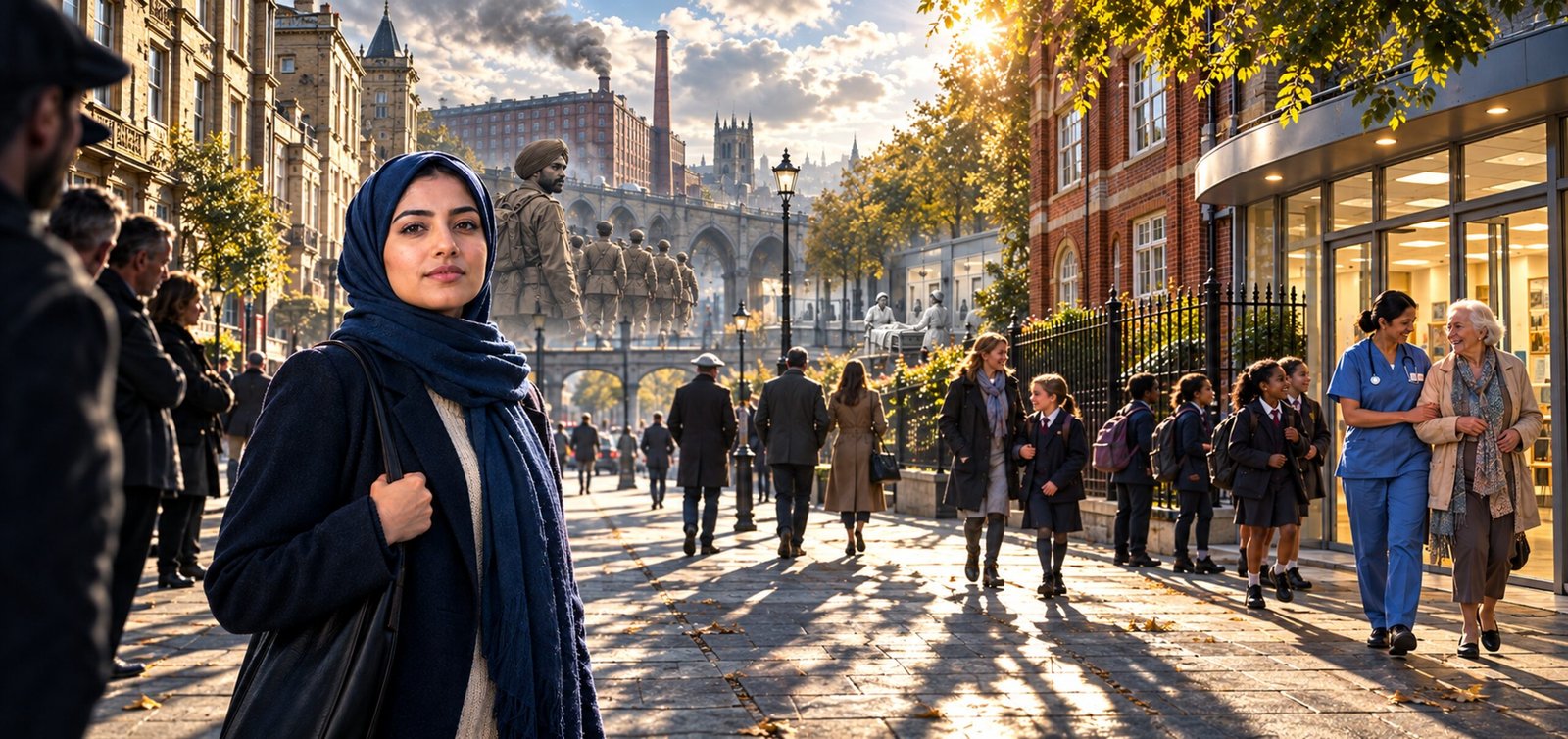
The hands that worked in Britain’s mills, the health workers who stood beside the sick, the children going to school, the families setting out to worship and the citizens who keep the law are all part of this country’s living portrait. It contains disagreement, frailty and hope. To cover it with the dark paint of an imagined threat would be faithful neither to history nor to the future.
To bring fear before the bar of reason is wise. To turn fear into a political weapon aimed at other human beings is not. Whether the veils are garments or the prejudices drawn across our own eyes, justice begins when we see the person beyond them.