Narratives, Secrets, and the Global Game

Power, Secrecy, and the Burden of Proof: A Reflection on Our Age
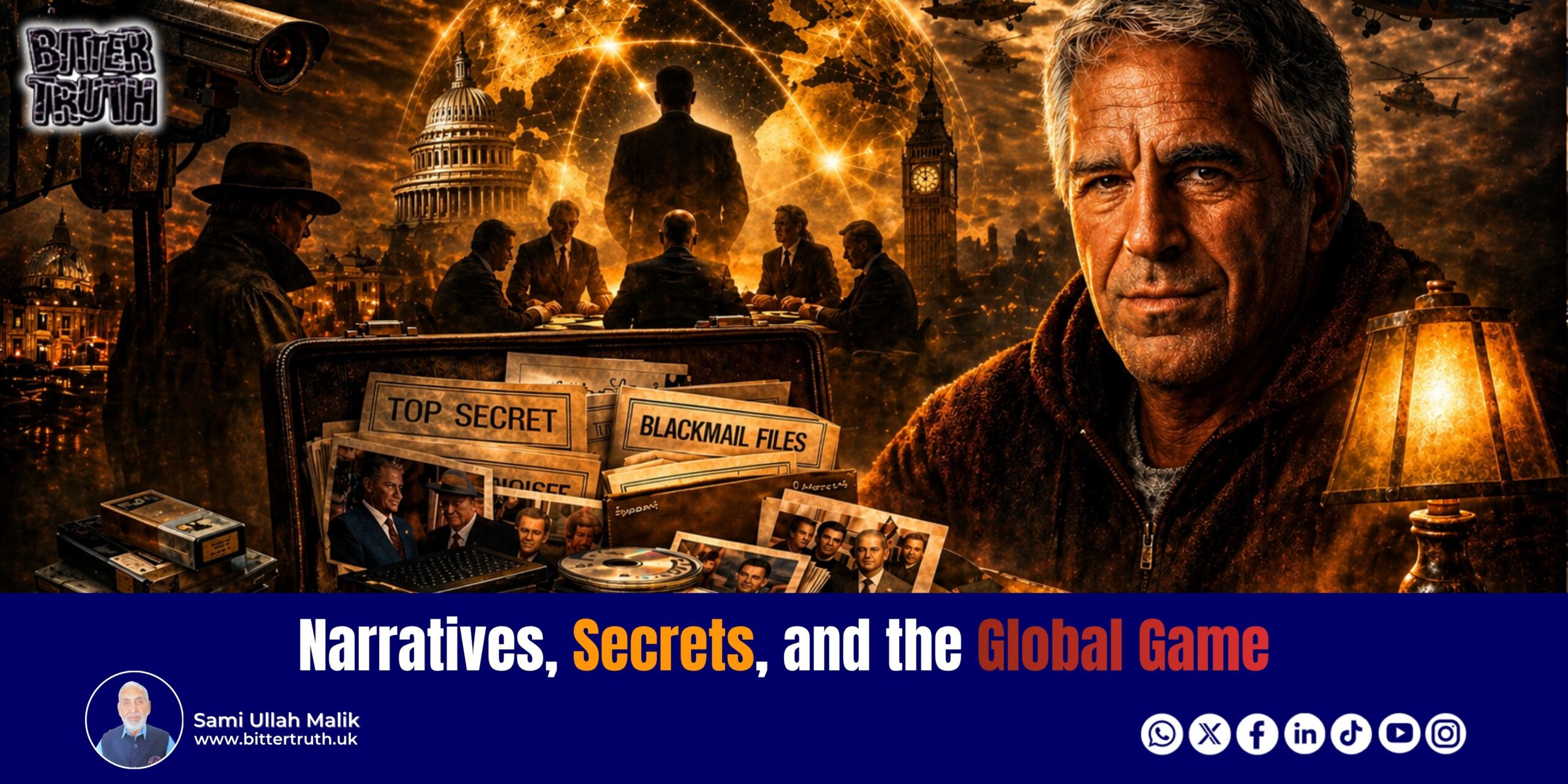
The political history of the twentieth and twenty-first centuries instructs us in a sobering truth: power has never been merely the faculty of decision. Rather, it has more often resembled a dense and intricate web—woven of influence, pressure, and interests too subtle to declare themselves openly. From time to time, revelations emerge—vast in scale, arresting in implication—comprising documents, images, and alleged evidentiary archives so extensive that they appear to gesture beyond the failings of any single individual towards something systemic, even civilisational in scope.
Yet prudence must not be abandoned at the altar of spectacle. For not all that glitters is gold, and not every shadow is cast by substance.
The question naturally arises: why would any individual preserve so exhaustive a record of his own alleged transgressions? At first glance, it seems an absurdity—an affront to reason itself. And yet history, that stern and unflinching tutor, reminds us that power is not always exercised through office or wealth alone. There exists another currency—quieter, more insidious—namely, information. Secrets, in particular, possess a peculiar potency. As an old maxim has it: a secret is a blade whose hilt remains unseen, yet whose wound cuts deep.
Within this frame, some observers advance the conjecture that relationships among the powerful are seldom confined to the formal or the diplomatic. Rather, they may be entangled with personal frailties, mutual dependencies, and—on occasion—subtle coercions. Such suppositions, however compelling, must be handled with intellectual discipline. The boundary between conjecture and substantiation must remain inviolate. Reports—whether issued under the imprimatur of international bodies or otherwise—derive their authority not from their tone, but from the rigour of their method: independent inquiry, transparent procedure, and verifiable evidence.
When we turn to the perplexities of global leadership—decisions which appear, at times, to run counter to the interests of the very populations they claim to serve—we encounter no novelty, but rather an ancient dilemma. Wars, sanctions, and policies are rarely the offspring of a single cause. They are born instead of a convergence: economic imperatives, geopolitical calculations, domestic constraints, and ideological commitments. The resulting picture may seem deceptively simple, yet beneath its surface lies a complexity as profound as the unseen depths of a river, whose currents cannot be measured from the safety of its banks.
It is both the tragedy and the distinction of our age that we inhabit a world inundated with information, yet increasingly starved of certainty. Each day presents us with fresh claims—documents unveiled, recordings circulated, narratives advanced—each purporting to tear aside the veil of power. But one must ask: does every revelation illuminate, or do some merely cast longer shadows?
This is no mere tale; it is a mirror held up to our times—a mirror in which faces are visible, yet so too are masks. The question is not simply what we see, but what we are prepared to believe.
There are moments when the sheer scale of a claim—millions of documents, thousands of recordings, countless images—imposes itself upon the mind with an almost tyrannical force, as though truth itself stood before us in monumental form. Quantity begins to masquerade as credibility; magnitude assumes the posture of proof. And yet, if such assertions were to hold, they would signify not merely the moral collapse of an individual, but the pathology of an entire system.
Still, we must resist the seduction of scale. For it is equally true that an abundance of material can serve to obscure, rather than illuminate—to conceal frailty of argument beneath a deluge of detail. The essential questions remain unchanged:
How was this material verified?
What is its provenance?
Through what lens is it interpreted?
Where the clamour of evidence grows loud, the voice of inquiry must grow louder still.
The claims themselves—of moral decay among influential circles, of abuses of power, of violations of human dignity—are grave enough to stir the conscience of any thinking observer. Such themes are neither trivial nor unprecedented; history bears ample witness to both the heights and the depths of human conduct. Yet the duty of a responsible analyst is clear: to distinguish, with care and precision, between that which is established and that which is merely alleged. Without such discipline, the smoke of accusation may blur the line between fact and fiction until both assume the same hue.
Here, it is important to maintain an important distinction: that between individual wrongdoing and grand conspiracy. These are not interchangeable categories. If history records injustice, it also records its redress. If it describes darkness, it does not deny the persistence of light. A narrative that subsumes every event into a single, all-encompassing design risks reducing the complexity of reality to the simplicity of fiction.
And so we arrive at the more sensational claims—those that gesture towards vast archives, implicating figures of wealth, influence, and authority across the global stage. If taken at face value, such assertions would suggest not merely personal depravity, but a catalogue of systemic corruption. Yet here, more than anywhere, the burden of proof must remain exacting. For in matters of such gravity, insinuation is no substitute for evidence, and scale is no guarantor of truth.
We have, by now, been confronted with fragments of a disturbing mosaic: lurid correspondence, explicit letters, and images of a deeply incriminating character. Yet even these, grave as they are, appear to fall short of the darker allegations that have since been advanced. Reports attributed to international bodies have, at times, alluded to crimes of a far more heinous order—claims invoking exploitation, coercion, and violence of the most reprehensible kind. Such assertions, if substantiated, would not merely indict individuals but cast a long and troubling shadow over the moral architecture of power itself.
And yet, one must proceed with intellectual restraint. For while the notion that influence may be exercised through the possession of secrets is hardly novel, its application to sweeping and universal conclusions demands a higher standard of proof than mere repetition can supply. From the tense stratagems of the Cold War to the subtleties of modern diplomacy, information has indeed functioned as a form of power—quiet, elusive, and often decisive.
Thus we are drawn once more to the central question: why record at all?
It has been suggested that surveillance—covertly embedded within private domains—served not indulgence, but instrumentality. That such recordings, if they existed, were intended to construct not a diary of excess, but an archive of leverage. This is a grave proposition, and one that has circulated widely in speculative discourse. Yet its seriousness demands that it be approached not with credulity, but with disciplined scrutiny. Assertions regarding intelligence affiliations or orchestrated designs by states must, if they are to be entertained at all, rest upon evidence commensurate with their magnitude.
There is, however, a broader and less contentious observation to be made. The idea that information functions as a currency of power—indeed, as its most discreet and potent form—is deeply embedded in the history of statecraft. In the corridors of power, where civility often masks calculation, knowledge is exchanged not merely as insight but as influence. Smiles may serve diplomacy; silence may conceal negotiation; and beneath both, information moves with a force unseen yet unmistakable.
But here a necessary distinction must be drawn. Does every secret bind, compel, or enslave? Or is it sometimes no more than a reflection of human frailty—significant, certainly, but not necessarily evidence of an all-encompassing design? Not every whisper constitutes a conspiracy; not every shadow implies a structure behind it. As Winston Churchill observed in another context, truth in moments of conflict becomes so precious that it is often surrounded—indeed, obscured—by layers of distortion. In such conditions, narrative and reality may intertwine until their boundaries blur.
It is precisely this ambiguity that unsettles the modern conscience. We live in an age of ceaseless disclosure, where each new claim appears to unveil a deeper layer of hidden intent. And so the question arises—posed not in cynicism, but in genuine perplexity: how are we to interpret those decisions of global leadership which appear, at times, so starkly at odds with the welfare of their own peoples?
History offers no shortage of troubling precedents. Policies enacted in the name of security have yielded devastation; alliances forged in necessity have produced moral compromise. Yet to attribute every such decision to clandestine coercion is to risk reducing the complexity of political life to a single, seductive explanation. This would be not analysis, but oversimplification of the most hazardous kind.
For the truth, as ever, is more intricate. Political decisions are seldom the product of a solitary force. They emerge instead from a convergence of pressures: domestic imperatives, international alignments, economic calculations, strategic doctrines, and ideological commitments. These elements, often in tension with one another, shape outcomes that may appear perplexing, even troubling, but are rarely reducible to a single hidden cause.
The suggestion that leaders act under the weight of concealed pasts, or are compelled by undisclosed vulnerabilities, cannot be dismissed outright; it belongs to the realm of possibility. Yet neither can it be elevated to a universal principle without eroding the very foundations of institutional accountability. For if every decision is attributed to coercion, then responsibility itself dissolves. Institutions fade into irrelevance, democratic processes are rendered illusory, and human agency is diminished to the point of extinction.
It is therefore essential to maintain perspective. Human weakness is real; history attests to it abundantly. But weakness does not invariably entail subjugation. To assume so is to underestimate both the resilience of institutions and the capacity—however imperfect—of individuals to act with
autonomy.
In the final analysis, we are confronted not merely with a question of facts, but with a question of interpretation. How we choose to understand power—whether as an open contest of interests or as a hidden web of coercion—will shape not only our conclusions, but our conception of political reality itself.
And herein lies the true challenge of our age: not simply to uncover what is hidden, but to discern, with care and discipline, what is real.
For the serious essayist, the central challenge is neither to succumb to reflexive denial nor to elevate unverified claims to the status of established truth. Eloquence, if it is to retain its dignity, must be accompanied by reason. The task is not merely to assert, but to inquire; not merely to persuade, but to provoke thought. It is in the careful framing of questions, the measured presentation of arguments, and the invitation to reflection that responsible writing finds its highest purpose.
History, in its austere wisdom, reminds us that when power escapes restraint, accountability is often the first casualty. Yet our present age introduces a further complication: it is not merely an era of information, but of competing narratives. Each report, each recording, each claim is advanced from a particular vantage point, shaped as much by intention as by fact. Here the burden shifts, in no small measure, to the reader. Does one merely receive, or does one examine? Does one absorb, or does one evaluate?
It is at this juncture that the responsibility of the writer deepens. The aim must not be to inflame, but to illuminate—to cast light rather than to generate heat—and, in so doing, to leave the final judgement where it properly belongs: with the discerning reader.
We inhabit a moment in which stories abound, yet truth remains elusive. Not every narrative is truthful, and not every truth presents itself in the form of a narrative. Reality is often obscured by the very noise that claims to reveal it. Wisdom, therefore, lies not only in listening, but in discerning—separating signal from clamour, substance from suggestion.
If the advancement of peace, justice, and a more informed global consciousness is indeed our aim, then such narratives must be approached with critical insight, rigorous method, and a language that reflects intellectual integrity. The objective is not to arouse emotion alone, but to awaken understanding.
It may be conceded that the notion of leaders acting under the influence of fear is not foreign to human experience. Yet it is equally true that political decision-making is rarely governed by a single impulse. Interest, ideology, and pressure converge in ways that defy reduction. To isolate one element as the sole cause is to risk distorting the whole.
Thus, we find ourselves in a peculiar condition: truth exists, yet it is fragmented; falsehood persists, yet it is often artfully presented; and the individual, confronted with both, remains uncertain. In such circumstances, a principle of enduring value must be upheld—extraordinary claims require commensurate evidence.
If peace is our aspiration, then our method must be worthy of it. Claims must be tested against evidence; arguments weighed in the balance of reason; conclusions presented with moral seriousness. Anything less would be a disservice not only to truth, but to the very idea of public discourse.
Modern politics—whether in one administration or another—has invariably been a theatre of contention, shaped by competing interpretations and opposing narratives. It is here that the writer must resist the pull of sentiment and instead anchor judgement in balance and inquiry. History may be written by the victors, but it is understood only by those willing to examine it from multiple perspectives.
And so we arrive at an enduring question: what are we to believe, and on what grounds? This is not a question to be answered lightly. It demands not only scepticism, but method; not only curiosity, but discipline. The duty of the responsible writer is not merely to pose questions, but to cultivate in the reader the capacity to pursue answers with care.
We live, unmistakably, in an age of abundant information and diminishing certainty. Every document, every image, every assertion tells a story; yet the complexity of these stories often obscures rather than clarifies. It is perhaps inevitable that some narratives acquire a life of their own, shaped as much by interpretation as by fact. Yet this should serve as a caution, not a conclusion.
For while much that transpires within the chambers of power remains beyond full public view, it does not follow that every hidden matter conceals the same design. Truth is rarely laid bare; more often, it is veiled—discernible only through patient inquiry and disciplined thought.
The question, then, endures. But its answer will not be found in the immediacy of reaction, nor in the comfort of assumption. It resides, rather, in the steady application of inquiry, the rigour of criticism, and the integrity of mind.