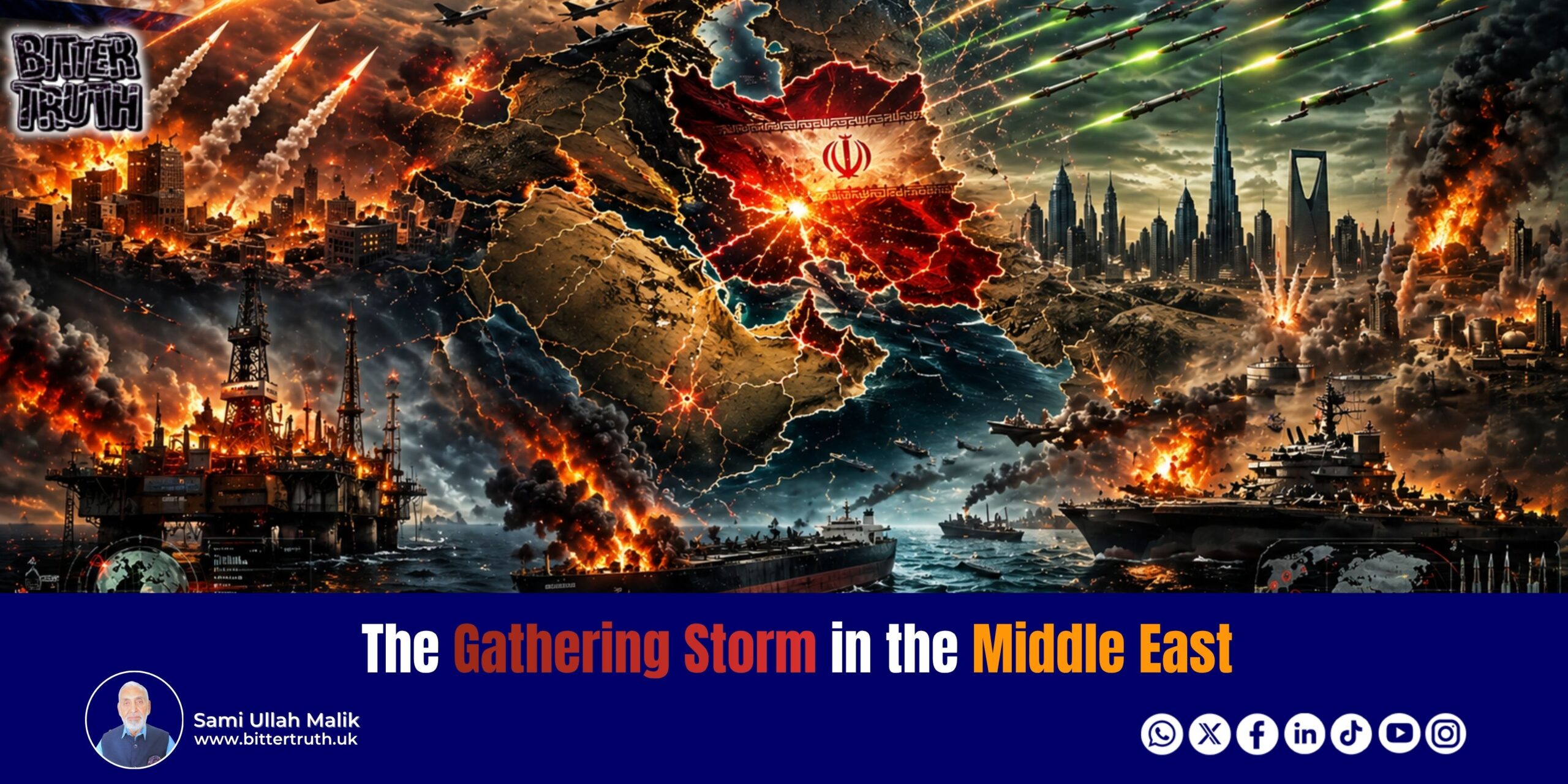
The Gathering Storm in the Middle East
A Region on Fire

On the night of the 28th of February, while in most corners of the world life proceeded with its customary tranquillity, a different drama was beginning to unfold beneath the skies of the Middle East. In the silent hours between Friday and Saturday, the United States and Israel launched a sweeping aerial assault upon Iran. Within the span of only a few hours, a region long accustomed to political turbulence, proxy confrontations, and delicate balances of power found itself drawn once more into the perilous embrace of a new and ominous war.
By dawn the following morning, it had become unmistakably clear that another conflict had been ignited in the Middle East. Iran responded with remarkable swiftness. In retaliation it began targeting Israel and American military installations scattered across the region. What had begun as a sudden exchange of blows soon threatened to assume the character of a broader regional confrontation. Within days the situation had deteriorated so profoundly that it was no longer merely Iran and Israel standing face to face across the lines of conflict; rather, the entire region appeared to be drifting into the gravitational pull of the struggle.
Early reports suggested that Iran’s senior leadership had suffered severe losses. News began to circulate that the country’s Supreme Leader, Ayatollah Ali Khamenei, along with several prominent figures of the military establishment, had been killed. American and Israeli strikes were said to have claimed the lives of more than a thousand Iranian civilians, among them over one hundred and fifty schoolgirls whose deaths lent the tragedy a particularly haunting dimension. Iran’s retaliatory attacks, meanwhile, were reported to have inflicted casualties among Israeli civilians and American servicemen alike.
Yet the boundaries of this war have not remained confined to Iran and Israel alone. In a region already scarred by instability—from Lebanon to Iraq and Syria—the tremors of the conflict have now begun to reverberate across the Gulf states. Countries such as Saudi Arabia, Qatar, Oman, Bahrain, and the United Arab Emirates have found themselves standing in the shadow of the confrontation. Iran has announced the closure of the Strait of Hormuz—one of the world’s most vital maritime arteries—while simultaneously directing attacks against energy infrastructure, American diplomatic missions, and airports across the Gulf.
As the war continues to widen, the toll in human suffering and economic damage rises steadily. It is therefore both necessary and urgent to ask what consequences this unfolding conflict may hold for the Gulf Arab states and for the wider Middle East.
Two questions in particular present themselves with unmistakable force.
First: why has Iran chosen to strike not only American bases but also what appear to be civilian targets within the Gulf states?
Second: what repercussions might this confrontation carry for relations among the Gulf countries themselves, and for their long-standing strategic partnership with the United States?
The Opening Phase of the War
If one surveys the present situation, the United States and Israel maintain that their strikes have successfully targeted numerous strategic and political sites within Iran. According to their claims, the compound of the Supreme Leader, the command-and-control centres of the Islamic Revolutionary Guard Corps, and even the presidential complex were among the locations struck and rendered inoperative.
American officials have asserted that more than twelve hundred targets inside Iran were attacked during the first forty-eight hours alone. Iran, however, presents a starkly different narrative. Iranian authorities report that in southern Iran, near the town of Minyab, three missiles struck a school, killing more than one hundred and fifty young students.
Elsewhere, military facilities in Kermanshah and Tabriz were targeted, while naval installations near Bandar Abbas and surrounding coastal areas also came under attack.
Former U.S. President Donald Trump claimed that American forces had destroyed ten Iranian naval vessels and had effectively crippled Iran’s naval headquarters.
For its part, Iran had long warned that if it were attacked it would respond not merely in kind but on a broader regional scale. That warning, it now appears, was no idle rhetoric.
In its retaliation Iran launched hundreds of missiles and nearly a thousand drone strikes against American bases across the region—in Israel, Kuwait, Jordan, Bahrain, Saudi Arabia, and the United Arab Emirates.
Among the locations reportedly targeted were the headquarters of the U.S. Navy’s Fifth Fleet in Bahrain, the Ras Tanura oil refinery in Saudi Arabia, and Dubai’s Jebel Ali port—one of the busiest maritime hubs in the world.
A Question of Foreknowledge
This inevitably raises a pressing question: did the United States not anticipate that Iran would respond in precisely this manner, extending the theatre of war across the wider region?
According to many analysts, the answer is unmistakably yes.
Washington, they argue, had long expected that any direct assault upon Iran would provoke a regional reaction. Indeed, evidence suggests that preparations for such a scenario had already been made. Prior to the outbreak of hostilities, several American military assets were quietly repositioned. Portions of the Fifth Fleet stationed in Bahrain were moved away from vulnerable positions. Aircraft were relocated from the Al Udeid Air Base in Qatar, and certain forward operating positions were shifted to more secure locations within Jordan and Israel.
In other words, the costs of war and the possible consequences of escalation had been carefully calculated in advance.
Economic Tremors
While differing accounts continue to circulate regarding the scale of the military damage inflicted on both sides, there is far greater agreement on one point: the economic cost of this conflict is already mounting.
Global oil and gas prices have begun to climb with unsettling speed. Financial markets are responding with growing uncertainty, and investors—ever wary of geopolitical storms—have adopted a cautious posture.
Economists frequently observe that markets react sharply to unexpected shocks but often regain equilibrium once the turbulence subsides. Yet the Middle East possesses a history that makes such optimism uncertain. Wars in this region have a disconcerting tendency to outlast initial expectations.
Unease Among the Gulf States
Within the Gulf states themselves, a new and delicate debate is quietly emerging.
Certain Saudi officials have begun to voice, albeit cautiously, a view that has long lingered beneath the surface of regional politics: that the centrepiece of American strategic thinking in the Middle East is Israel rather than the Gulf monarchies.
Their argument is straightforward. When Israel’s security is perceived to be under threat, Washington responds with remarkable urgency. When Gulf states face damage to their infrastructure or economic interests, the response appears less immediate and less emphatic.
Whether entirely fair or not, this perception has begun to generate a subtle yet perceptible sense of resentment. Political systems under pressure often reveal fissures that were previously concealed beneath the façade of stability. In the Gulf today, those fissures are becoming increasingly visible.
Iran’s Strategic Calculus
At the heart of the conflict lies a question that is perhaps the most consequential of all.
Iran insists that it is not deliberately targeting the Gulf states themselves. Rather, it argues that it is striking American military bases located within those countries. Iranian Foreign Minister Abbas Araghchi has stated that if attacks against Iran are launched from these bases, then those installations inevitably become legitimate military targets.
Yet the reality is more complex than this explanation suggests.
Several attacks have reportedly damaged civilian infrastructure within Gulf countries—airports in the United Arab Emirates, for example, or urban districts in Bahrain. Such incidents are difficult to dismiss merely as accidents.
Many analysts therefore believe that Iran’s strategy may be broader in scope. By expanding the economic and political costs of the war across the entire region, Tehran may hope to encourage Gulf governments to press Washington towards de-escalation. If the price of conflict becomes sufficiently burdensome for the region as a whole, pressure may mount for diplomacy to replace escalation.
In this sense, the unfolding war may represent not only a contest of military power but also a calculated struggle over the political endurance of an entire regional order.
Will the Gulf States Enter the War?
Another question of no small consequence concerns the role of the Gulf monarchies: will they themselves be drawn into the conflagration? Their leaders have issued stern communiqués and expressions of alarm, yet thus far they have refrained from direct military engagement.
One explanation lies in the stark arithmetic of capability. However formidable their financial resources may be, the Gulf states do not yet possess the fully autonomous defence capacity required to wage a sustained modern war. Were their military strength entirely self-sufficient, the Middle East would scarcely host the vast constellation of American bases that now dot its shores and deserts. The Al Udeid Air Base, the headquarters of the United States’ regional air operations; the Naval Support Activity Bahrain, home to the U.S. Navy’s Fifth Fleet; and a network of American military installations across Saudi Arabia all testify to a reality long understood but rarely spoken aloud: that the security architecture of the Gulf remains deeply entwined with the strategic guarantees of United States.
Yet this dependency carries its own anxieties. The present conflict may well accelerate the militarisation of the Gulf region. In recent years Iran has invested heavily in missile and drone technologies that have altered the strategic calculus of the Middle East. Its Shahed drone systems, capable of ranges approaching two thousand kilometres, place virtually the entire Gulf littoral within striking distance. Such capabilities have compelled Gulf governments to embark upon massive investments in missile defence shields and early-warning systems, pouring billions of dollars into technologies designed to intercept threats before they descend upon their cities and oil installations.
But wars, however grand their strategic narratives, are ultimately measured by their human consequences. And it is here that the most poignant dimensions of the conflict emerge.
The Gulf economies are built upon a delicate architecture of global capital and migrant labour. Millions of workers from Pakistan, India, and Bangladesh sustain the construction sites, ports, hospitals, and service industries of the region. Now, with airports shuttered and the spectre of missile strikes hovering over the skyline, thousands of travellers find themselves stranded in a landscape suddenly transformed by war.
Media outlets have begun to relay stories that read less like policy briefings and more like fragments of human tragedy. One American woman, speaking through tears, confessed that she had never imagined she might one day be trapped in circumstances such as these. Another traveller described fleeing toward the mountains in a desperate attempt to escape incoming missile fire. These testimonies serve as sombre reminders that war—whatever the banners under which it is waged—falls most heavily upon ordinary lives.
Are American–Gulf Relations Changing?
In the immediate term, the strategic partnership between Washington and the Gulf capitals appears unlikely to dissolve. The United States remains the pre-eminent security guarantor of the region, its fleets and air wings forming the backbone of the Gulf’s defensive posture.
Yet over the longer horizon subtle shifts are already visible. The Gulf states are increasingly seeking to diversify their strategic relationships. Defence cooperation with China, deeper security dialogues with European Union members, and the cultivation of alternative technological partnerships suggest a cautious effort to avoid excessive reliance upon any single power. Such manoeuvres are less an abandonment of American protection than an attempt to hedge against the uncertainties of a changing world order.
A War Beyond Two States
To interpret the present conflict merely as a military clash between Iran and Israel would be to miss
its deeper significance. The Middle East has rarely witnessed wars that remain confined to the ambitions of two states alone. More often they are expressions of a broader contest for regional influence and global balance.
In truth, the history of the region reveals a recurring pattern: almost every major conflict has been entangled with the interests of external powers and the rivalries of regional actors. Since the mid-twentieth century the politics of the Middle East have revolved around three enduring forces—energy resources, the intervention of great powers, and the competition among regional states for strategic primacy.
The current war is best understood within this very framework.
The Strategic Leverage of the Strait of Hormuz
Among the most unsettling developments has been Iran’s threat to close the Strait of Hormuz—one of the most vital arteries of the global energy system. A significant proportion of the world’s oil exports passes through this narrow maritime corridor. Any disruption to its flow would reverberate through international markets, sending energy prices soaring and potentially unsettling the entire architecture of global trade.
For precisely this reason the United States and its allies have long considered the freedom of navigation through the Strait a matter of strategic necessity. Iran, fully aware of this vulnerability, has repeatedly invoked the possibility of closure as a lever of geopolitical pressure. In the present crisis the same logic appears to be at work: Tehran seeks to convey that threats to its own security could, in turn, unleash consequences far beyond the battlefield.
The War of Narratives
Modern warfare is fought not only with missiles and aircraft but also with images, narratives, and perceptions. The present conflict offers a vivid illustration of this reality.
Iran, Israel, and the United States each present their own account of events—amplifying victories, minimising setbacks, and shaping the story for domestic and international audiences alike. Media channels have become extensions of the battlefield, where the struggle for legitimacy and morale unfolds in parallel with the clash of arms.
Iranian outlets frame the confrontation as a heroic resistance against a formidable coalition of powers. Meanwhile Israeli and American media often portray the campaign as a calculated effort to degrade Iran’s military infrastructure and restrain its regional ambitions. Between these competing narratives lies a complex and contested reality.
The Gulf Model Under Pressure
For the Gulf states themselves the conflict is not merely an external crisis; it carries profound internal implications. Over the past three decades these countries have sought to transform their global image—from austere oil exporters into hubs of commerce, finance, tourism, and technological innovation.
Cities such as Dubai, Doha, and Riyadh stand as monuments to that ambition. Their glittering skylines and sprawling infrastructure projects were designed to attract investors, tourists, and
skilled workers from across the world.
Yet war has a way of unsettling even the most carefully constructed economic models. Persistent instability in the region could prompt international investors to adopt a more cautious stance, while tourism and trade—pillars of the Gulf’s diversification strategies—might suffer significant setbacks. It is therefore hardly surprising that Gulf governments appear eager to see the present conflict brought swiftly to an end.
Iran’s Strategic Doctrine
To understand the military posture of Iran, one must look to its historical experiences. During the 1980s the country endured the devastating Iran–Iraq War, an eight-year conflict that inflicted enormous human and economic losses.
In the aftermath of that ordeal Iran undertook a fundamental reassessment of its defence strategy. Rather than attempting to compete directly with the conventional military strength of its adversaries, Tehran invested heavily in asymmetric capabilities: missile forces, drone technology, and networks of allied groups across the region.
The result is a strategic architecture that allows Iran to exert influence far beyond its borders. Its missile and drone systems form a deterrent shield, while allied movements provide Tehran with multiple fronts from which pressure can be applied. In the current conflict this doctrine appears clearly visible. Instead of relying solely upon direct confrontation, Iran seeks to exhaust its adversaries through dispersed and sustained pressure across several theatres.
Israel’s Preventive Doctrine
For Israel, by contrast, strategic thinking has long revolved around the principle of pre-emption. The country’s leaders have repeatedly argued that existential threats must be neutralised before they reach maturity.
This doctrine has guided Israeli policy for decades. It lay behind the strike on Osirak Nuclear Reactor in 1981 and later operations targeting suspected nuclear facilities in Syria. Within this strategic worldview, Iran’s expanding missile capabilities and regional alliances represent an intolerable risk.
From that perspective the current conflict may be seen not as an isolated eruption of violence but as part of a broader effort to prevent Iran from attaining a position of decisive military or technological superiority.
The Role of the Great Powers
In nearly every major conflict that has convulsed the Middle East, the shadow of the great powers has loomed large. The present crisis is no exception. The United States is already a direct participant in the strategic contest, yet other global actors—including China, Russia, and the nations of European Union—are observing developments with intense attention.
For China, the stakes are unmistakably economic. Its vast industrial engine depends heavily upon imported energy, much of which flows from the Gulf. Stability in the region, therefore, is not merely desirable from Beijing’s perspective; it is essential to the uninterrupted functioning of its economic system.
Russia, meanwhile, has its own reasons for maintaining a presence in the geopolitical theatre of the
Middle East. Over the past decade Moscow has carefully cultivated diplomatic and military footholds across the region, seeking both strategic influence and leverage within the wider global balance of power.
It is therefore entirely conceivable that, in the days or weeks ahead, these powers may attempt to play a role in shaping a ceasefire or facilitating diplomatic negotiations. History suggests that when conflicts in the Middle East threaten to spiral beyond control, the great powers rarely remain passive spectators for long.
Possible Scenarios
From the vantage point of the present moment, several possible trajectories for the conflict may be discerned.
The first and most optimistic scenario is that the war remains limited in scope and concludes within a matter of weeks or months. Under such circumstances, both sides might eventually claim victory—each presenting the outcome to its domestic audience as a strategic success—before quietly stepping back from the brink.
A second, darker possibility is that the conflict expands and draws additional regional actors into its orbit. Should that occur, the consequences for the global economy could prove severe. Energy markets, already sensitive to political turbulence, might experience dramatic instability, while international trade routes could face renewed disruption.
The third scenario lies in the realm of diplomacy. Mounting international pressure—combined with the mounting costs of prolonged hostilities—could encourage the protagonists to explore negotiated arrangements aimed at reducing tensions. Such outcomes are rarely swift or straightforward, yet the history of international relations shows that even the fiercest confrontations may ultimately yield to pragmatic compromise.
The Human Cost
As with every war in history, the gravest burden is borne not by governments but by ordinary people. Bombardments of urban areas, waves of displacement, and mounting economic hardship have already altered the lives of countless families.
Children, women, and the elderly are invariably the most vulnerable in such circumstances. In wartime environments the institutions that sustain social life—schools, hospitals, and employment opportunities—begin to erode. Communities that once functioned with relative stability find their social fabric gradually fraying under the strain.
This human dimension is often overshadowed by the rhetoric of strategy and power politics. Yet the reality remains that the true cost of war is paid in the disrupted lives of civilians whose voices seldom shape the decisions that determine their fate.
A Historical Turning Point
Viewed in its entirety, the present conflict suggests that the Middle East may once again be approaching a critical historical juncture. The ramifications of this war are unlikely to remain confined to Iran, Israel, or the Gulf states alone. Its reverberations may extend far beyond the region, influencing the broader landscape of global politics and economic relations.
At this stage it would be premature to predict with certainty the direction in which events will ultimately move. Yet one conclusion appears unavoidable: the consequences of the present confrontation will likely be felt for many years to come.
History repeatedly reminds us that wars in the Middle East seldom remain limited to the battlefield. They reshape alliances, alter the dynamics of energy markets, and redefine the contours of international diplomacy. It would not be surprising if future historians were to count this conflict among those pivotal episodes of the twenty-first century that subtly but decisively shifted the balance of the global order.
The Iranian Perspective
From the vantage point of Iran, the present confrontation is no longer perceived merely as a retaliatory operation. Rather, it has taken on the character of a struggle for national survival.
Tehran appears determined to convey a stark message: that instability within Iran would inevitably trigger instability throughout the wider region. In other words, the security of the Middle East cannot easily be disentangled from the stability of the Iranian state itself.
The Gulf in a Strategic Dilemma
For the Gulf monarchies, however, the situation is profoundly delicate. These states now find themselves navigating an increasingly perilous strategic environment. Should the war continue to drag on, it may be the Gulf economies and societies that bear the heaviest consequences.
Their prosperity depends upon a fragile equilibrium—regional stability, international investment, and the smooth functioning of global energy markets. Prolonged conflict threatens to unsettle each of these pillars simultaneously.
In this sense, one might argue that the true theatre of the conflict is not confined solely to Iran and Israel. Rather, the entire Middle East has become the stage upon which the drama of this confrontation unfolds.
And history offers a sobering lesson: when wars ignite in the Middle East, their repercussions rarely remain confined within the boundaries of the region. More often than not, they ripple outward—touching distant economies, reshaping diplomatic alignments, and leaving their imprint upon the wider currents of world affairs.