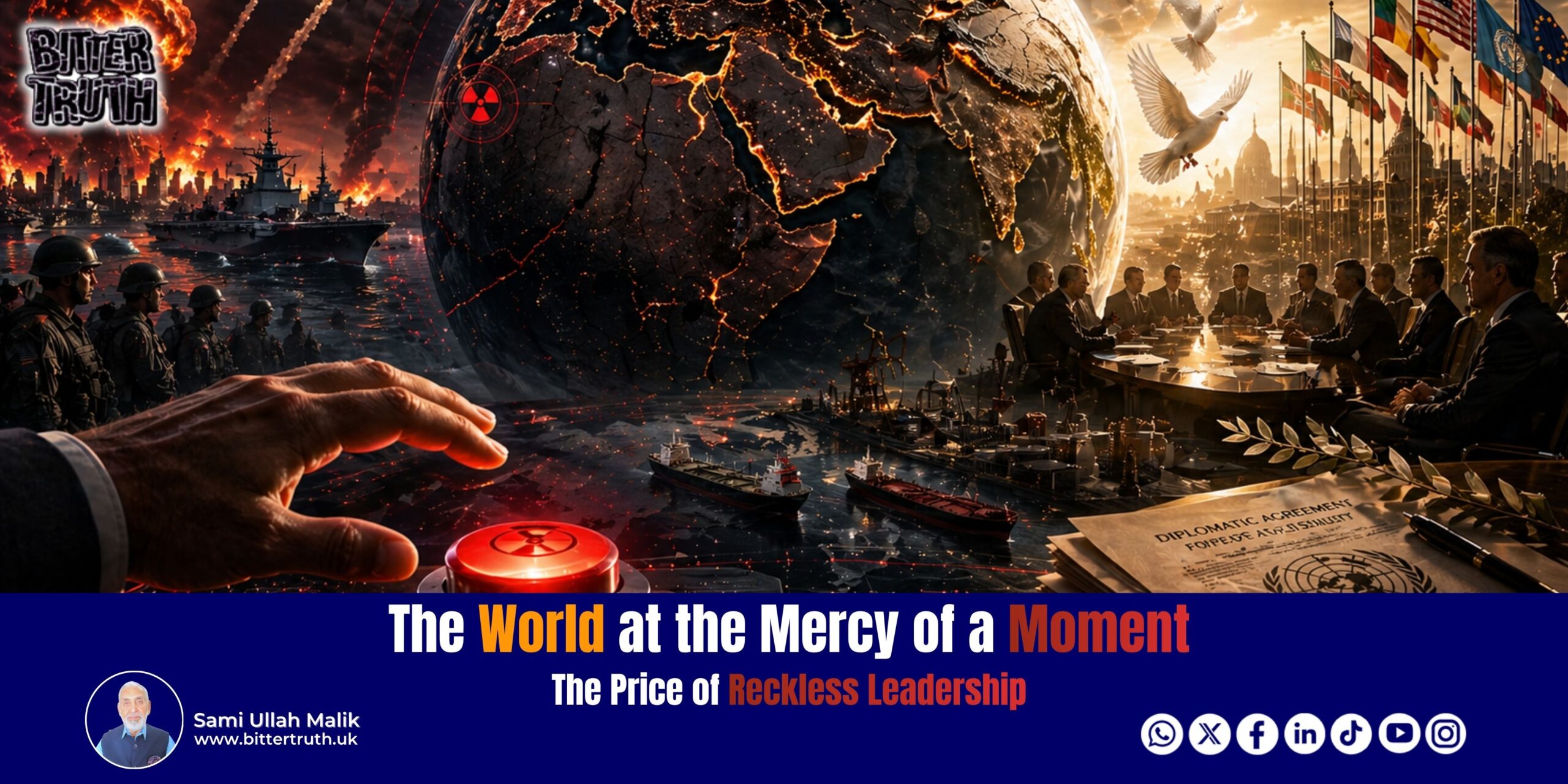
The World at the Mercy of a Moment
The Price of Reckless Leadership

History has taught humanity, again and again, a sobering and unmistakable lesson: that decisions made under the sway of power, fame, or private emotion rarely remain confined to the chamber in which they are taken. More often than not, they reverberate far beyond it, shaping the destinies of millions. The chronicles of civilisation are strewn with instances in which haste, wounded pride, or personal grievance—once enthroned in the councils of power—have served as the harbingers of calamity for mankind. Time and again the world has witnessed how the judgement of a single individual, a moment’s impulsive sentiment, or an intemperate reaction can alter the course of thousands, indeed millions, of human lives.
In this light, the presidency of the United States is no ordinary constitutional office. It is, in effect, a fulcrum upon which the delicate equilibrium of international order precariously rests. The nation long regarded as the emblem of liberty, justice, and global leadership entrusts to its chief magistrate not merely the stewardship of domestic affairs but a measure of influence that extends across continents and oceans. Every presidential decision may stand poised between peace and war, between life and death, between the fragile promise of hope and the shadow of fear.
It is therefore one of history’s more unsettling ironies that warnings once dismissed as the currency of electoral rhetoric have, with the passing of time, assumed the weight of prophecy. The caution voiced by Hillary Clinton—at the time perhaps heard merely as the refrain of a political campaign—now appears, in retrospect, as a remarkably prescient judgement. The volatile temperament, impulsive decision-making, and often cavalier approach to international relations displayed by Donald Trump have, in the eyes of many observers, placed not only America but the wider world at a perilous crossroads.
This essay reflects upon that larger lesson: that leadership cannot safely be entrusted to the fleeting advantages of celebrity or raw political force alone. True statesmanship rests upon a firmer foundation—knowledge, patience, judgement, and an informed awareness of the wider world. The annals of history repeatedly testify that leaders who act from wounded vanity or momentary passion seldom imperil only their own nations; they jeopardise the peace of the international community itself.
During the presidential contest of 2016, Hillary Clinton addressed the American electorate with a warning that carried the unmistakable echo of historical reflection. The decision to commit a nation to war, she argued, is neither simple nor trivial, and it cannot responsibly be entrusted to a temperament governed by impulse or personal grievance. Seen from the vantage point of subsequent events, her words possess a striking resonance.
Across the varied theatres of global politics, the consequences of erratic leadership have frequently been visible. Whether in the tense exchanges with North Korea, the fraught diplomacy surrounding the nuclear programme of Iran, or the ever-smouldering crises of the Middle East, observers have often detected the unsettling imprint of political volatility. Such episodes serve as a reminder that leadership is measured not merely by authority but by prudence, restraint, and moral responsibility.
The election of an American president therefore carries implications far beyond the borders of the republic. The office is not merely a pinnacle of domestic politics; it is intimately bound to decisions that shape the prospects of war and peace throughout the international system. For this reason, Hillary Clinton cautioned during the 2016 campaign that the character and policy instincts of Donald Trump might prove hazardous not only for the United States but for the global order as well.
Her argument was stark in its simplicity: the presidency is not an ordinary political prize but a responsibility of immense gravity. The occupant of that office commands the authority to make decisions whose consequences may determine the fate of nations and the lives of countless individuals.
In her assessment, Donald Trump appeared ill-suited—both emotionally and intellectually—for such a burden. His political discourse, she suggested, seemed too often animated by erratic assertions, personal grievances, and demonstrable falsehoods. To entrust the powers of the presidency to a figure governed by such impulses, she warned, would be to court danger, for it would place decisions of war and peace in the hands of a temperament prone to sudden reaction.
The peril becomes all the more acute when one recalls that the American president also holds authority over the use of nuclear weapons. Should a leader susceptible to anger or personal animosity command such destructive power, the consequences could extend far beyond the realm of conventional political miscalculation.
A glimpse of this danger appeared during the heated exchanges of 2017 between Donald Trump and Kim Jong Un of North Korea. The rhetorical skirmishes—often conducted through social media—generated palpable anxiety across the international community. For many observers, the spectacle illustrated how swiftly volatile language between nuclear-armed states could inflame global tensions.
Similarly, the abrupt repudiation of the nuclear agreement with Iran cast a shadow over America’s diplomatic credibility and unsettled the intricate architecture of international negotiations. Such developments seemed, to many commentators, to lend substance to earlier warnings that emotional volatility and thin-skinned leadership could produce risks on a global scale.
Thus the central contention advanced by Hillary Clinton was neither partisan nor trivial. It rested upon a broader principle of political prudence: that a president inclined toward haste, personal sensitivity, and impulsive judgement might inadvertently propel not only his own nation but the world at large into unnecessary peril.
When the authority to command nuclear weapons is joined to such a disposition, the danger ceases to be theoretical. It becomes a matter of immediate and universal concern. The tensions with North Korea in 2017, accompanied by inflammatory public statements, compelled analysts around the world to contemplate the possibility that a moment’s anger might escalate into a crisis of global proportions.
In the final reckoning, the lesson offered by history remains both plain and profound. The greatness of leadership lies not in the spectacle of power but in the quiet virtues of knowledge, judgement, and moral restraint. Where these qualities are absent, the sceptre of authority may cease to be an honour and instead become a grave burden—one whose weight is borne not merely by a single nation, but by humanity itself.
The spectre of nuclear peril, however, has never been confined solely to the Korean peninsula. The controversy surrounding the nuclear ambitions of Iran offers an equally instructive illustration of how precariously the balance of global security may tilt when diplomacy is displaced by impulse. In this theatre, too, the policies pursued by Donald Trump were widely regarded as having heightened rather than diminished the prevailing dangers. By withdrawing from the nuclear agreement painstakingly negotiated with Tehran, he reopened a pathway by which Iran might once again advance towards the acquisition of nuclear weapons—an outcome capable of unsettling not merely the Middle East but the wider constellation of international power.
For her part, Hillary Clinton repeatedly emphasised a principle long recognised by seasoned practitioners of statecraft: diplomacy is seldom the product of impatience. It demands patience, steadiness, and the quiet discipline of strategic judgement. In the case of Iran’s nuclear programme, the administration of Barack Obama had chosen a path markedly different from the drums of war. Rather than resorting to military force, it pursued a combination of economic sanctions and painstaking negotiations—an approach that ultimately produced a multilateral accord designed to restrain Iran’s nuclear ambitions.
The repudiation of that agreement by Donald Trump therefore carried consequences that reverberated far beyond Washington. International confidence in American commitments was weakened; Tehran resumed elements of its nuclear programme; and tensions throughout the Middle East intensified. The delicate architecture of global diplomacy—constructed through years of negotiation—was suddenly cast into uncertainty.
In this context, Hillary Clinton argued that diplomacy often remains the sole avenue by which the world may avert the gravest crises. Patience, continuity of purpose, and long-term strategic planning are the indispensable instruments through which enduring solutions to international disputes are forged. The negotiations surrounding Iran’s nuclear programme under Barack Obama stand as a case in point: stringent economic pressure combined with sustained dialogue produced an agreement that, at least for a time, prevented Iran from acquiring nuclear arms.
Had a more impulsive temperament governed the Oval Office at that moment, the outcome might well have been starkly different. A resort to precipitous military action—or even the reckless escalation of rhetoric—could easily have ignited a wider conflagration across the Middle East, a region already fraught with volatility.
Another illustration of the complexities of diplomacy emerged in the negotiations with North Korea. In 2018, Donald Trump engaged in unprecedented summit meetings with Kim Jong Un. Though historic in form, these encounters were frequently accompanied by unpredictable pronouncements and abrupt shifts in tone that left many international leaders uneasy. For observers steeped in the traditions of diplomacy, the spectacle raised a familiar concern: that delicate negotiations conducted amid theatrical unpredictability seldom yield durable peace.
Indeed, the abandonment of the Iranian nuclear agreement by Donald Trump drew widespread criticism across the international community. By weakening the consensus that had underpinned global sanctions and encouraging Iran to resume aspects of its nuclear programme, the decision contributed to a renewed atmosphere of instability in the Middle East while diminishing America’s diplomatic credibility. According to Hillary Clinton, such precipitous measures carry consequences that extend far beyond immediate political advantage; they may imperil the fragile equilibrium upon which international peace depends.
The repercussions soon became visible. In 2019, rising tensions between Iran and the United States threatened vital shipping lanes in the Persian Gulf—arteries through which a substantial portion of the world’s oil supply flows. The resulting uncertainty unsettled global markets, drove up energy prices, and imposed economic strain upon numerous nations. Events of this nature appeared to vindicate the earlier warnings that impulsive policy decisions could undermine both international security and economic stability.
Nor were the diplomatic consequences confined to adversaries alone. Relations with allies were also tested. The policies pursued by Donald Trump reverberated across the strategic landscape encompassing Israel, Europe, and other longstanding partners. For years, the Israeli prime minister Benjamin Netanyahu had urged Washington to adopt a far more confrontational stance toward Iran. Under the Trump administration, that pressure found a receptive audience, contributing to a more assertive regional posture that many analysts feared would deepen instability throughout the Middle East.
The consequences were not merely diplomatic abstractions. Heightened tensions exposed American interests themselves to greater risk. U.S. military installations across the region faced mounting threats, while attacks on American facilities in countries such as Iraq and Syria became more frequent. Each such episode underscored how swiftly regional crises could escalate into broader confrontations.
One particularly dramatic moment occurred in 2020 with the targeted killing of the Iranian general Qasem Soleimani. The strike triggered an immediate surge in regional tensions and raised the spectre of direct military conflict between Iran and the United States. Many analysts warned that had the crisis unfolded under a leadership more susceptible to emotional reaction, it might have spiralled into a far larger and more destructive confrontation.
Yet the ramifications of volatile leadership were not confined to foreign policy alone. Under Donald Trump, American domestic politics itself grew increasingly polarised and turbulent. Critics argued that his rhetoric and policy style eroded public trust and revealed troubling vulnerabilities within the nation’s decision-making institutions. The storming of the United States Capitol in 2021—an event linked by many observers to the incendiary political climate surrounding the outgoing president—cast a shadow over the stability of American democracy itself. To some commentators, it appeared as a stark confirmation of the earlier warnings that an unstable presidency could threaten not only global order but the resilience of America’s own constitutional system.
The broader consequences extended into the realm of global economics. Policies pursued during the Trump years, particularly in trade and sanctions, introduced new uncertainties into the international marketplace. Measures directed against Iran and the initiation of a trade confrontation with China unsettled financial markets and complicated global investment flows. The trade conflict launched in 2018 between Washington and Beijing generated a climate of uncertainty that reverberated across multiple economies, disrupting supply chains and dampening investor confidence.
Meanwhile, renewed tensions in the Middle East drove fluctuations in oil prices, further destabilising economic expectations. For many countries already navigating fragile financial conditions, these developments translated into tangible economic losses. The combined effect was a perceptible contraction in global investment opportunities and a widening atmosphere of economic insecurity.
Taken together, these episodes illustrate a sobering truth long recognised by historians of statecraft. Leadership exercised without restraint—guided more by impulse than by prudence—can imperil not only diplomatic stability but the economic well-being of the world itself. And it is precisely for this reason that voices such as Hillary Clinton have insisted that the surest safeguard against war and crisis lies not in displays of bravado but in the quieter virtues of patience, diplomacy, and reasoned judgement.
A further and often overlooked consequence of the policies pursued under Donald Trump lay in the quiet yet unmistakable advantages accrued by the American arms industry. As geopolitical tensions mounted and the spectre of conflict loomed ever larger, the demand for sophisticated weaponry inevitably rose. From a narrowly economic standpoint, such developments proved profitable for segments of the United States’ defence sector; yet from the broader vantage point of global stability, the implications were far less reassuring.
The sharpening rivalry with Iran prompted several regional powers to strengthen their military capabilities, often through extensive purchases from American manufacturers. Both Saudi Arabia and the United Arab Emirates acquired large quantities of advanced weaponry from Washington in an effort to reinforce their strategic posture against Tehran. While such transactions served commercial and strategic interests in the short term, they also contributed to an increasingly militarised environment in which suspicion and rivalry were deepened rather than alleviated.
In parallel, the long-standing Iranian policy agenda championed by the Israeli prime minister Benjamin Netanyahu found renewed momentum under the Trump administration. With the backing of Washington, Israel’s opposition to Iran’s regional influence gained additional diplomatic weight. Yet this alignment also intensified instability across the Middle East, placing several American partners in a more precarious strategic position.
A notable development came in 2020 with the establishment of diplomatic relations between Israel and the United Arab Emirates—a breakthrough welcomed by many observers as a historic shift in regional diplomacy. Nevertheless, the broader political landscape remained far from tranquil. The enduring dispute involving Palestine continued to generate resentment and unrest, illustrating how diplomatic realignments may resolve one tension even as they aggravate others. In this volatile environment, regional crises multiplied, alliances were tested, and even American military facilities stationed across the Middle East faced heightened risks.
Nor were the repercussions limited to the region alone. The shifting course of American foreign policy created profound dilemmas for its traditional partners in Europe. European governments had invested considerable diplomatic capital in preserving the nuclear agreement with Iran, yet the abrupt withdrawal of the United States left them grappling with a difficult and uncertain strategic landscape. Efforts to sustain the accord were complicated by Washington’s unpredictable posture, while the resulting diplomatic vacuum presented opportunities for rival powers such as Russia and China to expand their influence. Thus, a decision initially framed as a matter of national policy reverberated through the wider architecture of international relations, introducing fresh tensions among the world’s major powers.
Despite these challenges, Hillary Clinton expressed confidence in the discernment of the American electorate. The United States, she maintained, remained a nation endowed with deep reservoirs of civic awareness, national pride, and democratic responsibility. Given the gravity of global challenges, she believed that American voters would ultimately recognise the stakes and exercise their judgement accordingly.
Events would later offer a measure of confirmation for that belief. In the presidential election of 2020, the electorate of the United States rendered a decision that many interpreted as a response to the turbulence and unpredictability of the preceding years. For observers sympathetic to Clinton’s earlier warnings, the outcome appeared to affirm the expectation that democratic societies, though occasionally swayed by momentary passions, retain the capacity for correction.
Looking back upon the record of those years, many analysts contend that the leadership of Donald Trump contributed to a period marked by heightened geopolitical tension, renewed nuclear anxieties, economic uncertainty, and persistent instability across the Middle East. Such developments serve as a reminder that the election of an impulsive or volatile leader may carry consequences extending far beyond the borders of a single nation.
From these experiences several lessons emerge with unmistakable clarity. Responsible decision-making in global leadership is not a luxury but a necessity. Diplomacy and negotiation must remain the preferred instruments of international engagement. The immense authority associated with nuclear arsenals must rest only in the hands of stable, experienced, and judicious leadership. And citizens—whether in America or elsewhere—must exercise vigilance when entrusting power to those who claim to speak in their name.
The crises of the Middle East in particular underscore the need for a coordinated approach among the world’s major powers. Durable peace cannot be achieved through unilateral gestures or impulsive strategies; it requires sustained cooperation, careful negotiation, and a shared commitment to stability.
Today we stand as witnesses to a historical moment in which the decisions of a volatile leader have cast long shadows across global politics, economic equilibrium, and human security. The warning voiced by Hillary Clinton therefore appears not merely as a partisan admonition but as a broader historical lesson—one that future generations may well recall as an illustration of how fragile the balance of world order can be.
Her message ultimately speaks to a principle that transcends national boundaries. The selection of leaders is never a trivial act. It is a solemn responsibility borne not only by the citizens of one country but by humanity as a whole, for the consequences of political authority seldom remain confined within national frontiers.
The stewardship of global power—and the fateful decisions between war and peace—must never be governed by impulse, vanity, or personal grievance. They demand instead the steadier virtues of wisdom, patience, and an informed awareness of the world’s intricate interdependence. True leadership is not defined by displays of power or the indulgence of personal pride, but by the capacity to shoulder the burdens of history with knowledge, foresight, restraint, and moral responsibility.
Should humanity fail to heed this lesson, history will assuredly return us to the same bitter realisation: that irresponsible leadership threatens not merely the fortunes of a single nation but the welfare of civilisation itself. It is therefore a civic duty—indeed a moral obligation—to resist the ascent of leaders whose passions, ambitions, or personal interests place human life and global peace in jeopardy.
Our task in the present moment is clear. The standards by which leadership is judged must rise above the fleeting allure of power, fame, or emotional appeal. They must rest instead upon reason, experience, ethical conviction, and a profound awareness of humanity’s shared destiny. That is the enduring lesson of this age, the warning written into our political history, and the responsibility we bear in choosing the leaders who will shape the future of our world.