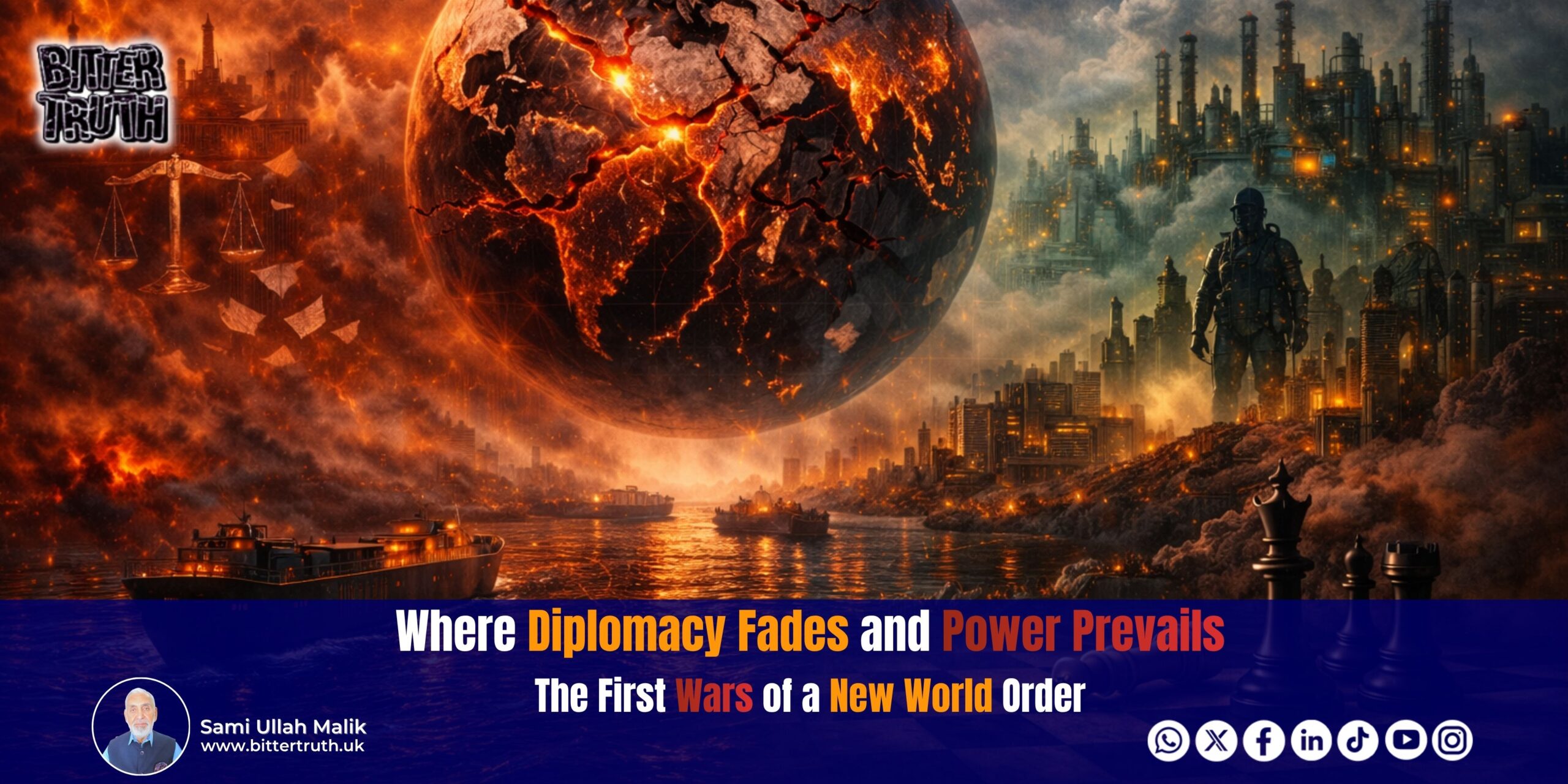
Where Diplomacy Fades and Power Prevails
The First Wars of a New World Order

It is by no means an extravagant conjecture to suppose that the present confrontation between the United States, Israel, and Iran may, in the fullness of time, be reckoned among the earliest great prologue-wars of an emergent world order—one still in the throes of defining its own character, both in thought and in practice. History, in its austere wisdom, teaches us that whenever the balance of global power shifts, its overture is most often inscribed upon the field of battle, whilst its preface is composed within the measured chambers of diplomacy. We stand, it would seem, at such a juncture: an age in which those principles that once underpinned international conduct now appear to fade beneath the dust of time, their authority diminished, their certitude questioned. The wheel of history has, perhaps imperceptibly yet decisively, entered a new orbit—one in which it is no longer the grammar of rules, but the redefinition of power itself, that assumes the decisive voice.
The annals of history bear eloquent witness to a recurring truth: that each new international order is born, not in tranquillity, but in the crucible of conflict. The religious wars of Europe gave rise to the modern conception of the nation-state; the twin cataclysms of the twentieth century laid the foundations of international institutions and a rules-based order. In like manner, the present turbulence may well herald an era in which the calibration of power supplants the authority of principle. We are, in effect, observing the composition of a new lexicon of global politics—one in which the idioms of the past are steadily losing their resonance.
The contemporary scene reflects precisely such a transition. It is an age of unsettling ambiguity, wherein long-standing norms fall away like autumnal leaves, while the values destined to replace them have yet to take firm root. This confrontation, therefore, is not merely territorial or military in nature; it is civilisational, intellectual, and systemic in its implications. The world, it seems, advances—cautiously yet inexorably—towards what might be termed a new covenant of power, an unwritten but deeply consequential reordering of the terms by which states engage one another.
In the decades following the Second World War, international politics was shaped within a disciplined framework, grounded in law and institutional authority. Though fissures appeared from time to time within this edifice, states nonetheless felt compelled to justify their actions within its bounds. Thus there endured a delicate equilibrium between power and legality—an equilibrium that, though often strained, provided at least the semblance of order. Today, however, that balance appears increasingly fragile, if not altogether imperilled.
Indeed, the post-war order may best be understood as a civilisational compact—an ambitious, if imperfect, endeavour to subject power to moral restraint. It was, in essence, an unwritten covenant, seeking to subordinate force to law. The United Nations, the Geneva Conventions, the International Court of Justice, and a host of multilateral agreements stood as institutional expressions of this aspiration: that war itself might be regulated, and peace sustained through adherence to shared principles. Even when great powers bent these norms to their own advantage, they could not wholly dispense with the need to cloak their actions in legal and moral justification. There persisted, therefore, an implicit acknowledgment that law remained a reference point—a standard against which conduct might be judged. It was this subtle yet persistent moral compulsion that rendered even the powerful, in some measure, accountable.
Such was the civilised veil that restrained power from descending into unbridled excess. Yet today, that veil appears frayed, its threads loosened, its authority diminished. The tomes of law, once consulted with reverence, now risk relegation to the quiet obscurity of neglected shelves.
In earlier eras, military action was never merely the thunder of artillery; it was accompanied by the careful choreography of diplomacy, the intricate reasoning of legal argument, and the strategic alignment of alliances. War, in this sense, was not a solitary act of force but a comprehensive narrative—one in which each bullet carried an argument, each campaign a justification. The echoes of battle resounded as much in conference halls as upon the battlefield. Public opinion, both domestic and international, was to be persuaded, if not convinced.
In the present Iranian crisis, however, these traditional accompaniments appear markedly diminished. Decisions are no longer forged in the open forums of legal deliberation, but within the guarded precincts of strategic councils and military headquarters. The locus of authority has shifted—from the courtroom to the command room, from the language of law to the calculus of power. It is as though policy is now drafted upon maps of force rather than within the measured lines of legal text. Diplomacy yields ground to strategy; justification to expediency. Actions are weighed less upon the scales of legality than upon the balances of interest. We may well be entering an era in which the very definition of “right” is increasingly determined by the possession and projection of power.
For Iran, such a mode of operation is neither novel nor unexpected. Its modern history attests to a persistent capacity for navigating adversity with a degree of strategic autonomy. Since the انقلابِ 1979, the nation has endured sustained sanctions, political isolation, and diplomatic pressure. Yet from this prolonged it has derived a distinctive resilience. Traversing decades of constraint, Iran has cultivated methods of survival that lie beyond the formal architecture of the international system. What might appear as from without has, in fact, engendered a form of self-reliance that is at once instructive and enigmatic.
This continuous испытание has endowed Iran with a singular strategic sensibility. Its economic and diplomatic practices have evolved in tandem to create an alternative operational framework. Through informal financial networks, regional alignments, and adaptive trade routes, it has sustained its economic lifeblood. In effect, Iran has fashioned a subsidiary system alongside the formal global order—a structure capable of functioning even within the confines of sanctions. It is an approach unconventional in form, yet demonstrably effective in practice: a parallel architecture of resilience, existing not in opposition to the global system, but in its shadow—breathing, enduring, and, in its own way, quietly asserting itself.
Iran’s oil exports are nothing less than the lifeblood of its economy. That they have endured — indeed, sometimes expanded — under the weight of overwhelming international sanctions is a testament to both strategic ingenuity and any ordinary kind of economic resilience. It is, by any prudent measure, a remarkable feat: that a state so beset by restrictive regimes has nevertheless maintained, and occasionally expanded, its access to energy markets while maintaining a discernible sphere of regional influence. One is forced to conclude that where determination and purpose are tempered, even sealed doors can yield unseen openings. This is not merely a feat of commercial skill. Rather, it is an expression of political insight of a higher order. It suggests with some force that even the most elaborate architecture of barriers can fail in the face of the steady pressure of national will. Iran has, in fact, demonstrated that where the doors of formal order are barred, apertures can be found—and where apertures are denied, new paths can be carved through the walls themselves.
Within Iran’s strategic culture, tension is not merely endured but curated—almost as an art form. Central to this disposition is the doctrine of what might be termed “calibrated escalation”: a measured interplay of patience, deliberation, and psychological pressure. Conflict, in this conception, is neither abandoned nor allowed to rage unchecked; rather, it is modulated with care, intensified only to the point at which the adversary’s costs become burdensome, yet restrained so as not to ignite a conflagration that would engulf the wider region. Each response is deliberate, each signal layered with meaning—pressure is applied, yet avenues remain ajar. The objective is not annihilation, but inducement: to bring the adversary, through the weight of accumulated cost, to the threshold of accommodation.
At first glance, such a strategy may seem soft, even temporary. In fact, it conceals a deeper tenacity: the recognition that victory does not always consist in decisive victory, and that, occasionally, the prolongation and management of conflicts can themselves be the cause of success. It is a practice in which every step is considered, every action is communicative. Iran, in this sense, does not simply fight the conflict, but it frames it, shaping its pace and momentum with the strictness of a craftsman.
Israel, by contrast, is clearly animated by a different strategic temperament. Its military doctrine is inclined towards immediacy, decisiveness and, where deemed necessary, preemptive force. In a security environment long defined by existential anxiety and frequent war, it has developed a temperament in which delay is often tantamount to danger. Rapid and forceful action thus becomes not merely an option but a necessity, calculated by its leadership. Within this framework, preemption and the strong use of force play a central role.
It would be incomplete, however, not to observe that such a posture is frequently accompanied by an extensive effort to frame and justify action within the theatre of international opinion. In pursuit of regional predominance, operations of considerable severity have, at times, been undertaken under the rubric of security, with narratives constructed to sustain their legitimacy. Israel’s historical experience—marked by persistent threats—has reinforced a belief that survival may demand forms of assertiveness that blur the line between defence and aggression. In this view, the imperatives of security admit little tolerance for moral ambiguity; force, whether anticipatory or retaliatory, becomes a singular instrument in the preservation of the state.
In recent years, particularly in the context of the Gaza and related conflicts, there has been increased scrutiny of Israeli actions in international legal forums. Institutions such as the International Court of Justice and the International Criminal Court have been included, to varying degrees, in the examination of its conduct. Yet Israel’s consistent position has been that its security requirements override other considerations. Increased assertiveness by the United States has reinforced this position, although not without raising questions about the balance of the broader international system. For where law is perceived to operate unequally, its authority is, by definition, diminished.
The role of the United States in this wider narrative remains both central and paradoxical. It is not merely a participant within the system but its principal architect and long-standing custodian. In the aftermath of the Second World War, Washington helped to erect a comprehensive edifice of institutions, alliances, and legal norms—an architecture that both reflected and sustained its global influence. Through these mechanisms, it codified the grammar of international conduct, shaping the rules by which states would engage one another.
Yet in recent years, a perceptible shift has emerged. When the very architect appears to diverge from the principles it once espoused, the stability of the structure itself invites question. It is a matter of no small consequence: for if the guardian of the order begins to treat its own principles with elasticity, the foundations of that order cannot but tremble. One is thus led to an unsettling inquiry—whether the builder, consciously or otherwise, has set in motion the gradual undoing of its own creation.
The 2003 invasion of Iraq is a striking example of this tension. It marked a moment in which the United States approached, if not crossed, the threshold of open departure from established norms. Yet efforts to recast the institution in the language of unity and collective purpose continued.
Despite deep disagreements over its legitimacy, the campaign was framed within a multilateral framework. The standards were strict, to be sure, but not entirely abandoned. The deviations were present in the words of the pledge itself. There was a subtle moral tension that defined the commitment. In the current conflict, however, even this profound restraint seems to be fading. The measured cadence and diplomatic decorum that once characterized statements of overwhelming power have given way to a more abrasive and colorless register. Language itself has undergone a transformation: it has become sharper, more declarative, and sometimes unbridled. Words now have a battlefield-like intensity—indeed, they can wound deeper than weapons. It is as if rhetoric has also absorbed the scent of gunpowder.
Such a shift is not merely stylistic; it is indicative of a deeper alteration in the temperament of international politics. Expression has become an extension of force and discourse a theatre of contestation. In this evolving landscape, words are no longer solely instruments of persuasion; they are, increasingly, weapons in their own right—swift, unyielding, and, on occasion, heedless of restraint. The change signals, with unmistakable clarity, that the ethos of global politics is itself in transition, moving away from the tempered idiom of principle towards a more austere language of power.
Certainly—here is your passage rendered into fully refined British English, preserving the elevated, editorial, and philosophical tone while eliminating all non-English intrusions and further polishing its rhetorical cadence:
In this emergent age, economic instruments have assumed a character strikingly akin to that of the sword. Tariffs, sanctions, and financial pressure are no longer mere tools of fiscal adjustment; they have been refashioned into instruments of political coercion, deployed with increasing candour and, at times, with a disquieting severity. The distinction between ally and adversary grows ever more indistinct, as measures once reserved for foes are now, on occasion, directed even towards longstanding partners. What unfolds, therefore, is not a retreat from conflict, but its transformation—into a domain where wars are waged without the discharge of arms, yet whose consequences may prove no less profound than those of open hostilities. It is a silent war, conducted in the ledgers of trade and the circuits of finance, yet capable of producing effects both far-reaching and enduring.
The mounting pressure exerted by the United States upon its own allies underscores a deeper truth: that the internal contradictions of the prevailing international order are becoming increasingly pronounced. The very pillars upon which this edifice rests appear to show signs of strain, even as they continue to bear its weight. When confidence erodes among allies, the foundations of the system are inevitably weakened. And when the architect himself begins—whether by design or neglect—to loosen the mortar of his own construction, it is scarcely surprising that questions should arise as to the durability of the whole. Such a condition intimates a future in which states, bereft of reliable frameworks, may be compelled to chart their own solitary courses in the uncertain waters of global politics.
Iran, for its part, has historically exhibited a notable restraint in the calibration of its responses. Even in moments of acute tension—such as the brief yet consequential twelve-day confrontation—it has, by and large, observed its self-imposed limits, ensuring that escalation did not exceed a certain threshold. This measured posture was no accident; it reflected a considered strategic judgement, an awareness that the preservation of control within conflict is itself a form of advantage.
Yet in the present crisis, that equilibrium appears increasingly unsettled. The scale and intensity of recent developments suggest a departure from earlier patterns of restraint. In the wake of significant losses to its leadership, Iran’s response has broadened in both scope and severity, shaped by mounting pressure and the imperatives of deterrence. The repercussions have extended well beyond the immediate theatre of conflict: from the waters of the Gulf to the critical arteries of global commerce. Disruptions in the Strait of Hormuz have served as a stark reminder that a regional confrontation may, with alarming rapidity, reverberate across the global economy. A single spark, it would seem, possesses the capacity to unsettle entire markets, to disturb the delicate machinery of international supply, and to expose the profound interconnectedness of the modern world.
Meanwhile, the major powers observe and interpret these developments through the prisms of their own interests. For Russia, rising energy prices present a tangible economic opportunity; for China, the unfolding crisis constitutes something akin to a strategic laboratory—a setting in which to discern how far international norms may bend, and in which direction the axis of power may ultimately incline. Each actor, in its own way, seeks to extract advantage from the prevailing disorder, drawing conclusions that may shape future conduct.
Europe, by contrast, appears in this drama as a more subdued presence. Despite earnest diplomatic endeavours, it finds itself cast less as a decisive participant than as a contemplative observer. Its diminished role reflects a broader reality: that its influence within the architecture of global politics has, in recent years, shown signs of attenuation. It is as though, upon the chessboard of international affairs, its pieces remain in place yet lack the motion necessary to alter the course of play.
Ultimately, the question that emerges with increasing insistence is whether the existing international order has reached the limits of its vitality. This confrontation is not merely a regional contest; it is, in essence, a test of the very framework that has governed global relations since 1945. Should power come to displace principle as the organising logic of international conduct, the world may find itself entering an era in which law yields to force, and restraint to expediency. In such a landscape, states will be guided less by shared norms than by the imperatives of survival, interest, and capability.
History offers a sober counsel in this regard. It reminds us that when principles lose their authority, conflict seldom remains contained. Periods marked by the erosion of norms have, more often than not, presaged instability and disorder. Should the present structure continue to weaken, we may witness the emergence of a global environment in which the discipline of law gives way to the dominion of power alone.
And when the light of law grows dim, the shadow of power lengthens—until it encompasses all, even those who once stood as its custodians. Taken together, these developments present a portrait not only of contemporary geopolitics but of the contours of a possible future: uncertain, intricate, and fraught with peril. The world, it would seem, stands upon the threshold of a new epoch—one defined as much by its dangers as by its latent possibilities.