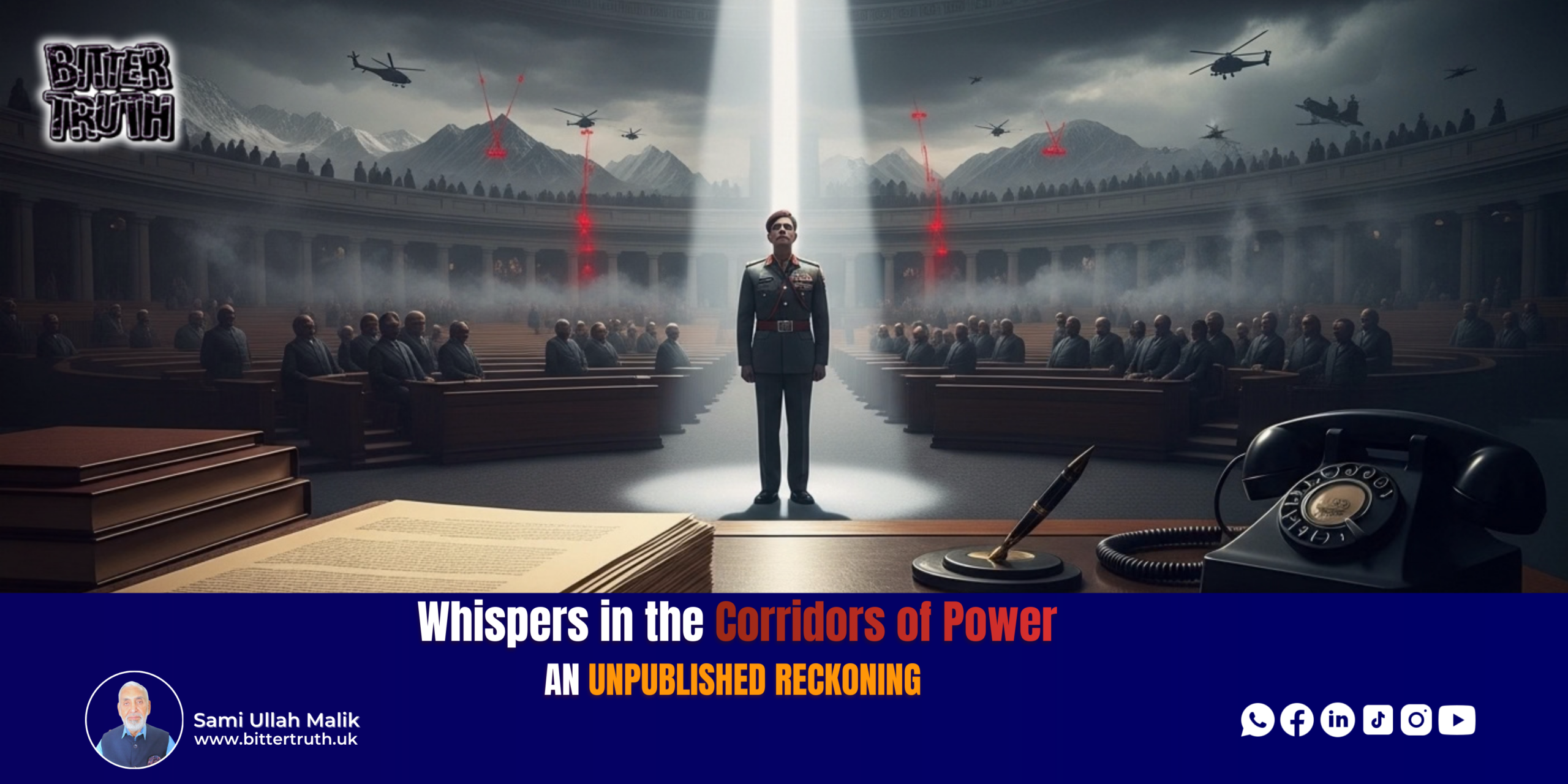
Whispers in the Corridors of Power
An Unpublished Reckoning

The pages of history often sit in austere silence, as though content to bear witness without intrusion. Yet there are moments when they lean towards us and whisper—softly, insistently—pleading the case of truth in subdued tones. There are hours in the life of nations when sentences uttered in the corridors of power, words withheld in calculated restraint, and those decisive murmurs of authority together alter the very current of national destiny. The recent convulsions within India’s political and military sphere belong unmistakably to such an hour—an hour in which words, decisions, and silences alike appear etched with consequence.
At the centre of this unfolding drama stands an unpublished memoir by India’s former Chief of Army Staff, General M. M. Naravane, entitled Four Stars of Destiny. It is less a personal recollection than a reflective mirror—one that casts light not only upon the sensitive judgments of military command but also upon the fragile equilibrium between political stewardship and the imperatives of national interest. In its yet-unprinted pages lies the suggestion that power is not merely exercised; it is weighed, deferred, and, at times, relinquished into ambiguity.
India’s present political-military contention thus forms a chapter in which an unseen manuscript has stirred visible tremors across the parliamentary floor. Questions have risen like dust in a summer squall, leaving national security, political accountability, and democratic convention momentarily standing at the same bar of scrutiny. Such episodes are not without precedent in India’s parliamentary annals. There have been occasions—outwardly procedural, even routine—which in retrospect revealed the most delicate fibres binding civil authority to military command. The events of 2024, however, bear a distinctive gravity.
General Naravane, who served as India’s Army Chief from 2019 to 2022, submitted his memoir for publication in 2024. It awaits official clearance, its progress slowed by the sensitivities attendant upon operational disclosures. The work, by all accounts, traverses both the arc of his personal journey and the strategic deliberations of a tenure marked by exceptional strain. It addresses questions of military preparedness, political consultation, and the burdens of command in moments when the margin for error narrows to a razor’s edge.
Yet even before it has reached the printed page, excerpts attributed to the memoir have entered the public domain—most notably within the Lower House of Parliament. There, in a scene more reminiscent of a constitutional trial than a routine debate, Rahul Gandhi sought to cite passages from a photocopied text. The effect was electric. Members rose in protest; objections rang out across the chamber; and what might have been a sober discussion of civil-military coordination devolved into a partisan tempest.
According to the cited extracts, during the 2020 military standoff with China in the Himalayan region of Ladakh, the nation’s senior political leadership was marked by hesitation and a want of clarity in directive command. The crisis, culminating in the deadly clash in the Galwan Valley—where twenty Indian soldiers and at least four Chinese personnel lost their lives—represented the gravest confrontation between the two powers since 1975. It was no mere border skirmish, but a perilous juncture between two nuclear-armed states, where miscalculation could have borne catastrophic
consequence.
The passages suggest that as Chinese armour advanced towards Indian positions, General Naravane was informed that he should “do what he deemed appropriate”. Repeated calls were reportedly placed to Defence Minister Rajnath Singh, through whom a message from Prime Minister Narendra Modi was conveyed. Yet the ultimate decision, it is claimed, was left in the hands of the Army Chief. In Mr Gandhi’s retelling, this amounted to a moment of profound isolation—“I truly felt alone; the entire establishment had left me,” he declared, invoking a phrase that has since reverberated far beyond the chamber.
Government ministers reacted with sharp rebuke. The Defence Minister and the Home Minister accused Mr Gandhi of misleading Parliament and of diminishing the honour of the armed forces. They further contended that citing an unpublished manuscript constituted a breach of parliamentary convention. Proceedings were adjourned amid uproar; tempers, already strained, flared anew the following day. Eight members of the opposition were subsequently suspended for disorderly conduct.
The Congress Party, for its part, maintained that the memoir of a former Army Chief constitutes a legitimate and authoritative source, and that Parliament must remain a forum for candid inquiry into matters of national defence. This was not, they observed, the first time the opposition had questioned the government’s handling of the China crisis. Indeed, the controversy has reopened an enduring debate: whether, in moments of strategic peril, political leadership must speak with unequivocal clarity—or whether ambiguity is sometimes the instrument of prudence.
The wider context remains the summer of 2020, when tensions along the Line of Actual Control reached their most volatile pitch in decades. Years of military disengagement talks, and diplomatic negotiation eventually yielded a phased withdrawal agreement in 2024. Yet the political reckoning over responsibility, preparedness, and communication has proven more resistant to closure. In democracies, after all, wars may be fought by soldiers, but they are judged by history.
General Naravane has publicly remarked that his duty extended to writing the book and submitting it to his publisher; the responsibility for clearance rests elsewhere. That measured comment has only deepened the aura surrounding the text. A manuscript unpublished, yet profoundly present; unseen, yet shaping discourse—such is the paradox that has lent it the character of a political document before it has ever become a literary one.
What emerges from this episode is not merely a dispute over procedure or personality. It is a meditation upon the nature of command in a constitutional state. Civil authority must guide the sword; the sword must defend the state; and between the two there must exist neither vacuum nor confusion. Where instruction falters, responsibility becomes diffuse; and where responsibility is diffuse, history records its verdict with unsparing clarity.
Thus the affair transcends partisan quarrel. It compels reflection upon the delicate architecture of democratic governance—upon the necessity of transparency without recklessness, of loyalty without silence, of authority without abdication. History, when it whispers, does not seek to indict; it seeks to remind. And in this instance, its murmur is unmistakable: that the destinies of nations are shaped as much by the words spoken in crisis as by those withheld in caution.
In the final reckoning, Four Stars of Destiny stands not simply as a memoir awaiting publication, but
as a prism through which India’s recent past is refracted. It invites the republic to consider how power is exercised, how responsibility is shared, and how silence itself may carry the weight of decision. For in the long ledger of history, it is not only the clash of arms that is remembered, but the clarity—or absence thereof—with which leaders rose to meet the hour.
According to Rahul Gandhi, the memoir records that when Chinese tanks advanced towards Indian positions, General Naravane was told to “do what he deemed appropriate”. The political resonance of that phrase lay not in its brevity, but in its implication: that the nation’s highest civilian authorities, rather than issuing explicit direction, entrusted the final decision to the military commander on the ground. In moments of crisis, such delegation may signify confidence; yet it may equally betray hesitation. The distinction is rarely settled in the heat of events—it is adjudicated in the cooler tribunal of history.
Mr Gandhi further asserted that General Naravane had telephoned the Defence Minister on several occasions, through whom a message from the Prime Minister was conveyed, but that the ultimate determination remained his alone. Describing the atmosphere of that hour, Mr Gandhi suggested that the General felt “alone, as though the entire establishment had left him”. Though presented as an interpretation of the former Army Chief’s state of mind, the phrase struck the chamber with uncommon force. Words of solitude, when uttered in the context of national defence, carry an unmistakable charge.
The government’s position was unequivocal. To cite an unpublished and unverified manuscript, it argued, offended the decorum and discipline of parliamentary procedure. The Defence Minister insisted that a document not yet formally published could not be selectively invoked upon the floor of the House. Kiren Rijiju, Minister for Parliamentary Affairs, cautioned that assertions neither substantiated nor procedurally admissible ought not to be pressed into debate. Yet Mr Gandhi was permitted to continue—a concession that underscored the delicate balance between preserving parliamentary order and safeguarding freedom of expression. In essence, the government sought to draw a firm demarcation between parliamentary privilege and national security. Military affairs, it maintained, must not become instruments of partisan point-scoring.
The Congress Party advanced the contrary view: that the memoir of a former Chief of Army Staff constitutes an authoritative source, and that if it raises substantive questions regarding national security, Parliament not only may but must examine them. They reminded critics that the government’s handling of China had been subject to scrutiny before; this was no novelty conjured for transient advantage, but part of a longer and unresolved national conversation.
Outside Parliament, Mr Gandhi displayed a copy of the unpublished manuscript to journalists and asserted that standing instructions had discouraged the firing of shots should Chinese troops enter Indian territory without prior political authorisation. This claim was received with acute sensitivity. It seemed to hint at a possible tension between military doctrine and political caution and thus touched the most combustible of subjects: the interface between strategic restraint and sovereign defence. Transparency, he implied, is not an indulgence but a democratic necessity.
The uproar did not subside with a single sitting. Proceedings were disrupted the following day; the atmosphere remained charged; and eight Congress members were suspended for disorderly conduct. Thus, an unpublished book achieved what many printed volumes do not: it altered the immediate rhythm of political life and produced tangible parliamentary consequence. The episode revealed, with unmistakable clarity, that in contemporary India military questions are no longer confined to defence briefings—they have entered the bloodstream of political narrative itself.
At its heart lay a question both simple and profound: where does responsibility begin and where does it end between civil authority and military command? In a constitutional democracy, the armed forces are subordinate to elected leadership; yet the tempo and pressure of real-time crisis may thrust commanders into circumstances where decision precedes deliberation. If authority was indeed devolved to the Army Chief, that act might be construed either as an expression of trust or as a manifestation of uncertainty. Interpretation, inevitably, follows political alignment.
It is for this reason that Four Stars of Destiny has come to symbolise more than personal recollection. It has become a meditation upon the relationship between power and accountability. Intended for publication in 2024, its release has been delayed by the intricate processes of governmental clearance and the sensitivities inherent in operational disclosure. General Naravane himself observed with restraint that his duty was to write and submit the manuscript; its further progress rests with publisher and authorities. In that measured remark resides the complexity of the matter: the tension between military confidentiality and the historian’s claim upon the record.
When an unpublished manuscript becomes the axis of political contention, it ceases to be merely literary. It becomes emblematic of power’s architecture—of who decides, who authorises, and who answers. The controversy illuminates the fragile geometry binding military leadership, political authority, national security, and the integrity of historical memory. The memoir stands as a mirror in which crises, judgments, and burdens of responsibility are refracted layer upon layer.
The significance of the episode is manifold. First, it has revived the unresolved questions of 2020 and reawakened debate regarding the stewardship of that perilous summer. Secondly, it has placed parliamentary convention and the limits of speech under renewed examination. Thirdly, it has drawn the relationship between soldier and statesman into the arena of public discourse, where once it was discussed in quieter rooms.
Such moments leave a durable imprint upon a nation’s collective memory. They are not mere parliamentary skirmishes; they are stages in the formation of national narrative. Decisions taken in the corridors of power often reveal their full meaning only with time. A sentence uttered in haste may return years later as a question; a silence maintained in prudence may acquire the weight of an indictment. In the realm of authority and national obligation, every utterance matters, every hesitation carries implication, and every silence possesses intellectual dimension.
The unpublished memoir of General Naravane—and the storm it has stirred—reminds us that national security is not solely the defence of borders. It is equally the preservation of trust, clarity, and responsibility within the constitutional order. The controversy has laid bare the intricate weave of military and political relations and demonstrated that history’s pages are not sterile catalogues of fact. They are records of human judgment, moral tension, and the ceaseless contest between prudence and principle.
In democracies, the equilibrium between civil and military leadership is exquisitely delicate. When maintained, the state stands firm; when strained, questions echo across generations. This episode therefore conveys more than the fate of a book or the turbulence of a debate. It affirms that in the court of history neither words nor decisions vanish. Each age must answer for its choices. That is history’s sternest lesson—and its most enduring counsel.
Ultimately, this account urges us not merely to observe events but to comprehend the responsibility, sacrifice, and intellectual gravity that lie beneath them. It is for this reason that the memoir—and the parliamentary tempest surrounding it—resonates beyond immediate politics. It speaks to the enduring relationship between a nation’s destiny, the duty of its leaders, and the conscience of its citizens.