Secrets Behind the Silence
The Quiet Storm of Power

The Critical Hour: A Turning Point in History
This is the pivotal moment, standing at the very edge of which one cannot help but feel that history is on the cusp of a significant shift. It is a juncture where events cease to be mere headlines; they inscribe themselves upon the very fabric of time, determining the destiny of eras yet to unfold.
My friends, the subject we are about to address represents the true point of revolution in this ongoing conflict. Before we delve into its deeper layers and uncover its multi-faceted truths, it is imperative to clarify that this is no conjecture, nor a baseless hypothesis. What is being presented is drawn from credible sources, and we shall acquaint you with each and every aspect of this unfolding reality.
Across the vast expanse of history’s canvas, there are moments that emerge not merely as events, but as milestones that forever alter the course of civilizations. There are, indeed, instances within the annals of time when certain moments transcend the ordinary and become defining, epoch-shaping turning points—times when the balance of power shifts, narratives crumble, and the truth, in all its majestic clarity, reveals itself.
These are the moments when the very foundations of power tremble, when decisions are no longer abstract judgments but fateful acts, and when the true nature of nations’ strategies is laid bare for all to see. And today, the global landscape presents us with just such a moment—a moment of revolution, where the land of the Middle East stands poised once again to alter the course of world politics, shifting the currents of global power towards uncharted territories.
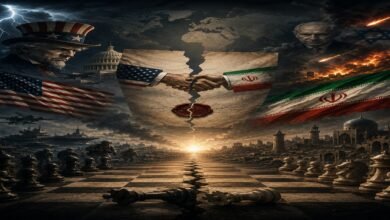
This crisis is no longer confined to a single nation, region, or isolated conflict. It has now evolved into a far-reaching transformation—one that challenges not only the global dominance of the United States but also casts doubt upon the very moral foundation upon which its authority has been built. This is not a transient crisis, but rather the result of a gradual evolution—an evolution that has long been brewing in the shadows and has now emerged in the form of a tempest. This storm has not only called into question America’s military supremacy but also unsettled its moral justification.
The situation has reached a point where Washington’s hold is not merely loosening but is on the brink of collapse. At the heart of this crisis lies an ally upon which America once based its regional influence. Ironically, at the very moment when it was most needed, this very ally has risen in opposition. From the American perspective, this is a betrayal so unforeseen that it defies belief. Yet, Iran—a nation that has long adhered to a strategy of patience and calculated restraint—has perhaps been awaiting this moment for far longer than we might imagine.
This is the same Iraq upon which America poured its energy, its resources, and its strategy for two decades. In 2003, the United States invaded Iraq—an invasion that was justified to the world on the grounds of “weapons of mass destruction.” It was presented as an inevitable step, one taken for the greater good, with the argument that Iraq possessed lethal weapons that posed a dire threat to global peace and humanity. This narrative was so vigorously propagated that the global conscience was swept along in its wake. The media amplified this message to such an extent that a large portion of the world came to believe this distortion of truth. Yet, when the dust of war finally settled, the reality was starkly different. No weapons of mass destruction were found, no immediate threat emerged, no nuclear arsenal had been uncovered. What was discovered, however, were vast reserves of oil—resources that, alongside a once-prosperous nation, lay buried beneath the rubble of destruction.
In the wake of this, the United States embarked upon the costly task of rebuilding Iraq, remaking it in its own image. This was a project in which trillions of dollars were spent—on military training, the establishment of a political system, and the creation of diplomatic infrastructures. Trillions of dollars were invested to establish a new military, rebuild a political framework, and construct the world’s largest embassy in Baghdad. All of this was done under the belief that Iraq would be a loyal ally—a belief that has since proven tragically misplaced. Today, that very pillar, which was once seen as a cornerstone of American strategy, is not only shaking but is now riddled with deep fissures. The very assets—those resources, that military power, that political infrastructure—now seem poised against the forces that originally constructed them. Reports indicate that the very bases, built with American capital, are now being used as sites to launch attacks against U.S. forces, and the very individuals trained by Washington are now providing targets to the enemy.
History has once again demonstrated that the loyalties of nations cannot be bought with investments alone. Where the United States relied on power, capital, and military might, Iran chose a different path—a path that, though slower, has proven to be far more enduring. Through quiet, gradual, and cultural influence, Iran strengthened its ties with Iraq—not through billions of dollars in contracts, but through cultural, religious, and familial connections, subtly weaving its presence into the very fabric of Iraqi society.
While Washington built monumental structures, Tehran was building relationships. And now, the fruits of this silent struggle are coming to bear. This crisis is revealing another profound truth: loyalty cannot be purchased with capital alone. The United States built edifices; Iran built relationships. One constructed a framework; the other created bonds within the hearts of the people. In doing so, Iran fostered trust and cultivated a network that has only grown stronger with time. This was not a strategy that demanded immediate results, but rather one rooted in patience, continuity, and shrewdness. And now, as the circumstances shift, it is this strategy that is beginning to show its impact.
This is the war that was fought not with guns, but with relationships. And today, its consequences are being felt with all their intensity. Iraq’s political leadership, its security apparatus, and its internal decision-making are no longer immune to this influence. And history bears witness that, in the end, decisions are made by hearts, not by walls.
Iraq’s Current Policy: A Silence That Speaks Volumes
The current policy of Iraq—particularly its silence—carries a profound message. Baghdad’s silence, which may appear as mere inaction, is in fact a decision in itself. The political leadership of Iraq, especially the Prime Minister, has emerged under the influence of forces whose roots stretch deep into Tehran. Despite appeals from the Arab League, Iraq has neither condemned the attacks nor announced any investigations, nor called for peace. Those familiar with the subtleties of regional politics understand that sometimes silence speaks louder than words—a declaration that may be too sensitive to voice openly but whose effects are undeniable.
On the regional level, when Iraq was called upon to denounce the attacks taking place on its soil, its silence spoke volumes. There was neither a statement, nor a denial, nor a response. This silence is, in essence, a declaration—one that does not come from words but is revealed in the course of events. This silence is, therefore, the embodiment of the fact that Iraq has now embarked on a path from which there is no easy return.
When the Arab world demanded that Iraq condemn the attacks occurring on its land, it chose silence. This silence is not merely a void; it is a decision—one that may be difficult to express publicly but whose consequences are manifest. This silence signals that Iraq is now treading a new path—a path where its priorities have shifted and its allegiances are being redefined.
In the past seventy-two hours, the intensification of attacks on American targets appears to be no accident. Iran has openly claimed responsibility for these attacks, and state-run media have described them as part of a well-coordinated military strategy. What was once perceived as the work of “rebel groups” now emerges as a unified military campaign, with Iraqi and Iranian forces seemingly aligned in common cause.
The clearest symbol of this shifting atmosphere is the evacuation order issued by the U.S. Embassy in Iraq. Such an order allows no delay; it demands immediate compliance. The embassy’s latest directives highlight the severity of the threat: citizens have been warned not only to leave Iraq but to avoid the U.S. Embassy in Baghdad and the Consulate in Erbil, as these locations have now become direct military targets. How tragic it is that a state must now advise its own citizens to stay away from its own diplomatic centers.
Washington’s directive for American citizens to leave Iraq immediately is not merely an extraordinary step; the promptness of the embassy’s evacuation order serves as a stark reminder of the gravity of the situation. This is not just an administrative measure but a declaration that even the airspace has become unsafe. The only remaining exit is through land borders—toward Jordan, Kuwait, Saudi Arabia, or Turkey. This is not simply a precautionary action; it is a recognition that the very ground where years of investment were made has now become a stronghold for opposing forces.
Reports suggest that certain state elements are not only failing to prevent these attacks but are, in fact, facilitating them; the defense systems fall silent precisely when they are most needed. The question arises: Is this all-mere coincidence, or is it part of a well-coordinated strategy? This is the moment when even the mightiest of states are forced to retract their steps—moments when history holds them accountable, forcing powerful nations to acknowledge their limits and revealing their true status.
Should the situation continue to deteriorate, the consequences could be even more severe than those witnessed in Afghanistan. While U.S. withdrawal from Afghanistan left behind modern weaponry, the stakes in Iraq are far higher. Patriot missile systems, intelligence frameworks, radar installations, and a geographically invaluable position are at risk. Should these assets fall into enemy hands, it will not merely be a military setback; it will constitute a strategic catastrophe for generations to come.
This crisis is no longer confined to foreign policy alone; its echoes are now being felt within the United States itself. Political circles in Washington are rife with unease, extraordinary anxiety, and deep concern. Numerous American leaders—whether former officials or current political figures—are openly expressing that the present leadership is not only a threat to global peace but is also undermining the very credibility of the United States.
Donald Trump, who once portrayed himself as a strong and decisive leader, has now become the focal point of criticism. Particularly in the wake of Trump’s recent speech—which many had hoped would herald an announcement of a ceasefire, a new chapter in the conflict—he once again failed to deliver. His words mentioned peace, yet his actions stood in stark contrast. This contradiction now appears to be a permanent feature of American politics.
In international diplomacy, words hold weight—but it is actions that truly matter. When a state diverges from its commitments, retracts its narrative, and denies its own principles, it is not merely a political failure; it becomes a symbol of moral decay. Trump’s rhetoric spoke of peace, negotiation, and stability, yet the practical measures he put forth contradicted these ideals. This dissonance has become a defining characteristic of American foreign policy today.
The Duality of Diplomacy: A World in Crisis
On one hand, there are calls for peace; on the other, military operations persist. One moment, there are proclamations of negotiations; the next, there are new sanctions. This duplicity has not only left the international community bewildered but has also plunged the American populace into a profound moral dilemma. Today, this duplicity is not just eroding America’s global credibility; it is sowing disillusionment within its own ranks. The American public, who once saw themselves as champions of democracy, justice, and moral superiority, now find themselves at a crossroads—forced to question the very system they once held as a paragon of virtue.
The most immediate and severe impact of this crisis has been felt within the global energy market. The Strait of Hormuz—a critical artery for the world’s energy supplies—has, for all practical purposes, been closed. This disruption has severely impacted global energy availability, and yet another dangerous aspect of this crisis emerges—the impact on the global energy market. The closure of the Strait of Hormuz has resulted in the daily disappearance of eleven million barrels of oil from the market—double the amount seen in past major oil crises. Prices are soaring into the stratosphere, and should this trend continue, the world economy may be thrust into an unprecedented upheaval. This situation is not only a challenge for industrial nations but has already spiralled into an economic crisis for developing countries.
The reality is that the situation today is far more dire than the energy crises of yore. Governments across the globe are scrambling to take emergency measures—fuel rationing in some places, price controls in others, and a swift pivot towards alternative sources of energy. The most striking aspect of this crisis is that it has once again reinforced the trend toward state control. Governments around the world are imposing drastic measures—fuel rationing, price restrictions, and aggressive movement toward alternative energy solutions. The expansion of state control is evident in this growing trend. When resources are scarce, states inevitably extend their powers. Restrictions on movement, limitations on energy use, and increased government intervention in daily life—these are the symbols of a new era. They signify a reality where states, in times of crisis, expand their authority. There is an eerie resemblance to the pandemic era, with the key difference being that this time, the threat is not a virus but a geopolitical and territorial clash. Mobility restrictions, dependence on state directives, and the regulation of daily life have become the norm, leaving open the unsettling prospect that this may well lead down a path of fascism—another great calamity for humanity.
While many countries are searching for short-term solutions, the United Kingdom has seized this crisis as an opportunity for long-term transformation. With an eye towards alternative energy sources—such as solar power and heat pumps—through the enforcement of environmental policies, and efforts to secure energy independence, the UK is paving the way for a fundamental shift. Other nations, in their own distinct ways, are also striving to manage this crisis. These actions have the potential to reshape the future of global politics. The question remains: can this transformation occur swiftly enough to mitigate the current crisis?
What is unfolding today is not merely a disruption or a crisis—it is the rebirth of the global order, the reconstruction of a new world framework. America’s strategic dominance is being challenged, Iran’s strategy appears to be yielding results, and the global system is in search of a new equilibrium. The global energy infrastructure, upon which the world has relied for decades, is disintegrating. The strategic architecture that America built in the Middle East is crumbling. Decisions made in Baghdad, Tehran, Washington, and Beijing will set the course for the coming decade.
This is the moment when decisions are not being made solely by governments—history is not merely being written—it is being forged. The world is carving out a new path, one that will ensure that the future is not one in which the fate of humanity rests in the hands of a single individual or state. Perhaps the most crucial question today is this: Is the world ready for this new path?
And, indeed, this may be the most critical question history asks: Is humanity prepared for this new world?