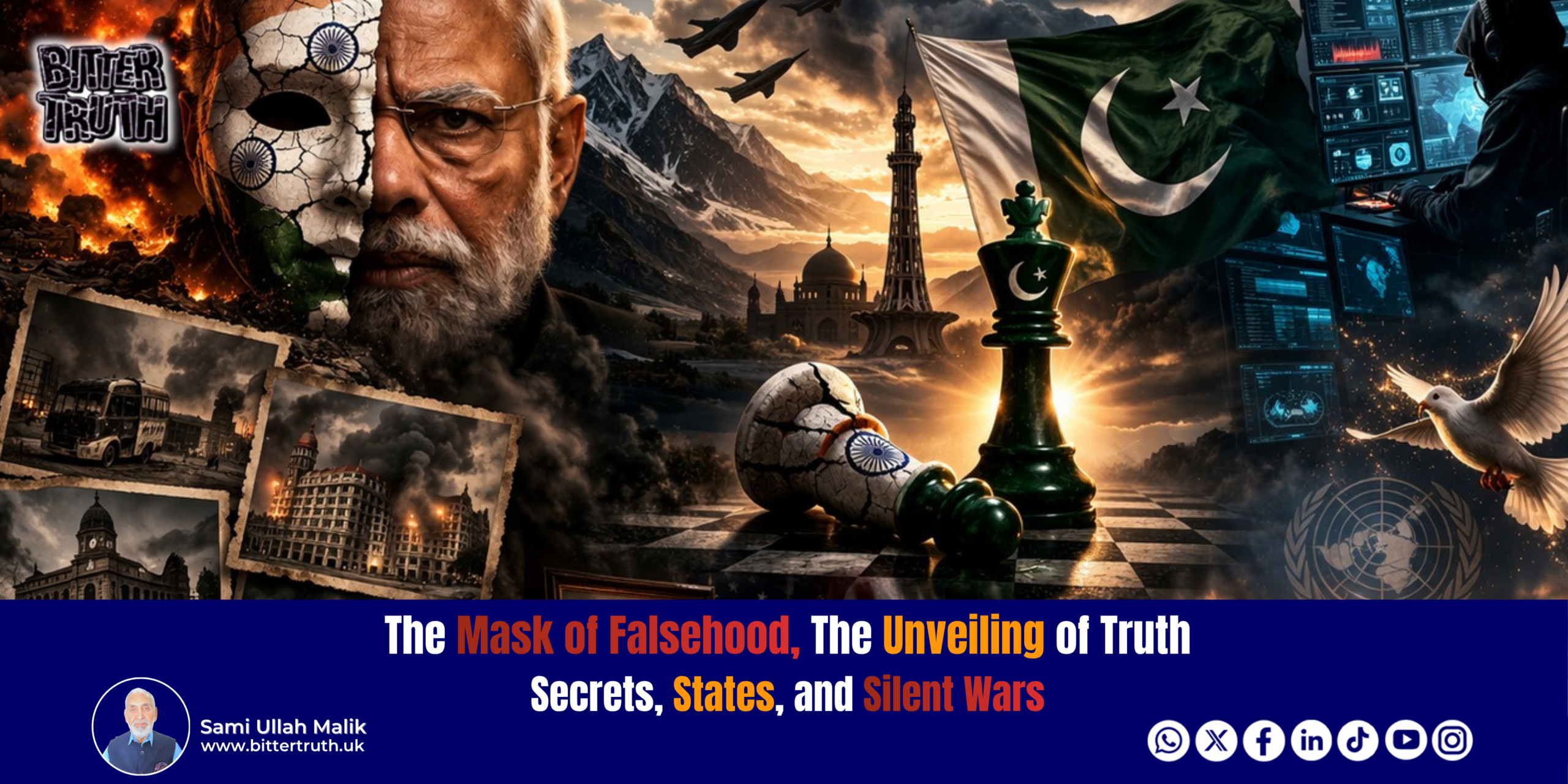
The Mask of Falsehood, The Unveiling of Truth
Secrets, States, and Silent Wars

A World Unmoored: Power, Deception, and the Quiet Theatre of Modern Conflict
Time, in its onward march, has never been a creature of constancy. At moments it breathes in the gentle airs of concord, and at others it is seized by tempests of disorder, losing even the semblance of its own equilibrium. The present global condition bears unmistakable testimony to this unease. We inhabit an age in which those ensconced within the chambers of power speak the language of peace, yet—behind the measured cadence of diplomacy—there operates a more intricate loom, weaving designs in which truth is too often ensnared and suffocated.
This report is, therefore, an attempt—however modest—to disentangle that web. It seeks not merely to recount events, but to situate them within a wider intellectual and historical frame, where the echoes of the past, the reverberations of the present, and the forebodings of the future converge into a single, reflective narrative. It is written in the conviction that the reader ought not to remain a passive consumer of headlines, but rather an engaged inquirer, capable of discerning the deeper currents that shape the visible world.
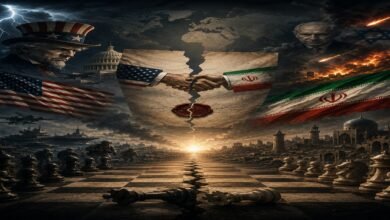
There was a time, not altogether distant, when the conduct of politics was thought to embody a certain equilibrium—a balance between prudence and principle. Today, that equilibrium appears grievously impaired. The chessboard of international affairs has grown more obscure: the moves are concealed, the intentions labyrinthine, and the consequences increasingly ruinous for the commonwealth of mankind. One is compelled to observe that global politics has drifted into a vortex wherein the distinction between right and wrong is no longer clearly apprehended, and where, behind the courteous smile of diplomacy, there glints the unmistakable edge of the dagger.
It is in this fraught and ambiguous climate that the reported exposure by Pakistan’s security institutions of an alleged Indian false-flag design assumes significance beyond the ordinary. This is not merely an episode in the shadowy annals of intelligence work; it constitutes, rather, a moment of considerable historical consequence. For if substantiated, it represents not only the averting of a potentially grave escalation in the region, but also a contest of minds and methods—a diplomatic and intellectual engagement whose implications extend far beyond the immediate theatre. It is, indeed, the kind of revelation that compels reflection, not only within the region but across the wider conscience of the international community.
Such revelations remind us that the most productive conflicts of our time rarely take place in the open. Instead, they unfold in the quiet recesses of planning rooms, in the coded exchanges of unseen actors, and in the calculated ambiguity of statecraft. According to security sources, Pakistan’s intelligence apparatus has succeeded in decoding secret Indian communications – a breakthrough that speaks not only to technical prowess, but also to a depth of analytical acumen, institutional discipline, and strategic foresight. It is essentially a confirmation of the principle that in the modern era, knowledge has become a decisive instrument of timely, precise, and well-defined power.
One might say that a veil has been lifted: that secrets, long concealed within the dense fabric of strategic design, have been brought into the clarifying light of scrutiny. For in contemporary conflict, it is no longer the weight of armaments alone that determines outcomes, but the mastery of information—its acquisition, its interpretation, and its judicious use. In this respect, the reported success represents not only a defensive advantage, but an assertion of intellectual primacy: the capacity to anticipate an adversary’s design and thereby to forestall its execution.
History, if it teaches anything, teaches us that false-flag operations are no novel contrivance. They belong to that darker repertoire of statecraft in which deception is elevated to an instrument of policy, and falsehood is dressed in the garments of legitimacy. The purpose is as old as it is pernicious: to mislead public opinion, to manufacture consent, and to furnish a pretext for actions that might otherwise invite censure. From the annals of Europe to the theatres of the modern Middle East and South Asia, such stratagems have recurred with unsettling regularity.
It is within this historical continuum that current concerns must be addressed. Reports suggesting a renewed readiness for such practices inevitably raise concerns. For they amount to the deliberate construction of a narrative—a staged event—designed to attribute culpability elsewhere and thus justify escalation. Particularly troubling are the indications that released prisoners may be used as instruments in such a design. If true, this is not simply a violation of legal principles but a profound affront to the moral sensibilities upon which any civilized order must rest.
To use those already rendered vulnerable as pawns in a larger political contest is to cross a threshold beyond which the language of ethics begins to lose its meaning. It is here that politics, stripped of its moral moorings, reveals its most disquieting aspect: the reduction of human beings to expendable pieces upon a board of strategy. No calculus of national interest, however expansively construed, can wholly absolve such a descent.
The logic underlying such a course is, unfortunately, familiar. By engineering an incident and attributing it to an adversary, it becomes possible to inflame tensions, stir up emotions, and disrupt ongoing efforts at reconciliation. The old maxim—commit first, blame later—has accompanied, in various ways, many of history’s gravest mistakes. Yet in an interconnected world, where instability spreads with alarming frequency, such tactics carry far greater immediate risks. What begins as a calculated movement can end in a chaos beyond the control of its founder.
Nor should it be overlooked that such tactics are often part of a broader design: to force an adversary into a state of strategic distraction, to spread his capabilities across multiple fronts, and thus to erode his effectiveness. This is a classic principle of warfare, transposed to present-day realities. Yet history advises caution, as such maneuvers have often produced unintended consequences in achieving their intended objectives.
In the final analysis, what emerges is a picture that is both clever and instructive. It reveals a world in which the tools of deception have become more sophisticated, the stakes more dangerous, and the margin for miscalculation is increasingly narrow. And it points above all to the enduring truth that in the contest between power and principle, it is not always the former that wins the more lasting victory.
The Burden of History and the Peril of Power: Alignments, Intrigue, and the Fragile Promise of Peace Where the pages of history speak with any authority, they speak to a recurring pattern: that operations of deception—those now commonly termed “false-flag” manoeuvres—are by no means innovations of the present age. Rather, they belong to a lineage of stratagems that have, time and again, cast long shadows over the conduct of states. Incidents such as Chittisinghpura, the Mumbai attacks, Pathankot, and more recent episodes of violence in Kashmir have all, in varying degrees, attracted lingering questions—questions that refuse to be neatly settled within official narratives.
Nor has this unease been confined to the subcontinent. Allegations, at times substantiated and at others fiercely contested, have surfaced on the international stage, including those concerning the targeting of Sikh figures abroad. The reported admissions of individuals such as Nikhil Gupta have only served to deepen the disquiet, lending credence to the proposition that covert operations—operating in the penumbra of deniability—remain an enduring instrument of geopolitical contest. Taken together, these episodes suggest a disconcerting truth: that in the theatre of global politics, ethical restraint is too often relegated to the margins, while expediency assumes the centre.
Recent pronouncements and policy gestures have further unsettled an already delicate regional equilibrium. New alignments appear to be forming, while older understandings show signs of strain, if not outright dissolution. The geometry of power is being redrawn before our eyes, and with it the assumptions that once underpinned international stability. It would seem that the world is entering a fresh geopolitical chapter—one in which alliances are less fixed, loyalties more contingent, and calculations increasingly governed by immediate advantage rather than enduring principle.
Within this changing landscape, statements attributed to elements of the Indian military leadership, which signal support for Israel’s stance towards Iran, have introduced an additional element of tension. Such pronouncements, whether strategic or declarative, have consequences that are out of their immediate context. They risk entangling regional disputes in broader global hostilities, thus exacerbating the volatility of an already volatile environment. One is left with the unpleasant impression that, in the pursuit of strategic leverage, the wider balance of the region is being tarnished with insufficient regard for its fragility.
Against this backdrop, the response from segments of the Iranian and Palestinian leadership appreciating Pakistan’s role has a particular diplomatic significance. It suggests Pakistan’s gradual emergence as a state capable, at least in some quarters, of balancing principles with prudence. Expressions of trust – however rhetorically constructed – are rarely extended without calculation. They are more often the product of sustained engagement and a consistent posture of moderation. If such trust is indeed taking root, it could be read as a modest but significant shift in the region’s diplomatic narrative.
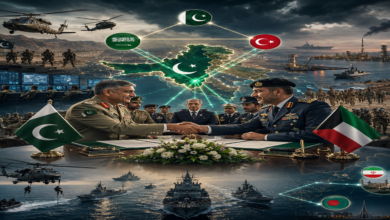
Equally noteworthy is the convening of dialogue-oriented initiatives within Pakistan, drawing participation from regional actors including Saudi Arabia and Turkey. In an era too readily defined by confrontation, even tentative steps towards structured dialogue carry a significance that ought not to be dismissed. Should such efforts acquire continuity and depth, they may yet mark the beginnings of a more constructive regional ethos—one in which contest is tempered by conversation, and rivalry moderated by restraint.
The supporting indicators attributed to Russia and China further complicate, yet further reinforce, this emerging picture. They point to a more pluralistic world order, one in which unilateral imposition of will—however gradual—is shifting toward a more distributed and negotiated balance of influence. Whether this trend matures into a stable order remains to be seen. Yet its emergence is itself indicative of a system transition.
Meanwhile, within India, critical voices on foreign policy conduct suggest that external currency is inseparable from internal scrutiny. Disagreements—expressed through political competition and public debate—are not in themselves signs of weakness. Yet they signal that consensus is neither automatic nor certain. Where policy is perceived as weak, or the exact costs are disproportionate to its gains, it is inevitable that questions will arise—questions that can shape both direction and tone over time.
Reports of attempts to revive proxy dynamics through neighbouring theatres, including Afghanistan, add yet another layer of concern. Such approaches, rooted in indirect engagement and strategic outsourcing of conflict, have historically produced consequences far exceeding their initial design. To revisit them, in a region already burdened by instability, is to risk reopening chapters whose outcomes are neither easily contained nor readily reversed.
In contrast, the apparent failure of attempts to create internal chaos within Iran—whether through overt pressure or more subtle means—illustrates a counter-lesson: that states with internal cohesion and public legitimacy are not easily freed from external design. Where internal structures maintain flexibility, external interventions—however sophisticated—face limitations that cannot be wished away.
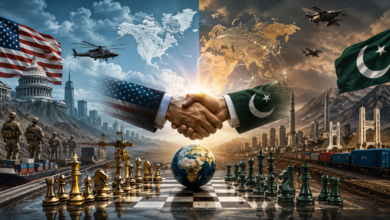
The posture of the United States, marked at times by a tension between declaratory commitment to dialogue and the simultaneous application of pressure, illustrates the complexities—and contradictions—of contemporary statecraft. Such dualities, while not unprecedented, carry reputational costs. For when policy appears to oscillate between engagement and coercion, it risks eroding the very trust upon which durable agreements depend.
Developments in the Arab world also reflect growing anxiety. Statements and gestures that are dismissed or perceived as disproportionate have contributed to a perception—fair or otherwise—that outside powers continue to privilege selected interests at the expense of a more even-handed approach. The Middle East, long accustomed to turmoil, once again appears to be on the verge of significant change.
However, it would be a mistake to describe these dynamics in purely military terms. Increasingly, the lines of competition extend to the economic sphere, where energy routes, supply chains, and access to resources become strategic instruments. Efforts to disrupt or reorder energy flows—whether from Iran, Venezuela, or elsewhere—speak to a broader contest in which economic resilience is as important as military capability. In this sense, current tensions cannot be understood simply as regional conflicts, but rather as aspects of a broader, systemic contest.
Concerns regarding access to, or control over, strategic resources—particularly in relation to energy and nuclear capacity—further heighten the stakes. Statements hinting at such objectives, when issued in already volatile circumstances, carry the potential to accelerate escalation rather than contain it. The margin between deterrence and provocation, never wide, becomes perilously narrow under such conditions.
In the face of these interlocking pressures, the case for a principled recalibration of global conduct becomes not merely desirable, but imperative. Certain propositions long acknowledged yet insufficiently realised, demand renewed attention: that transparency in international dealings be strengthened; that dialogue and diplomacy be accorded primacy over force; that regional cooperation be cultivated rather than undermined; that international institutions be rendered both effective and impartial; and that the rights and dignity of individuals be upheld as ends in themselves, not subordinated to transient advantage. The role of the media, too, must be exercised with a sense of responsibility commensurate with its influence.
History offers a sober, if ultimately optimistic, piece of advice. Power struggles, however fierce, are rarely permanent. Yet their traces can linger from generation to generation. Our world is filled with suspicion, narrowed by hostility, and shadowed by the constant possibility of miscalculation. And yet, it is equally true that darkness has never proved permanent in the long arc of human affairs.
Renewal remains possible—provided that states act with foresight, that leaders temper ambition with restraint, and that the wider claims of humanity are not wholly eclipsed by narrower designs.
If such a reorientation can be achieved—if prudence is allied with principle, and strength moderated by wisdom—then the same world that now bears the scent of powder may yet, in time, be restored to a more habitable condition. For hope, though often subdued, is not extinguished. It endures in the belief that tomorrow need not be a mere continuation of today’s disquiet but may instead offer the first light of a more settled and humane order.
The task, therefore, is not to remain passive observers of unfolding events, but to engage—intellectually, morally, and, where possible, practically—in the shaping of a more stable peace. For this is not only the demand of prudence; it is, in the final reckoning, the obligation of our shared humanity.