The Mirage of Power: Beneath the Surface of a Changing World
A Quiet War: Power, Illusion, and the Making of a New Order

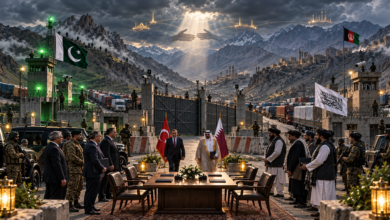
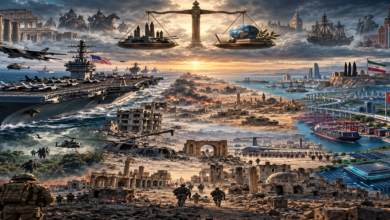
This world—once a confluence of civilisations—now appears to be receding into a wilderness of competing interests. There was a time when caravans passed through these lands singing the hymns of peace, and the lamps of knowledge and wisdom burned brightly in every direction. Today, however, the air is tinged with the acrid scent of gunpowder, and clouds of rising smoke obscure the very visage of humanity. Outwardly, all seems routine—news bulletins, official statements, the measured cadences of diplomacy—yet beneath this veneer of calm there stirs a disquiet so profound that it bears the unmistakable forewarning of a gathering historical tempest.
This is not merely an age of wars; it is, more insidiously, an age of narratives—narratives that veil reality and estrange mankind from its own discernment. We are told that wars are waged in the name of peace, that interventions are undertaken for stability, and that destruction itself is but a prelude to reconstruction. Yet one cannot help but ask: if all this is indeed for peace, why does unease haunt every corner of the globe? If it is for stability, why do the very foundations of human existence seem to tremble?
This is where a story begins, which at first glance seems to be a combination of contrasting elements, but in reality is made up of different colors of the same design. A design in which a centralised power aspires to draw the entire world into its orbit—an idea often encapsulated in certain circles as the “One World Order.” This is no mere political phrase; it is a vision wherein a singular force seeks to consolidate its hold not only over resources and economies but even over thought and consciousness itself. At this juncture, the heart quivers and the soul poses its most searching question: has humanity truly become so helpless that a handful of powerful hands may decree its destiny? Has the world arrived at a turning point where interest has supplanted justice, and power has eclipsed morality?
A glance through the pages of history reveals that this is no novel tale. In every age, powers have arisen that sought to perpetuate their dominance by moulding the world in their own image. Yet the present moment is distinct in that this process has grown more organised, more subtle, and more pervasive. Wars are no longer confined to battlefields; they are waged across the domains of economy, energy, information, and technology.
It is important to understand recent global developments against this backdrop. They are not isolated but part of a continuum — a carefully orchestrated strategy aimed at gradually gaining control of the world’s resources, regardless of the cost, regardless of how many regions are reduced to ashes.The sages of old have long said that the world is but a mirage: what appears is seldom real, and what is real often remains unseen. Contemporary politics seems to reflect that very illusion. What we are shown may not be the truth; and what is true has perhaps been deliberately concealed from our sight.
This essay is, therefore, an attempt to pierce that mirage—to strip events of their outward обол and discern the reality that operates beneath. For until we apprehend the truth, we can neither form sound judgement nor chart a prudent course for the future. It is, in essence, a lament for a world shrouded in mist, wandering in restless search of justice and equity.
In every epoch of history, the emergence of a new power has provoked an instinctive reaction from the old. Whenever the clouds of politics gather densely upon the horizon, attention is invariably drawn to the flash of lightning rather than to the accumulating heat within the clouds themselves. Today, too, a new storm seems to be rising—one that outwardly manifests itself in the tensions surrounding Iran or Israel, yet whose deeper layers lie concealed elsewhere. As in ages past, when an ascending power approaches the thresholds of the prevailing world order, established powers respond—often unconsciously, yet decisively.
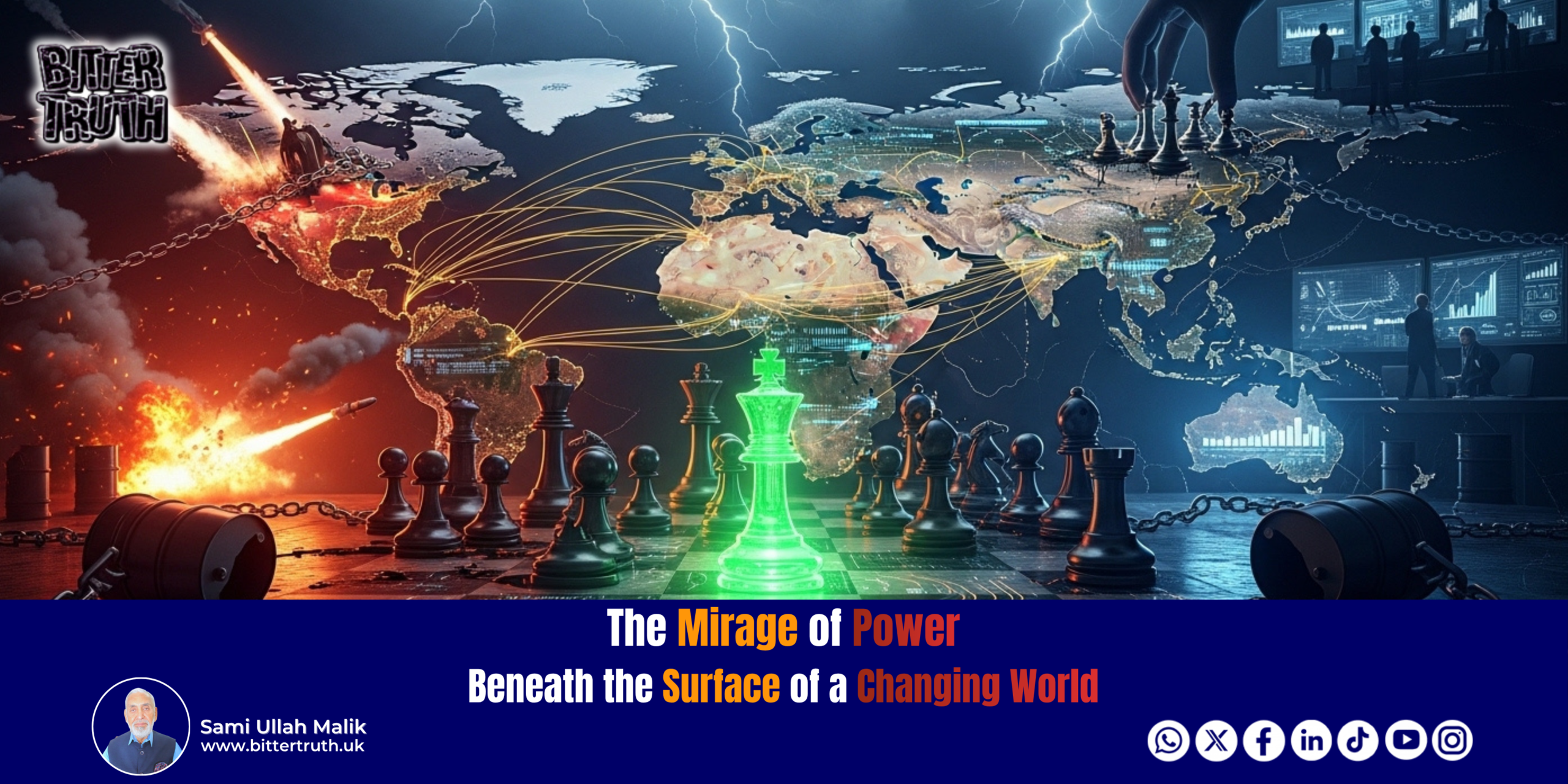
Such is the condition of our time. Here, Iran dominates the discourse; there, Israel commands the headlines; yet the caravan of reality passes silently through these avenues towards an altogether different destination. The contemporary global landscape is a living embodiment of this principle. What appears to be illuminated before the public eye often serves to obscure the true paths beneath. History teaches us that international politics resembles a vast chessboard: the pieces move in full view, yet the real intent lies hidden behind the curtain.
It is my purpose here to reveal, through the prism of two events, the deeper logic of this global strategy. Let us look not merely at the events themselves, but at the connections that bind them; not at the clamour, but at the silent design that underlies it. In doing so, I shall attempt to lift the veil from the geographical, economic, and political complexities that shape the strategies of global powers—particularly the interplay between China’s economic ascendancy and the dynamics of global energy supply—so that more meaningful conclusions may be drawn.
The United States conducted a controversial operation in Venezuela, which resulted in the arrest of President Maduro. At first glance, it seemed like a political coup. In reality, it was a calculated blow to an economic artery. When Maduro was removed, the world declared it a victory for democracy. Applause erupted in some quarters. Legal measures were taken in others. Yet scant attention was paid to a more fundamental question: where did the true impact of this change fall?
Few paused to consider who the principal consumer of Venezuelan oil had been. The answer is clear: China. Venezuela had been supplying tens of thousands of barrels of oil daily to fuel China’s vast economic engine. With Maduro’s removal, that pipeline was effectively severed, and the جریان of energy abruptly halted. Venezuelan oil was not merely a commodity; it was the lifeblood coursing through the arteries of China’s industrial body. To arrest that flow was akin to drying up the very source of a river.
History, it must be remembered, rarely changes its course with great difficulty. Rather, it changes silently—and by the time humanity wakes up, the map has already been redrawn. This was not a mere political ploy. It marked the beginning of a broader strategy to contain China’s growing economic influence. It stands as a reminder that the struggle for power is never limited to political maneuvering but is deeply intertwined with the ebb and flow of economic power.
The case of Iran is another link in the same chain. The measures taken against Iran have sent shockwaves of fear and anxiety around the world. Some saw them as attempts to neutralize the nuclear threat. Others condemned them as violations of international law. Yet the essential question remains: whose lifeline was really affected? Once again, the answer points to China. Iran has been a direct supplier of large quantities of oil to keep China’s economy afloat. This supply disruption has not only disrupted global energy flows but also limited China’s trade momentum and put it in a state of uncertainty.
One could say that two important springs of China’s economic caravan have suddenly stopped. This
recalls an old metaphor: if the roots of a tree are deprived of water, its branches cannot bear fruit for long. It seems that China’s economy is now going through a similar crisis. These two events, although seemingly unrelated, are actually connected within the same strategic design – an attempt by world powers to curb China’s growing economic, political, and geopolitical reach.
The theory outlined by Ray Dalio is not merely analytical. It is a principle drawn from the depths of history: when a rising power approaches parity with an established power, conflict is inevitable. The rivalry between Germany and Britain sparked the devastation of World War I. Japan’s clash with the United States in the Pacific sparked the second, which culminated in the devastating nuclear destruction of Hiroshima and Nagasaki. The long shadow of the Cold War – cast by the emergence of the Soviet Union as America’s rival – completely reshaped the global order. And now, as Russia shows signs of rising again, the Ukraine crisis looms like a noose around its neck.
China now appears to be moving at this historic pace—and the process is already underway. The great powers of the past are beginning to recognize with calculated precision the vulnerabilities within this vast and emerging engine of global trade. China’s burgeoning economy, and its expanding stake in the global oil market, stand as a modern reflection of an old and immutable law of history. In their determination to preserve strategic pre-eminence, established powers are exerting influence over China’s energy lifelines and its arteries of trade. For power, when examined through a more reflective lens, is never merely material; it is inseparable from a deeper civilisational and intellectual contest. It is precisely this contest that has brought the contemporary world order to a moment of profound inflection.
Let us, for a moment, imagine China as a formidable engine—one that powers a vital part of the world’s economic machinery. Yet, like every engine, it has an inherent weakness: fuel. While China contributes a significant share of global oil production, its industrial appetite makes it heavily dependent on imports. Its energy survival runs through four primary conduits: Venezuela, Iran, Russia, and Saudi Arabia. When two of these lines are cut, a third is restricted, and a fourth is thrown into uncertainty, the engine inevitably collapses, unable to maintain its full speed and momentum.
In just a few months, a large part of China’s oil supply has been affected—yet the global focus, focused on Iran, has obscured a deeper strategic design. This is no trivial economic maneuver. This is a silent war fought not with bullets but with sanctions, policy instruments, and calibrated political warfare. Thus, beneath the visible theater of events, the true strategy remains artfully hidden.
China’s Belt and Road Initiative is far more than a network of trade routes; it is, in essence, a reimagining of global power itself. Stretching from Beijing to the heart of Europe, this intricate web signifies a fundamental truth: he who commands the channels of commerce holds the pulse of the world. Through railways, ports, and pipelines—modern echoes of the ancient Silk Road—China has extended its economic reach deep into the European continent. The objective is unmistakable: to secure influence over Europe’s trade corridors, and thereby to assume a commanding position within the architecture of the global economy.
The subtle yet discernible inclinations of nations such as Germany, France, and Italy suggest that Europe, albeit gradually, is recalibrating its orientation—edging away from the United States and, cautiously, towards China. For Washington, this shift rings like a warning bell—one that speaks not only of competition, but also of potential strategic erosion. The rising posture of these European powers is already altering the delicate balance on which global power rests.
If energy is the fuel of this unfolding competition, technology is its blade—and Taiwan is its driver. As a center of advanced semiconductor production, Taiwan has become the beating heart of the 21st-century economy. Whoever commands that heart effectively commands the machinery of modern technological civilization. Both the United States and China want to bring that pulse under their sway. The United States’ position is ambiguous, while China’s claims to sovereignty make conflict inevitable. Here, there is little room for compromise. The clash of interests is too stark, too uncompromising. Indeed, it is here that the potential for a decisive clash is greatest—this island is, perhaps, destined to become the central theater of great-power rivalry.
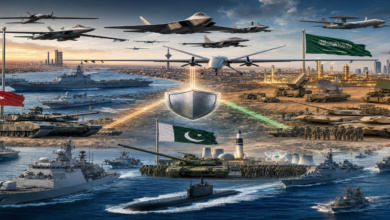
Yet it is not simply a matter of coercing China. There is a lasting reckoning of American industrial and defense interests in this unfolding drama. War, throughout history, has never been the sole focus of destruction. It has also been a source of profit for certain powers. Every explosion, every crisis in the Middle East, echoes through the arms markets in the Gulf — testimony to a system in which conflict feeds an economic circulation measured in billions. Thus, the machinery of global strategy turns in tandem with the wheels of industry. Where materialism rules, humanity is marginalized, and expediency dominates.
When these threads are woven together, a coherent strategic pattern emerges—one that reveals a sixfold design underpinning American policy:
To restrict China’s energy supplies;
To disrupt and recalibrate its trade routes;
To consolidate influence across critical regions;
To retain Europe within its strategic orbit, thereby limiting Sino-European integration;
To sustain the war-driven economic cycle, to profit from the arms trade;
and to weaken China before any potential conflict over Taiwan.
What appears scattered, in fact, gravitates around a single axis.
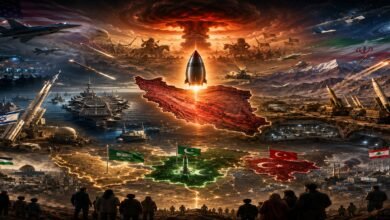
These scattered events on the world map are just chapters in a single unfolding story. Venezuela, Iran, Russia, Europe, and Taiwan represent separate fronts, yet the fundamental contest is one: to contain China’s economic and geopolitical rise. It is a war fought less with weapons than with minds—a contest not just for territory, but for the architecture of economic order, technological supremacy, and global authority. Like a seasoned boxer who weakens his opponent by cutting off water and food, so too do world powers operate on a global scale—tightening the very resources that sustain power.
When history delivers its verdict, it does so without mercy. It pardons neither the powerful nor the meek. It asks only who understood the truth, and who chose to ignore it. Today, the world stands at a decisive juncture where silence itself may be guilty, and ignorance is a danger. We live in an era in which the control of resources is no longer a mere economic concern. It has become a basis for power. Energy, trade, technology—these are no longer tools of development alone, but rather weapons of control, wielded by those who seek to extend their reach across the globe.
It may be an uncomfortable truth, but it is a truth: in this relentless competition for power, humanity is often trampled underfoot. Settlements that once teemed with life are reduced to rubble. Dreams that once adorned imaginations dissolve into smoke. And amidst this devastation, a silent question lingers in the air: is this the world that man once imagined?
Democracy, once considered the authoritative voice of the people, has in many places played the role of a mask, behind which policies are made in the name of public welfare, but in reality serve the interests of a privileged few. It is this paradox that unsettles the conscience: that a system that aims to protect human freedom can, in certain circumstances, become an instrument of its subjugation.
In the words of the wise, the world is but a clear field where each individual must prove his point. He who understands only the surface is deceived. He who recognizes the inner reality comes closer to the truth. The need of the hour, therefore, is to awaken this deeper insight—to question, to ponder, and to peer beyond the superficiality of the headlines into the layered meanings that lie beneath.
It is also true that every dark night is followed by dawn. Yet dawn does not arrive unbidden; it must be summoned—through the lighting of lamps, the awakening of consciousness, and the courage to recognise truth. If mankind resigns itself to the role of a passive spectator, history will trample it with the same indifference with which it has trampled others.
This essay does not claim to deliver a final verdict; rather, it extends an invitation—to think, to reconsider, to perceive the world from a renewed vantage point. For what transpires across the globe is seldom accidental; it is part of an unfolding continuum. And if this continuum proceeds unchecked, the day may not be far when the world’s resources, its economies, and even its modes of thought are concentrated within the grasp of a few.
History does not repeat itself in the same form. It resurfaces in new ways. Nations that fail to heed its cues are swept away by its current. This reflection is a modest attempt to awaken that awareness — so that we can look beyond events to the forces that animate them. So that we listen not only to the noise but also to the silence in which truth often resides. For in global politics, truth is often hidden, and events that seem disconnected are often connected by a coherent strategic design.
In the final analysis, mankind still retains the power of choice. It may lose itself in illusion, or rise in pursuit of truth. It may remain a silent spectator or awaken and form its own judgement. For history belongs not only to the powerful, but also to those who recognise truth and stand—amidst the ashes of broken dreams—with the resolve of awareness and the courage of awakening.
And perhaps this is that very moment—when we must decide where we stand.
Tuesday, March 31, 2026