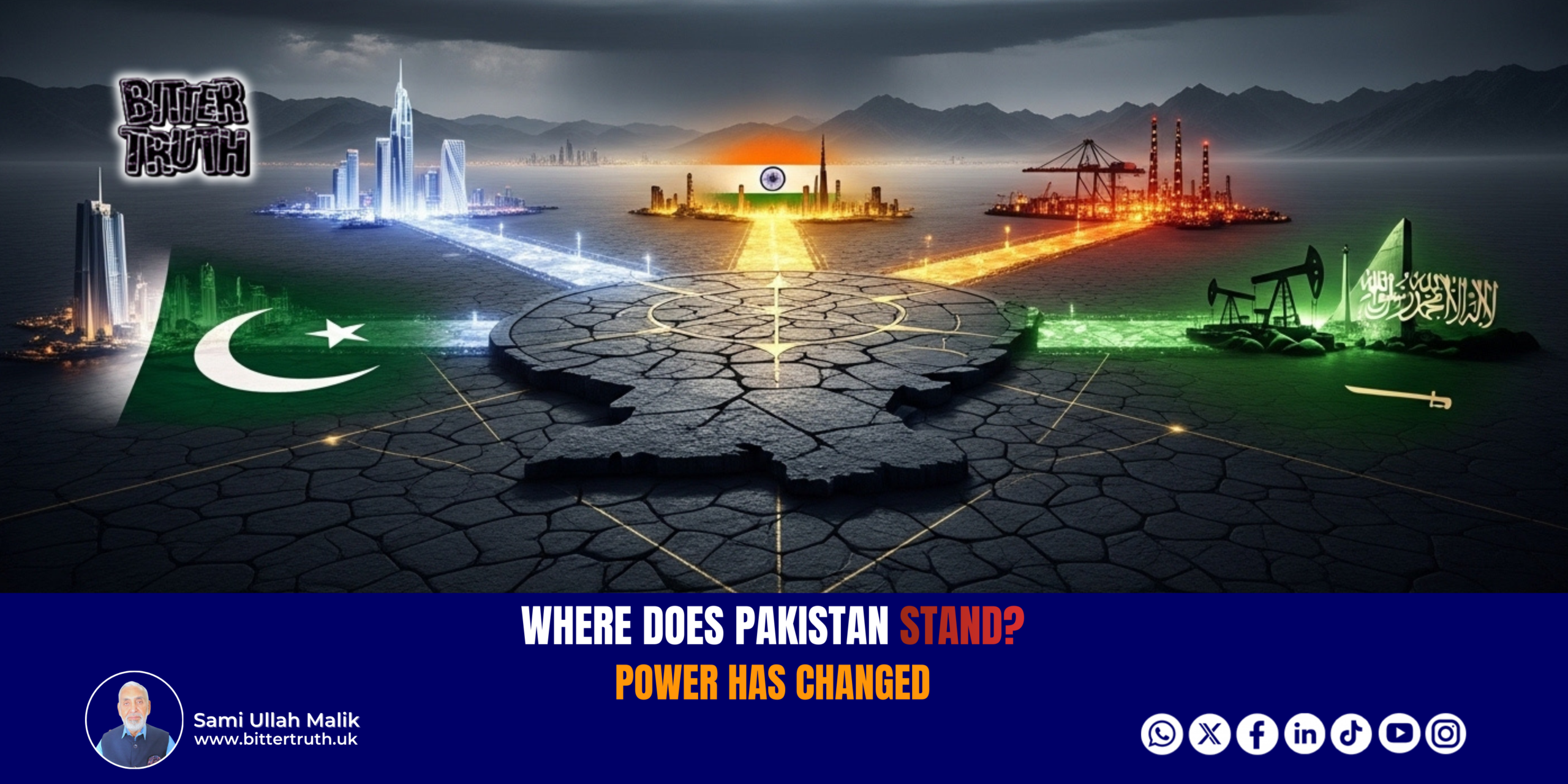
Where Does Pakistan Stand?
Power Has Changed

Mirrors of Power: Pakistan and the Changing Geometry of Global Politics
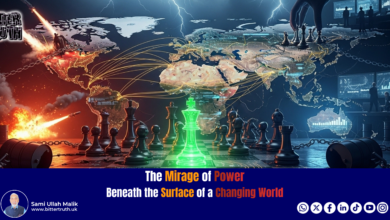
In international politics, there are moments that transcend the status of mere events. They become mirrors—held up before nations—reflecting their choices, their priorities, and their errors, however bitter that reflection may be. Some developments on the global stage are not simply items of news; they are moments of reckoning, demanding reflection rather than reaction.
The shifting balance of power across the Middle East, South Asia, and the wider constellation of global powers presents Pakistan with precisely such a mirror. Again and again, it confronts us with the question we have long sought to evade: are we standing on the right side of history—or merely standing still while the world moves on?
The United Arab Emirates’ accelerating tilt towards India; the quiet yet deepening tension between Saudi Arabia and the UAE; the steady erosion of Pakistan’s influence in Afghanistan—these are not isolated developments. Consider Afghanistan: a country upon which Pakistan expended decades of economic resources, security commitments, diplomatic capital, and immeasurable human sacrifice. Despite these investments, Pakistan has not only lost influence there, but now finds the same Afghanistan drawing closer to India, emerging as a platform through which New Delhi seeks to weaken Pakistan’s regional position.
This is not an anomaly; it is a pattern. The same mindset has shaped Pakistan’s approach to the Gulf—emotional attachment in place of strategic clarity, decisions driven by short-term necessity rather than long-term economic logic, and a foreign policy too often divorced from economic reality. The consequences are now plain to see. These developments are not separate failures, but different expressions of a single strategic misjudgement—chapters of the same unfinished and troubling story.
This essay is an attempt to read that story with sobriety rather than sentiment. Through the prism of shifting Gulf politics, Saudi–UAE divergences, and the growing proximity between the UAE and India, it gestures towards a larger and more unsettling question. This is not merely about Gulf diplomacy, or Emirati–Indian relations, or even the future of Saudi leadership. It is about a deeper crisis that has seeped into Pakistan’s foreign policy, economic direction, and state decision-making apparatus.
The question, therefore, is not why the world is changing. The real question is why Pakistan has been left behind. Have we demonstrated the seriousness required to adapt? Have we undertaken an honest reckoning with our failures—holding decision-makers accountable and learning from costly mistakes? If not, why not? Is Pakistan prepared to ground its foreign policy in realism, or will it continue to mortgage its future in an attempt to salvage the present with the instruments of a fading past?
In international politics, some headlines are not headlines at all—they are mirrors. Mirrors in which nations glimpse their true face, whether pleasing or painful. The sudden, brief, yet extraordinary visit of UAE President Sheikh Mohamed bin Zayed to India was one such moment. Lasting little more than an hour and forty-five minutes, the visit was not an act of diplomatic courtesy but the public unveiling of strategic choices made over years—choices whose reverberations are being felt from New Delhi to Riyadh, Islamabad to Washington.
The expansion of UAE–India defence cooperation; the elevation of bilateral trade from $100 billion to $200 billion; and announcements of investment across energy, space research, artificial intelligence, nuclear reactors, and infrastructure were not reactive gestures. They were the product of a deliberate, long-term strategy. The pertinent question, therefore, is not why the UAE moved closer to India. The real question is where Pakistan stands in this evolving picture—and what, meanwhile, is changing within the Gulf itself.
If Gulf politics can be distilled into a single sentence, few would be more accurate than this: in the Gulf, friendships are not permanent; interests are. Saudi Arabia and the United Arab Emirates appear, at first glance, as pillars of the same tent—bound by shared religious identity, oil-based economies, alignment with the United States, common regional security narratives, and a professed commitment to stability. Yet beneath this surface harmony lies a far more complex reality.
Below the façade of unity runs a fault line of disagreement that has deepened with time. Behind closed doors—and increasingly in public—the two states are separated by differences that are not temporary but structural: questions of power, leadership, economic direction, and global alignment. These divergences have moved beyond diplomatic murmurs and private consultations. They now shape economic policy, military strategy, regional leadership ambitions, global alliances, and even the balance of power in South Asia.
For this reason, their consequences will not remain confined to Riyadh and Abu Dhabi. They will extend across the Middle East, South Asia, and the wider international system.
Once again, if Gulf politics is to be summarised in a single line, it is this: interests endure where friendships do not. Saudi Arabia and the UAE may appear as steadfast pillars of the same Gulf order, yet the gulf between them grows wider by the day. Their tensions—economic, military, and geopolitical—are no longer hidden. They are structural rather than emotional, and their effects will shape regional politics for years to come.
Saudi Arabia has long viewed itself as the natural leader of the Gulf world—a claim grounded not merely in wealth or geography, but in history, demography, and religious authority. Custodianship of the Two Holy Mosques, a central place in the Muslim world, decades of Arab leadership, and a longstanding strategic partnership with the United States all form the architecture of Saudi self-perception.
The United Arab Emirates, by contrast, presents an entirely different model. Its legitimacy does not rest on religious authority but on modern economics: global investment, technology, logistics, financial services, smart governance, and integration into the arteries of global capital.
Mohammed bin Salman and Mohammed bin Zayed are both decisive, ambitious leaders with aspirations that extend beyond the regional to the global. History teaches us that two powerful and autonomous leaderships rarely coexist indefinitely within the same region without friction—whether expressed through open confrontation or silent rivalry. It is here, at this juncture, that the roots of Saudi–UAE divergence lie. And it is this rivalry that increasingly defines the trajectory of Gulf politics today.
Economics as Destiny: The Saudi–Emirati Divergence and Pakistan’s Diminishing Space
Nowhere have Saudi–Emirati differences become more visible—or more consequential—than in the economic sphere. Saudi Arabia’s Vision 2030 is nothing short of a revolutionary project: an ambitious attempt to loosen the kingdom’s historic dependence on oil and recast Riyadh as a regional commercial hub. Foreign corporations are being compelled, through regulation and incentive alike, to relocate their regional headquarters to the Saudi capital. Billions of dollars are being poured into mega-projects such as NEOM, the Red Sea initiative, and Qiddiya, all designed to reposition Saudi Arabia as the economic centre of the Middle East.
Yet this strategy carries an unmistakable implication. By seeking to attract capital, talent, and corporate headquarters, Riyadh is mounting a direct—if unspoken—challenge to the Dubai model painstakingly constructed by the United Arab Emirates over decades. What Saudi Arabia presents as national transformation is perceived in Abu Dhabi as an existential economic threat.
The UAE, after all, has already established Dubai and Abu Dhabi as global financial and commercial hubs. It dominates logistics, aviation, and trade, and offers one of the most open and flexible business environments in the region. It is hardly surprising, therefore, that disputes between the two countries have surfaced openly within OPEC+, over oil production quotas, commercial privileges, and the flow of investment. This is no mere competition over markets; it is a struggle for regional economic primacy and strategic influence.
The war in Yemen was the first arena in which these differences played out in practical terms. Saudi Arabia and the UAE entered the conflict as partners, but over time their objectives diverged sharply. Riyadh sought a unified Yemeni state and the decisive defeat of the Houthis. Abu Dhabi, by contrast, focused on southern Yemen—its ports, maritime routes, and coastal access—strengthening local allies to secure long-term commercial and strategic footholds.
Unable to exit the conflict simultaneously, the UAE gradually scaled back its military role, while Saudi Arabia increasingly found itself carrying the burden alone. It was at this juncture that a crisis of trust took root, and long-standing bonds of partnership began to fracture.
A similar divergence is evident in attitudes towards the Muslim Brotherhood and political Islam—differences that are not merely geopolitical or economic, but profoundly ideological. The UAE regards the Muslim Brotherhood as an existential threat to its state structure and internal security, which explains its uncompromising positions in Egypt, Libya, and Tunisia. Saudi Arabia’s stance, by contrast, has shifted with circumstance—at times rigid, at others conciliatory—marked by caution, tactical flexibility, and strategic ambiguity. This ideological inconsistency has only widened the intellectual and strategic distance between the two capitals.
Iran presents yet another point of divergence. For decades, Saudi Arabia maintained a hardline posture towards Tehran. The UAE, however, has in recent years pursued a path of quiet accommodation—reopening channels of trade, diplomacy, and security dialogue. In parallel, Abu Dhabi’s decision to normalise relations with Israel through the Abraham Accords not only opened a new regional corridor but also positioned the UAE as Washington’s most dependable Gulf ally.
Saudi Arabia, constrained by domestic religious sensitivities and its historic self-image within the Muslim world, has thus far proceeded with caution. The UAE’s willingness to move decisively ahead sent Riyadh a message that was silent yet unmistakable. This divergence lies at the heart of the quiet tension between the two states and reveals a fundamental disagreement over the very meaning of Gulf security. It is within this context that the UAE’s growing tilt towards India becomes intelligible.
Superficially, UAE–India relations are often described in terms of defence cooperation. In reality, they constitute a comprehensive economic partnership. Long-term gas supply agreements, multi-billion-dollar energy investments, infrastructure development, agricultural trade, artificial intelligence, space industries, and nuclear technology together signal a clear strategic judgement: the UAE views India as a pillar of the future.This choice is not merely an endorsement of India; it is also an indirect message—addressed to both Riyadh and Islamabad.
Sheikh Mohamed bin Zayed’s brief yet extraordinary visit to India was not ceremonial diplomacy. Whether in defence agreements or the expansion of trade from $100 billion to $200 billion, the central theme was not military alignment but economic destiny. The UAE has selected India as its future market, its secure investment environment, and its technological partner. Pakistan, by contrast, has been left trailing in this race.
Within this tableau, Pakistan’s position is particularly revealing. When the UAE President visited Pakistan, he went not to the civilian capital but to the military cantonment. No major trade agreement followed; no significant investment announcement was made. This was no coincidence. It was a quiet diplomatic signal that the relationship with Pakistan is now framed largely in security terms, not economic partnership.
Pakistan continues to offer defence services, military training, and security cooperation to Gulf states. Yet in return, exports do not rise, investment remains limited, and industry, technology, and long-term trade fail to materialise. The relationship has become dangerously one-sided. Here, Pakistan emerges as a silent yet significant variable. Saudi Arabia continues to view Pakistan as a defensive pillar and strategic guarantor, while the UAE’s strategic gravity shifts steadily towards India. This divergence is likely to bind Gulf politics ever more tightly to South Asia’s power equations.
An unavoidable question thus arises: has the UAE chosen India in part to balance Saudi influence? Defence cooperation between Saudi Arabia and Pakistan is hardly new, but recent agreements have deepened it further. Pakistan remains the only Muslim nuclear power—a reality that renders it a sensitive factor in Gulf calculations. Saudi–Emirati disagreements over Yemen, political Islam, and leadership have compelled Abu Dhabi to seek alternative strategic pathways. Proximity to India is one such pathway.
To ignore the United States in this entire configuration would be an act of self-deception. Washington regards India as a central counterweight to China, and the UAE is among America’s closest regional allies. Normalisation with Israel and participation in initiatives such as the Gaza peace framework form part of the same strategic logic. The UAE’s tilt towards India thus aligns closely with American priorities.
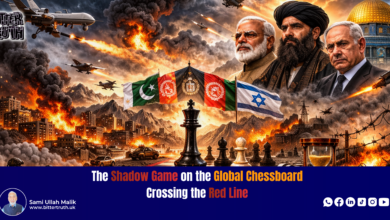
An undeclared triad—comprising the United States, Israel, and India—now stands arrayed against the
China–Russia bloc. Pakistan, as China’s close partner, the hub of CPEC, and a country cultivating closer ties with Moscow, naturally finds itself under pressure.Yet a harsh truth must be acknowledged: external pressure is effective only when internal weaknesses already exist.
During last year’s Pakistan–India crisis in May, Pakistan’s military capabilities were widely acknowledged at the international level. But military strength is no substitute for economic attraction. The world no longer asks who can fight better; it asks who can safeguard capital, deliver long-term returns, and integrate into global supply chains. In this arena, Pakistan remains behind.
Between Warning and Reckoning: Pakistan at the Crossroads of Power
It may sound emotive to say so, yet the reality is difficult to escape: the undeclared alignment of the United States, Israel, and India has little interest in seeing Pakistan economically resilient, for economic weakness constrains strategic autonomy. A financially dependent state is rarely permitted an independent foreign policy. Yet external pressure is effective only where internal frailty already exists.
Here lies the central crisis of Pakistan’s foreign policy: in its effort to rescue the present, it repeatedly sacrifices the future. Debt, bailouts, and short-term relief have become its organising principles, while the patient construction of economic power has been consistently neglected. This, more than any conspiracy, marks the fundamental difference between India and Pakistan.
Even today, Pakistan continues to provide defence services to Gulf states. Yet in return there is no meaningful flow of investment, no industrial integration, no technological partnership. The relationship has drifted into a dangerously one-sided arrangement. If Pakistan genuinely seeks an effective and dignified regional role, it must anchor its foreign policy firmly in economic logic.
Strategic alignment with Russia and China—and potentially with Turkey and Iran—must extend beyond defence and diplomacy to encompass long-term economic and institutional cooperation. Above all, Pakistan must abandon the habit of blind alignment with any single Gulf camp and adopt a policy of balance.
The growing tension between Saudi Arabia and the UAE, the UAE–India partnership, and Pakistan’s diminishing diplomatic leverage are not separate stories; they are chapters of the same narrative. The Saudi–Emirati rift is not an accident of personalities, but the outcome of a new distribution of power. The lesson is stark: the world has changed and so has the currency of power. Global politics today is not driven by sentiment, historical services, or emotional loyalty, but by economics, strategy, and sustained decision-making. If this lesson is not learned now, such agreements will become routine—and Pakistan will find itself endlessly repeating the same question: why does this keep happening to us?
For Pakistan, this moment is not a humiliation; it is a warning. Either it restructures its foreign policy around trade, economic partnerships, and strategic investment, or it will remain a spectator in a changing world—asking questions while others write answers. The world does not move on curses or grievances, but on contracts, capital, and coherence. Nations do not advance by asking questions alone, but by preparing credible answers. This is the test before Pakistan today.
Perhaps the most painful aspect of the present moment is that Pakistan finds itself rich in complaints but poor in effective responses. The loss of influence in Afghanistan, India’s growing presence there, the Gulf states’ perception of Pakistan as merely a security partner, and the closure of doors to capital, trade, and technology—these are not the results of a single external plot. They are the cumulative outcome of internal weaknesses, flawed priorities, and chronic inconsistency in policy.
It has therefore become unavoidable to pose a direct question to the country’s ruling elite, state decision-makers, and centres of policy formulation: do we truly believe that states are run on emotion, sacrifice, and gratitude for past services? Or are we prepared to accept the reality that today’s world recognises only economic strength, institutional stability, and strategic continuity?
The time has come for Pakistan to speak honestly to itself. The loss of Afghanistan was not the failure of a single government or a single episode, but the result of decades of misguided policies, institutional fragility, and opaque decision-making. If the same model is replicated in relations with the Gulf, the cost will not merely be diplomatic; it will be economic and strategic.
The question can no longer be deferred: has Pakistan’s bureaucracy lost the autonomy required to formulate policy in the national interest? Or are there unseen forces that have effectively taken the state hostage—exercising control in such a way that honest, competent, professional, and principled officers are punished for their integrity, reduced to ceremonial irrelevance, as I have discussed in detail in an earlier essay? If policy is shaped by those whose primary loyalty lies not with the national interest but with specific mafias, pressure groups, or short-term gains, then policies will inevitably serve narrow interests. The result, as history repeatedly demonstrates, is a return to the brink of economic collapse.
This, then, is the moment for Pakistan to move beyond an emotional foreign policy towards an economic one. Relations with the Gulf must no longer be confined to defence and security, but integrated with trade, industry, investment, and technology. Instead of blind alignment, Pakistan must prioritise balance, sovereignty, and institutional strength. The bureaucracy must be freed from political and invisible pressures and entrusted with genuine decision-making authority. Otherwise, these same unseen forces will once again entangle the country in agreements and policies whose cost will be borne by the entire nation.
The world no longer listens to stories of sacrifice; it looks for capital, stability, and credibility. Military capability matters, but without economic power it cannot translate into diplomatic influence. If Pakistan truly seeks a dignified role in the region, it must connect its Gulf relationships to trade, industry, technology, and investment—not limit them to security alone. Equally unavoidable is the need for a balanced strategic alignment with Russia, China, Turkey, and Iran, grounded in long-term interests rather than episodic necessity.
This essay is not directed against any adversary; it is an invitation to internal accountability. It is not an indictment of individuals or institutions, but a warning. The world has changed; the measure of power has changed with it. If Pakistan fails to recalibrate its priorities now, agreements like the UAE–India partnership will become commonplace, and Pakistan will appear increasingly as a secondary actor in narratives written by others.
Nations do not advance by endlessly asking why; they advance by preparing answers. States are not built on declarations, but on decisions. And for Pakistan today, delay in decision-making has become the gravest danger of all.