When Silence Speaks: PL-17 and the Politics of Air Superiority
Silent Deterrence: China’s PL-17 and the New Balance Aloft

In the contemporary military world—where the brute force of arms has gradually ceded primacy to the power of knowledge, discretion, and silent preparation—the first public glimpse of China’s advanced and enigmatic long-range air-to-air missile, the PL-17, is not merely an image released into the digital ether. It is, rather, a meaningful signal in the shifting geometry of power: a signal that speaks volumes precisely because it leaves so much unsaid.
In Western strategic circles, this initial appearance of the PL-17 has not been treated as a routine military photograph. Instead, it is widely interpreted as another carefully calibrated chapter in China’s long-term grand strategy—one defined by silence, ambiguity, and gradual revelation. Western defence institutions understand this logic well: what China chooses to display is invariably less significant than what it deliberately withholds. And it is in that realm of concealment that the true message often resides.
Pakistan today stands at a historical juncture where global power rivalries are no longer abstract or theoretical, but are palpably felt across the region’s skies, seas, and contested borders. China’s accelerating military ascent, and its emergence as a producer of sophisticated weapons systems—most notably the PL-17—represents for Pakistan not merely the strength of an ally, but the announcement of an evolving strategic environment. The changing global military balance, particularly the advent of China’s advanced aerial capabilities, is reshaping traditional conceptions of power across South Asia and the Indo-Pacific. Owing to its geography and strategic partnerships, Pakistan is among the states most directly affected by this transformation.
Global politics in the twenty-first century no longer appears to rest upon two pillars alone. It now stands, at minimum, upon three: China, the United States, and India. The contest among these actors is not confined to military hardware; it is equally civilisational, economic, and psychological. Power in the international system is in motion. China’s rapid introduction of cutting-edge defensive technologies is compelling both Washington and New Delhi to revisit long-held strategic assumptions.
Although defence analysts in the West speak with caution, a subtle tremor of unease runs through their assessments. Many suggest that the PL-17 may well be the longest-range air-to-air missile yet developed. Should such estimates prove accurate, its implications for American air dominance in the Western Pacific would be profound. It would represent not merely the arrival of a new weapon, but the declaration of a new strategic logic. The United States continues to view itself as the custodian of the global order, yet China’s quiet, methodical, and scientifically grounded advance is increasingly challenging that perception. The PL-17 stands as a symbol of this challenge—a weapon that raises more questions than it answers.
Within American defence circles, the PL-17 is frequently described in the language of a game changer. For decades, U.S. air strategy in the Western Pacific has rested upon aircraft carrier strike groups and the layered aerial protection surrounding them. An air-to-air missile with a range of four hundred kilometres or more, however, has the potential to fracture the very foundations of this doctrine.
Defence cooperation between China and Pakistan has long transcended the realm of formal agreements and joint exercises. It has matured into a shared strategic consciousness. In this context, systems such as the PL-17 offer Pakistan an indirect yet significant sense of strategic cover—particularly at a time when sustained efforts are under way to tilt the regional balance of power decisively in India’s favour.
China’s long-range aerial strike capability constrains traditional notions of air superiority within the region. The operational freedom of the Indian Air Force could, as a result, be meaningfully curtailed—an outcome that may serve, indirectly, as a deterrence stabiliser for Pakistan. This shift does not signal an invitation to war; rather, it presents an opportunity to preserve equilibrium and prevent any single actor from attaining unchecked dominance.
Chinese media sources indicate that the image of the PL-17 circulated on domestic social media platforms in recent days, though no official confirmation has been offered regarding its timing or location. In this ambiguity lies method. The image itself conforms to China’s established military tradition: a symbol that speaks most eloquently through silence.
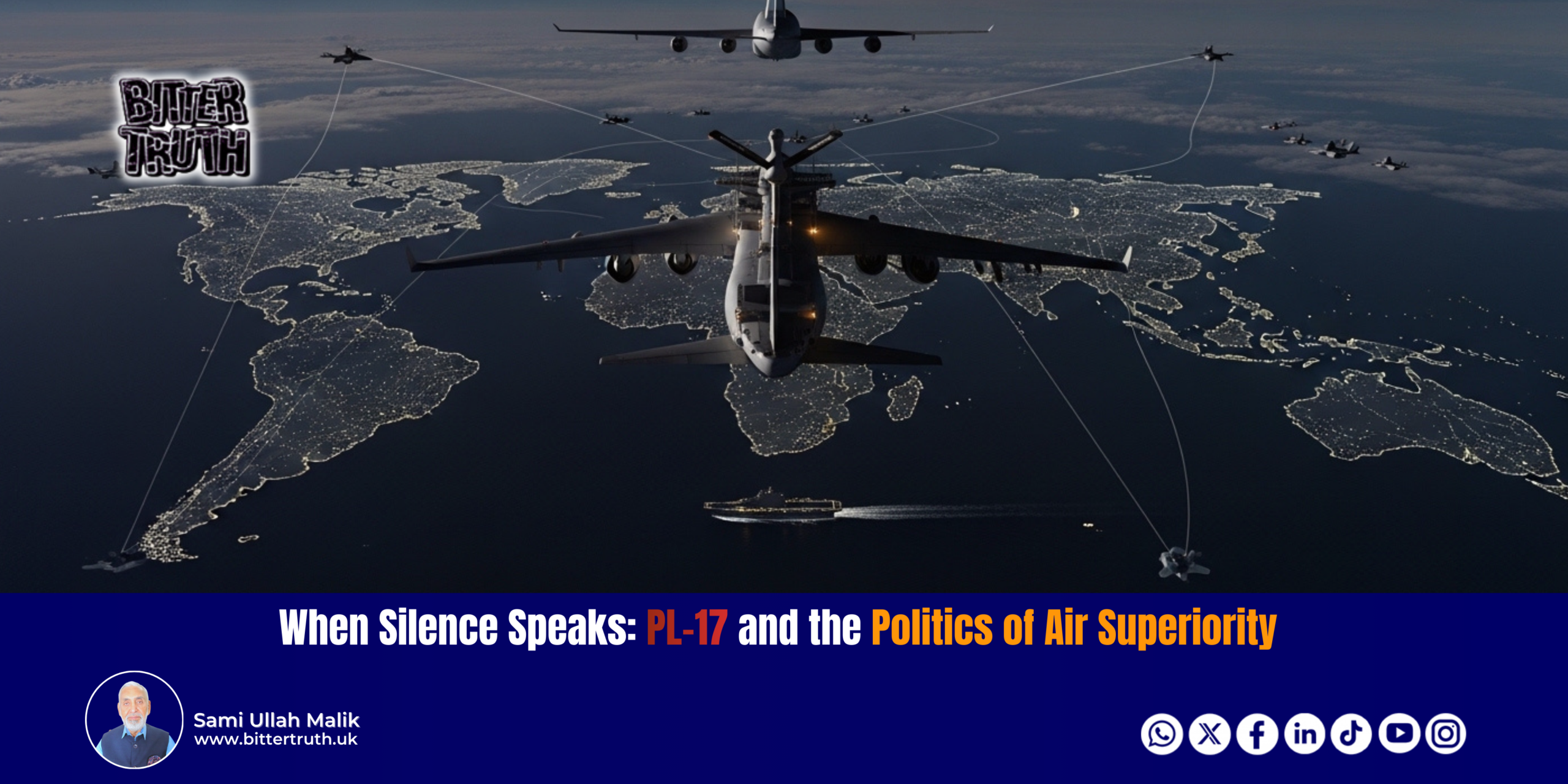
American analysts broadly concur that the PL-17’s primary targets are not conventional fighter aircraft, but high-value aerial assets—air-to-air refuelling tankers, airborne warning and control systems (AWACS), and command-and-control platforms. These are the eyes and arteries of modern air warfare; without them, aerial combat becomes blind and enfeebled.
In Pakistan’s military planning, air power has always occupied a decisive role. Should China secure a commanding advantage in long-range aerial combat, Pakistan may derive from it a form of strategic depth—one that preserves balance without inviting direct confrontation.
Pakistan’s defence partnership with China is not merely transactional, nor confined to the acquisition of weapons. It is rooted in convergent strategic interests. China’s growing aerial superiority could provide Pakistan with a more secure strategic environment—provided that Pakistan retains its policy autonomy. China’s strength does not absolve Pakistan of responsibility; rather, it demands greater prudence in both defence and diplomacy.
India, within this emerging configuration, increasingly perceives itself as a natural ally of the United States. Yet geography places it faces to face with China. For this reason, Chinese military advancement—particularly in the aerial domain—has generated not just concern but palpable anxiety within Indian strategic circles. A growing realisation is taking hold: should China achieve decisive dominance of the skies, the balance of power in South Asia may no longer tilt in India’s favour. It is this apprehension that is propelling India toward accelerated militarisation and deeper entanglement with Western alliances.
At such moments of strategic flux, the Qur’an’s reminder acquires renewed resonance:
وَتِلْكَ ٱلْأَيَّامُ نُدَاوِلُهَا بَيْنَ ٱلنَّاسِ
“Such days We rotate among people.” (Āl-ʿImrān 3:140)
Power, history teaches us, is never static. It circulates—sometimes announced with thunder, sometimes revealed through a single, carefully released image that changes how the world reads the future.
In the image itself, a PL-17 missile—or a full-scale mock-up indistinguishable from the real article—rests upon a display stand. Standing before it is a figure whose face has been digitally obscured, transforming the individual into a living metaphor for the secrecy that defines Chinese defence planning. Most military specialists believe the object to be a model rather than an operational missile; yet its dimensions appear faithful to reality—and in the martial realm, size is often an unguarded truth-teller.
Within the corridors of the Pentagon, the PL-17 is increasingly viewed as a logical extension of China’s strategic trajectory: an anti-access/area-denial instrument designed not to provoke battle, but to deter an adversary before it ever enters the field. Seen from this vantage, the missile becomes less a device of overt force and more an instrument of psychological power—a means of shaping behaviour without firing a shot.
Systems such as the PL-17 may well deepen defence cooperation between the United States and India. As Indo-American strategic convergence intensifies, regional pressures are likely to mount. For Pakistan, this demands restraint rather than reflex, and engagement rather than isolation. Such developments should not be read solely as threats, but as opportunities for policy recalibration—particularly in the domains of air defence and electronic warfare. Yet the other side of this equation cannot be ignored. Heightened military competition among great powers may compel Pakistan to clarify its stance, and history bears sober witness to the fact that neutrality, under pressure, is often the hardest posture to sustain.
According to Chinese sources, the PL series represents a continuum of air-to-air missiles developed for the People’s Liberation Army. Within this lineage, short-range systems such as the PL-10 and medium-range variants like the PL-11 and PL-12 have already secured their place in China’s defensive architecture. The PL-17 thus emerges not as an anomaly, but as the apex of a carefully layered design.
Another concern voiced in Western military circles is that the large-scale deployment of missiles like the PL-17 would force American and allied air forces to operate from greater distances, with heightened caution and escalating costs. In warfare, “expensive” operations are often the first sign of diminishing effectiveness.
For Pakistan, the central test is not the question of alignment, but the preservation of autonomous military and diplomatic decision-making. China’s rise presents both opportunity and ordeal—an opportunity to sustain balance, and a test of national self-possession. Pressures of bloc politics may intensify; regional instability could impinge upon Pakistan’s economic priorities; and excessive reliance upon any single power risks becoming a strategic vulnerability. The United States may view India as a pawn in this triangular contest, yet history teaches that pawns, in the games of great powers, often begin to imagine themselves kings—and such illusions have repeatedly given birth to catastrophe.
True power does not reside in weapons alone. It lies in economic resilience, diplomatic equilibrium, and military prudence.
Reports suggest that the PL-17 has been under development for at least a decade, passing through multiple phases of refinement. Yet official information has remained deliberately sparse. The missile has never been paraded with theatrical flourish, nor prominently featured in exercise footage. Still, since around 2016, a few attentive observers have reportedly sighted it mounted on the J-16 fighter—quiet confirmations rather than public declarations.
European defence analysts, less vocal yet deeply attentive, are observing these developments with growing concern. To them, the PL-17 signals that China is no longer merely a regional power, but a state increasingly capable of shaping global military benchmarks—a prospect that carries long-term implications for Europe’s strategic calculus.
Should Pakistan read this shifting balance with wisdom, it need not remain a reactive state; it could instead emerge as a voice of stability within the region. If the moment is squandered, however, history offers a grim lesson: in contests among the powerful, the fate of the unwary has rarely been kind. With judicious choices, Pakistan can present itself not as a weak actor in a changing world, but as a responsible and effective one. Investment in air defence systems and electronic warfare, insistence on technology transfer within defence cooperation with China, balanced diplomatic engagement with the United States and other global powers, and an active diplomatic role in reducing regional tensions—these are not optional ambitions, but strategic necessities.
China, by contrast, continues to avoid direct confrontation, employing power primarily as deterrence. Missiles such as the PL-17 are an extension of this philosophy: designed not to fight wars, but to prevent them.
On the basis of the limited imagery available, one American military analysis website has estimated the missile’s length to exceed six metres—approximately twenty feet. Analysts assess it to be a radar-guided, long-range air-to-air missile with a potential reach beyond four hundred kilometres. It is this figure, more than any other, that has stirred unease across global defence circles.
As far as India is concerned, the PL-17 is not viewed as a distant Pacific concern. Indian strategic thinkers increasingly link it directly to the Sino-Indian balance of power—particularly against the backdrop of persistent border tensions that have become a defining feature of bilateral relations.
Thus, for Pakistan, the significance of weapons like the PL-17 lies not merely in their range, but in the breadth of political insight they demand: how power is perceived, how it is interpreted, and how it is restrained. Within this triangular balance, Pakistan remains a quiet yet consequential factor. Its geography, proximity to China, and historic rivalry with India place it at a juncture where a single misstep could push the region toward instability.
At such moments, a timeless reminder acquires renewed relevance:
إِنَّ ٱللَّهَ لَا يُغَيِّرُ مَا بِقَوْمٍ حَتَّىٰ يُغَيِّرُوا۟ مَا بِأَنفُسِهِمْ
“Indeed, God does not change the condition of a people until they change what is within themselves.” (al-Raʿd 13:11)
In the end, missiles may shape the horizon of power—but it is wisdom, restraint, and foresight that determine how a nation walks beneath it.
For Pakistan, the central challenge is not embodied in any single weapon or any one country. It lies, rather, in the timely comprehension of a changing global reality—and in the capacity to adapt accordingly. National security now demands a synthesis of power, prudence, and economic resilience within a single strategic vision. If wisdom prevails, this emerging triangular balance may yet spare South Asia from the descent into a new cold war. If, however, pride, fear, or miscalculation gain the upper hand, history will once again record that power outran reason.
By contrast, the longest-range air-to-air missile currently in operational service with the United States Air Force—the AIM-120D—has a reported maximum range of approximately 160 kilometres. This comparison speaks eloquently in its own austere language.
Indian defence analysts caution that should China deploy long-range missiles such as the PL-17 effectively within its Western Theatre Command, the operational freedom of the Indian Air Force could be significantly constrained—particularly for platforms dependent on aerial refuelling and airborne surveillance. The implications are not theoretical; they touch the very sinews of modern air operations.
In its annual report on China’s military power, submitted to the U.S. Congress in December, the Pentagon explicitly noted that a J-16 fighter equipped with the PL-17 could possess a strike reach exceeding 1,400 kilometres. The risk, therefore, is not confined to the missile alone; it extends across the entire aerial system that carries, guides, and sustains it.
It is within this context that voices in India are calling for a reassessment of air defence capabilities, missile technologies, and the selection of strategic partners. Defence cooperation with the United States, France, and Israel is increasingly viewed not merely as procurement, but as a means of restoring technological balance.
Analysts further suggest that the PL-17 may incorporate an advanced AESA radar seeker, similar to that already employed in the PL-15 missile. The PL-15 entered operational service in 2015 and is believed to possess a range exceeding 200 kilometres. In this evolutionary sequence, the PL-17 appears as the next—and markedly more formidable—link in the chain.
Within the broader panorama of international power relations, the PL-17 stands as a clear signal that the world is once again drifting toward a multipolar military order. The era in which one or two powers exercised uncontested dominion over the skies is gradually receding into the margins of history.
Chinese media reports indicate that imagery of the PL-17 first surfaced in 2016, when it was observed during testing phases mounted on the J-16 fighter. The J-16 is China’s most powerful heavy multirole combat aircraft and, to date, the only platform on which the PL-17’s integration has been confirmed—suggesting a pairing designed with deliberate exclusivity, as though weapon and aircraft were fashioned for one another.
Students of military history understand that the balance of power is not altered by weapons alone, but by the idea of those weapons. The PL-17 may not yet have fully entered operational maturity, but its very concept is already shaping allied planning, air exercises, and defence budgets.
From Beijing’s perspective, the PL-17 is neither a proclamation of aggression nor an invitation to war. It is the extension of a philosophy that seeks strength sufficient to make war unnecessary. It is at this juncture that military capability begins to speak the language of diplomacy. To regard the PL-17 merely as a missile is thus to underestimate its significance. In truth, it is a symbol—a symbol of a global centre of gravity in gradual motion, a movement now reflected even in the skies.
If military history teaches any enduring lesson, it is that silent preparation is often the loudest declaration. The PL-17 may well be the embodiment of that silence—a name not yet fully spoken, but whose echo is already audible across the Pacific horizon.
Power, when stripped of wisdom, becomes disorder; wisdom, when divorced from power, remains only a prayer. The modern world requires both. Pakistan, therefore, must carve its own path between the two.
This is not an age defined by noise, but by balance. The nation that comprehends balance is the nation that secures its place in history. This essay is not news; it is a marginal note written in advance, a line whose meaning time will slowly underline. The PL-17 may today appear as an indistinct shadow—but in the annals of power, shadows have often been the first heralds of gathering storms.
And here, a final reminder resonates beyond strategy and steel:
وَٱعْتَصِمُوا۟ بِحَبْلِ ٱللَّهِ جَمِيعًۭا وَلَا تَفَرَّقُوا۟
“Hold firmly to the bond of God, all together, and do not become divided.” (Āl-ʿImrān 3:103)
In an era of shifting power and sharpening silhouettes, unity of purpose, clarity of judgment, and restraint of ambition remain the surest safeguards against the tempests that lie ahead.